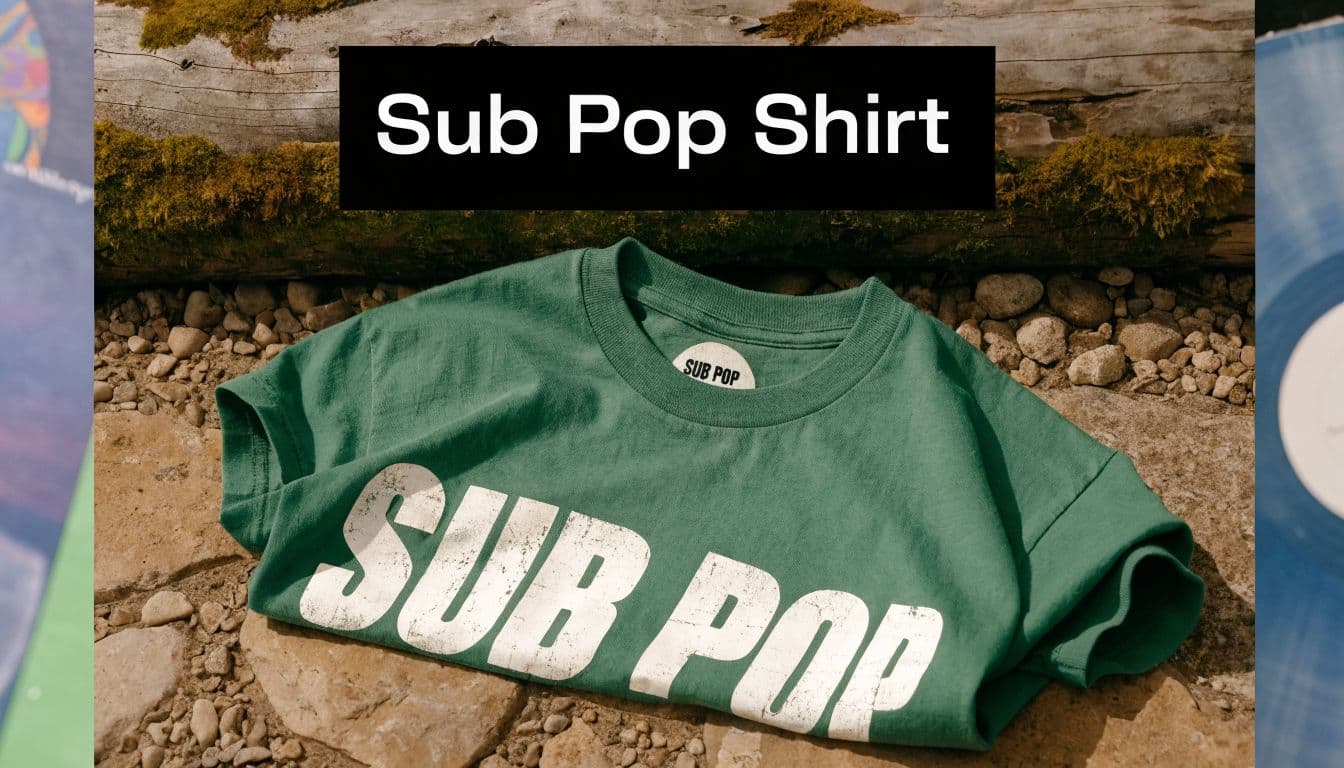
Sub Pop Shirt: A Guide to Grunge-Era Style & History
Your complete guide to the Sub Pop shirt. Learn its history, how to find authentic vintage and new tees, and how to spot fakes. Perfect for collectors and fans.
May 15, 2026
Music Marketplace Advisor
Buying & SellingYou're probably here because you saw one in the wild. A black tee with the Sub Pop logo across the chest, or maybe an older faded one that looked like it had survived a thousand club nights and a few cross-country moves. It stands out in a way most label merch doesn't. People don't wear a sub pop shirt by accident.
That's because it isn't just a record-label tee. It's a signal. It points to a specific corner of music history, a specific attitude toward independent culture, and a very particular kind of taste. If you know what it represents, the shirt lands differently.
A good sub pop shirt also sits at an interesting crossroads. It has cultural value, because of what the label meant to late-1980s and early-1990s Seattle. It has consumer value, because there are still official versions in circulation. And it has collector value, because vintage examples and older designs live in the same market as current retail stock.
More Than a Logo The Enduring Appeal of the Sub Pop Shirt
You can spot the shirt from across a room. The logo is clean, blunt, and readable in a second. That's one reason it lasted. Another is that the shirt carries more than branding. It carries context.

In a record shop, I've watched people react to a Sub Pop logo tee the same way football fans react to a historic crest or a patch from a title-winning season. The garment works because the image is simple, but the meaning behind it is dense. If you've ever read about the history and meaning of the badge, the same basic idea applies here. A strong mark becomes shorthand for membership, memory, and status inside a culture.
Why the shirt still matters
A sub pop shirt still feels current because it avoids the two traps that kill most music merch. It isn't overloaded with artwork, and it isn't dependent on one album cycle. It's a label shirt, which gives it a longer life. You can wear it if you love grunge, if you collect indie-label ephemera, or if you just appreciate good music branding.
Practical rule: The best merch lasts when it works on two levels. It has to mean something to insiders and still look good to everyone else.
That's also why the shirt moves so easily between old heads, younger fans, collectors, and people who just like the look of a worn black tee with some history behind it. The cool factor is real, but it isn't empty. The shirt means Seattle. It means independent music done with conviction. It means someone paid attention.
How a T-Shirt Defined a Generation The History of Sub Pop
A customer pulls a faded black Sub Pop tee from a rack, turns it over in their hands, and asks the question I hear all the time. Why does this shirt matter more than a lot of old band merch? The answer starts with the label itself.
Sub Pop was founded in Seattle in 1986 and formally incorporated on April 1, 1988, after Bruce Pavitt and Jonathan Poneman raised $43,000 to expand it, according to Sub Pop's official company history document. That was the moment the label stopped looking like a local operation and started becoming a cultural marker. Once that happened, the shirt carried more than a logo. It carried a point of view.

The label became part of the message
By the early 1990s, Sub Pop was tied so closely to grunge, and to bands such as Nirvana, Soundgarden, and Mudhoney, that the label name started functioning almost like a genre tag. That is unusual. Record labels usually sit in the credits. Sub Pop moved into the foreground.
That shift matters if you are trying to understand why the shirt still has resale weight now. A band tee often rises and falls with one tour, one lineup, or one album cycle. A Sub Pop shirt points to a whole network of artists, a city, and a specific era of independent music business. Buyers are not just paying for design. They are paying for association.
If you want one artist entry point into that world, the Nirvana page on OohYeah helps show how one early Sub Pop band shaped the way fans read the label as a whole.
Why the “Loser” shirt lasted
The “Loser” shirt is the clearest example of Sub Pop understanding its own audience. It worked because the slogan matched the label's tone. Dry, defensive, funny, and slightly confrontational. In a retail sense, that is hard to beat. Shirts sell better when the message feels native to the culture that produced them.
I have seen plenty of vintage music tees that survive because the print looks good. The best Sub Pop shirts survive for a stricter reason. They still communicate the attitude of late 1980s and early 1990s underground rock without needing any explanation on the tag.
That is also why certain original prints draw stronger prices than newer reissues. Age alone does not create value. Cultural accuracy does. If a shirt captures the label's self-aware outsider stance, collectors respond.
A strong Sub Pop shirt does two jobs at once. It marks a real chapter in music history, and it still reads clearly as clothing someone would choose to wear now.
Why it outlived ordinary merch
Sub Pop shirts held up better than standard band merch for a few practical reasons.
- They represented a broader scene: One shirt could signal loyalty to a label roster, not just one act.
- They arrived at the right cultural moment: Seattle was turning into a global music reference point.
- The design stayed disciplined: Clean typography and direct layouts age better than crowded tour graphics.
That combination gave the shirt a longer commercial life. It also created a split market that still exists today. Some buyers want a clean official logo tee because they like the history and the design. Others want an older print because the age, tag, and wear pattern add collector value.
That split is what makes Sub Pop shirts more interesting than a lot of nostalgia merch. They sit in two categories at once. Cultural artifact and wearable staple. If you understand that history, you buy smarter.
Finding Your Perfect Sub Pop Shirt Official Stores and Vintage Markets
If your goal is simple, buy an official current shirt. If your goal is older, rarer, or more personal, start preparing for some digging.
The first thing to understand is that official Sub Pop shirts are sold across fragmented channels. The label's Bandcamp merch page and its Direct/Mega Mart collections are both official, but they maintain separate catalogs and stock information, which means you often have to check more than one site to see whether a specific design or size is available, as shown on the official Bandcamp merch listing.
Buying new from official channels
This is the safest route if you care most about authenticity, clean condition, and a straightforward return or exchange process. It's also the right move if you're buying a gift and don't want to explain to someone why the “vintage” shirt you found smells like an attic and fits like a tube.
Use this approach:
- Check the label-run stores first: Start with Sub Pop's own online channels before opening resale apps.
- Compare both official storefronts: One channel may have a design or size run the other doesn't.
- Read fulfillment notes carefully: Bandcamp listings can include stock and shipping notes that are useful when timing matters.
- Think like a buyer, not a browser: If you want one specific shirt, search by design name, colorway, and size immediately.
For broader reading on how music merch and direct fan commerce work, the OohYeah blog is worth a look.
Hunting vintage and resale
The vintage route is where things get interesting. It's also where people overspend on mediocre shirts and underinspect the details.
Vintage stores, record fairs, collector circles, and resale platforms all have their place. The right channel depends on your tolerance for risk. In person, you can check the fabric, tag, hem, and print. Online, you're dependent on photos and the seller's honesty.
Buy the shirt, not the story. Sellers love a dramatic backstory. Condition, construction, and print tell you more than nostalgia does.
Here's how I'd split the market:
- Official current stock if you want certainty.
- Trusted vintage dealers if you want older shirts with at least some curation.
- Peer-to-peer resale if you know how to authenticate and can live with more variance.
What works and what doesn't
What works is deciding your lane before you shop. Want an everyday shirt? Buy current. Want a collector piece? Accept that you'll spend more time inspecting and walking away.
What doesn't work is mixing those goals. A lot of buyers say they want “vintage” when what they really want is “old-looking but easy.” That usually leads to a compromised purchase. Either buy a clean modern official tee and wear it hard, or commit to the collector hunt and inspect everything.
Real Deal or Replica How to Authenticate a Sub Pop Shirt
Authentication gets easier once you stop looking for one magic tell. There usually isn't one. You're building a case from several details at once. Tag, stitching, print, fabric, and wear pattern should agree with each other.
A fake often fails because one element tells a different story from the others. You'll see a shirt with a distressed print but a suspiciously fresh body, or an “old” tee with construction details that feel too modern. That mismatch is where experienced buyers catch problems.
Start with the tag and body
The tag is your first checkpoint, not your final answer. Tags can be removed, swapped, or worn beyond recognition, but they still matter. Look for whether the blank, fiber content, and general construction make sense for the shirt's claimed age.
Modern official Sub Pop shirts are associated with premium retail blanks and standardized sizing. A supposed vintage piece should not feel like a current mall blank that someone attacked with sandpaper and wishful thinking.
Focus on these basics:
- Tag consistency: The tag should feel appropriate to the era the seller claims.
- Fabric hand: True older cotton often feels softer through wear, not artificially thinned in random places.
- Shrink behavior clues: Old tees can have shape changes from years of washing. Forced “vintage” distress often misses that natural proportion shift.
Inspect the print like a printer would
The logo matters, but the print behavior matters more. A real older print tends to age with the shirt. It settles into the fabric, softens, and may crack in ways that follow actual wear. A fake distressed print can look theatrical. The cracking appears too even, too decorative, or disconnected from the rest of the garment.
Ask for close-ups if you're buying online. Good sellers won't mind. If they refuse detailed print photos, assume they know why you asked.
A natural print ages unevenly. Shoulder fade, chest wear, and wash softness usually tell a more believable story than a perfectly “cracked” logo.
Construction still tells the truth
Stitching helps, but don't reduce the whole question to one buzzword. Buyers love to talk about single-stitch hems as if that alone proves age. It doesn't. It's one clue among several. Construction has to line up with tag, body, and print.
Use a checklist, not a shortcut.
| Feature | Vintage Clues (pre-2000s) | Modern Clues (2000s-Present) |
|---|---|---|
| Tag | Era-appropriate tag wear, older blank branding, fading that matches shirt age | Cleaner retail presentation, newer blank styles, modern labeling conventions |
| Print feel | Softer hand, wear integrated into fabric, aging that looks unforced | Crisper print edges, newer ink feel, distress sometimes added rather than earned |
| Hems and sleeves | Older construction details may appear, but should match all other signs | More contemporary finishing and consistency across garment construction |
| Fabric wear | Natural thinning in high-friction areas, balanced fading | Uniform body, cleaner cotton surface, less organic age pattern |
| Overall shape | Wear may affect drape and proportion over time | More standardized fit and sizing behavior |
Red flags that should slow you down
Some shirts aren't fake so much as misrepresented. That still matters if the price assumes rarity.
Watch for these warning signs:
- Overwritten listings: If the seller spends more time romanticizing the shirt than documenting it, be cautious.
- Weak photos: One blurry front shot is not enough for a meaningful vintage purchase.
- Convenient uncertainty: “Unsure of age” paired with a premium ask is usually a pass for me.
- Artificial distress: Rips, tea-staining, or theatrical fading often look staged.
The best collector habit is simple. Leave room to walk away. There will always be another shirt. The expensive mistakes happen when a buyer falls in love with the idea of owning one before checking whether the garment deserves the story attached to it.
Understanding Sizing Materials and Care for Your Shirt
The practical side of a sub pop shirt matters more than people admit. A shirt can have all the historical charge in the world, but if it fits poorly or dies after a rough wash cycle, you won't wear it much. Good merch survives because it works as clothing.
Official Sub Pop logo shirts are specified as being printed on premium retail blanks, including 100% cotton in one listing and an American Apparel shirt in another, and the shirt is sold at a $29 price point on the official Sub Pop product page. That tells you a lot. This isn't custom cut-and-sew fashion. It's a quality blank chosen because it prints well, fits consistently, and supports a premium merch presentation.

How modern sizing differs from vintage
Modern official stock is the easier buy if fit matters most. Sub Pop's FAQ states that the store uses standard American Apparel t-shirt dimensions, and related listings show size availability from XS through 3XL on some SKUs, while the store also provides exchange guidance in the official FAQ. That kind of standardization helps.
Vintage is less forgiving. Old tees can run shorter, narrower, boxier, or oddly stretched depending on wear and wash history. Two shirts marked the same size can fit very differently. If you're buying resale, ask for pit-to-pit, length, and shoulder measurements. Don't rely on the tag alone.
Care that preserves wear without ruining the shirt
Modern tees are easier to maintain, but they still benefit from basic discipline. Wash cold, turn inside out, and skip harsh heat when possible. The print will thank you.
Vintage tees need more restraint. Don't wash them like gym clothes. If the shirt is fragile, use a gentle cycle or hand wash. Dry flat or hang dry if the fabric feels thin.
A few care rules are worth following:
- For modern shirts: Prioritize print preservation. Inside-out washing helps keep the logo sharp.
- For vintage shirts: Handle for longevity, not maximum cleanliness. Overwashing strips character and weakens old cotton.
- For storage: Fold rather than hang if the fabric is delicate. Hangers can distort older shoulders over time.
If you're designing shirts yourself and want to understand how newer production tools are changing the merch workflow, it's worth browsing examples of AI-powered custom shirt designs. Not because a Sub Pop shirt needs gimmicks, but because good blank choice and print discipline still separate memorable merch from forgettable merch.
What Is a Sub Pop Shirt Worth A Pricing Guide
The first thing to understand about value is that not every Sub Pop shirt belongs in the same pricing conversation. A current official logo tee, a later catalog-linked design, and a genuine older collectible may all carry the same label name, but buyers aren't paying for the same thing.
Sub Pop's merch strategy has real staying power. The label still sells T-shirts decades after its founding, and the current store includes designs like the Sub Pop 200 T-Shirt, which the label says uses artwork by Charles Burns originally created for the Sub Pop 200 compilation, as shown in the official T-shirt collection. That continuity matters because it keeps the brand active rather than freezing it in nostalgia.
What drives value
Condition still rules. A rare shirt in rough shape can be less desirable than a common shirt in excellent shape, depending on the buyer. Design matters too. Some people want the clean logo. Others want a design tied more directly to label history.
In practice, value usually turns on four variables:
- Age: Earlier examples carry more collector interest than recent printings.
- Design: A standard logo tee and a more historically loaded design don't occupy the same lane.
- Condition: Cracking can look great. Holes, dry rot, and seam failure usually don't.
- Market context: Some shirts are bought to wear, others to archive, and each audience pays differently.
How to think about price without guessing
For current shirts, the official store gives you the cleanest baseline. That's your anchor for what a new, authentic Sub Pop shirt costs in today's retail environment.
For older shirts, don't chase a mythical “correct” price. Evaluate whether the ask makes sense for what's in front of you. A seller may be pricing the legend, not the garment. Collector interest is strongest when the shirt has a believable age profile, strong graphics, and enough condition left to justify ownership beyond bragging rights.
Paying more only makes sense when the shirt offers something current retail can't. That could be age, rarity, or a specific design history.
A smart buyer compares the asking price to three things. Current official retail, the shirt's actual condition, and how often that exact version seems to surface. If one of those pillars is weak, the premium should shrink.
Wearing a Piece of Music History
A sub pop shirt earns its place because it works on every level that matters. It has a rooted story, a durable visual identity, and a market that includes official retail, vintage hunting, and collector scrutiny. Few music shirts hold all three at once.
The best part is that ownership doesn't have to be precious. You can buy a current official shirt and wear it hard. You can chase an older one and treat it like a document from a scene that changed popular music. Both approaches are valid. The shirt still carries weight.
What the shirt says now
It says you know where some of modern alternative music came from. It says you value labels, not just stars. It says independent music culture leaves artifacts worth keeping.
If your taste runs deeper into the label's foundational roster, the Mudhoney page on OohYeah is a fitting stop. A lot of the spirit people project onto the shirt makes more sense when you trace it back to the bands that gave the logo its voltage.
Buy smart and wear it honestly
Don't overcomplicate the decision. If you want certainty, buy official. If you want the older aura, learn to authenticate. If you want long-term satisfaction, pay attention to fit and fabric before you romanticize rarity.
A good sub pop shirt doesn't need explanation once it's on your back. But if someone asks, there's a reason the answer tends to be longer than a comment about a regular band tee. You're not just wearing merch. You're wearing a piece of independent music history that still feels alive.
If you care about music culture beyond collecting it, OohYeah is worth exploring. It gives artists a direct place to sell music, merch, and fan access without the usual clutter of middlemen, which is exactly the kind of artist-first ecosystem that keeps scenes, labels, and the shirts tied to them meaningful in the first place.