Step Up Revolution Music: The Ultimate Soundtrack Guide
Explore the complete Step Up Revolution music guide. Get the full soundtrack list, standout tracks, and learn how artists can get their music in dance projects.
June 2, 2026
Music Marketplace Advisor
Buying & SellingYou're probably here for one of three reasons. You rewatched Step Up Revolution and remembered how hard the dance scenes still hit. You found a song from the movie and want the full soundtrack context. Or you make music, choreograph, edit short videos, or pitch sync, and you've started to notice that this film's music strategy feels strangely current.
That instinct is right.
What makes Step Up Revolution music worth revisiting isn't only nostalgia. It's the way the film tied songs, choreography, public spectacle, and teachable movement into one package. From a music supervision perspective, that's powerful. From a creator-economy perspective, it looks like an early blueprint for how songs travel now.
The Cultural Flash Mob Behind the Music
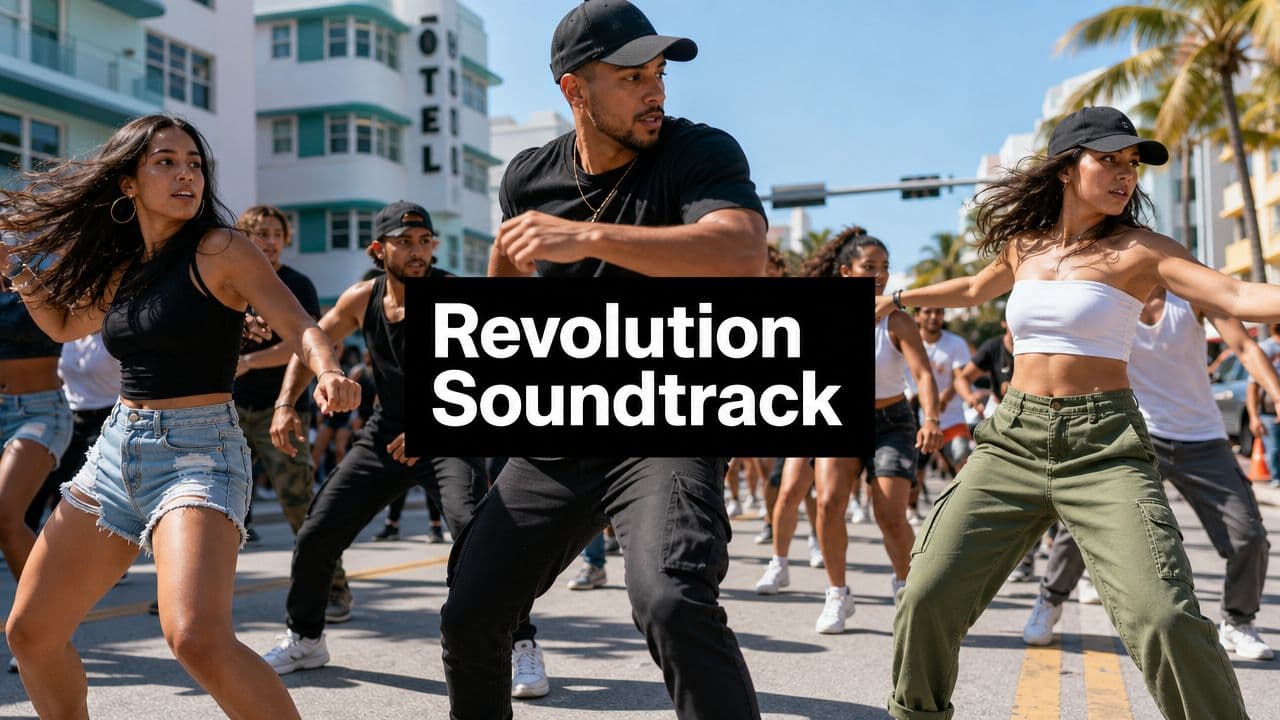
In 2012, flash mobs still felt like public magic. A crowd froze in place, or a beat dropped in a shopping district, and suddenly ordinary space turned into performance space. Step Up Revolution understood that energy and built an entire identity around it.
The film arrived on July 27, 2012 as the fourth installment in the franchise, directed by Scott Speer and distributed by Summit Entertainment in both 2D and 3D, according to the film's release details. More important than the release format, though, was the setting. Miami wasn't just scenery. It shaped the entire sound and movement language of the movie.
Why Miami mattered to the soundtrack
Miami suggests heat, nightlife, tourist spectacle, Latin-pop crossover, club rhythms, and visual brightness. Even before you look at a single song title, you can hear the likely brief a music supervisor would receive: music that feels public, kinetic, glamorous, and easy to move to in groups.
That matters because Step Up Revolution didn't frame dance as a private skill. It framed dance as interruption. The characters use flash mobs as performance protest art, which gave the music a different job than in earlier dance films. Songs didn't just need to support romance or battle scenes. They had to help transform public space.
Practical rule: When a dance film uses public-performance scenes, the soundtrack has to work on two levels. It must serve the story, and it must feel believable as music people would actually rally around in real life.
The soundtrack as movement engine
This is why the music feels inseparable from the action. In many movies, songs decorate scenes. In Step Up Revolution, songs activate scenes. A flash mob doesn't work without immediate rhythmic clarity. Dancers need countable phrases. Viewers need an obvious pulse. Casual fans need a hook they can remember after the scene ends.
That's one reason the movie still feels relevant to today's short-form culture. Public dance content needs instant readability. If the rhythm is too subtle, the movement won't spread. If the chorus doesn't hit quickly enough, the clip won't stick in memory. Step Up Revolution was operating with that logic before TikTok and Reels turned it into everyday strategy.
Where people often get confused
Some fans think the soundtrack's appeal comes mostly from “big dance songs.” That's only part of it. The stronger explanation is that the film connected repeatable movement with commercially legible music. That combination is what made the whole package feel larger than a standard soundtrack album.
The result was a dance movie where the songs didn't sit behind the choreography. They were the choreography's delivery system.
The Official Soundtrack Deconstructed
If you're looking for the practical basics first, here they are. Step Up Revolution (Music from the Motion Picture) is a 2012 compilation album released on July 17, 2012, and the Spotify-cataloged version contains 13 tracks with a total runtime of 54 minutes and 5 seconds, according to the soundtrack release listing.
That compact size tells you something useful. This wasn't built as an exhaustive score archive. It was built like a focused commercial tie-in. In music business terms, that usually means songs were selected for recognition, scene compatibility, and replay value.
How to read a film soundtrack like a music supervisor
When fans see a soundtrack album, they often ask, “Are these the best songs?” That's not usually the right question. A better one is, “Why were these songs chosen for this release?”
For a dance-driven film, a soundtrack album usually needs to do four jobs:
- Sell the mood: It should remind listeners of the film's world the moment they press play.
- Support choreography memory: Tracks with strong rhythmic identity help fans mentally replay scenes.
- Create standalone listening value: Songs have to work outside the movie.
- Extend marketing life: A soundtrack can keep the film present between trailer drops, clips, and fan-made dance content.
Step Up Revolution Official Soundtrack Tracklist
| # | Track Title | Artist(s) | Length |
|---|---|---|---|
| 1 | Let's Go | Travis Barker feat. Yelawolf, Twista, Busta Rhymes & Lil Jon | 3:41 |
| 2 | Live My Life | Far East Movement feat. Justin Bieber | 3:28 |
| 3 | Hands in the Air | Timbaland feat. Ne-Yo | 4:23 |
| 4 | Bad Girls | M.I.A. | 3:47 |
| 5 | To Build a Home | The Cinematic Orchestra | 6:11 |
| 6 | U Don't Like Me | Diplo feat. Lil Jon | 3:40 |
| 7 | This Is the Life | My Name Is Kay | 3:29 |
| 8 | Bring It Back | Travis Porter | 4:08 |
| 9 | Goin' In | Birdman feat. Lil Wayne | 3:58 |
| 10 | Dance Without You | Skylar Grey | 3:31 |
| 11 | I Don't Like You | Eva Simons | 3:20 |
| 12 | Smash the Club | Brasko feat. Kevin Rudolf | 3:17 |
| 13 | Feel Alive | Fergie | 4:12 |
What this tracklist reveals
Look at the spread and you can see the curation logic. There's mainstream rap, pop crossover, club material, harder-edged electronic energy, and a few emotionally spacious records that give the movie room to breathe. That balance matters in dance films. If every song is maximal, the scenes blur together.
A soundtrack like this also helps different audience segments enter from different doors. One listener arrives through a radio-friendly single. Another comes for EDM-adjacent energy. Another remembers the emotional placement of a slower cue. A good soundtrack album broadens entry points without breaking tone.
A soundtrack doesn't need stylistic purity. It needs emotional continuity.
A creator takeaway from the album format
For artists and producers, there's a useful lesson here. A soundtrack placement isn't only about whether your song is “good enough.” It's about whether your song fills a missing role in a sequence of moods.
If you make dance music and want placements, think in categories:
- Opening-impact tracks for instant scene ignition
- Mid-sequence builders with clear rhythmic architecture
- Emotional release songs that reset energy
- Finale records that feel big enough for payoff
That's how supervisors often hear a catalog. Not as isolated songs, but as possible scene functions.
Analyzing Standout Tracks and Iconic Dance Scenes
Some soundtrack songs work because they're catchy. The best ones work because their structure gives choreography something to grab onto. That's where Step Up Revolution earns respect from music supervisors and editors.

Hands in the Air and the logic of escalation
“Hands in the Air” is a useful example because it carries the kind of title, pulse, and release pattern that group choreography loves. In dance cinema, songs like this do practical work. They create expectation, then reward it. A choreographer can build formation changes, crowd reveals, or synchronized accents around those shifts.
From a supervision angle, this is why certain club-oriented tracks outperform more subtle records in visual media. They announce their own structure. Editors can cut to them cleanly. Dancers can hit them cleanly. Audiences can feel the turning points without musical training.
Bad Girls and attitude as choreography fuel
M.I.A.’s “Bad Girls” brings a different value. It isn't just about pulse. It's about stance. Some songs tell dancers how to move through rhythm. Others tell them how to carry themselves. This one leans into swagger, command, and image.
That distinction matters. A memorable dance scene usually combines countable movement with strong attitude cues. If the music only gives tempo, the scene can feel technically sharp but emotionally flat. If the music gives posture, tension, and character, the choreography gains identity.
To Build a Home and the value of contrast
A lot of fans associate dance soundtracks only with high-energy records, but slower or more emotionally open songs often make the loud moments land harder. “To Build a Home” represents that side of soundtrack construction. It creates emotional depth and tonal contrast.
That kind of placement is common in strong music supervision. If every cue pushes intensity, the audience stops feeling lift. You need contrast for payoff.
Here's a clip to revisit with that idea in mind:
What fans and creators can learn from these scenes
Watch the dance sequences once for enjoyment. Then watch them again with three questions:
- Where does the song signal a movement change?
- What part of the track gives the dancers attitude, not just tempo?
- What emotional job does the song perform in the larger story?
That's how you move from fan listening to supervisor listening.
The Soundtrack's Legacy in the Creator Economy
What looked like a dance movie gimmick in 2012 now reads like an early creator-era model. Step Up Revolution centered on elaborate flash mobs, and official clip and tutorial content was released to teach choreography, as shown in official franchise choreography content featuring Stephen “tWitch” Boss. That matters because today's short-form platforms reward the same behavior pattern: a song spreads when people can repeat what they see.

The film treated choreography like shareable media
That's the key insight.
A lot of older soundtrack campaigns treated songs as promotional support. Step Up Revolution treated dance itself as a distribution format. Once you do that, the song stops being just audio. It becomes a participatory prompt.
That's very close to how TikTok and Reels now work. The winning track often isn't the most musically complex one. It's the one that gives creators a clear action path. A hook, a gesture, a repeatable sequence, a dramatic reveal, a transition moment.
The creator economy loves songs that come with instructions, even if those instructions are nonverbal.
Flash mobs were social distribution before algorithmic feeds
A flash mob is coordinated visibility. People gather, perform in public, draw attention, and create an event people want to record and retell. Replace the street with a vertical video feed and the mechanism still feels familiar.
The difference is distribution speed. Back then, choreography spread through live spectacle, music video culture, and official tutorials. Now it spreads through clips, remixes, reposts, and audience imitation. But the underlying principle is the same: music travels farther when movement gives it a social use case.
Why some dance content travels and some doesn't
Creators often assume dance virality is random. It isn't fully random. Songs tend to travel better when they offer a mix of these traits:
- Immediate entry point: The rhythm or hook tells users where to start.
- Visible signature move: Audiences can identify the “moment” worth copying.
- Flexible difficulty: The move can be simplified without losing identity.
- Strong visual punctuation: The choreography creates obvious clip-friendly beats.
That's why Step Up Revolution music still feels modern. The soundtrack and choreography weren't built only for passive viewing. They were built for reenactment.
The bigger legacy
For artists, managers, and creative directors, the lesson is simple. Don't ask only whether a song sounds good. Ask whether it gives people something to do.
In the creator economy, action beats admiration. A song people dance to publicly, teach, quote, or reenact has a wider cultural path than a song people merely save.
How Artists Can Pitch Music for Dance Projects
If Step Up Revolution makes you want your own track in a dance film, live performance video, ad, or game, start with a professional truth. Music supervisors aren't shopping for vague potential. They're solving scene problems under deadline.
That means your music has to arrive ready.

Build a sync-ready package
A strong dance-placement pitch usually includes more than the main audio file.
Have these assets prepared:
- Clean metadata: Include song title, artist name, contact email, genre, mood, and tempo description.
- Non-vocal version: Editors often need room for dialogue, trailers, or alternate cuts.
- Clean version if relevant: If lyrics may limit placement use, offer an option.
- Ownership clarity: Be able to say who controls the master and publishing.
- Short description: One or two lines that describe where the song fits visually.
Many artists lose opportunities because the music is promising but the paperwork is messy.
Think like an editor, not only a songwriter
Dance projects need songs with usable structure. If your best section takes too long to arrive, it may be harder to place. If every section sounds equally dense, editors have fewer landmarks.
Ask yourself:
- Does the intro give enough setup for movement?
- Is there a clear section change for choreography?
- Does the track offer a moment of lift, drop, or emotional turn?
- Could a creator cut a short sequence from it and still keep its identity?
These questions don't make your music less artistic. They make it more placeable.
Music supervisor mindset: A great sync song doesn't just sound strong. It creates edit points.
Pitch with context
Generic emails rarely work. If you pitch dance-oriented music, be specific about use case. Say whether the track fits a street sequence, rehearsal montage, finale, fashion-dance crossover, sports choreography spot, or short-form tutorial content.
That specificity helps because supervisors search by feeling and function. “High-energy dance track” is too broad. “Percussive club track with a clean build for ensemble choreography” is much more useful.
Keep your relationships professional and light
Don't send giant folders. Don't over-explain your life story. Don't pitch songs you don't control.
Do this instead:
- Introduce yourself in a few lines.
- Name the track or small group of tracks.
- Explain the visual fit.
- State rights status clearly.
- Provide a simple listening link.
- Make follow-up easy.
That approach respects how this part of the business works. You're not asking someone to believe in your dream. You're helping them finish a job well.
Empowering Dance Music Creators with OohYeah
The long-term lesson of Step Up Revolution isn't just that soundtrack music can become culturally sticky. It's that music moves further when artists give audiences a way to participate.
Today, that participation doesn't have to depend only on a film studio, label campaign, or viral accident. Dance music creators can build their own ecosystem around songs, stems, edits, behind-the-scenes clips, rehearsal notes, alternate versions, and direct fan access. That matters because modern music careers often grow through repeated interaction, not one big gatekept placement.
For creators working in dance, remix, pop, and visual-first genres, the strongest career model combines two things. First, make music that's usable in culture. Second, own the relationship with the people who respond to it. That's where a platform built for direct artist commerce can change the equation.
OohYeah is built around that artist-first idea. It gives musicians a place to stream, sell, market, and connect without treating the song as the end of the relationship. For dance-oriented artists, that opens up practical options: offer exclusive edits, sell downloadable tracks, share rehearsal content, post voice notes about production choices, or build subscription access for fans who want more than a passive listen.
That model fits the world Step Up Revolution pointed toward. Music isn't just consumed. It's activated, replayed, taught, clipped, and shared. The artists who understand that can build something more durable than a brief trend.
If you make dance-ready music and want a better way to sell tracks, share exclusive content, and connect directly with fans, explore OohYeah. It's a music-first platform designed to help creators build sustainable careers around the communities they inspire.