
8 Essential Stage Plot Example Templates for 2025
Download our 8 essential stage plot example templates. Get clear, professional plots for any band or venue to master your live show's technical setup.
November 24, 2025
Music Marketplace Advisor
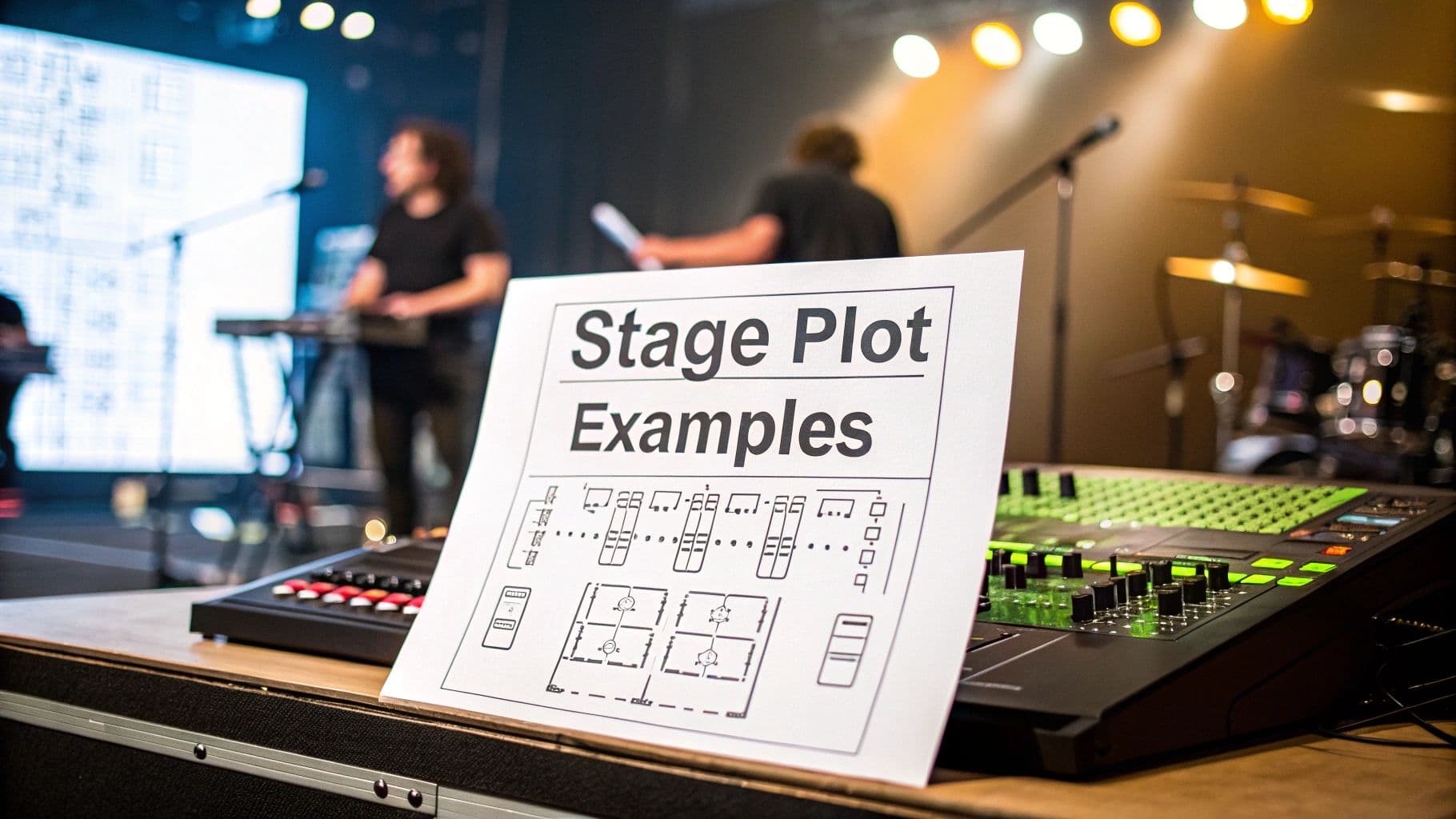
Buying & SellingA well-crafted stage plot is more than just a diagram; it’s the single most important document for communicating your technical needs to a venue's sound engineer and technical director. It is the professional blueprint that ensures your monitors are in the right place, the correct microphones are ready for your vocalists, and the front-of-house (FOH) team knows exactly what to expect before you even load in your gear. A clear, professional stage plot prevents stressful soundchecks, eliminates on-stage chaos, and sets the foundation for a seamless, powerful performance.
This guide provides eight distinct stage plot example templates, each designed for a specific performance scenario-from a standard concert stage to an immersive theater environment. We will break down the strategic elements of each, offering downloadable templates and actionable insights to help you create a plot that guarantees a great show, every time. Understanding the technical specifications and spatial limitations of different spaces is a critical first step; properly exploring music venues beforehand allows you to tailor your stage plot for an optimal performance, ensuring your setup perfectly matches the room's capabilities.
For artists managing their entire career, from live gigs to merchandise sales, this level of technical organization is non-negotiable. It reflects a standard of professionalism that venues and promoters appreciate. Here, you will find replicable strategies and tactical insights to translate your artistic vision into a clear technical document that anyone can understand, ensuring your live show runs as smoothly as a studio recording.
1. The Classic 4-Piece Rock Band Stage Plot
This is the quintessential stage plot for the standard rock band lineup: drums, bass, two guitars, and vocals. It’s a foundational layout that balances sonic separation, on-stage communication, and efficient setup. This specific stage plot example is designed for maximum clarity and is universally understood by venue technicians, making it a reliable starting point for any rock, pop, or indie band.
Strategic Analysis of the Layout
The classic 4-piece plot is effective because it adheres to fundamental audio engineering principles. The drum kit is placed center stage upstage (at the back), providing a solid rhythmic and visual anchor. The bass amplifier is typically stage left, next to the drummer's hi-hat side, locking in the rhythm section both sonically and visually.
Lead and rhythm guitarists flank the drummer on either side, creating a wide stereo image for the front-of-house (FOH) mix. Vocal microphones are positioned downstage (at the front), allowing vocalists clear sightlines to each other and the audience. This layout minimizes stage volume bleed between instruments, giving the sound engineer cleaner signals to work with.
Key Insight: The strategic placement in this layout is not just about where musicians stand. It’s a deliberate plan to manage on-stage sound, prevent feedback, and facilitate non-verbal cues between band members, which is crucial for a tight live performance.
Tactical Implementation & Actionable Takeaways
When creating your own version of this plot, focus on providing specific, actionable details. Generic icons are good, but annotations are better.
- Specify Power Needs: Clearly mark every location that requires AC power, from pedalboards to amplifiers to laptops. Use a universal symbol like a lightning bolt or "AC."
- Detail Vocal Mics: Don't just place a mic stand icon. Specify the singer's name and whether they play an instrument. For example: "LEAD VOX (Plays Guitar)" or "BASS VOX (Backing Vocals)." This informs monitor mixes and FOH channel labeling.
- Clarify Monitor Mixes: Number each floor wedge monitor and create a corresponding list that details what each musician needs to hear. For instance, "Monitor 1 (Lead Vox): More kick, more bass, and my vocal."
By using this rock band stage plot example as a template and adding your specific details, you provide the venue's technical team with a precise, easy-to-follow guide. This clarity ensures a faster setup, a better soundcheck, and a more professional experience for everyone involved.
2. The Thrust Stage Plot
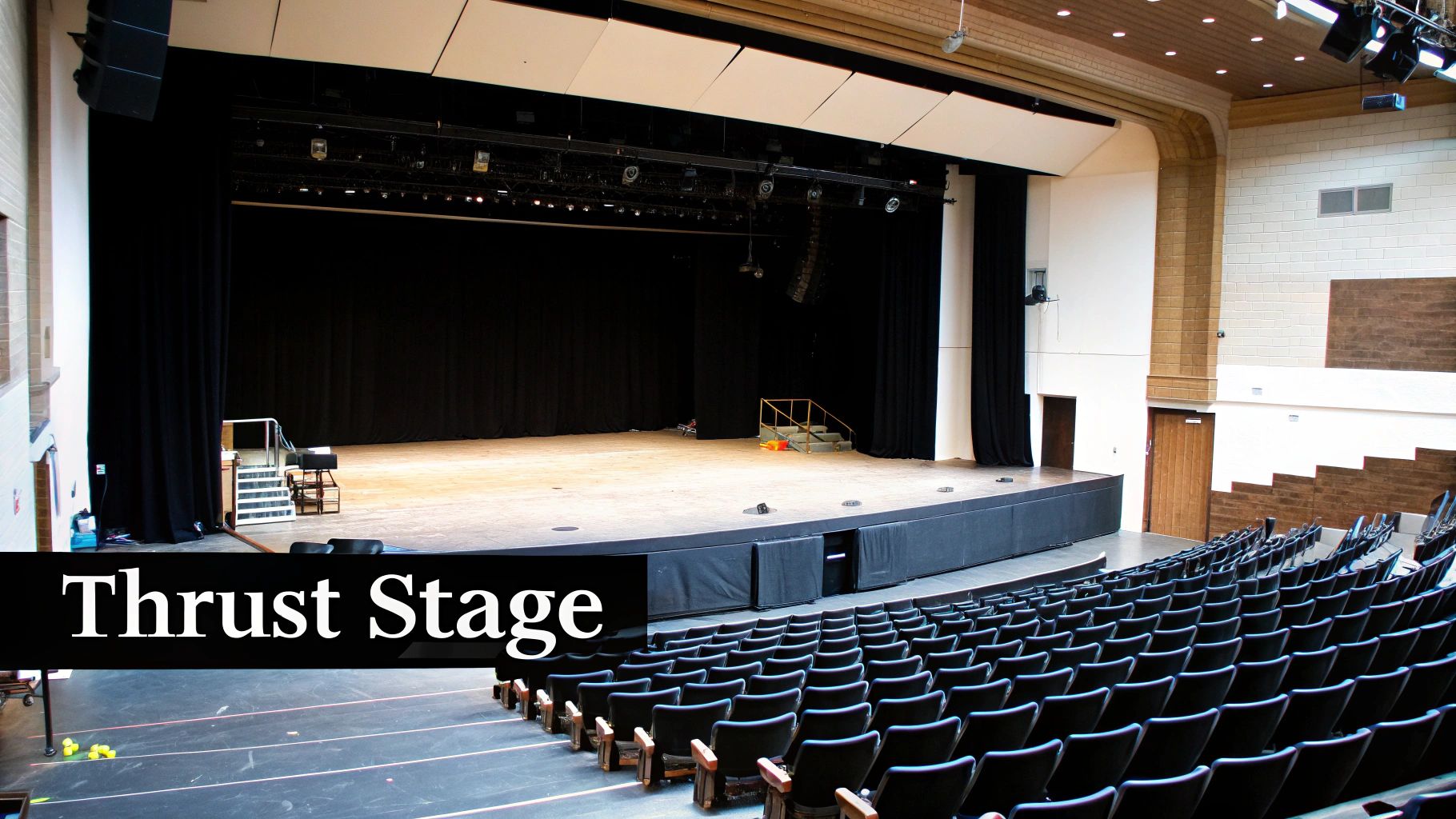
A thrust stage extends into the audience on three sides, creating a more intimate and immersive experience than a traditional proscenium stage. This configuration, famously used at venues like The Globe Theatre in London, demands a unique approach to stage plotting. This stage plot example is less about a single band setup and more about a theatrical or multi-performer layout where sightlines and performer movement are paramount.
Strategic Analysis of the Layout
The primary challenge of a thrust stage is ensuring a compelling experience for all three audience sections. A successful plot for this configuration manages sightlines meticulously, preventing performers from having their backs to one section for too long. Unlike a standard concert stage, equipment like monitor wedges, amplifiers, and even mic stands can become visual obstructions that must be strategically placed.
This layout forces a more dynamic and three-dimensional performance. The plot must account for multiple entrance and exit points, often from upstage or via aisles within the audience (vomitoriums). The sound design must also be more complex, often requiring distributed speaker systems to provide clear audio to all seating areas without creating excessive on-stage volume.
Key Insight: A thrust stage plot is a document of choreography as much as it is a technical diagram. It dictates not only where equipment goes but also how performers will move to engage audiences on all three sides, ensuring no single viewpoint is neglected.
Tactical Implementation & Actionable Takeaways
Creating an effective thrust stage plot requires thinking from the audience's perspective. It’s about managing the entire visual and auditory field, not just the front-facing view.
- Map Sightline Triangles: On your plot, draw lines of sight from the extreme left, right, and center audience positions. This helps identify where set pieces or large equipment will create blind spots.
- Indicate Stage Elevations: Clearly mark any changes in stage height, such as platforms or ramps. These elements affect both visibility and performer movement and must be communicated to the entire production team.
- Plan Cable Management Carefully: With the audience so close on three sides, cable runs are a significant safety and aesthetic concern. Your plot should detail specific pathways for cables to keep them hidden and secure.
- Specify Performer Blocking: For complex shows, consider adding key performer positions or movement paths to the plot. This helps lighting and sound technicians anticipate cues and coverage needs.
By using this type of stage plot example as a guide, you can proactively address the unique challenges of a thrust stage. This detailed planning ensures every member of the audience feels included and has a clear view of the performance.
3. Arena/In-the-Round Stage Plot
This advanced stage plot addresses the unique challenges of a 360-degree performance space where the audience surrounds the stage entirely. Unlike traditional proscenium setups, the "in-the-round" configuration eliminates the concepts of upstage and downstage, demanding a completely different approach to layout, sound, and sightlines. This stage plot example is crucial for large-scale arena tours, immersive theater, and any production aiming to create an intimate, all-encompassing audience experience.
Strategic Analysis of the Layout
The core principle of an in-the-round plot is ensuring a quality experience from every angle. This means there is no "back" of the stage; every position is a "front." The layout must facilitate constant performer movement and rotation to engage all sections of the audience. Audio design is particularly complex, often requiring a distributed sound system and carefully planned monitor placement to avoid feedback and deliver clear sound to both the performers and the entire venue.
Technical elements like drum risers, backline, and monitor worlds are typically placed centrally or even beneath the stage to minimize visual obstruction. All cable runs, power distribution, and technical stations must be meticulously planned to be invisible or non-intrusive, preserving the 360-degree illusion. This setup prioritizes audience immersion over traditional stage conventions.
Key Insight: An arena stage plot is less about instrument placement and more about managing sightlines and performer traffic flow. The goal is to make every seat feel like the best seat in the house, which requires designing the technical elements to be as low-profile and central as possible.
Tactical Implementation & Actionable Takeaways
Creating an effective in-the-round plot requires a shift in thinking from a 2D plane to a 3D space. Your document must be exceptionally detailed to coordinate with lighting, video, and venue teams.
- Designate Stage Zones: Use compass points (North, South, East, West) or clock positions (12:00, 3:00, 6:00, 9:00) on your plot to label stage areas. This creates a universal language for blocking and technical cues.
- Detail All Entry/Exit Points: Clearly mark all tunnels, voms (vomitories), and access points for performers and crew. Specify which entrances are used for which scenes or songs to help the production team manage backstage traffic.
- Map Monitor and Mic Inputs: In a 360-degree setup, wireless systems are paramount. Your plot should detail wireless microphone and in-ear monitor (IEM) frequencies for every performer. Specify locations for any necessary floor wedges, keeping them low-profile to avoid blocking views.
This type of stage plot example is a masterclass in logistical planning. By focusing on clear directional cues and minimizing physical obstructions, you provide a blueprint for a seamless and immersive production that captivates the audience from every possible angle.
4. The Black Box Theater Stage Plot
Unlike a fixed concert venue, a black box theater is a versatile, reconfigurable space. This requires a modular and highly adaptable stage plot that can account for various seating arrangements and performance styles, from proscenium to thrust or arena formats. This specific stage plot example is less a single fixed layout and more a flexible template designed for clarity amidst variability, making it crucial for experimental theater, intimate concerts, and avant-garde performances.
Strategic Analysis of the Layout
The effectiveness of a black box plot lies in its modularity and clear documentation of all potential configurations. Instead of a single "stage," the entire room is the canvas. The plot must clearly define where power, audio lines, and lighting grids are accessible, regardless of where the performance area is established for a given show. This allows production teams to quickly and accurately adapt the technical setup to the artistic vision.
This approach prioritizes communication about the space's potential over a rigid instrumental layout. It documents utility and access points, sightlines from different seating banks, and potential high-traffic areas. For a musical performance, this means the plot might show three potential band setups corresponding to three different audience arrangements, ensuring technical needs are met for each scenario.
Key Insight: A black box stage plot is fundamentally a communication tool about the venue's capabilities. Its goal isn't just to place performers but to provide a blueprint for transforming an empty room into a functional and safe performance environment for any chosen configuration.
Tactical Implementation & Actionable Takeaways
Creating a successful black box plot requires thinking in terms of systems and possibilities rather than a single, static setup. It’s about creating a master document for the space itself.
- Document All Configurations: Create separate, clear plot diagrams for each common seating arrangement (proscenium, thrust, in-the-round, traverse). This allows for quick, pre-planned technical deployment.
- Mark Utility and Access Points: Your master plot must show the precise locations of all power outlets, audio patch bays, lighting circuit connections, and entry/exit points. This is the non-negotiable information that informs every possible layout.
- Design for Flexible Monitoring: Since the performer-audience relationship changes, so will monitor needs. Plan for multiple monitor wedge and in-ear monitor (IEM) scenarios, detailing potential placements and mix requirements for each configuration.
By using this type of stage plot example as a foundation, you empower both the artistic and technical teams to leverage the full creative potential of the space. It replaces ambiguity with a clear, actionable plan for any performance style.
5. Concert Stage Plot (Festival Configuration)
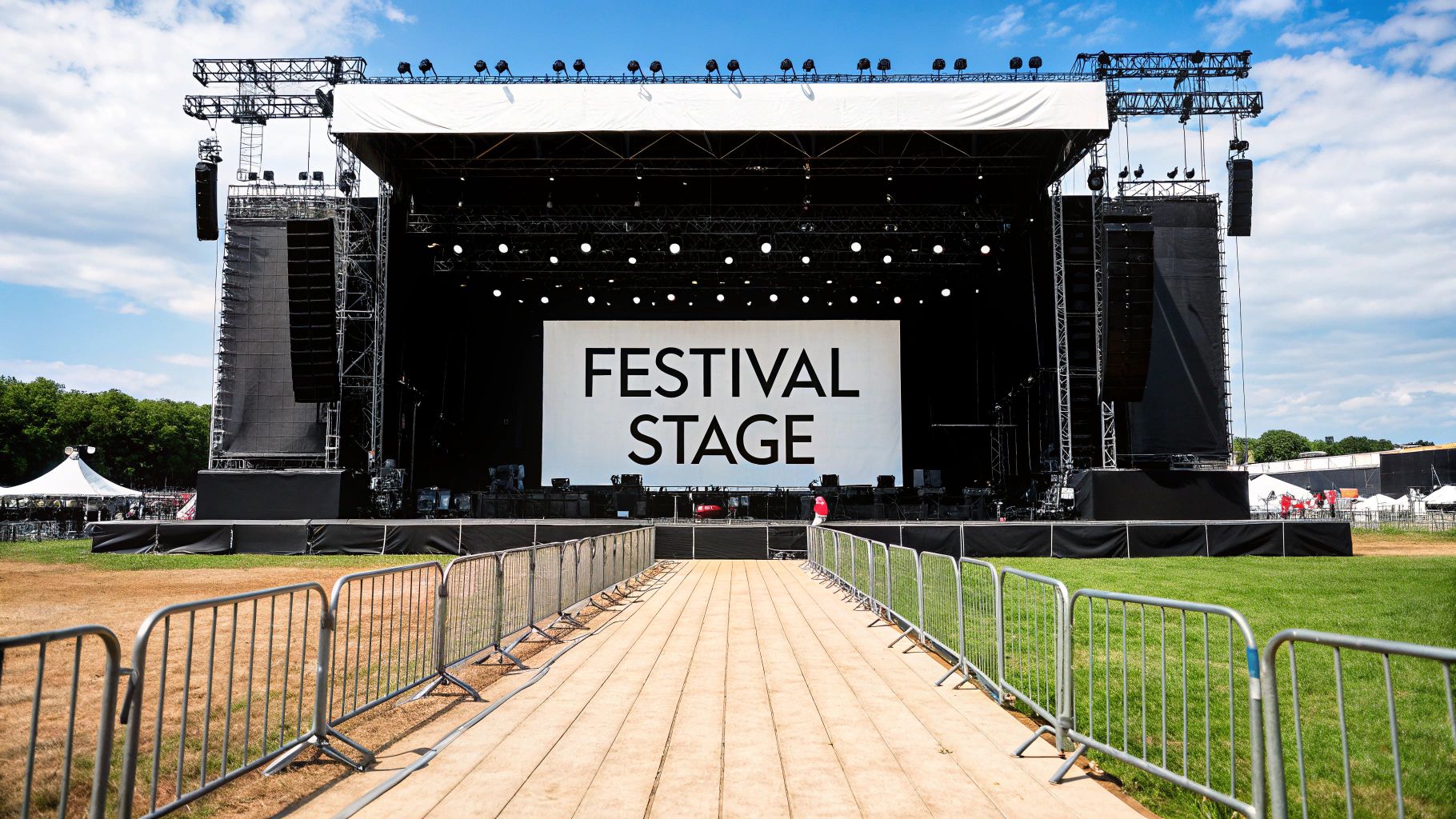
This stage plot example scales up from the club or theater to the massive stages found at major music festivals like Coachella or large-scale arena tours. It addresses the complexities of large-format productions, where rapid changeovers, extensive audio-visual integration, and safety are paramount. This plot is less about a single band's needs and more about creating a standardized, flexible system for multiple acts.
Strategic Analysis of the Layout
A festival stage plot is a master plan for efficiency. The key principle is creating universal "zones" for backline, monitors, and power, allowing for rolling risers to be pre-set and moved into position with minimal downtime. The plot dictates not just where instruments go, but also the location of video walls, lighting trusses, and power distribution units (distros).
Unlike a club plot, this layout is designed for multiple sound engineers and stage managers. It standardizes input patching through a "festival patch" system, where core channels (like drum mics) remain consistent for every artist. This ensures that the festival's technical crew can anticipate needs and streamline the soundcheck process, which is often limited to a brief line check. Such coordination requires high-level communication, where networking and professional relationships become crucial for smooth operations. You can learn more about why networking is important in the music industry on OohYeah.
Key Insight: The festival plot is a logistical document focused on minimizing transition time between artists. The strategy shifts from catering to one band's ideal setup to creating a robust, repeatable system that works for a dozen acts in a single day, ensuring the show runs on a tight schedule.
Tactical Implementation & Actionable Takeaways
When submitting your band's information for a festival, your stage plot must integrate seamlessly with the festival's master plan. Clarity and adherence to the promoter's technical specifications are non-negotiable.
- Use Rolling Risers: Indicate clearly if your drum kit, keyboards, or other gear will be on a rolling riser. Provide the riser's exact dimensions so the stage manager can plan its placement both on and off stage.
- Specify Large Power Needs: Beyond standard AC, note any high-draw equipment like video walls or lighting packages that require their own power distro or tie-in. Use industry-standard terms like "L21-30" or "Cam-Lok."
- Create a "One-Sheet": Condense your stage plot, input list, and backline requirements onto a single, easy-to-read page. Production managers handle dozens of these a day; making yours clear and concise ensures your needs are met accurately.
This festival stage plot example is fundamentally about clear communication and professional preparedness. Providing a detailed, standardized plot demonstrates that your act understands the demands of a large-scale production, making you a more reliable and desirable artist for festivals to book.
6. The Cabaret/Intimate Venue Stage Plot
This stage plot is tailored for small, intimate settings like jazz clubs, comedy venues, or supper clubs, where the barrier between performer and audience is minimal. The focus shifts from large-scale sound reinforcement to creating a personal, engaging experience. This specific stage plot example prioritizes clear sightlines, controlled stage volume, and seamless artist-audience interaction over a complex technical setup, making it essential for acts performing in close-quarters environments.
Strategic Analysis of the Layout
The cabaret plot is effective because it embraces the venue's limitations and turns them into strengths. Performers are often positioned at a low stage height or even on the same level as the audience, fostering a direct connection. Technical elements like speakers and monitors are minimized and strategically placed to be unobtrusive, preserving the room's ambiance.
Instead of a wide instrumental spread, the layout is often compact, grouping musicians tightly to allow for easy non-verbal communication in a low-volume setting. The plot must also account for audience seating, ensuring tables and chairs have clear views of the performers. This layout acknowledges that in an intimate venue, the entire room is the stage, and every element contributes to the overall atmosphere.
Key Insight: The primary goal of this plot isn't just technical clarity for the crew; it's about designing a shared space. It strategically maps out how the performance will integrate with the audience, managing acoustics, sightlines, and traffic flow for both performers and patrons.
Tactical Implementation & Actionable Takeaways
When designing a plot for an intimate venue, your focus must extend beyond the stage itself. Clarity and consideration for the unique environment are paramount.
- Map Audience Proximity: Indicate the distance to the front row of tables. This informs the sound engineer about potential feedback issues with acoustic instruments or vocals and helps plan for appropriate stage volume.
- Specify Unobtrusive Monitoring: Instead of large floor wedges, you might request smaller, personal monitors or even in-ear monitor (IEM) systems. Clearly mark these preferences on the plot to maintain clean stage aesthetics. This is especially useful for performers who want to maintain a connection with the audience, a topic explored further in discussions about the benefits of live-streaming performances for music sales.
- Detail Performer Access: Show clear entry and exit paths for performers, especially if they need to move through the audience area. Note any space constraints, such as tight corners or nearby tables, that could be an obstacle.
By using this cabaret-style stage plot example as a guide, you demonstrate an understanding of the nuances of intimate performances. This foresight shows professionalism and helps the venue's staff execute a smooth, immersive experience that connects you directly with your audience.
7. Multi-Stage Festival/Event Plot
This is an entirely different class of document, moving beyond a single performance to orchestrate an entire event. A multi-stage festival plot is a master plan detailing the technical and logistical requirements for multiple stages operating concurrently. This complex stage plot example is less about individual artist placement and more about managing power distribution, audio signal flow, crew movement, and scheduling across a large-scale environment like a music festival or corporate event.
Strategic Analysis of the Layout
The effectiveness of a multi-stage plot hinges on macro-level planning rather than micro-level artist details. It visualizes the entire event footprint, showing the relative positions of Stage A, Stage B, the Front of House (FOH) compound, and monitor world locations. The primary goal is to prevent logistical chaos and technical failures by planning for potential conflicts, such as audio bleed between stages, power distribution bottlenecks, and inefficient pathways for technical crews.
This master document ensures that each stage's technical needs are met without interfering with another. It maps out cable runs, generator placements, and wireless frequency coordination zones. For example, the plot would strategically place stages with high sound pressure levels (SPL) far apart or angled away from each other to minimize sound pollution, ensuring a quality audience experience at each location.
Key Insight: This type of plot is a strategic communication tool for the entire production team, from the event producer to the lighting director and audio department heads. It's a blueprint for the event's technical infrastructure, focusing on preventing system-wide failures rather than just ensuring one band sounds good.
Tactical Implementation & Actionable Takeaways
Creating a multi-stage plot requires a shift in perspective from a band manager to a production manager. It's a vital document for anyone trying to break into large-scale event production. For more information on career paths, you can learn more about getting into the music industry.
- Map All Infrastructure: Go beyond stages. Mark the locations of power generators, distribution boxes ("distros"), FOH tents, mobile restroom facilities, and emergency access lanes. This comprehensive view prevents day-of-show surprises.
- Detail Crew & Equipment Flow: Use dotted lines or color-coded paths to indicate how crew, equipment (like backline), and artists will move between stages, backstage areas, and production offices. This is crucial for efficient changeovers.
- Integrate a Master Schedule: The plot should work in tandem with the event schedule. Include notes like "Stage B Quiet during Main Stage Headliner Intro" to guide engineers and stage managers, preventing sound conflicts during critical moments.
By using this advanced stage plot example as a framework, event organizers can create a clear, unified plan that ensures every department works in harmony. This level of detailed pre-planning is what separates a smooth-running festival from a logistical nightmare.
8. Immersive/Environmental Theater Stage Plot
This advanced approach to plotting treats the entire venue as the performance space, dissolving the traditional separation between the stage and the audience. Productions like Punchdrunk's Sleep No More utilize this method to create a living, breathing environment where action happens simultaneously in multiple rooms. This type of stage plot example is less a single diagram and more a collection of interconnected "micro-plots" for each designated performance zone within a larger architectural blueprint.
Strategic Analysis of the Layout
Unlike a traditional plot focused on a single proscenium stage, an immersive plot prioritizes audience flow, environmental storytelling, and complex technical coordination across multiple spaces. The strategy is to map out the entire audience journey, identifying key performance areas, technical support stations, and crucial safety pathways. It's a logistical and creative blueprint for turning a building into an interactive narrative world.
The layout must account for everything from hidden speaker placements and modular lighting rigs to performer entrances and emergency egress routes for both cast and audience. Each zone requires its own detailed plot, noting power, sound, and lighting needs, while a master plot illustrates how these zones connect and how performers and audiences move between them.
Key Insight: The success of an immersive plot hinges on its ability to manage both the scripted performance and the unscripted audience experience. It is a tool for choreographing chaos, ensuring technical consistency and safety within a dynamic, multi-sensory environment.
Tactical Implementation & Actionable Takeaways
Creating an immersive stage plot requires a shift from two-dimensional thinking to three-dimensional, experience-based planning. It’s a document designed for the entire production team, not just the audio engineers.
- Create Zone-Specific Plots: Break the venue down into numbered or named zones (e.g., "The Parlor," "Zone B"). Create a detailed plot for each, specifying all technical elements, prop placements, and performer positions within that space.
- Map Audience and Performer Flow: Use a master blueprint of the venue to overlay arrows and pathways indicating the intended (and potential) movement of the audience and cast. Clearly mark restricted areas and one-way routes.
- Prioritize Safety and Egress: Prominently mark all fire exits, extinguisher locations, and emergency pathways on every version of the plot. Given the free-roaming nature of the audience, this is a non-negotiable safety requirement. This immersive stage plot example must double as a safety plan.
Stage Plot Comparison: 8 Layouts
| Stage Type | Implementation Complexity 🔄 | Resource Requirements ⚡ | Expected Outcomes 📊 | Ideal Use Cases 💡 | Key Advantages ⭐ |
|---|---|---|---|---|---|
| Theater Proscenium Stage Plot | Moderate — standardized arch, wings, orchestra pit | High — fixed infrastructure, extensive lighting/sound | Polished, controlled sightlines; large-audience reach | Musicals, opera, large plays, concert halls | Clear focus on performers; scalable productions |
| Thrust Stage Plot | High — sightlines from three sides; complex blocking | Moderate — platform extensions, flexible lighting | Intimate yet formal staging; dynamic actor-audience interaction | Shakespeare, ensemble drama, mid-size theaters | Strong performer-audience connection; versatile staging |
| Arena / In-the-Round Stage Plot | High — 360° sightline planning; complex blocking | Moderate — mobile tech, many access points | Maximum engagement; intimate but limited tech scope | Comedy, cabaret, experimental & immersive shows | No "bad seats"; intense audience immersion |
| Black Box Theater Stage Plot | Moderate — frequent reconfiguration; modular planning | Low–Moderate — movable seating, storage needs | Highly flexible programming; variable aesthetics | University theater, experimental pieces, small companies | Maximum versatility; cost-effective for varied work |
| Concert Stage Plot (Festival) | High — large-scale rigging, crowd control coordination | Very High — PA systems, stage trusses, power distribution | Professional sound coverage; supports huge audiences | Music festivals, arena concerts, touring events | Scalable production; robust crowd/sound management |
| Cabaret / Intimate Venue Stage Plot | Low — simple staging and blocking | Low — minimal technical infrastructure | Strong intimacy; personal performer-audience contact | Jazz clubs, comedy rooms, supper clubs | High intimacy; low setup cost; flexible placement |
| Multi-Stage Festival / Event Plot | Very High — multi-venue timing & interference planning | Very High — multiple systems, crews, backup power | Continuous, diverse programming across stages | Large festivals (SXSW, Outside Lands) | Maximizes programming & capacity; scheduling efficiency |
| Immersive / Environmental Theater Plot | Extremely High — multi-zone mapping, safety planning | High — layered technical elements, site prep | Deeply memorable, multi-sensory experiences | Immersive storytelling, site-specific productions | Unprecedented immersion; unique narrative engagement |
From Diagram to Standing Ovation: Your Next Steps
We've explored a wide array of stage plot examples, from the structured formality of a proscenium arch to the dynamic chaos of an immersive theater environment. The journey through these templates has illuminated a core truth of live performance: a great show doesn't begin when the lights go up. It starts with a clear, concise, and professional document that translates your artistic vision into technical reality.
A well-crafted stage plot is more than just a map; it's a statement of intent. It tells a venue’s technical director, a festival stage manager, and a local sound engineer that you are prepared, you respect their time, and you are serious about your craft. This single document is the foundation of a smooth load-in, an efficient soundcheck, and a performance free from technical distractions. It's the silent handshake that builds trust and rapport before you even step on stage.
Key Takeaways: From Concept to Execution
Reflecting on the various stage plot example formats we've analyzed, several universal principles emerge as critical for success. These are the non-negotiables that separate a good plot from a great one.
- Clarity Over Complexity: The goal is instant comprehension. Use standardized symbols, clear labels, and a clean layout. A front-of-house engineer should be able to grasp your entire setup in under 30 seconds.
- Detail is Your Ally: Specify everything. Include microphone model preferences (e.g., SM58 for vocals, SM57 for snare), DI box requirements (active/passive), monitor mix counts, and precise power drop locations. The more information you provide, the fewer questions you'll have to answer on a busy show day.
- Context is King: Always tailor your plot to the environment. The needs of a sprawling festival stage are vastly different from those of an intimate cabaret club. Use the examples provided as a starting point, but always adapt them to the specific venue and performance context.
- The Plot is a Living Document: Your band evolves, your gear changes, and your needs shift. Review and update your stage plot and input list after every major tour or gear acquisition. An outdated plot is a recipe for confusion and delays.
Actionable Next Steps: Putting Your Plot to Work
Now that you're armed with high-quality examples and strategic insights, it's time to put this knowledge into practice.
- Build Your Master Template: Using a tool like StagePlot Pro, Google Drawings, or even a simple graphics editor, create a master stage plot for your most common band configuration. This will be your foundational document.
- Create an Accompanying Input List: In a separate document or on the same page, create a detailed input list and channel patch sheet. This is the technical counterpart to your visual diagram and is equally important.
- Develop Key Variations: From your master template, create versions for different scenarios you frequently encounter: an acoustic duo setup, a stripped-down "fly-date" configuration, or a full festival production plot.
- Integrate with Your Tech Rider: Your stage plot is a crucial component of your technical rider. Ensure it is embedded or attached to every rider you send out. This comprehensive package becomes your primary communication tool with venues and promoters.
Effectively communicating with venues, production companies, and sound engineers is a critical skill. Think of them as essential partners in your performance. Managing these relationships well requires clear documentation and professional communication, principles that are central to effective vendor management best practices across any industry. By providing a stellar stage plot, you are not just managing your technical needs; you are managing a key professional relationship that directly impacts your show's success.
Ultimately, mastering the art of the stage plot empowers you to take control of your live show. It minimizes variables, eliminates guesswork, and ensures the technical team has exactly what it needs to make you sound your best. This frees you and your band to focus on the one thing that truly matters: delivering a powerful, unforgettable performance that earns a standing ovation.
Ready to centralize your professional assets and streamline your music business? OohYeah provides artists with the tools to manage everything from digital and physical sales to essential documents like tech riders and stage plots, all in one place. Take the next step in professionalizing your career and ensure you're always show-ready by visiting OohYeah today.