A Modern Guide to Pitching Spotify Playlist Curators
Learn how to find, vet, and pitch the right Spotify playlist curators. Our guide offers real-world strategies for artists to get their music heard.
December 13, 2025
Music Marketplace Advisor
Buying & SellingSpotify playlist curators are the new gatekeepers of music discovery. These tastemakers range from official editorial teams at Spotify to influential independent creators, and getting your track placed on the right list can mean millions of streams.
But let's be real: success here requires a lot more than just firing off a few generic emails and hoping for the best.
The New Rules of Spotify Playlist Pitching
Landing your music on the right playlists can completely change the trajectory of a release, but the game has changed. This guide is your modern playbook for connecting with the Spotify playlist curators who matter, from the major editorial teams to the indie tastemakers who drive niche genres.
Forget the outdated "spray and pray" tactics. We're focusing on a sustainable approach that builds real momentum. It’s about creating genuine relationships in an incredibly crowded music scene. The goal isn't just a one-off placement; it's about building a network of supporters who truly connect with your sound.
Understanding the Curator Landscape
The playlisting world is massive and diverse. As of 2025, Spotify is home to roughly 4 billion playlists, but only about 3,000 of them are official editorial lists curated by Spotify's internal teams.
While those major lists like Today’s Top Hits can reach tens of millions of followers, the independent curators are just as crucial for building a groundswell of support. According to some reports, even a solid placement with a third-party curator can generate millions of streams. For more on Spotify's growth, check out the latest stats on soundcamps.com.
Success starts with knowing who you're pitching to.
A Look at Different Curator Types
Here’s a quick breakdown of the main types of Spotify curators and the impact they can have on your music.
| Curator Type | Primary Role | Potential Reach | Pitching Method |
|---|---|---|---|
| Editorial | Spotify's in-house teams managing flagship playlists. | Massive (millions of followers) | Spotify for Artists pitch tool (pre-release only) |
| Independent | Music bloggers, DJs, influencers, dedicated fans. | Niche to large (hundreds to hundreds of thousands) | Email, social media, submission forms |
| Algorithmic | Playlists like Discover Weekly, driven by data. | Highly targeted and personal | Indirect (driven by user engagement and other placements) |
Each type plays a different role in an artist's journey. Getting to know them is the first step toward building a smart outreach campaign.
The most effective strategy involves targeting both editorial and independent curators. Editorial placements provide massive reach, while independent placements build foundational support and help trigger Spotify's algorithms.
Why a Modern Approach Is Essential
The days of mass-emailing hundreds of curators with a generic message are long gone. Those emails go straight to the trash.
Today's successful artists understand that playlist pitching is a core pillar of their overall marketing plan. It takes research, personalization, and follow-through. For a bigger picture view on building your promotional strategy, take a look at our guide on how to market your music as an independent artist.
In the sections ahead, we’ll walk you through how to find the curators who are a perfect match for your sound, spot the fake playlists, and craft a pitch that actually gets a response.
Discovering the Right Curators for Your Music
Finding the right Spotify playlist curators isn’t a numbers game—it's about finding the right fit. Before you even open Spotify, you need to get brutally honest about your own music. Who is your sound actually for? If you were to open for another artist, who would it be? Answering these questions gives you a compass for everything that comes next.
Your best starting point is almost always right there on Spotify. It’s a bit like being a musical detective. First, pull together a list of 5-10 artists who genuinely sound like you. I'm not talking about your heroes or dream collaborators, but artists who operate in the same sonic world. These "reference artists" are the key to unlocking a whole network of curators who are already looking for music just like yours.
Once you have that list, it's time to go digging into their profiles.
Using Spotify to Uncover Opportunities
Spotify has some powerful discovery tools baked right in, but most artists fly right past them. For this kind of research, two features are absolute gold.
- Discovered On: Head to an artist’s profile and scroll down. This section shows you the public playlists they've been added to. It's a direct window into which active curators are programming music in your lane.
- Fans Also Like: This is your map to an entire ecosystem of similar sounds. Clicking through these related artists will open up new rabbit holes, revealing even more playlists and pockets of potential listeners.
You’ll find this process starts to snowball. A playlist you spot on one artist's "Discovered On" page can lead you to another similar artist, which then expands your target list. Be methodical. Work through your reference artists one by one and log every promising playlist in a spreadsheet. Keep it simple: playlist name, curator's name (if you can find it), and a link.
This hands-on approach is critical because it builds a foundation of relevance. Every playlist on your list will have a proven connection to your sound.
Advanced Search and Keyword Modifiers
That simple search bar at the top of Spotify is more powerful than it looks. Don't just search for a broad genre like "Indie Pop." You need to get specific by using keyword modifiers to filter out the noise. This is how you find those amazing niche playlists with die-hard audiences.
Think about combining a mood, an activity, and a subgenre in your searches.
Here are some examples of what this looks like in practice:
- "rainy day indie folk"
- "late night lofi study"
- "synthwave driving"
- "underground hip hop workout"
Queries like these immediately cut through the clutter of massive, generic lists. They help you pinpoint curators who are crafting a very specific vibe. Honestly, a placement on a "Morning Commute Chillwave" playlist will often do more for you than a spot on "Electronic Hits" because every single listener is there for that exact sound.
Don't get distracted by a huge follower count. A niche playlist with 5,000 highly engaged listeners is almost always more valuable than a generic one with 50,000 passive ones.
Leveraging Third-Party Databases
While doing your homework on Spotify is non-negotiable, third-party platforms can really speed things up. They also give you data you just can't find inside the app. Tools like Chartmetric, Soundcharts, and PlaylistSupply were built for this kind of work.
These platforms let you search for playlists using all sorts of criteria, like genre, keywords, and even follower growth trends. But here’s the real kicker: they often surface curator contact info or links to their social media profiles, which you'll need for your outreach. Many of these tools cost money, but most offer a free trial that’s perfect for building your initial hit list. For a deeper look at getting your music in front of the right ears, check out our guide on how to get my music heard.
By combining your own direct research on Spotify with the powerful data from these external tools, you can build a laser-focused list of curators. This methodical approach means you won't be wasting your time pitching to playlists where your music simply doesn't belong.
How to Vet Playlists and Avoid Scams
So you’ve got a list of potential playlists. Now for the most important part: figuring out which ones are real and which are total junk. A high follower count can be deceiving; many are just ghost towns full of bots that can tank your Spotify for Artists data and even get you penalized.
The goal here isn't just to get streams—it's to get your music in front of real people who might actually become fans. A sudden, fake spike in plays from a bot-farm playlist can trigger Spotify's fraud detection, and that's a headache you don't want. Let's dig into how to separate the gold from the garbage.
This flowchart gives you a bird's-eye view of the entire process, from pinning down your sound to finding the right curators and giving them a final once-over.
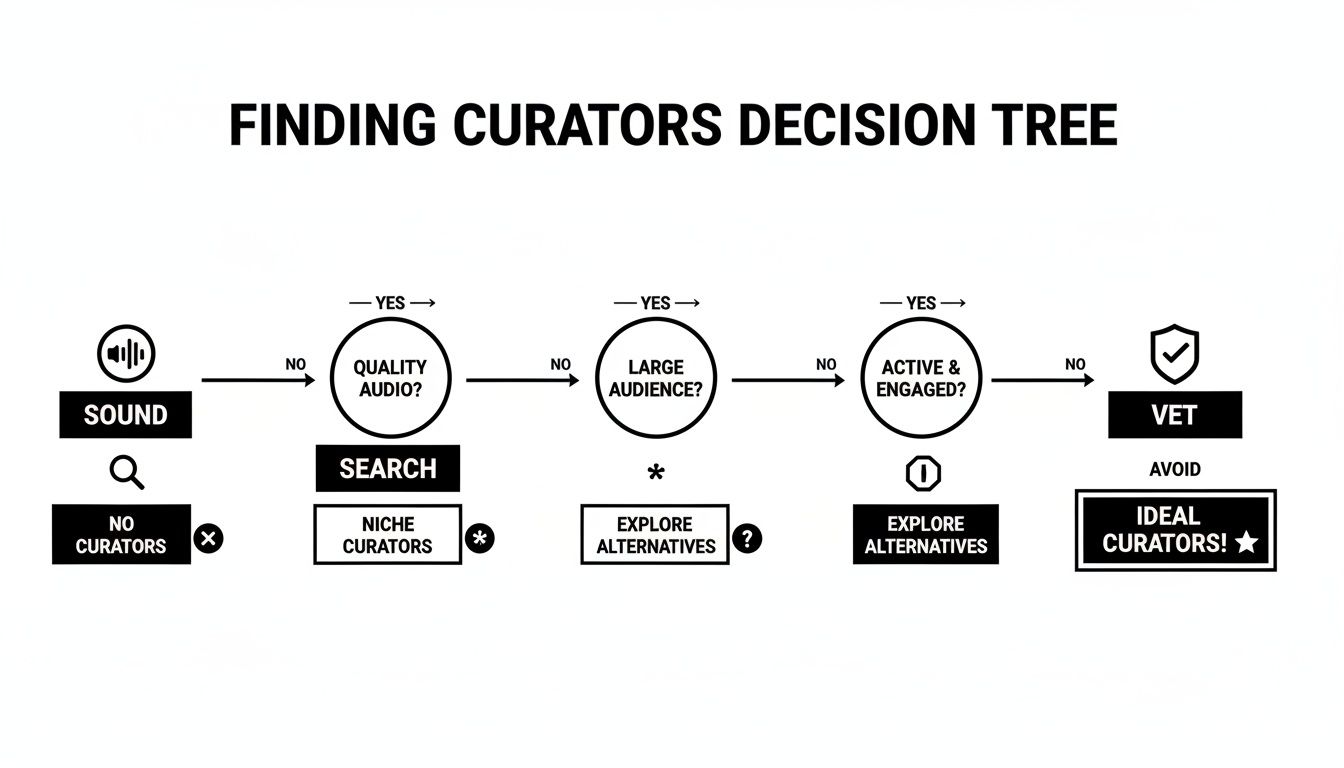
Think of it as a funnel. You start with a wide search and systematically narrow it down until you’re left with a handful of high-quality, relevant opportunities that are actually worth your time.
Analyzing the Numbers (The Right Way)
First things first, you have to look at the data, but you need to know what you're looking for. A playlist with 100,000 followers sounds amazing, but if only a few hundred people are actually listening, it's all for show.
Start by looking at the artists currently on the playlist. Do their monthly listener counts make sense in the context of the playlist's size? If you see a playlist with tens of thousands of followers, but every artist on it has only a few hundred monthly listeners, something is fishy. That's a huge red flag.
A healthy playlist shows a natural link between its follower count and the general listener base of the artists it features. A massive disconnect usually screams "bot farm."
To get a clearer picture, you’ll want to use a third-party analytics tool. A platform like Chartmetric is invaluable here because it can show you a playlist's follower growth over time.
- Green Flag: Look for a steady, gradual upward curve. This is what organic growth looks like.
- Red Flag: Be wary of sudden, massive spikes. A playlist that jumps from 500 to 50,000 followers in a week didn't just go viral—it bought bots.
These tools also provide deeper engagement metrics, which tell you if anyone is actually pressing play. If the numbers show that followers aren't listening, it’s a dead end.
Spotting Red Flags in Real-Time
You don’t always need fancy tools to spot a scam. A quick look at the playlist itself can often tell you everything you need to know.
To make it easy, I've put together a quick checklist. Use this to quickly spot the differences between a fraudulent playlist and a genuinely engaged one.
Signs of a Legit vs Fake Playlist
| Indicator | Legitimate Playlist (Green Flag) | Fake/Bot Playlist (Red Flag) |
|---|---|---|
| Curator Presence | The curator has an active, professional social media presence or website linked to the playlist. | The curator is anonymous, with no social links or contact information available. |
| Playlist Art & Name | The artwork is unique, and the name is creative and specific to a mood or niche. | The artwork is generic stock imagery, and the name is keyword-stuffed (e.g., "Hits 2025 Rap Pop"). |
| Track Selection | Features a mix of well-known and emerging artists within a consistent genre or theme. | The tracklist is bizarre, jumping between completely unrelated genres and artists. |
| Artist Profiles | Artists on the playlist have legitimate-looking profiles with consistent monthly listeners. | Many artists have suspiciously high monthly listeners but almost no followers or engagement. |
This simple table can save you a ton of time and prevent you from pitching to playlists that will only hurt your music's reputation. If you see more red flags than green, just move on.
The Social Media Credibility Check
The final sanity check is to see if the curator exists outside of Spotify. Do they have an Instagram, a blog, or a Twitter account where they actively talk about music? Real curators are almost always music fanatics who are excited to share their discoveries.
Look for genuine community engagement. Are people commenting on their posts? Do they interact with artists? This kind of social proof is often the most reliable sign you’ve found a human tastemaker instead of a front for a scam.
If their social media feels hollow—think fake-looking followers or zero comments—it’s best to walk away. Focus your energy on curators who are clearly invested in building a real community around music.
Crafting a Pitch Curators Actually Read
Alright, you've done the legwork and have a solid list of vetted playlists. Now comes the moment of truth: the pitch. Keep in mind, an influential curator might be swimming in hundreds of submissions a day. Your email has a tiny window—mere seconds—to grab their attention before it gets lost in the shuffle.
Success here isn't about fancy graphics or over-the-top hype. It’s about being professional, personal, and making the curator’s job incredibly easy. Every single part of your email, from the subject line to your sign-off, has to be intentional. A generic, copy-paste job is a one-way ticket to the trash folder. Your mission is to prove you've done your homework and genuinely believe your track belongs on their playlist.
The Anatomy of a Perfect Pitch
A winning pitch is lean, respectful, and gets straight to the point. Think of it less like a hard sell and more like a friendly recommendation from someone who gets their taste in music.
Every pitch email needs these core elements:
- A No-Nonsense Subject Line: Make it clear and easy to scan.
- A Personal Opening: Show them you know who they are.
- The Track Intro: Briefly describe your song and connect it to their playlist.
- Social Proof & Momentum: Give them a reason to believe your track has legs.
- Frictionless Listening Links: Get them to the music in one click.
Structuring your message this way shows you respect their time and know how this game is played.
Nail the Subject Line
This is your first, and maybe only, impression. The subject line is what gets your email opened. Vague titles like "Music Submission" or "Check out my new song!" are dead on arrival.
You need something direct that gives the curator all the key info at a glance. I’ve found a simple, effective format that works wonders:
Music Submission: [Artist Name] - "[Track Title]" ([Genre/Vibe])
Here’s how it looks in practice:
Music Submission: Echo Bloom - "Northern Lights" (Dream Pop / Chillwave)
Before they even open the email, they know who you are, the track name, and what it sounds like. It helps them instantly categorize your submission and decide if it's worth a look.
Personalization Is Not Optional
That first sentence is your chance to prove you’re not a robot spamming a list. This is where your earlier research on the playlist pays off. Address the curator by name if you can find it, mention the specific playlist you’re pitching, and briefly explain the connection you see.
"A personalized pitch shows you respect the curator's work. Mentioning a specific song you love from their playlist, or a recent add that caught your ear, proves you're a real listener, not just an artist asking for a favor. It’s a small detail that makes a huge difference."
Try something like this: "I'm a huge fan of your 'Midnight Drive' playlist—the way you weave in artists like The Midnight and LANY creates the perfect late-night vibe." It builds instant rapport and shows you actually understand what they're curating.
Highlight Your Momentum
These days, a great song isn't always enough. Curators are often looking for tracks that already have some heat behind them. A little social proof can go a long way.
Many Spotify playlist curators now look for real engagement metrics—things like a baseline of monthly listeners, track saves, and adds to other user playlists. It's become standard to include a few key data points in your pitch to show your track is connecting with listeners.
You can drop these in as quick, scannable bullet points:
- Recently featured on the Indie Shuffle blog.
- Our TikTok for the release just passed 50,000 views.
- Added to over 150 user playlists in the first week.
Of course, none of this matters if your email lands in the spam folder. Before you hit send on any campaign, it's worth taking a moment to understand why emails might go to spam so you can make sure your pitch actually gets delivered.
Make Listening Effortless
This is the final, crucial step: make it dead simple for them to hear your song. Do not attach MP3 files. They clog up inboxes, look unprofessional, and can even trigger spam filters.
The gold standard is a direct link to Spotify.
Just provide the essentials, clean and simple:
- Your Track:
[Spotify Track Link] - Your Profile:
[Spotify Artist Profile Link]
The goal is to move them from reading your email to pressing play in a single click. Combine this easy access with a personal touch and a professional format, and you’ll dramatically boost your chances of getting noticed by the right Spotify playlist curators.
Building Relationships After the Pitch

So, you hit "send" on your pitch. Don't close that laptop just yet. The real work—the part that separates a one-hit wonder from an artist with a career—is just getting started. Forging genuine connections with Spotify playlist curators is how you build a network that pays off long after your current song fades out.
To do this right, you need to stay organized. A simple spreadsheet is your best friend. Seriously, it doesn't need to be fancy. Just track the playlist, the curator's name, when you pitched them, and what happened. This little bit of housekeeping saves you from the embarrassment of sending duplicate emails and gives you a bird's-eye view of your outreach.
The Art of the Follow-Up
Following up is a tightrope walk. You need to be persistent without being a pest. My rule of thumb? If you haven't heard back in about a week, it's fine to send one—and only one—polite nudge.
Keep it brief and professional. Just reply directly to your original email with something like, "Just wanted to gently follow up on this submission." That’s usually enough to bump your message to the top of their inbox. If there's still silence after that? It's time to move on. Constantly bugging a curator is the quickest way to end up on their blacklist.
Turning a Placement into a Partnership
Okay, the best-case scenario happened: you landed a placement! This is a huge opportunity. Your response right now can be the difference between a curator remembering you for your next single and forgetting you exist.
First things first, show some real gratitude.
- Send a Thank You Email: A short, personal note of thanks goes a surprisingly long way. It shows you appreciate their platform and the time they took to listen.
- Share and Tag on Socials: Blast the playlist out on your social media channels. Make sure you tag the curator! This is a win-win: they get new listeners, and you look like a pro who supports those who support you.
- Engage with Their Content: Actually follow their playlist on Spotify and check out the other artists they featured. This shows you’re invested in their taste, not just your own track.
These small steps prove you’re a professional and a collaborator, making it a no-brainer for them to check out your future music.
"A curator who adds your track is more than a gatekeeper; they're an early advocate for your music. Treat them like a valued partner, and you'll begin building a network that supports your entire career, not just a single song."
Nurturing Connections for the Long Haul
The end goal here is to cultivate a trusted circle of curators you can reach out to directly for future releases. This means you have to stay on their radar without constantly asking for a favor. Send them a quick update when you drop a new music video or announce a tour. Keep the connection warm.
This is all about playing the long game. The strategies you use here aren't that different from running effective influencer marketing campaigns, where consistent, authentic engagement is key.
Each placement isn't just a number on your stream count; it's a new relationship and another brick in the foundation of a sustainable career. Investing time here complements the essential work of growing your own audience, because https://oohyeah.app/posts/why-building-a-fanbase-is-essential-for-selling-music is ultimately what proves your value to everyone, curators included.
Pitching Questions You're Probably Asking
Even with the best game plan, pitching your music to Spotify playlist curators can feel like you're just guessing. Most artists run into the same handful of questions about timing, etiquette, and what actually works.
Getting these fundamentals right can be the difference between a successful campaign and a silent inbox. Let's clear up some of the most common questions I hear from artists.
When Is the Right Time to Pitch My Music?
Timing is absolutely critical. For Spotify's official editorial team, you have to submit your track through the Spotify for Artists dashboard at least 7 days before your release date. That's the hard-and-fast rule.
But honestly, the real sweet spot is 2-4 weeks in advance. Why? Because it gives their team enough breathing room to actually listen to your track among the thousands they get every single day. Cutting it too close to that 7-day minimum seriously jeopardizes your shot at a major list like New Music Friday.
When it comes to independent curators, you can tighten up that timeline a bit. I’ve found that reaching out 1-2 weeks before your song drops is perfect. This timing gets your music on their radar right as they're planning their release-day updates, which is exactly where you want to be to catch that initial wave of listener excitement.
Key Takeaway: Pitching way too early means your email gets buried. Pitching on release day is a rookie mistake and almost always too late. Stick to the 2-4 week window for editorial playlists and 1-2 weeks for independents.
Is It Okay to Pay for Playlist Placements?
This is a big one, and you need to be extremely careful here. Let's be blunt: paying a curator for a guaranteed spot on their playlist is a violation of Spotify's rules. But more importantly, most of these "pay-for-play" offers are scams that lead to bot-filled playlists.
A sudden, massive spike in fake streams looks terrible and can get your track flagged by Spotify's algorithms. The last thing you want is a penalty on your account or, in a worst-case scenario, having your music pulled from the platform entirely.
Instead of gambling with those shady services, look at legitimate third-party platforms. Companies like SubmitHub or Groover work differently. You're typically paying a small fee for a curator to simply listen and give you feedback. Placement is never guaranteed. This model connects you with real curators who are actively looking for new music, not just selling empty slots. It's a much smarter way to spend your time and money.
What Should I Do After I Get Added to a Playlist?
Getting that "added" notification is an awesome feeling. Celebrate it! But don't stop there. What you do next can turn a single placement into a lasting connection with a curator.
As soon as you see your track on a list, jump into action.
- Shoot them a personal thank-you email. Keep it short and genuine. A simple "Hey, thank you so much for adding my track!" goes a long way and makes you look like a pro.
- Share the playlist on your socials. Post a story or tweet about the placement and be sure to tag the curator or the playlist's account. This sends your fans their way, which they'll definitely appreciate.
- Actually engage with their playlist. Follow it on Spotify. Listen to a few other songs. This small gesture shows you're not just a spammer—you're a real music fan who values their taste.
These simple steps build real rapport and make it far more likely that the curator will remember you and support your next release.
How Do I Find a Curator's Contact Info?
This part can feel like detective work, because most curators don't just plaster their email addresses everywhere.
Start with the obvious: check the playlist description right on Spotify. Sometimes they'll drop a social media handle or an email address right there. No luck? Head over to Google, Instagram, or X (formerly Twitter) and search for the playlist name or the curator's name. Many have dedicated profiles or websites for their curation work.
If you find a social media profile but no email, it’s generally okay to send a polite, concise DM to introduce yourself. And don’t forget to check if they’re on a submission platform—that’s often their preferred way to take in new music.
At OohYeah, we believe in giving artists the tools to build their careers on their own terms. From selling music and merch commission-free to connecting directly with your fans, our platform is designed to put you in control. Build your future in music today at https://oohyeah.app.