Your Guide to a Modern Social Media Music Strategy
Transform your social media music strategy. This guide offers actionable advice on promotion, licensing, and monetization to help artists succeed online.
December 12, 2025
Music Marketplace Advisor
Buying & SellingThink of "social media music" not as a genre, but as a living, breathing ecosystem. It’s where songs are found, passed around, and transformed into genuine cultural moments. This is music that’s inseparable from the interactive and visual world of platforms like TikTok and Instagram, where a killer 15-second clip can outshine weeks of traditional radio play.
Understanding Social Media as the New Music Arena
Forget everything you know about the old gatekeepers—the radio programmers and A&R reps. Today, the path from unknown artist to chart-topper can ignite with a single viral post. Social media has completely leveled the playing field for music promotion, giving artists a direct, unfiltered connection to a worldwide audience.
This new reality has also flipped the script for listeners. They've gone from being passive consumers to active collaborators. People aren't just listening anymore; they're remixing, choreographing, and shaping a song's meaning through their own content. A track's success is now just as likely to be measured in shares and "uses" as it is in streams and sales.
The Power Shift from Playlists to People
For decades, getting discovered meant navigating a world curated by insiders. Your big break depended on landing on the right radio show or a major Spotify playlist. While those channels still matter, social media has introduced a far more powerful, people-driven alternative.
Now, discovery happens peer-to-peer. A fan in one part of the world can make a video with your song, and within hours, it can be seen by millions in another. That kind of organic, explosive reach is the engine behind modern social media music.
The new music arena isn't a physical stage or a radio frequency; it's an infinite scroll. Your opportunity to connect with an audience refreshes with every swipe, making authentic, engaging content more powerful than a massive marketing budget.
This model rewards authenticity and genuine connection over high-gloss production. The artists who win here are the ones who get that it’s not just about broadcasting their music—it's about building a community around it. They pull back the curtain on their creative process, jump into the comments, and embrace the wild, unpredictable ride of viral trends.
Key Elements of This New Arena
To make your mark, you have to treat this digital stage for what it is. It's not just a place to dump a link to your new single. It's a rich, multimedia environment where your music becomes the soundtrack to countless other stories.
Three things really define this space:
- Speed: Trends catch fire and burn out in a matter of days, not months. Being able to jump on an idea and share content quickly is absolutely critical.
- Participation: Your audience is your best marketing team. The goal is to make music and content that inspires them to create something of their own using your sound.
- Authenticity: People connect with the human behind the art. Sharing behind-the-scenes glimpses, personal stories, and real interactions is what builds the kind of loyalty that lasts.
When you get these elements right, you stop just sharing music and start building an interactive brand that can truly thrive in the digital spotlight.
Choosing the Right Platforms for Your Music
Let's be honest: not all social media platforms are created equal, especially for musicians. Thinking you can just drop the same post everywhere is a fast track to burning out with very little to show for it. The real game is about focus. Spreading yourself thin across every app is a rookie mistake; the pros figure out where their music and personality will truly connect with an audience.
Think of each platform as a different city with its own unique culture, language, and vibe. You wouldn't wear a tuxedo to a backyard BBQ, right? The same logic applies here. A one-size-fits-all strategy just doesn't work. To actually get traction, you have to learn to "speak" TikTok, Instagram, and YouTube fluently by creating content that feels native to each one.
The Short-Form Video Giants
Right now, the world of music discovery revolves almost entirely around short-form video. These apps are the modern-day A&R, capable of turning a 15-second soundbite into a global anthem, sometimes overnight.
TikTok is the undisputed giant in this arena. Its power is staggering—an incredible 90% of its top videos in Q2 2024 featured music, reaching an audience of over 1 billion monthly active users. This is the "TikTok effect" in action, a phenomenon that has completely rewritten the rules for how a song becomes a hit. Often, it's a track tied to a quirky dance or a relatable meme that rockets up the streaming charts.
Of course, Instagram Reels and YouTube Shorts are right there in the mix. Between them, a massive 68% of social media users say these platforms are where they find new tunes. Each has its own distinct feel, but they all run on the same fuel: content that is immediate, engaging, and easy for others to replicate.
The secret sauce for these platforms is participation. Your music isn't just something to be passively listened to; it's a building block, a soundtrack for someone else's creativity. The ultimate win is inspiring hundreds or thousands of people to use your audio in their own videos. That's the ripple effect the algorithms are designed to reward.
This reality requires a mindset shift for artists. You're not just a musician anymore; you're also a content creator. Simply uploading a polished music video isn't enough. You need to supply the raw ingredients—the catchy hooks, the funny outtakes, the lyric that hits just right—that give other creators something to work with. For a much deeper dive into this, check out our guide on how to promote your music on TikTok and other short-form platforms.
Platform Strategy at a Glance for Artists
To help you decide where to invest your time and energy, it’s critical to understand the unique strengths and audience expectations of each major platform. This isn't about being everywhere; it's about being in the right places, in the right way.
Here’s a quick breakdown to get you started.
| Platform | Primary Strength for Music | Best Content Format | Key Audience Characteristic |
|---|---|---|---|
| TikTok | Viral Discovery & Trend Setting: Unmatched potential for a song to go from unknown to global hit through user-generated trends and challenges. | Raw, Authentic Clips: Short, unpolished videos (15-30 seconds) that are creative, funny, or centered on a repeatable action or dance. | Gen Z-Dominant & Trend-Driven: This audience values authenticity and humor, quickly adopting and adapting new sounds and formats. |
| Instagram Reels | Aesthetic Storytelling & Community Building: Great for sharing higher-quality visuals and behind-the-scenes content with an established follower base. | Polished Short Videos: Visually appealing clips, tutorials, "day in the life" content, and stylized performance snippets. | Millennial & Aesthetically-Focused: Users often appreciate a more curated and visually pleasing presentation of your artist brand. |
| YouTube Shorts | Search-Driven Longevity & Monetization: Leverages YouTube's powerful search engine, giving your content a longer shelf life and connecting it to your wider video catalog. | Informative & Repurposed Content: Educational clips (e.g., "how I made this sound"), highlights from long-form videos, and vertical music video teasers. | Broad & Intent-Based: Viewers often arrive via search, looking for specific content, making it ideal for tutorials and evergreen material. |
By tailoring your approach to match each platform's unique culture, you stop shouting into the void and start building real connections with people who will become genuine fans.
2. Navigating Music Rights and Licensing on Social Media
It's one thing to upload your music to social media, but it's a whole other ballgame to understand what happens to your rights afterward. For a lot of artists, licensing feels like a legal minefield—dense, intimidating, and something you'd rather just ignore. But skipping this step is like building a house on land you don't own. Sooner or later, someone's coming to collect.
Here’s the simplest way to think about it: every song you write has two distinct halves, and both make you money. There’s the master recording (the actual "finished" audio file) and the composition (the underlying melody and lyrics). Each half has its own bundle of rights, and you need to protect both to get paid what you're owed.
Every time your track gets used on social media—whether it's in your own post or a fan's video—a whole system of licenses kicks in. Sure, platforms like TikTok and Instagram have massive deals with rights organizations, but those agreements don't cover every single use case. Getting a grip on your rights is the first real step in turning that online buzz into a reliable paycheck.
This map shows how the big players fit together, driving discovery and keeping fans engaged with your work.
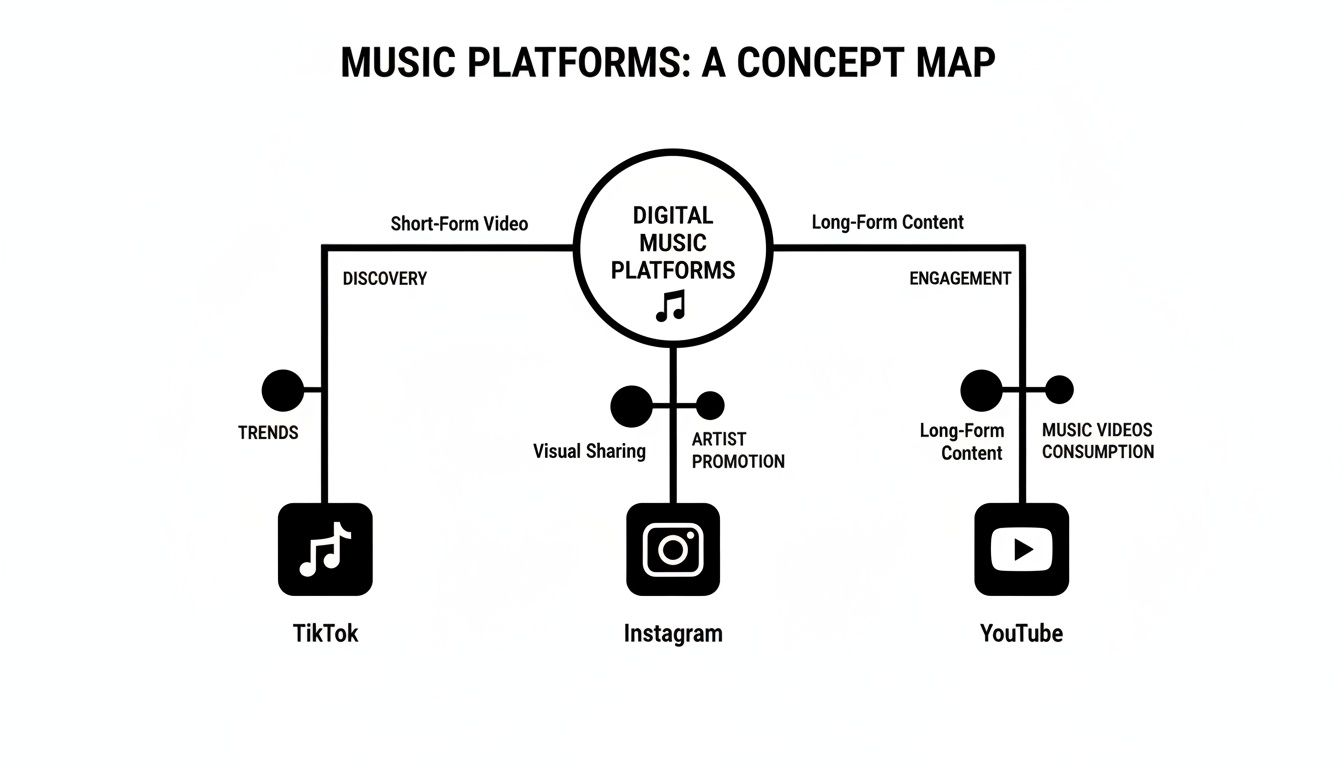
You can see that while each platform has its own specialty, they all feed into one another, with your music acting as the fuel for user content and viral moments.
The Key Licenses You Need to Know
You don't need a law degree to handle the business side of your music, but you do need to know the basic terms. These are the building blocks for how your art generates income online.
- Mechanical Royalties: These are paid out every time your song is reproduced, which in the digital world means a stream or a download. On social apps, this often happens when a creator pulls your track from the platform's official music library to use in their video.
- Performance Royalties: You're owed a performance royalty anytime your music is played "in public." That definition has expanded to include everything from a radio spin to a TikTok clip that gets millions of views.
- Sync Licensing: This one is a big deal for visual content. A synchronization (or "sync") license grants permission to pair your music with a moving image—think Instagram Reels, YouTube videos, TV commercials, or even films.
This is exactly why registering your work is non-negotiable. If you don't, the money generated from all these uses just sits in a digital black box, often going completely unclaimed.
Protecting Your Work and Getting Paid
So, how do you actually lock down your rights and collect those royalties? It comes down to a few essential administrative steps that put you firmly in control of your intellectual property. It’s a bit of paperwork upfront, but it pays off for the rest of your career.
First, you have to register your compositions with a Performance Rights Organization (PRO). In the U.S., that means ASCAP, BMI, or SESAC; in Canada, it's SOCAN. These organizations are built to track where your music is being played and collect performance royalties for you.
Think of a PRO as your personal royalty collection agency. They have the technology to monitor billions of data points across radio, TV, and digital platforms—a job that would be impossible for any single artist. They find your money and make sure it lands in your bank account.
Next, you'll need to work with a publisher or a publishing administrator. While a PRO handles your performance rights, a publisher is focused on your composition rights, collecting things like mechanical royalties. Services like Songtrust or TuneCore Publishing have made this incredibly accessible for independent artists. To dive deeper, check out our guide on understanding music licensing how it can boost your revenue.
Finally, make sure your music is correctly registered with your digital distributor, like DistroKid or TuneCore. Your distributor is the one who delivers your tracks to the official libraries on social platforms and helps track the royalties owed to you for the master recording. Taking these steps ensures the whole system knows exactly who to pay when your song starts taking off.
How to Monetize Your Music on Social Platforms
Likes and shares are great for the ego, but they don't pay the rent. The real test of your social media strategy is whether it can generate a real, sustainable income for your music career. To make that happen, you have to move beyond just chasing exposure and build a system that turns casual listeners into genuine supporters.
This is where you start thinking less like an artist and more like an entrepreneur. It’s about converting all that hard-earned engagement into actual revenue. Thankfully, social platforms now offer a solid mix of direct and indirect ways to make money, letting you build an income stream that isn't reliant on just one thing.
Direct Platform Monetization Tools
Most of the major social platforms have built-in features that let creators earn money right inside the app. These are often the easiest entry point for generating income, as they reward you for the audience you've already spent time building.
Think of these tools as your first line of financial offense:
- Creator Funds and Programs: Platforms like TikTok's Pulse Program and the YouTube Partner Program essentially pay you for views and engagement. You usually need to hit certain milestones for followers and watch time to qualify, but it’s a great passive income source.
- Tipping and Gifting: Features such as Instagram Badges and TikTok Gifts let your fans send you money directly during a live stream or in response to a video. It's a simple, direct transaction that lets your most dedicated fans show their support.
- Fan Subscriptions: On Instagram and other platforms, you can offer exclusive content—like behind-the-scenes footage or early access to songs—to fans who pay a monthly subscription fee.
For anyone creating short-form video content, figuring out how to monetize YouTube Shorts is a particularly smart move. These built-in tools are your foundation, but the real money is made elsewhere.
Building Your Sales Funnel Beyond Social Media
The most successful artists treat social media as the top of their sales funnel. It's the magnet that pulls people in. The real goal is to guide those followers to places off-platform where the actual financial transactions happen. Your social profile is the flashy window display; your website, merch store, and streaming pages are where you actually do business.
Every post, story, and live stream is an opportunity to gently nudge your audience toward taking that next step. A viral video is fantastic, but its true value is measured by how many people it sends to your Spotify profile, your online store, or a ticket-purchasing page.
The ultimate goal isn't just to be popular on social media; it's to leverage that popularity to build a self-sustaining career. Your social media is the engine, but your website, streaming platforms, and direct-to-fan offerings are the destinations where your business truly operates.
Don't underestimate the power of this connection. Social media discovery is a massive driver for music streaming, which accounted for a staggering 84% of total music industry revenue in 2024, hitting $17.5 billion globally. That number shows just how directly social buzz translates into real-world earnings.
Converting Followers into a Sustainable Fanbase
The final, and most important, step is to turn those followers into a loyal community that supports you directly. Social media algorithms can change in an instant, but a direct line to your fans is an asset you'll always own. This is where creator-first platforms truly shine.
Here’s how to build a more stable financial foundation for your music:
- Drive Traffic to Streaming: Use a link-in-bio tool to create a simple landing page that points followers to your music on Spotify, Apple Music, and other services. Every stream that comes from a social click adds to your royalty checks.
- Promote Merchandise: Don't be shy about showing off your merch. Wear your own shirts in videos, use your branded mugs in behind-the-scenes clips, and create posts that link directly to your online store.
- Sell Tickets to Shows: Give your social followers first dibs on tickets for tours and local gigs. This creates a sense of exclusivity and rewards them for being part of your community.
- Launch a Fan Club: Use a platform like OohYeah to build a central hub for your true fans. It's a place where you can offer exclusive content, sell commission-free downloads, and interact directly with supporters—all without the noise and algorithmic whims of social media. This creates a reliable income stream that you actually control.
Building Your Social Media Music Promotion Plan
Throwing content at the wall and hoping something sticks isn't a strategy. Success on social media, especially for artists, is never an accident—it’s the result of a deliberate, well-thought-out plan. Without one, your efforts will feel scattered and, frankly, ineffective.
Think of your promotion plan as the blueprint for your online presence. It guides every single post, interaction, and campaign you run, making sure everything works together toward a clear goal. A solid plan turns your social media from a chore into a powerful engine for building a real fanbase.
Defining Your Artist Brand and Audience
Before you even think about hitting 'post,' you need to nail down two things: who you are, and who you're talking to. Your artist brand is your identity. It's the unique mix of your sound, your look, your personality, and what you stand for. Are you the introspective songwriter, the high-energy performer, or the experimental producer?
Knowing this makes your content feel consistent and authentic. Once you know who you are, you can figure out who your audience is. Don't just stop at age and location. What are they into? What other artists are on their playlists? What kind of content makes them stop scrolling?
Creating a "fan persona" can make this so much easier. For example, if your ideal fan loves vintage video games and lo-fi hip-hop, you can create content that genuinely speaks to both, showing them you're on their wavelength.
Creating a Sustainable Content Schedule
Consistency is everything. If you post sporadically, the algorithms will ignore you and your followers will forget you. A content calendar is your best friend here, keeping you on track and preventing you from scrambling for ideas at the last minute.
Try planning your content out in weekly or bi-weekly chunks. This doesn't mean every post has to be a major production, but it ensures you always have something in the pipeline. A balanced schedule might look something like this:
- Music-Focused Posts (40%): Think performance clips, snippets of new tracks, or a peek into your writing process.
- Personal Connection Posts (30%): Share your hobbies, tell a story, or just ask your audience a question. This is the human stuff.
- Promotional Posts (20%): Announce new releases, pre-save campaigns, merch drops, and show dates.
- Community Engagement Posts (10%): Reshare fan content, run a poll, or shout out another artist you admire.
Your content schedule is more than just a to-do list; it's a commitment to your audience. It signals that you are a serious artist who values their attention and is dedicated to showing up for them consistently, building the trust that turns casual listeners into devoted fans.
Mastering Authentic Engagement and Community Building
Social media is a two-way street. Just posting content and walking away is a massive missed opportunity. The real magic happens in the comments, the DMs, and the live streams—that's where you build a real community. To get this right, it's worth understanding the principles of mastering social media and community management.
This means replying to comments, asking questions in your captions, and making your fans feel seen. When someone uses your sound in their video, go leave a comment! When you're live, shout out viewers by name. These small, consistent actions build incredible loyalty over time. For a deeper dive, check out how social media can boost an artist's career when you truly connect with people.
This genuine interaction is what turns passive followers into an active community. A strong community doesn't just listen to your music; they champion you, promote you, and become your single greatest marketing asset. It’s the difference between having an audience and having a true fanbase.
Take Back Control: Why You Need to Own Your Fan Relationships
Social media is, without a doubt, the most powerful discovery engine for music today. It's the place where your tracks can find a global audience, where a snippet can explode into a worldwide trend, and where millions of potential fans are just a swipe away.
But let's be real: building your entire career on these platforms is like building a house on rented land. The landlord can change the rules—or even the locks—at any moment.
Sudden algorithm shifts, surprise policy updates, and the never-ending battle for visibility mean you don't truly own that audience. A follower count isn't a fan club. The secret to a lasting career is turning that fleeting social media buzz into genuine, direct relationships that you actually control.
That's where a creator-first platform like OohYeah becomes your most valuable asset. It serves as the central hub for your true supporters, giving you a place to bring together the audience you worked so hard to attract on TikTok, Instagram, and everywhere else.
From Rented Land to Your Own Home Base
Think of OohYeah as your digital headquarters. It’s the place you send your social followers when they're ready to go deeper than a 30-second clip. While social media is for discovery, your OohYeah hub is for connection, commerce, and community.
Here’s how it works hand-in-glove with your social media presence:
- Talk Directly to Your Fans: Send messages, share exclusive news, and start real conversations without fighting an algorithm just to be seen.
- Create a One-Stop Shop: It becomes the single destination for fans to find everything—new tracks, behind-the-scenes content, tour dates, and personal updates. No more scattered links.
- Sell Without the Middleman: Offer your music, merch, and special content directly to the people who want it most, and keep more of the money you earn.
Social media platforms are your storefront window—they grab attention and pull people in off the street. A platform like OohYeah is the actual store, where you build relationships, offer premium experiences, and create a real business around your art.
By guiding your audience from a public feed to a private, curated space, you're not just gaining followers. You're building an active, invested community.
Build a Career That Lasts
At the end of the day, a smart social media strategy uses these platforms for what they do best: reaching new people. But it also involves building a resilient career foundation somewhere you own. When you integrate OohYeah into your workflow, you create a powerful feedback loop.
A viral TikTok can drive traffic to an exclusive download on your OohYeah page. An engaging Instagram Story can point followers to a pre-order for your new vinyl. This strategy gives you the best of both worlds: massive reach from social media and direct ownership of your fanbase.
This is how you build a career that can weather any storm and support your art for years to come.
Your Top Social Media Music Questions, Answered
Diving into social media as an artist can feel like learning a whole new instrument. It’s natural to have questions. Here are some straightforward answers to the big ones we hear all the time.
How Often Do I Really Need to Post My Music?
Let's get one thing straight: consistency beats frequency, every single time. It's not about spamming feeds; it's about staying present in a way that feels right for you and the platform.
For the fast-moving worlds of TikTok and Instagram Reels, aiming for 3-5 quality posts a week is a solid target. This keeps you on people's "For You" pages and in their minds. But for something like YouTube, where production value is higher, one great video a week (or even every other week) can make a much bigger splash.
The real secret? Find a pace you can stick with without burning out.
Your main job is to create content that actually connects, not just to check a box. Pay attention to your analytics—they’ll tell you exactly when your audience is listening. That's how you make every post count.
Do I Need a Viral Hit to Make It?
Honestly? No. A viral song is like winning the lottery—it’s an incredible boost, but you can't build a career strategy around it. True, sustainable success comes from the slow, steady work of building a genuine community.
Instead of trying to catch lightning in a bottle, pour your energy into what actually works long-term:
- Nailing your brand: Figure out what makes you you, and let that shine through in everything you post.
- Finding your people: Connect with a niche audience that gets what you’re doing. These are your future super-fans.
- Growing from the ground up: Share your journey, your process, your ups and downs. That’s how you turn casual listeners into a loyal fanbase.
This is how you build a career that lasts. A loyal community will stick with you far longer than the 15 seconds of a viral trend.
Can I Actually Promote My Music with Zero Budget?
Yes, you absolutely can. Social media’s biggest gift to independent artists is its potential for organic reach. Your creativity and willingness to show up consistently are your most powerful currencies.
Forget about ad spend for a minute. Focus on creating awesome, native content—the kind of stuff people are already on each platform to see. Think short-form videos, a look behind the curtain at your creative process, or just you being you.
Start engaging with other artists and creators in your scene. Use hashtags that make sense for your sound, and hop on trends in a way that feels authentic to you. And here’s the big one: encourage your followers to use your music in their own content. While ads can pour gas on the fire, a strong organic foundation is what keeps it burning, and you can build that without spending a dime.
Ready to turn those followers into a real community? With OohYeah, you can bring your music, merch, and fans together in one place—all on your terms. See how it works and start building your homebase at https://oohyeah.app.