Selling Music Online: Proven Strategies for Success
Learn how to effectively sell music online with expert tips. Discover strategies to distribute, market, and monetize your music easily.
October 3, 2025
Music Marketplace Advisor
Buying & SellingGetting your music online is more than just hitting "upload." If you want to sell your tracks and build a career, you need to treat every release with the same care and professionalism as a major label. This means getting your audio files, artwork, and all the behind-the-scenes data just right. It’s this prep work that really separates the pros from the hobbyists.
Laying the Groundwork for a Professional Release

Before a single person streams your song, a few crucial steps make all the difference. Nailing this prep ensures your music sounds incredible on every platform, you get paid correctly, and new fans can actually find you. Skipping this stuff can lead to bad sound quality, lost money, and a release that just fizzles out. Think of it as giving your music the best possible launchpad for success.
The music industry has never been more open to independent artists, but that also means it’s more crowded than ever. We're in a period of amazing growth—in 2024, global recorded music revenues soared to US$29.6 billion, continuing a ten-year hot streak. With streaming subscriptions making up over $20 billion of that pie, the opportunity is massive. You can read up on the latest global music revenue trends to see just how big the market is.
Mastering for Digital Platforms
I’ve heard it a thousand times: "My track sounds amazing in my studio!" That's great, but platforms like Spotify and Apple Music play by their own rules. They use loudness normalization to keep the listening experience consistent from song to song.
If you upload a track that hasn't been mastered specifically for streaming, it could end up sounding weak, distorted, or just plain flat next to everything else. Professional mastering isn't about a volume war; it's about fine-tuning your music’s dynamics and clarity so it shines in the environment where 99% of your audience will hear it.
The Power of Cover Art and Metadata
In an endless scroll of new music, your cover art is your visual handshake. It’s what makes someone stop and listen instead of swiping by. Don't cut corners here. Your art needs to be high-resolution—think at least 3000x3000 pixels—and it has to capture the vibe of your music and your brand.
Just as critical is the metadata, which is all the data packed into your files. This includes:
- Song Title and Artist Name: Seems obvious, but typos happen!
- Album and Track Number: Keeps your projects organized.
- Genre and Release Date: Helps stores categorize your music.
- ISRC Codes: This is the International Standard Recording Code. It's like a digital fingerprint for your track, essential for tracking every single play and sale.
Accurate metadata is non-negotiable. It's how streaming platforms, collection societies, and your distributor track your plays and ensure that royalties are paid to the correct rights holders. Inaccurate data means lost money.
Your Pre-Release Digital Music Checklist
To keep everything straight, it helps to have a checklist. Here are the absolute must-dos before you even think about distribution.
| Task | Why It's Important | Recommended Tool/Service |
|---|---|---|
| Final Mix & Master | Ensures your audio sounds professional and is optimized for all streaming platforms. | iZotope Ozone, LANDR, or a professional mastering engineer. |
| High-Res Cover Art | Your primary visual asset. Must meet platform specs (3000x3000px). | Canva for DIY, or hire a designer on Fiverr/Upwork. |
| Accurate Metadata | Guarantees proper credit, discovery, and royalty payments. | Your music distributor's upload portal (e.g., OohYeah). |
| ISRC & UPC Codes | Unique identifiers required by all digital stores to track sales and streams. | Your distributor will typically assign these for you. |
| PRO Registration | Allows you to collect performance royalties from streams, radio, etc. | ASCAP, BMI, or SESAC (in the U.S.). |
Treating this checklist like a pre-flight inspection for your release will save you a world of headaches down the road.
Registering Your Work With a PRO
Last but definitely not least, you need to collect all the money you're owed. To do that, register your songs with a Performance Rights Organization (PRO) like ASCAP, BMI, or SESAC. These organizations are responsible for collecting performance royalties whenever your music is played in public—on the radio, in a coffee shop, and yes, on streaming services.
If you're not registered with a PRO, you're literally leaving a huge chunk of your earnings on the table. For any serious artist, this isn't optional; it's a foundational part of the business.
Finding the Right Digital Distribution Partner
So, your tracks are mixed, mastered, and ready for the world. What’s next? You can't just drop your files onto Spotify or Apple Music yourself. You need a digital distributor to get your music into all the major online stores and streaming services. Think of them as the crucial link between your studio and your listeners.
Choosing who to partner with is a huge decision, one that will directly affect your reach, your analytics, and most importantly, how you get paid. This isn't just about uploading files; it's about picking a long-term partner for your career.
Evaluating Business Models
As you start looking around, you'll see that distributors generally fall into two camps: those who charge a flat fee and those who take a cut of your earnings. Neither one is automatically better—it really comes down to where you are in your career and how often you plan to release music.
Let's break down the two main approaches you'll find:
- Fee-Based Distributors: These services charge an annual fee to keep your music live. If you’re confident you'll be pulling in a lot of streams, this can be a fantastic deal because you get to keep 100% of your royalties. The downside? Those yearly fees can start to sting if you have a large catalog or release music infrequently.
- Commission-Based Distributors: These guys typically don't charge anything upfront. Instead, they take a percentage of your royalties, usually somewhere around 10-15%. This is a great, low-risk option for artists who are just starting out or don't want to deal with recurring payments.
But the price tag isn't everything. You've got to look under the hood at the features. A solid analytics dashboard is non-negotiable. You need to see who's listening, where they are, and which tracks are getting the most love. That data is gold for planning your next move.
The entire music industry has been reshaped by digital's dominance, and for independent artists, understanding this shift is key to making a living.
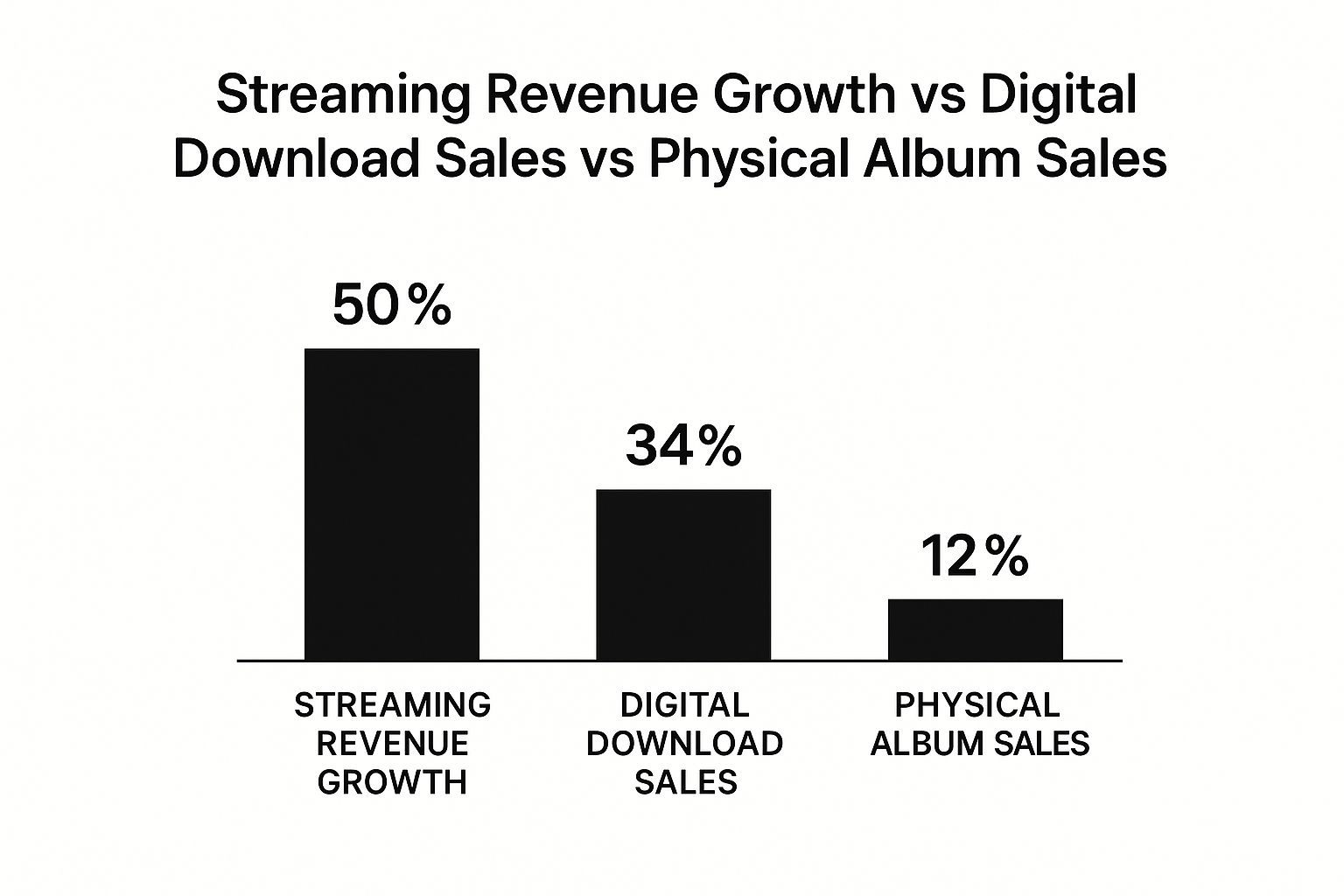
The numbers don't lie. Streaming is no longer "the future"—it's the here and now, completely overshadowing downloads and physical sales. Making sure you have the right partner for this reality is critical. For a much deeper dive, check out our guide on how to choose the right music distribution service.
To make it even clearer, let's compare these common models side-by-side. Seeing how they work in practice can help you figure out which lane you belong in.
Comparing Common Digital Distribution Models
| Model Type | How It Works | Best For | Example Scenario |
|---|---|---|---|
| Annual Fee | Pay a flat fee per single/album per year. You keep 100% of the royalties. | Artists with an established following and high stream counts. | An indie band consistently getting millions of streams per year wants to maximize their take-home pay. |
| Commission | No upfront or annual fees. The distributor takes a percentage of your earnings. | New artists, or those releasing music sporadically without a predictable income. | A singer-songwriter is releasing their first EP and wants to avoid costs until they start earning. |
| Hybrid/Tiered | Offers multiple plans, from free (commission-based) to premium (fee-based) with added features. | Artists who want to scale up as their career grows. | A producer starts on a free plan, but once their tracks get playlisted, they upgrade to a premium tier. |
Ultimately, the goal is to find a model that supports your creative output without draining your bank account before you've even started earning.
Reading the Fine Print
Before you sign on the dotted line, you absolutely must read the distribution agreement. I know, it’s boring, but this is where the hidden details live that can seriously affect your career.
Pay close attention to things like payout thresholds (how much you need to earn before they pay you), payment processing fees, and whether they offer critical services like YouTube Content ID or automatic royalty splits for your collaborators.
Some distributors even throw in extra marketing tools, which can be a huge help. With the global digital music market projected to hit USD 53.09 billion by 2030, the opportunity is massive. You can discover more insights about digital music market growth to get a sense of where things are heading. Your choice of distributor is your ticket to getting a piece of that pie.
Developing Your Release and Pricing Strategy
Just uploading your finished tracks and hoping for the best is a huge missed opportunity. If you really want to sell your music online, you need a smart release plan that builds momentum and convinces listeners to become actual buyers. A well-timed strategy is what creates buzz, gets your core fanbase excited, and maximizes your earnings right from the start.
The cornerstone of any good plan is a solid timeline. Don't just pick a random Tuesday and drop your music into the void. Think strategically. Try to avoid major holidays or the day a superstar artist is releasing a massive album that will completely overshadow you. Building anticipation is everything.
Singles Versus Albums: The Modern Approach
Let's be real—the traditional album cycle isn't what it used to be. For many independent artists, releasing a steady stream of singles is a much more effective way to stay on your fans' radar and keep the streaming algorithms happy. This approach gives you far more chances to promote your work throughout the year.
- Singles: These are perfect for building momentum, testing out a new sound, and keeping your social media feed fresh with new content.
- EPs: A great middle-ground option. An EP offers a more substantial body of work than a single but without the massive undertaking of a full LP. It's an ideal way to showcase your artistic range.
- Albums: Still incredibly powerful for making a major artistic statement. For your dedicated followers, an album drop is a major event that can drive serious engagement and merch sales.
The format you choose really comes down to your specific goals, your budget, and how much finished music you have in the tank. A lot of artists I know are using a hybrid model now—they'll drop several singles to build hype before collecting them into a larger EP or album.
A crucial step in developing your strategy is understanding your target market and who your music truly connects with. Knowing your audience's listening habits helps you decide whether a quick-hitting single or a deep-dive album will make a bigger splash.
Pricing for Direct-to-Fan Success
When you sell directly to your fans through a platform like OohYeah, you get total control over your pricing. This is your chance to get creative and build a much stronger connection with the people who support you. A standard price is just a starting point.
You should definitely explore flexible pricing options to boost your revenue and reward your most dedicated fans. For a much deeper dive into this, OohYeah has a fantastic guide on finding https://oohyeah.app/posts/what-is-the-best-pricing-strategy-for-selling-music.
Here are a few powerful models worth trying out:
- Pay-What-You-Want: This model lets fans support you at a level they're actually comfortable with. You’d be surprised how many people will voluntarily pay more than the minimum just to show their appreciation for your work.
- Bundles: This is a classic for a reason. Combine your digital download with exclusive merch—think limited-run t-shirts, signed posters, or even a behind-the-scenes video about making the record.
- Exclusive Content: Create a premium version of your release. You could include bonus tracks, instrumental versions, or high-resolution audio files and offer it at a higher price.
This direct-to-fan approach isn’t just about making a little more money on each sale. It’s about creating real value and turning casual listeners into a loyal community that’s invested in seeing you succeed for years to come.
Marketing Your Music in a Crowded Digital World
With tens of thousands of new tracks hitting streaming services every single day, just making great music isn't enough anymore. That’s the hard truth. A smart, focused marketing plan is what makes the difference between an artist who finds their audience and one who gets lost in the static. This isn't about just dropping links everywhere; it's about thoughtfully building a brand and connecting with people who will stick with you for the long haul.
It all starts with a professional hub for your career—your Electronic Press Kit (EPK). Think of it as your digital business card for the entire music industry. When a journalist, blogger, promoter, or playlist curator wants to know about you, your EPK is the first place they'll look.
Your EPK needs to be clean, professional, and give them everything they need at a glance. No digging required.
- A killer artist bio that grabs their attention from the first sentence.
- High-resolution press photos and your official cover art.
- Links to your best music (for both streaming and download).
- Embedded music videos that show off your visual style.
- Key press quotes or mentions to add that crucial layer of credibility.
Here’s a snapshot of how a well-organized EPK can present your most important info, giving anyone a clear picture of your brand in seconds.
This kind of layout makes it incredibly easy for busy industry pros to get what they need. Remember, your EPK isn't a "set it and forget it" tool. Keep it fresh with your latest releases and biggest wins.
Build Your Community on Social Media
Sure, social media is a place to sell your music, but its real power is in building a genuine community. Platforms like Instagram, TikTok, and X are where you let people in on the story behind the songs. That’s what gets them invested in you, not just the track.
Instead of another "New song out now!" post, show them a clip of you struggling with a lyric, some behind-the-scenes chaos from a video shoot, or ask them to vote on a new t-shirt design. You're aiming for a conversation, not a monologue. For artists, understanding the best social media platforms for ecommerce is key, as it directly translates to better sales and a more engaged fanbase.
Pitching to Playlists and Blogs
Getting featured on a popular playlist or a respected blog is huge. It’s third-party validation that tells new listeners, "Hey, this artist is worth your time." But you have to remember that curators are absolutely swamped with submissions. Your pitch has to cut through the noise.
Never, ever send a generic mass email. It’s the fastest way to the trash folder. Take the time to find the curator's name. Mention a specific song they recently featured and why you liked it. Then, briefly explain why your track is a perfect fit for their audience. Keep your email short, be respectful of their time, and make their job easy by including a direct link to your song and your EPK.
The Unmatched Power of Your Email List
Social media is great, but you're always at the mercy of the algorithm. It can change overnight and tank your reach. Your email list, on the other hand, is yours. It's a direct, unfiltered connection to your most dedicated fans—the people who are most likely to buy your music, your merch, and your concert tickets.
Give people a good reason to sign up. Offer a free download of a demo, an exclusive discount code, or early access to a music video. Use your list to share more personal stories, announce pre-orders, and make your subscribers feel like true insiders. This direct line to your core audience is one of the most powerful tools you have.
For a deeper dive into strategy, check out our complete guide on how to market your music as an independent artist.
Getting Paid: How Your Music Royalties Actually Work

Selling music online creates several different income streams, but let’s be honest—figuring out where the money comes from can feel like trying to read a different language at first.
Once you get the hang of it, though, understanding royalties becomes one of the most powerful tools for building a real, sustainable career. It’s not just about getting a confusing spreadsheet every quarter. Knowing the difference between the types of royalties is the first step toward making sure you collect every single cent you've earned.
Every time your song is played, streamed, or downloaded, it generates a few different kinds of revenue. The two big buckets you'll hear about most are publishing royalties (tied to the song's composition—the melody and lyrics) and master royalties (tied to the specific recording you made).
Your distributor, in this case OohYeah, is primarily focused on collecting those master royalties for you. The publishing side of things? That's what your PRO is for.
Decoding Your Royalty Streams
Let's break down the most common royalty types you'll see as an indie artist. Getting this wrong is one of the easiest ways to leave money on the table, so it’s crucial to get it right from day one.
- Mechanical Royalties: These are paid out every time your song is reproduced. Think of it as a fee for the right to make a copy of your musical composition, which happens with every digital stream or download.
- Performance Royalties: Your PRO (like ASCAP or BMI) collects these for you whenever your song is performed "publicly." That includes plays on streaming services, spins on the radio, and even when it's used in a coffee shop or bar.
- Master Royalties: This is the money you earn from the sound recording itself—the "master." It’s what you get paid per stream or per download, and it’s collected by your distributor.
This is exactly why you need both a distributor and a PRO. One organization is chasing down money for your recording, and the other is collecting money for your songwriting. Skipping one is like deciding you only want half your paycheck.
Think about a single stream on Apple Music. That one play actually generates a tiny mechanical royalty (for the songwriter), a performance royalty (also for the songwriter), and a master royalty (for whoever owns the recording). All three have to be collected through different channels to make sure everyone gets paid.
Following the Money Trail
So, how does that fraction of a penny from a stream actually find its way into your bank account?
It starts with a listener hitting play. The platform, say Spotify, then pays a master royalty to your distributor (OohYeah). At the same time, it sends performance and mechanical royalties to various collection societies, including your PRO.
OohYeah processes its share, takes its fee (if there is one), and deposits the rest directly to you. Meanwhile, your PRO is doing the same thing—collecting its portion and paying you after taking a small administrative cut.
This model is the engine of the entire modern music economy. Today, music streaming makes up a staggering 84% of the industry's total revenue. In 2023, the global market blew past $17.5 billion, driven by more than 600 million paid subscribers worldwide. Every single stream adds up. If you're curious, you can dive deeper into the explosive growth of music streaming stats to really see the scale of this thing.
To get the most out of every play, you have to be meticulous. Make sure your tracks are correctly registered with OohYeah and your PRO, with all the songwriter and publisher details listed perfectly. Then, use the analytics dashboards your distributor provides to see your top-earning songs and territories. That data tells you exactly where your music is connecting, helping you turn those plays into paychecks.
The Big Questions: What Artists Always Ask About Selling Music Online
If you're getting ready to sell your music online for the first time, you've probably got a ton of questions. That's completely normal. Let's tackle some of the most common ones I hear from artists just starting out, so you can skip the guesswork and move forward with a solid plan.
How Much Money Can I Realistically Make?
This is the million-dollar question, isn't it? The truth is, it's all over the map. Your income potential is tied directly to how big your audience is, how hard you push your marketing, and where you choose to sell your music.
Let's be real: a single stream on a major platform pays a tiny fraction of a cent. You need massive volume to see any real money from that alone. But when you sell directly to your fans through a platform like OohYeah, you're in a different league entirely because you keep the lion's share of the money.
To put it in perspective, 1,000 streams might only earn you enough for a cup of coffee. Selling just a couple of digital albums directly to fans through your own store can easily beat that. The key is to build a core group of supporters who want to buy from you directly. That's how you build a career.
Is It Still Worth Selling Music on My Own Website?
One hundred percent, yes. Don't skip this. While a presence on platforms like Bandcamp is great for getting discovered, your own website is your command center. It's the only corner of the internet that you own and control, with no commissions or wacky algorithm changes to worry about.
Your website is where you build your email list, and your email list is the single most valuable asset you have as an artist. It's a direct line to your most dedicated fans, letting you announce new music, launch pre-orders, and offer exclusives without getting lost in the social media noise.
Think of your website as your digital home. All roads should lead back to it—from your social bios, your streaming profiles, and your newsletters. Make it easy for people to find you and support you on your own terms.
Should I Release Singles or a Full Album?
In today's fast-paced music world, consistently dropping singles is a powerful strategy for staying on people's radar. Every single is a new event. It's a new opportunity to talk to your audience, pitch to playlist curators, and post fresh content. This approach keeps you relevant and plays well with streaming platform algorithms, which love seeing consistent activity.
But that doesn't mean the album is dead. Far from it. An album is still the ultimate artistic statement and a way to give your true fans something deep to connect with.
I've found a hybrid strategy works best for most artists:
- Build Momentum: Drop 3-4 of your strongest tracks as singles over a few months. This creates a slow burn of anticipation.
- The Main Event: Package those singles into a larger EP or album, adding a few new, exclusive tracks.
- Get More Mileage: This approach gives you multiple "release days" to promote from a single project, maximizing your reach and impact.
This way, you get the steady buzz from singles and the cultural weight of a full-length project. It's the best of both worlds.
Ready to stop guessing and start building? OohYeah gives you the tools to sell directly to the people who matter most—your fans. You can build your brand, market your music, and actually keep what you earn. Get started with OohYeah today.