Sell Tracks Online and Build Your Music Career
Ready to sell tracks online? Our guide offers proven strategies for distribution, marketing, and maximizing your earnings as an independent musician.
September 8, 2025
Music Marketplace Advisor
Buying & SellingBefore you can even think about selling your music online, you need a product that's polished, professional, and buttoned-up on the legal side. This means getting your audio mastered for different platforms, designing killer artwork, and making sure your metadata is flawless for discovery. Honestly, nailing these details before you upload is what separates the pros from the amateurs and makes a real difference in your bottom line.
Getting Your Music Ready for the Digital Shelf
Putting your music out there is more than just exporting a file. To really compete, you have to think like a record label, even if you're a one-person show. It's about presenting a complete, professional package that doesn't just sound good, but looks good and is easy for platforms and fans to find.
The first—and most important—piece of the puzzle is making sure your audio can stand up against major label releases. That starts with professional mastering.
Finalize Your Master Audio Files
Mastering isn't a "one-size-fits-all" kind of deal. The master file you prep for a high-fidelity platform like Bandcamp should be different from the one you send to Spotify. It’s a good practice to have a high-resolution WAV or FLAC file on hand for direct sales—this gives your biggest fans the best listening experience possible.
For streaming services, however, you'll need a master that’s specifically tailored to their loudness normalization standards. If you don't, you risk your track sounding way quieter than everything else or getting crunched by their compressors.
My Two Cents: Always create at least two masters: one uncompressed, high-dynamic-range version for downloads, and another optimized for streaming loudness targets. It’s a small extra step, but it ensures your music sounds incredible everywhere it’s heard.
Create Unforgettable Cover Art and Metadata
In a world of endless scrolling, your cover art is your first handshake. It has to grab someone's attention instantly. The standard here is a high-resolution square image, typically 3000x3000 pixels. Think of it as your digital billboard—make it count.
Just as crucial is the data hidden inside your files, your metadata. This isn't just busywork; it's how you get found and get paid.
- Artist & Track Names: Check your spelling and capitalization. Consistency across all platforms is key.
- Album/EP Title: This is what groups your releases together properly.
- Genre/Subgenre: Essential for helping algorithms and curators place your music in front of the right listeners.
- ISRC Code: This is your track's unique fingerprint, used to track every single sale and stream.
Protect Your Work and Get Paid
As you're getting ready to release, you have to think about protecting your creations. Understanding the basics of things like intellectual property violations can save you a world of headaches down the road.
More importantly, you need to get set up to collect your royalties. Registering your songs with a Performing Rights Organization (PRO) like ASCAP, BMI, or SESAC is an absolute must. This is how you collect performance royalties when your music is played on the radio, in a coffee shop, or streamed online.
This step is so easy to overlook, but it's foundational to building a career. With streaming platforms projected to generate around 84% of total music industry revenue, leaving that money on the table just isn't an option.
Finding the Right Platforms to Sell Your Music
Your tracks are mixed, mastered, and ready to go. Now comes the million-dollar question: where do you actually sell them? It’s easy to get overwhelmed by the sheer number of options out there, but the best choice really boils down to your personal goals as an artist.
Are you trying to get your music in front of as many ears as possible, or are you focused on building a dedicated community of fans who will support you directly? The truth is, a smart strategy involves a bit of both. It's not about picking one lane and sticking to it; it’s about understanding how different platforms can work together to build a sustainable career.
This visual lays out the fundamental decision you'll need to make when deciding where to put your music.
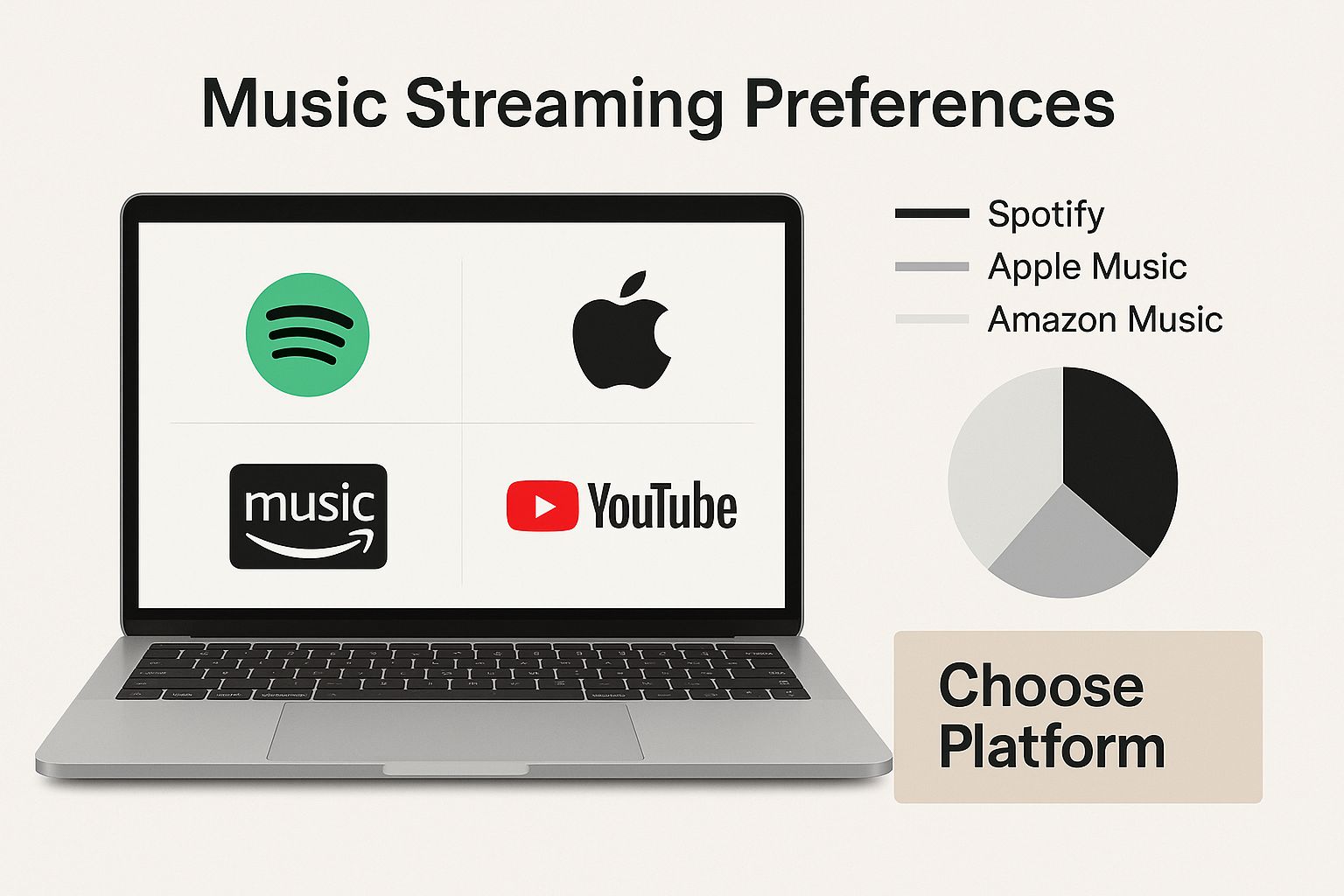
As you can see, the core of your strategy is finding that sweet spot between widespread exposure and direct fan engagement that actually pays the bills.
Digital Distributors for Maximum Reach
If you want your music on the big players like Spotify, Apple Music, and Amazon Music, you can't just upload it yourself. You’ll need to go through a digital distributor. Companies like DistroKid, TuneCore, and CD Baby are the gatekeepers that get your music onto hundreds of global streaming services and online stores.
This is an essential first step for getting discovered. Landing on a popular Spotify playlist can be a game-changer, introducing your sound to thousands of new listeners overnight. The trade-off? The payout per stream is tiny, often just fractions of a cent.
Key Takeaway: Think of distributors as your marketing arm, not your primary bank account. Use streaming as the top of your sales funnel—it’s how you attract new listeners that you can later guide toward platforms where you earn real money.
Direct-to-Fan Platforms for Real Profit
This is where you take control and start selling your music in a way that truly supports your art. Platforms like Bandcamp or your own artist website (powered by a service like Bandzoogle) cut out the middleman, giving you a direct line to your audience.
When a fan buys your album on Bandcamp, you can pocket up to 85% of the sale—a staggering difference compared to streaming royalties. Even better, you get their email address. That simple piece of data is gold, allowing you to tell them about your next release, a new t-shirt, or an upcoming tour.
Let's look at how this plays out in the real world:
- The Hip-Hop Producer: A producer can use a specialized marketplace like BeatStars or Airbit to sell instrumentals directly to rappers and content creators looking for fresh sounds.
- The Indie Singer-Songwriter: An acoustic artist might build a passionate following on Bandcamp, using its "pay-what-you-want" feature to let fans show their support and feel connected to the music.
- The Electronic Artist: An electronic musician could use their own website to sell exclusive bundles with high-quality WAV files, stems, and limited-edition merch that aren't available anywhere else.
Deciding where to focus your energy is a critical part of your business plan. To help clarify the options, this table breaks down the main platform types.
Platform Comparison for Selling Tracks Online
This table compares key features of different platform types to help you decide where to sell your music.
| Platform Type | Primary Use Case | Revenue Model | Key Advantage |
|---|---|---|---|
| Digital Distributors | Broad reach and discovery | Low per-stream royalties | Getting on major platforms (Spotify, Apple Music) |
| Direct-to-Fan | High-profit sales, community building | High revenue share (80-95%) | Full control and direct fan relationships |
| Niche Marketplaces | Selling specific assets (beats, samples) | Platform-specific commission | Access to a targeted, ready-to-buy audience |
Ultimately, the strongest strategy is a hybrid one. Use distributors to cast a wide net and direct-to-fan platforms to build a real, profitable career.
For a deeper dive into fee structures and features, our complete guide on how to choose the right platform to sell your music has all the details you need to make an informed decision.
Designing Your Release and Pricing Strategy
How and when you drop your music can be just as crucial as the song itself. A well-thought-out launch isn't just an upload; it's an event for your audience. Getting this right builds the kind of momentum that turns into real sales and keeps your fans buzzing. If you want to successfully sell tracks online, you have to think like a marketer, not just a musician.
Your release strategy needs to be a timeline, not an afterthought. The real work begins long before the track goes live, and it’s all about building genuine excitement. Think about running a pre-save campaign on a platform like Spotify; it’s a simple but powerful way to get followers to add your track to their libraries, which gives the algorithm a nice kick on release day.
Make sure your entire online presence is in sync. Announce the date, drop some sneak peeks, share behind-the-scenes clips, and do a countdown on your socials. But don't forget your email list—these are your core supporters. Give them a heads-up first or some exclusive content no one else gets.
Choosing Your Pricing Model
Okay, you’ve got a launch plan. Now, how much are you going to charge? There’s no magic number here. The best strategy often mixes a few different approaches to hit different goals.
Here are a few models I’ve seen work wonders:
Standard Pricing: This is the old standby. You set a fixed price, like $1.29 for a single track or $9.99 for a full album. It’s straightforward and works great if you have an established audience that knows what to expect.
Pay-What-You-Want: This model is fantastic because it puts the power in your fans' hands. It removes the barrier for new listeners who might be hesitant to pay, but you’d be surprised how much your die-hard fans are willing to contribute to show their support.
Bundles and Bonuses: This is all about sweetening the deal. Package your music with something extra to make the purchase feel more valuable. Think about bundling a digital album with instrumental versions, high-res artwork, or even physical merch like a limited-run t-shirt.
A lot of artists make the mistake of undervaluing their work. The fans who buy your music directly are your ride-or-dies. They aren't just buying MP3s; they're investing in you. Don't be afraid to set a price that truly reflects the blood, sweat, and tears you poured into your art.
Maximizing Your Launch Impact
The psychology of pricing is a powerful tool when you know how to use it. For example, have you ever considered releasing a "deluxe" version? Adding a few bonus tracks for a slightly higher price can make the standard album look like a bargain, which can actually increase your total sales.
You can also create a sense of urgency. Limited-time offers or special "early bird" pricing for pre-orders can give your followers that little nudge they need to take action right away.
Figuring out the perfect approach takes some trial and error. To dive deeper into the different models out there, check out our guide on finding the best pricing strategy for selling music. At the end of the day, your goal is to make your release feel like a shared experience—something your fans are genuinely excited to be a part of.
Marketing Your Music Without a Big Budget
Let's be real: having great music is only the starting line. The real marathon is getting people to actually listen. A lot of independent artists get hung up on the idea that you need a huge budget to make any real noise, but that’s just not true anymore. Your most effective marketing tools are often the ones that focus on genuine connection, not pricey ad campaigns.
The goal is to shift people from being passive listeners to becoming true fans—the kind who buy your music and show up for you. This all starts with your story. Don’t just drop a link to your new track; tell people what it’s about. What was the spark? A weird dream, a tough breakup, a line from an old movie? People don't connect with products; they connect with stories.
Start by Building Your Inner Circle
Social media is great for getting discovered, but your email list is where you build loyalty. Think of your email list as your direct line to your biggest supporters. It’s an audience you actually own, one that isn't at the mercy of some algorithm change on Instagram or TikTok.
Every time you sell tracks online, especially through a direct platform like OohYeah, you should be focused on growing that list.
Here’s a simple way to look at it:
- Social Media: This is your storefront. It’s loud, busy, and where you meet new people and show off your personality to a broad audience.
- Email List: This is your VIP lounge. These are the people who raised their hand and said they want more. Treat them like gold.
Offer them exclusives—early access to new music, behind-the-scenes videos, or subscriber-only discounts. This kind of direct, personal communication is how you drive sales and build a community that’s genuinely invested in your success. For more on this, check out our deep-dive guide on how to market your music as an independent artist.
The Power of Partnering Up
One of the quickest ways to expand your reach is to tap into someone else's. Collaborating with other artists in your genre (or even a complementary one) is a time-tested strategy that just works. This could mean co-writing a song, hopping on a track as a feature, or even just curating a shared playlist.
When you team up, you're not just creating something cool and new. You're cross-promoting to a fresh audience that’s already pre-qualified to like your vibe. Find artists whose work you genuinely respect and just reach out. You'd be surprised how many are looking for the exact same thing.
Pro Tip: Think beyond just other musicians. Partner with a visual artist for your cover art, a local filmmaker for a music video, or even a coffee shop for a sponsored acoustic set. Every collaboration opens up a new avenue for marketing.
The demand for selling music directly to fans is growing fast, thanks to new tech and shifting listening habits. The music streaming market alone is projected to jump from USD 27.5 billion to USD 76.8 billion between 2023 and 2032. That's a massive opportunity waiting for you.
Create Content That Builds a Connection
Finally, remember that you're more than just your music. Your "brand" is the whole package, and creating content that reveals the person behind the art is incredibly powerful. This doesn't have to be a huge production.
Here are some simple ideas:
- Post a quick video of you figuring out a new chord progression.
- Do a tutorial showing how you get a specific guitar tone or vocal effect.
- Share a "day in the life" story on Instagram.
This kind of content pulls back the curtain on the creative process and makes you more human and relatable. It gives people more reasons to care about your art and, in the end, to support you by buying your music.
Getting to Grips with Your Royalties and Revenue
Getting your music online is one thing, but understanding how the money finds its way back to you is what turns a passion into a career. When you sell tracks online, you're tapping into several different income streams. Knowing how to tell them apart is absolutely essential for making smart decisions and maximizing what you earn.
It’s not just about seeing a number hit your bank account. It’s about knowing where that money came from, why it was paid, and how you can make more of it.
The Main Buckets of Music Revenue
At first glance, the revenue landscape can seem a bit tangled. But it really boils down to money earned from your master recording and royalties from your song's composition. Think of it like this: one payment is for the specific recording of your song, and the other is for the song itself—the underlying melody and lyrics.
Here’s a quick breakdown of the key streams you'll see:
- Master Recording Revenue: This is the most straightforward. It's the cash you make from the direct sale or stream of your audio file. When a fan buys your track on OohYeah or plays it on Spotify, you're earning master revenue.
- Mechanical Royalties: These get paid to the songwriter every time a "copy" of the song is made. That used to mean CDs and vinyl, but today it primarily means every permanent download and every on-demand stream.
- Performance Royalties: This is money generated whenever your song is performed in public. That includes radio, TV, bars, and live shows, but just as importantly, it includes every single stream online.
This is the part a lot of artists miss. Understanding these distinctions is non-negotiable. I've seen countless musicians leave serious money on the table because they didn't properly register their work with a Performing Rights Organization (PRO) to collect all the performance and mechanical royalties they were owed.
Your Analytics Reports Are a Goldmine
Every platform, from your distributor to OohYeah, gives you analytics reports. It's tempting to just check the total earnings and call it a day, but that's a huge mistake. These reports are packed with strategic insights that can shape your entire release strategy.
They show you which tracks are actually connecting with people, where in the world your fans are, and which platforms are giving you the most traction.
For instance, if you notice a random spike in streams from Brazil, that’s your cue. Maybe it's time to run some targeted social media ads in that region or even look for a Brazilian artist to collaborate with. If one deep cut is suddenly outperforming your lead single, maybe that's the track that deserves a music video or a push to playlist curators.
This kind of data-informed thinking is more important now than ever. The global music streaming market was valued at USD 47.06 billion in 2025 and is on track to hit a staggering USD 143.89 billion by 2032. You can read the full research about this explosive growth to see just how massive the opportunity is. Your analytics are the map that helps you navigate this world and turn casual listeners into genuine fans.
Got Questions About Selling Your Music? We've Got Answers.
When you're first diving into selling your music online, it's easy to get overwhelmed. A ton of questions pop up, and honestly, most independent artists are wrestling with the same ones. Let's tackle some of the biggest hurdles right now so you can build a smarter strategy from day one.
Streaming vs. Direct Sales: Do I Have to Choose?
This is probably the number one question I hear: "Should I focus on Spotify or sell directly to my fans?" The answer is simple: you absolutely need both. They serve two completely different, but equally vital, purposes for your career.
Think of streaming platforms as your global discovery engine. They're incredible for getting your music in front of potentially millions of new ears. But let's be real—the payout is minuscule.
Direct-to-fan platforms like OohYeah are where you actually build a sustainable business. The revenue from a single album sale can easily equal thousands of streams. The winning strategy is to use streaming as the wide-open top of your funnel, then actively guide your most dedicated listeners over to your OohYeah page. That's where they can support you in a way that truly counts.
How Much Should I Charge for My Music?
Pricing your own art feels weird, I get it. It's a sticking point for so many musicians. While there's no magic number, there are some well-established industry standards that make a great starting point.
For a single digital track, the sweet spot is usually between $1.00 and $1.29. If you're selling a full album, a price tag in the $7 to $12 range is pretty common and what fans have come to expect.
But don't just set it and forget it. This is your chance to get creative and see what your specific audience responds to.
- Try a "Pay-What-You-Want" model. This is an incredible tool, especially for a new release. It removes any financial barrier for new listeners and is a fantastic way to build your email list and generate goodwill.
- Create compelling bundles. Package your digital album with high-value extras. Think instrumental versions, PDF lyric books, or a short behind-the-scenes video. You can charge a premium for a bundle that feels special.
- Offer tiered options. You can have a "standard" version of your album and a "deluxe" version with bonus tracks or content. This lets casual listeners buy in easily while giving your superfans a way to spend more and get more.
Never forget this: you are not just selling MP3 files. Your true fans are investing in you and your journey as an artist. Price your work in a way that reflects the time, effort, and value you've poured into it.
How Often Should I Be Releasing New Music?
Finally, the question of release frequency. In the current music world, consistency is everything. The days of dropping an album every two years and disappearing are long gone.
Regularly releasing singles is a powerful way to stay on your fans' radar and keep the platform algorithms working in your favor. It keeps the conversation going and gives you a constant stream of new content to promote.
Ready to stop giving away the farm and start building a real connection with the people who love your music? Join OohYeah today to sell your tracks, merch, and more—all with zero commission. Sign up for free at https://oohyeah.app and take control of your career.