Sell Songs Online Your Definitive Guide
Ready to sell songs online? Our guide covers distribution, royalties, and marketing strategies to help independent artists succeed and get paid.
November 6, 2025
Music Marketplace Advisor
Buying & SellingIf you want to sell songs online, the first step is letting go of the old physical sales mindset. Your focus needs to pivot to a digital-first strategy that embraces streaming services, digital downloads, licensing opportunities, and direct-to-fan sales. This is how you'll build a real, sustainable income as an independent artist today. The great news is, there are more ways to reach your audience now than ever before.
Understanding the Digital Music Landscape
Welcome to the new music economy. In this world, your home studio has a direct line to listeners across the globe. Gone are the days of needing a record label to get your music out there, but you absolutely have to understand how this new environment works to succeed.
The biggest change? The whole model has flipped from ownership to access. Most fans would rather pay for a subscription to a massive music library than buy an individual album.
This shift completely changes how you should plan your releases and think about your income. A single download might net you around $0.70, but a single stream earns just a fraction of a penny. To make a living, you need to play the volume game while also diversifying your income.
Key Revenue Streams for Artists
Think of your music career as a business with multiple income sources. Each one serves a different purpose, and you’ll need a specific approach for each.
- Streaming Royalties: This is your bread and butter for discovery but brings in the lowest pay per play. Platforms like Spotify, Apple Music, and TIDAL pay you based on how many times people stream your songs.
- Digital Downloads: Selling your tracks on platforms like Bandcamp, iTunes, or even your own website gives you a much bigger cut of the sale. It's also a great way to collect fan emails and build a direct connection.
- Sync Licensing: This is where the big money can be. Getting your music placed in TV shows, movies, ads, or video games can lead to substantial one-time payments and incredible exposure.
- Direct-to-Fan Sales: Cutting out the middleman entirely is powerful. Through your own website or a service like OohYeah, you can sell music, merch, and exclusive content directly to your fans, keeping almost all of the profit.
The Streaming-Dominated Market
The digital music market is massive, and it's almost entirely fueled by streaming. To put it in perspective, the U.S. recorded music market soared to $5.6 billion in the first half of 2025 alone, and streaming platforms were responsible for 84% of that revenue.
With paid subscriptions in the U.S. now topping 105 million, it's crystal clear that on-demand access is what people want. You can dig into the numbers yourself in the latest RIAA report.
This data isn't just a number—it's your strategy guide. It tells you that while you need to be on streaming platforms for discovery, relying on them as your only source of income is a recipe for disappointment.
The smart move is to use the massive reach of Spotify and Apple Music to pull in new listeners. Then, work on converting your most passionate fans into direct customers who will buy downloads, merch, or exclusive content from you. This hybrid approach is what allows you to build a lasting career on your own terms.
Choosing Your Digital Distribution Partner
Picking a digital distributor is hands-down one of the most critical decisions you'll make as an independent artist. This isn't just about uploading a file; it's about choosing the partner who will carry your music to the world. They're the bridge between your finished tracks and Spotify, Apple Music, and all the other platforms where people will hear your work.
Think of them like a logistics company for the digital age. Instead of loading vinyl onto a truck, they’re packaging your music with all the right data and delivering it to hundreds of digital storefronts. Without a distributor, there's no practical way to get your songs onto the major streaming services.
The opportunity here is massive. The global music streaming market was estimated to be worth $46.7 billion in 2025, a huge leap from $34.5 billion in 2022. And with around 667 million paid streaming subscribers worldwide in 2023, you need the right partner to help you get a piece of that pie.
Differentiating the Main Players
Walk into the world of distribution and you'll immediately hear a few names: DistroKid, TuneCore, and CD Baby. While they all get your music to the same places, they operate on different models that suit different kinds of artists.
The right choice really depends on your workflow. Are you dropping a new single every month? Or are you spending a year crafting a concept album? Your release schedule and budget should be the main drivers behind your decision.
The best distributor for a prolific beatmaker releasing a new track every week will likely be different from the one a singer-songwriter chooses for their carefully crafted EP. It's not about which is "best," but which is best for you.
Fee Structures Unpacked
The biggest fork in the road is how these services charge you. Nailing this down is key to managing your finances and making sure you actually profit from your music.
- Annual Subscription Model: This is DistroKid's game. You pay one flat fee per year and can upload as much music as you want. It’s a no-brainer for artists who are constantly creating and releasing. The cost-per-song drops to almost nothing if you're prolific.
- Per-Release Fee Model: TuneCore and CD Baby built their names on this. You pay a one-time fee for every single or album you upload. It can feel a bit steep upfront for a full album, but there are no recurring annual charges, which is great for artists who only release music every year or two.
Here’s a look at DistroKid's homepage, which gets right to the point about their core offer.
That "unlimited uploads" message is a powerful hook for creators who don’t want to be nickel-and-dimed for every release.
Choosing the right partner involves weighing these different fee structures and features against your personal career goals.
To help you visualize the differences, here’s a quick breakdown of how the top three distributors stack up.
Digital Distributor Feature Comparison
| Feature | DistroKid | TuneCore | CD Baby |
|---|---|---|---|
| Pricing Model | Annual subscription for unlimited uploads | Per-release fees (with annual renewal) | One-time per-release fee (no recurring fees) |
| Artist Commission | 100% of royalties | 100% of royalties | 91% of royalties (they take a 9% cut) |
| Revenue Splits | Yes, free and easy to set up | Yes, available as an add-on | No, requires manual payment to collaborators |
| Publishing Admin | Yes, as an affordable add-on | Yes, as a comprehensive add-on service | Yes, bundled with their "Pro" distribution |
| Cover Song Licensing | Yes, built-in for a small fee | Yes, via a partnership service | Yes, via a partnership service |
This table gives you a snapshot, but it's always a good idea to dig into each platform's specifics before committing.
Beyond Basic Distribution
Getting your music online is just the first step. The best distributors offer tools that can genuinely help build your career. These aren't just flashy extras; they can be critical for managing your business as an artist.
Keep an eye out for these valuable features:
- Royalty Collection: A publishing administration add-on is huge. It helps you collect mechanical royalties from all over the world—money that is notoriously difficult to track down on your own.
- Detailed Analytics: Good data is gold. Knowing where your listeners are, which playlists are driving streams, and your daily stats helps you make smarter marketing decisions.
- Automatic Revenue Splits: If you work with co-writers, producers, or other musicians, this feature is a lifesaver. It automatically divides the earnings and sends everyone their share, so you don't have to play accountant.
- Cover Song Licensing: Want to release a cover? Some distributors will handle the complex process of securing the mechanical license for you, which saves a ton of time and legal headaches.
Getting this choice right sets the entire foundation for your online music career. Once you've picked your partner, you can start thinking bigger. For more on that, check out our guide on the best strategies for independent music distribution.
Getting Your Music Ready for a Flawless Release
Before you even start comparing distribution platforms, you need to get your house in order. Your music and all its related pieces have to be in pristine, professional shape.
Trying to sell songs online with sloppy files is like showing up to a gig with a guitar that's out of tune—it just tells everyone you don't take this seriously. Getting the technical details right isn't just about looking professional; it's a non-negotiable requirement for every single digital store and streaming service.
Nailing the Master Audio Files
Everything starts with your master audio file. This is the final, polished version of your track, and it has to meet some pretty strict technical standards. Forget about MP3s or other compressed formats. Your distributor needs a high-resolution file to deliver the best possible sound quality to your listeners.
The undisputed champion for digital distribution is the uncompressed WAV file. This format keeps every last bit of audio data from your mix, ensuring nothing gets lost when it's prepared for platforms like Spotify or Apple Music.
Here's what virtually every distributor will ask for:
- Format: WAV
- Bit Depth: 16-bit or 24-bit
- Sample Rate: 44.1 kHz
While 24-bit gives you a bit more dynamic headroom, the 16-bit/44.1 kHz standard (the same as CDs) is perfectly fine. The real key is to export your final master directly from your recording software with these exact settings. Avoid converting the file over and over, as that can slowly chip away at the quality.
A professional master is essential. It's what ensures your song has competitive loudness and clarity, allowing it to sit confidently in a playlist right next to a track from a major label artist.
Designing Album Art That Grabs Attention
In a sea of new music, your album art is the visual handshake that introduces your sound to potential fans. A blurry, pixelated, or poorly designed cover is an instant scroll-past for most listeners. Your artwork has to be both visually compelling and technically perfect.
The specs are simple but incredibly strict:
- A perfect square (a 1:1 aspect ratio)
- Minimum resolution of 3000 x 3000 pixels
- High-quality JPG or PNG file format
- RGB color mode (this is the standard for all digital screens)
And a pro tip: keep it clean. Don't put your website URL, social media handles, or any mention of pricing on the artwork itself. The stores will reject it flat out. The goal is a clean, high-impact image that visually represents your music.
Why Your Metadata Is So Critical
If your song is the car, metadata is the VIN number, the license plate, and the title all rolled into one. It’s all the text-based info that identifies your music—song title, artist name, songwriter credits, you name it. Getting this information 100% correct before you start uploading is absolutely crucial for people to find your music and, just as importantly, for you to get paid.
Messing up your metadata can lead to your music being listed under the wrong artist or, even worse, your royalties getting lost in the system. This includes details like:
- Song Title
- Artist Name(s) & Featured Artists
- Album Title
- Composer and Songwriter Names
- Record Label (if you're independent, this is often just your artist name)
- Genre
- Explicit Content Warning
Think of metadata as the DNA of your track. It tells every platform, PRO, and payment system exactly what the song is, who made it, and who should get paid for it. Errors here can create payment nightmares that are a real headache to untangle down the road.
One of the most vital pieces of metadata is the ISRC. An International Standard Recording Code (ISRC) is a unique 12-character code assigned to a specific recording. It acts like a digital fingerprint, allowing every single stream and sale of that master to be tracked across the globe.
The good news? You almost never have to hunt these down yourself. Most modern distributors, like DistroKid or TuneCore, will generate and assign ISRCs to your tracks for free as part of the upload process.
Here’s a quick look at the official ISRC agency website, which has great resources for understanding how these codes work.
This is the central hub for understanding how ISRCs are structured and why they're the key to tracking your music everywhere. My advice? Open a simple spreadsheet and organize all your metadata before you start uploading. It will save you a massive amount of time and prevent costly mistakes.
Securing Your Rights and Collecting Royalties
Selling your music is more than just an artistic release—it's a business move. To really make a living when you sell songs online, you have to start thinking less like a creator and more like a CEO. This means getting a firm grip on how to protect your work and how to track every single dollar you're owed. If you skip this part, you're not just leaving money on the table; you could lose control of your music entirely.
It all starts with understanding your music copyrights. This is where a lot of artists get tripped up, because every song you write actually has two separate copyrights.
- The Composition Copyright (©): This is for the song itself—the melody and lyrics. It belongs to whoever wrote it.
- The Sound Recording Copyright (℗): This covers a specific version of that song, a.k.a. the master recording. This belongs to the artist or label that paid for the studio time.
Getting this distinction is crucial because it dictates how you get paid. A single stream on Spotify actually triggers royalties for both of these copyrights, and the money flows through completely different channels. Locking down your ownership from day one is non-negotiable. For a deeper look, our guide on how to protect your music rights online really breaks this down.
This map lays out all the pieces you need to have in place before you even think about hitting "upload."
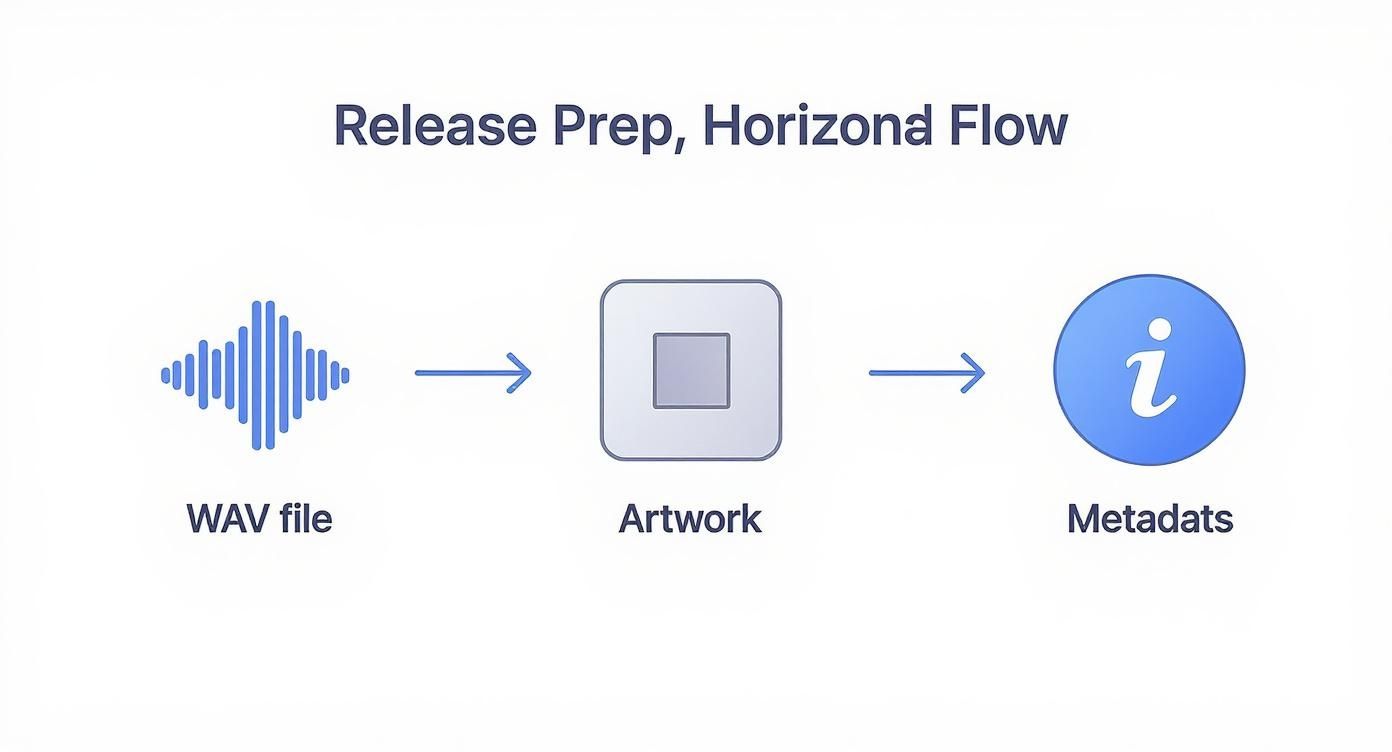
Think of it this way: the pristine audio, the killer artwork, and the accurate metadata are all gears in the same machine. They not only help you market your music but are essential for getting paid correctly.
Navigating the Royalty Maze
Once you’ve wrapped your head around the two copyrights, you can start to see how the different royalty streams work. It can feel like a lot at first, but these are the main ways your music will make money.
- Performance Royalties: These kick in anytime your song is played in public. That includes the radio, TV shows, in a coffee shop, or—most importantly for online artists—every time it's streamed on platforms like Spotify and Apple Music.
- Mechanical Royalties: This is the money you earn when your song is reproduced. In the digital age, that means every single download and every single stream. Yes, a stream generates both a performance and a mechanical royalty.
- Master Royalties: This is what the owner of the sound recording gets paid from streams and downloads. Your digital distributor (like TuneCore or DistroKid) is usually the one who collects this for you and passes it on.
To really get the full picture, it helps to understand basic financial models like the definition of revenue sharing. This is the underlying principle that governs how platforms like Spotify split their income with rights holders like you.
Who Collects Your Money
Here's the thing: you can't just sit back and wait for all this money to show up in your bank account. You have to partner with specific organizations built to track, collect, and pay out these royalties on a global scale.
Registering with the right organizations isn't optional. If you don't, your royalties end up in a "black box" of unclaimed money. Eventually, that cash gets paid out to other major artists and publishers based on their market share, not to you.
Here’s your registration checklist:
- A Performing Rights Organization (PRO): To get your performance royalties, you need to join a PRO. In the U.S., your main options are ASCAP, BMI, or SESAC. They track all the public performances of your songs and pay the songwriter's share directly to you.
- The Mechanical Licensing Collective (The MLC): This is a huge one. In the United States, The MLC is now the organization responsible for collecting mechanical royalties from streaming services and paying them to songwriters. It’s free to register, and you absolutely have to do it.
And for the ultimate layer of legal armor, you should formally register your work with the U.S. Copyright Office. This is the government authority on protecting creative works and gives you the strongest possible footing if you ever have to deal with infringement.
The Importance of Split Sheets
If you work with anyone else—a co-writer, a producer who helped with the melody, even a bandmate who wrote a key guitar riff—get your ownership agreement in writing from day one. A split sheet is a simple contract that spells out exactly who owns what percentage of the composition.
This one piece of paper can save you from massive headaches down the road. Before you even think about releasing the track, have an honest conversation with your collaborators, agree on the percentages, and get everyone to sign the split sheet. I've seen way too many friendships and bands implode over this. Don't let it happen to you.
Marketing Your Music to Drive Real Engagement
Getting your music uploaded is a huge milestone, but it's really just the starting line. The real work begins when you need to get people to listen, connect, and ultimately sell songs online. Effective marketing isn't about dropping a fortune on ads; it’s about being smart, consistent, and genuinely connecting with the people you want to reach.
The data you see in your Spotify for Artists dashboard is your secret weapon. It shows you exactly who your listeners are and where they are, giving you the critical insights needed to build a marketing plan that actually works.
The digital music market is growing fast, with some projections showing it could hit over $53 billion by 2030, up from around $34.1 billion in 2025. This isn't just about streaming—it's about live streams, podcasts, and all the new ways artists can find an audience.
Build Buzz Before You Release
The best releases never just drop out of the blue. They’re built on a wave of anticipation you create weeks, or even months, in advance. Your job is to get people hyped before they can even hit the play button.
This is where a pre-save campaign comes in. Platforms like Spotify and Apple Music let fans add your upcoming track to their libraries before it's even out. This does two things: it guarantees they get a notification on release day, and it tells the platform’s algorithm that your music is already gaining traction, which is a huge boost for landing on editorial playlists.
Your social media channels become ground zero for this pre-release hype.
- Create Teaser Content: Post short clips from the studio, a picture of handwritten lyrics, or a sneak peek of the album artwork.
- Use Countdown Timers: Instagram and TikTok stories are perfect for building urgency with their built-in countdown stickers.
- Engage with Your Audience: Ask them questions. Run polls on which snippet they like best. Make your fans feel like they're a part of the process.
To really broaden your reach, it pays to learn some effective strategies to increase your Twitter followers. A bigger social following directly translates to more pre-saves and bigger release day numbers.
Create Your Electronic Press Kit
If you want to get your music in front of industry gatekeepers—playlist curators, bloggers, radio programmers—you need a professional pitch. An Electronic Press Kit (EPK) is your musical resume, all packaged up and ready to go.
A good EPK doesn't have to be complicated. At its core, it's a single, well-organized page on your website that gives someone everything they need to feature your music.
Your EPK should make a journalist's or curator's job as easy as possible. They are incredibly busy, so if they have to hunt for your bio or a high-res photo, they'll likely just move on to the next submission.
Here's what every EPK should include:
- Your Music: Embed your best tracks with a player from SoundCloud or Bandcamp. Crucially, include private links for any unreleased material.
- Artist Bio: Keep it short and compelling. Tell your story and describe your sound in a way that hooks them in.
- High-Resolution Photos: Offer a few different options, both portrait and landscape, that are pre-approved for press use.
- Key Accomplishments: List any solid press coverage, big playlist adds, or impressive streaming milestones.
- Contact Information: Make it dead simple for them to reach you or your manager.
Post-Release Strategies to Find New Fans
The song is live. Now what? The work definitely doesn't stop. Now, you shift from building hype to driving discovery. It’s time to look at the early data and use it to find more people who will love your music.
Your Spotify for Artists dashboard is a goldmine. Seriously, live in it. It tells you who's listening, where they are, and how they found you. Did that blog feature cause a spike? Are you suddenly popular in a city you've never even heard of? This is the data that should guide your next move.
Even a small budget can go a long way with targeted social media ads. Don't just "boost" a post—create a specific ad campaign that targets fans of artists similar to you. You can run these for as little as $5 per day and push your new track to a super-relevant audience. The goal is to build a real community, which is why understanding why building a fanbase is essential for selling music is the cornerstone of any long-term career.
Got Questions About Selling Your Music? We've Got Answers.
When you're starting to sell your songs online, it feels like a thousand questions pop up at once. How much can I actually make? What's the deal with the legal stuff? Getting straight answers is the only way to build a real music career, so let's clear up some of the most common things artists ask.
How Much Money Can You Realistically Make?
Honestly, this varies wildly and it all comes down to your game plan. It's so important to understand that streaming payouts are tiny—Spotify's rate, for example, is often somewhere around $0.003 to $0.005 per stream. That means you need an absolutely massive number of plays to see any significant cash from streaming alone.
On the flip side, selling digital downloads directly from your own website or a platform like Bandcamp pays way more for each sale, though you'll probably move fewer units. The artists who really succeed don't just pick one path; they create a mix that works for them.
Think of streaming as your marketing engine. It’s how new listeners discover you and how you build a community. Direct sales, sync licensing, and merch are where you actually make your living from that loyal fanbase. Your income is a blend of everything working together.
Do I Need a Record Label to Get on Spotify?
Absolutely not. This is one of the biggest and best changes in the music industry. You are completely in the driver's seat when it comes to your own distribution.
Digital distributors like DistroKid, TuneCore, or CD Baby are your direct pipeline to Spotify, Apple Music, and hundreds of other platforms around the globe. You pay a small fee, they handle the technical side of things, and you keep your rights and the lion's share of your royalties. It gives you worldwide distribution power without having to sign your life away.
What Is an ISRC and Do I Really Need One?
Yes, you 100% need an ISRC. It's completely non-negotiable. Every single track you release needs a unique ISRC (International Standard Recording Code). The best way to think of it is as a digital fingerprint for your specific master recording.
This 12-character code is the universal key to tracking your sales and streams everywhere. It’s what ensures that when someone in another country plays your song, that play gets tracked and the money finds its way back to you. Trying to get paid accurately without one is a nightmare.
The good news? You don't have to go hunting for these yourself. Any reputable distributor will automatically assign ISRCs to your songs for free as part of their service when you upload your music.
Can I Legally Sell a Cover Song Online?
You definitely can, but you have to get the right license before you release it. To legally record and sell your version of someone else's song, you need to secure what's called a mechanical license. This is the agreement that makes sure the original songwriter and their publisher get paid for your use of their work.
Releasing a cover without this license is a serious copyright violation. It can get your music pulled down and could even land you in legal trouble. Thankfully, getting it done is pretty straightforward.
A few services make this process simple:
- Easy Song Licensing: A popular choice specifically for helping artists clear the rights for cover songs.
- TuneCore Publishing: If you distribute through TuneCore, their publishing administration service can handle this for you.
- Distributor Add-Ons: Many distributors have built-in tools or partners that will manage the licensing for a small fee right when you're uploading your track.
Handling this the right way isn't just about following the law—it's about showing respect for the artists who wrote the songs that inspired you in the first place.
At OohYeah, we're building an ecosystem where artists have the tools and control to build a career on their own terms. From commission-free sales to direct fan engagement, our platform is designed to put more power—and profit—back into your hands. Start building your future today at https://oohyeah.app.