Royalty Free Music Licensing Guide: Save on Legal Music Rights
Learn everything about royalty free music licensing, its benefits, and how to legally source music for your projects without ongoing fees.
September 13, 2025
Music Marketplace Advisor
Buying & SellingRoyalty-free music is your ticket to legally using incredible, high-quality tracks in your content without getting tangled up in recurring fees. It’s a common misconception that "royalty-free" means the music is free of charge. It's not.
Instead, think of it as being free from paying royalties. You pay a simple, one-time fee for a license, and that license gives you the freedom to use that specific track in your projects as many times as you want, forever.
What Does Royalty-Free Really Mean?
Let's use an analogy. Buying a royalty-free music license is a lot like buying a piece of software for your computer. You pay an upfront cost to install and use it on as many projects as you need, but you don't actually own the software's code or have the right to sell it to someone else. The developer keeps the ownership; you just have a license to use their product.
Music licensing works in the exact same way. The artist who created the track retains the copyright, but you've legally purchased permission to feature their work in your videos, podcasts, or ads.
This straightforward model is a breath of fresh air compared to other licensing types, which can quickly become a maze of costs and legal complexities. It's no surprise that creators are embracing this approach. The global royalty-free music market jumped from USD 1.43 billion to USD 1.52 billion just last year and is on track to hit USD 2.03 billion in the next five years. You can read more about these market trends on GlobeNewswire.
Music Licensing Models at a Glance
To really appreciate why royalty-free is so popular, it helps to see how it stacks up against the other options out there. For most creators, the choice boils down to one of three main licensing models, each with its own rules.
| Licensing Model | Payment Structure | Usage Restrictions | Best For |
|---|---|---|---|
| Royalty-Free | One-time fee per track. | Broad usage across multiple projects, forever. | YouTubers, businesses, podcasters, and online creators. |
| Rights-Managed | Pay-per-use based on scope. | Limited by time, location, and audience size. | Large-scale TV commercials or film productions. |
| Public Domain | Free to use. | None, but selection is limited to very old works. | Projects needing a classical or historical feel. |
As you can see, the royalty-free model gives you the most bang for your buck, offering predictability and creative freedom without the administrative headache of other options.
When you choose a royalty-free music platform, you sidestep the complicated negotiations and recurring payments tied to performance royalties—the fees artists get when their music is played publicly.
This one-and-done payment structure gives you total peace of mind. You can hit "publish" on your content without ever worrying about surprise invoices or copyright claims down the road.
If you're curious to learn more about how the mechanics of licensing work, our guide on understanding music licensing and how it can boost your revenue is a great next step. Ultimately, this approach lets you focus on what you do best: creating.
Let's Bust Some Common Music Licensing Myths
The music licensing world is a minefield of misinformation. These half-truths and outright myths can trip up even experienced creators, leading to everything from a takedown notice to a painful legal bill. Let's clear the air so you can use music with confidence.
One of the biggest culprits is the term royalty-free music. People hear "free" and assume it means "no cost." That's not quite right. It actually means the music is free from ongoing royalty payments to the artist every time it's played.
You almost always pay something upfront—either a one-time fee for a single track or a subscription to a platform like OohYeah. That payment secures a license, giving you the legal green light to use the music as outlined in the agreement.
Royalty-Free vs. Copyright-Free: They're Not the Same
Here’s where a lot of creators get into hot water. They treat "royalty-free" and "copyright-free" as the same thing, but they are fundamentally different. Confusing the two is a direct path to copyright trouble.
Let’s break it down simply:
- Royalty-Free Music: This music is very much protected by copyright. The artist who created it still owns it. You're just buying a license—a permission slip—to use their copyrighted work without having to pay them recurring performance fees.
- Copyright-Free Music: This is music in the Public Domain. The copyright has expired (think really old classical music), or the creator has intentionally given up all their rights. Anyone can use it for anything, no permission or payment needed.
The key difference is ownership. With royalty-free, you're a renter with specific rights. With copyright-free, it's a free-for-all. The catch? The library of genuinely copyright-free music is tiny and often not what you need for a modern project.
Remember this: A royalty-free license is a permit to use the music, not a deed of ownership. The artist always retains the copyright to their work.
The Deal with Creative Commons and Attribution
Another area of confusion is Creative Commons (CC). While CC licenses are a fantastic way for artists to share their work, they come with their own set of rules that can be surprisingly complex. They aren't the same as a straightforward royalty-free license.
A Creative Commons license lets artists share their music under certain conditions. Some are pretty open, but many require attribution. This means you must credit the original artist in a very specific way. If you forget or get the credit wrong, you're violating the license.
For example, a "CC BY" license means you can use a track for commercial projects, but only if you provide the correct credit. Other CC licenses might block commercial use entirely or prevent you from remixing the track. For a busy creator who just needs a track that works, this adds an extra layer of legal homework.
This is exactly why most professionals prefer a standard license from a royalty-free music platform. When you license a track that way, you typically don’t have to worry about complicated attribution rules. It’s a clean, simple transaction that gives you a professional result without the extra legal strings attached.
Why Smart Creators Use Royalty Free Music
For any modern content creator, every choice is strategic. You're constantly juggling your time, budget, and legal risks—any of which can make or break a project. This is exactly why royalty free music licensing has become an essential tool for professionals who need to work efficiently and sleep well at night.
Let's picture a YouTuber named Alex, who's committed to posting two high-quality videos every single week. Without a simple licensing solution, each video would be a logistical nightmare. Alex would have to hunt down an artist, get tangled in complex usage rights negotiations, and then face unpredictable, recurring fees. That whole process could take weeks and cost thousands, making a consistent content schedule completely impossible.
Instead, Alex uses a royalty free music subscription. That one decision completely changes the game, solving the biggest headaches that come with producing content.
Predictable Budgets and Massive Cost Savings
The first and most obvious win is financial clarity. With traditional music licensing, costs are a constant moving target. The fees can shift based on where your video is shown, how many people see it, and for how long. It's a mess, both logistically and financially.
A royalty free music licensing model flips that script. As a creator, you typically pay a single, upfront fee for one track or a flat monthly/annual subscription for unlimited access to an entire library.
- No Hidden Fees: You know exactly what you’re paying from day one. There are no surprise invoices from performance rights organizations waiting for you down the line.
- Unlimited Use: A single track you license can be used in your YouTube video, your podcast intro, and a social media ad without costing you an extra penny.
- Thousands Saved: When you compare it to licensing a single commercial song—which can easily run into the thousands or even tens of thousands of dollars—a royalty free subscription offers incredible value, often for less than your daily coffee budget.
This one-and-done payment structure lets creators like Alex budget with confidence. It frees up resources to invest in other critical areas, like better camera gear or marketing, instead of getting bogged down by endless music fees.
The core benefit is simple: you pay once to secure the rights to use the music in your projects forever, as defined by the license, without owing another dime.
This approach has been so effective it's reshaped the entire industry. The royalty-free model is perfect for creators who distribute content across multiple platforms, and the market reflects that. In fact, the royalty-free category now holds the largest share in the global music copyright market, showing a huge shift toward more flexible and creator-friendly solutions.
Eliminating Legal Risks and Copyright Headaches
Beyond just saving money, royalty free music acts as a powerful legal shield. Let's be honest, navigating copyright law is intimidating. One misstep can lead to disastrous consequences like channel strikes, demonetization, or even a lawsuit.
Using music without the right license is a huge gamble. Automated systems like YouTube's Content ID are incredibly good at finding unauthorized use. A copyright claim can get your video muted, blocked, or worse, have its ad revenue diverted to the original copyright holder.
Royalty free music licensing offers a clear, legally sound way forward. When you license a track from a reputable platform like OohYeah, you get a license certificate. This document is your proof of permission. If an automated claim ever pops up, you simply present that certificate to get the claim released quickly. It turns a potential channel-threatening crisis into a minor administrative task, giving you the freedom to publish globally without looking over your shoulder.
Access to a Limitless Creative Toolkit
Finally, royalty free music platforms put a vast, curated library of high-quality tracks right at your fingertips. Instead of being limited to a few trendy (and legally risky) songs, you suddenly have access to an ocean of creative possibilities.
Think about what you might need for your next project:
- An epic, cinematic score for a travel vlog.
- A chill, lo-fi beat for a study-with-me stream.
- An upbeat, corporate track for a product demo.
- Suspenseful sound effects for a short film.
A quality library means you can find the perfect sound in minutes, not weeks. You can search by genre, mood, tempo, or instrumentation to pinpoint the exact track that will elevate your content from good to unforgettable. For anyone serious about producing top-tier content, this instant access to a professional creative toolkit is an absolute game-changer. If you want to dig deeper into the business side, you can check out our insights on how royalty-free music sales operate.
How to Read a Music License Agreement
Think of your music license agreement as your project's legal shield. It’s the one document that officially proves you have the right to use a specific track, protecting you from nasty surprises like copyright claims, takedown notices, or even legal trouble down the road. But let's be honest—these agreements are often packed with legal terms that can make your eyes glaze over.
The good news is that a royalty free music licensing agreement is designed to be much simpler than traditional music licenses. Its whole purpose is to give you broad permissions with a one-time payment, so you can publish your content anywhere in the world without worrying about ongoing fees or complicated restrictions.
Identifying the Key Clauses
When you open that license file, don't let the wall of text intimidate you. Most of the information you actually need is tucked away in just a few key sections. If you know where to look, you can confirm you’re covered in minutes, not hours.
Scan for these core areas first:
- Grant of License: This is the most important part. It's the clause that explicitly says the licensor (the music platform) gives you (the licensee) permission to use the music.
- Permitted Uses: This section gets specific, outlining exactly how you can use the track. Is it cleared for a monetized YouTube video? A paid Instagram ad? A local TV spot? This is where you find out.
- Restrictions: Just as critical is what you can't do. This part will list the limitations, like prohibiting you from reselling the song or trying to claim you own it.
- Term: For almost all royalty free licenses, the term is perpetual. This means your right to use the music in the specific project you licensed it for will never expire.
By zeroing in on these sections, you can quickly get a handle on the scope of your rights and make sure they match what your project needs.
A common mistake is thinking one license covers you for any future project. In reality, a standard license is almost always for a single end product. If you love a track and want to use it again in a brand-new video, you’ll typically need to get a separate license for that new project.
Translating the Legal Jargon
Legal language can feel like learning a different dialect, but the concepts behind the words are usually straightforward. At its core, a royalty free music licensing agreement is designed to let you bypass the complex world of Performance Rights Organizations (PROs) like ASCAP and BMI, which traditionally collect royalties for artists. This type of license cuts through all that, simplifying everything into one clean transaction.
Here’s a quick translation guide for some common terms:
| Legal Term | What It Really Means |
|---|---|
| Perpetual | Your license for this project lasts forever. No expiration date. |
| Non-Exclusive | You're not the only person who can use this track. Others can license it, too. |
| Worldwide | You can publish or broadcast your content anywhere on the globe. |
| Single-End Product | The license covers your use of the music in one specific project (e.g., one video). |
So, if your license says it’s for “worldwide, perpetual use in one non-commercial web video,” you know you’re clear to post your travel vlog on YouTube and leave it there forever for anyone to see. But you couldn't turn around and use that same license for a paid advertisement. Getting these details right is a huge part of learning how to protect your music rights online and keeping your creative work safe.
What to Look for Before You Download
Before you hit that download button, it’s worth running through a quick mental checklist. This simple habit can save you from some serious headaches later on.
Confirm the Scope of Use: Does the license explicitly cover your specific plan? A license for a personal podcast is very different from one for a national TV ad. Always double-check that your use case, whether it’s "paid advertising" or "monetized streaming," is clearly permitted.
Check for Audience Size Limits: Some licenses, especially for bigger commercial projects, might have limits based on audience size or ad spend. A standard license might be fine for up to 1 million views, but a bigger campaign might require an extended license.
Verify It's Truly Royalty-Free: The agreement needs to state clearly that no future payments (royalties) are owed to the artist or any PROs for the uses it permits. That's the entire point, after all.
Download and Save Your License Certificate: This is your golden ticket—your proof of permission. Always download it and store it somewhere safe, like in a dedicated cloud folder for your project's assets. If an automated system ever flags your content, this certificate is the evidence you’ll need to clear things up fast.
Taking a moment to review these points gives you the confidence to create, knowing your project is built on a solid legal foundation.
Licensing Music for Your Project Step by Step
Alright, let's move from theory to action. You've got the concepts down, so now for the fun part: finding and licensing that perfect track for your project. This whole process might seem complicated from the outside, but once you do it once, you'll see it's a clear, repeatable workflow designed to save you time and headaches.
It really just boils down to a few key stages, from discovering the right sound to getting the final files in your hands.
This flow chart breaks it down into the three core steps to get your licensed music.
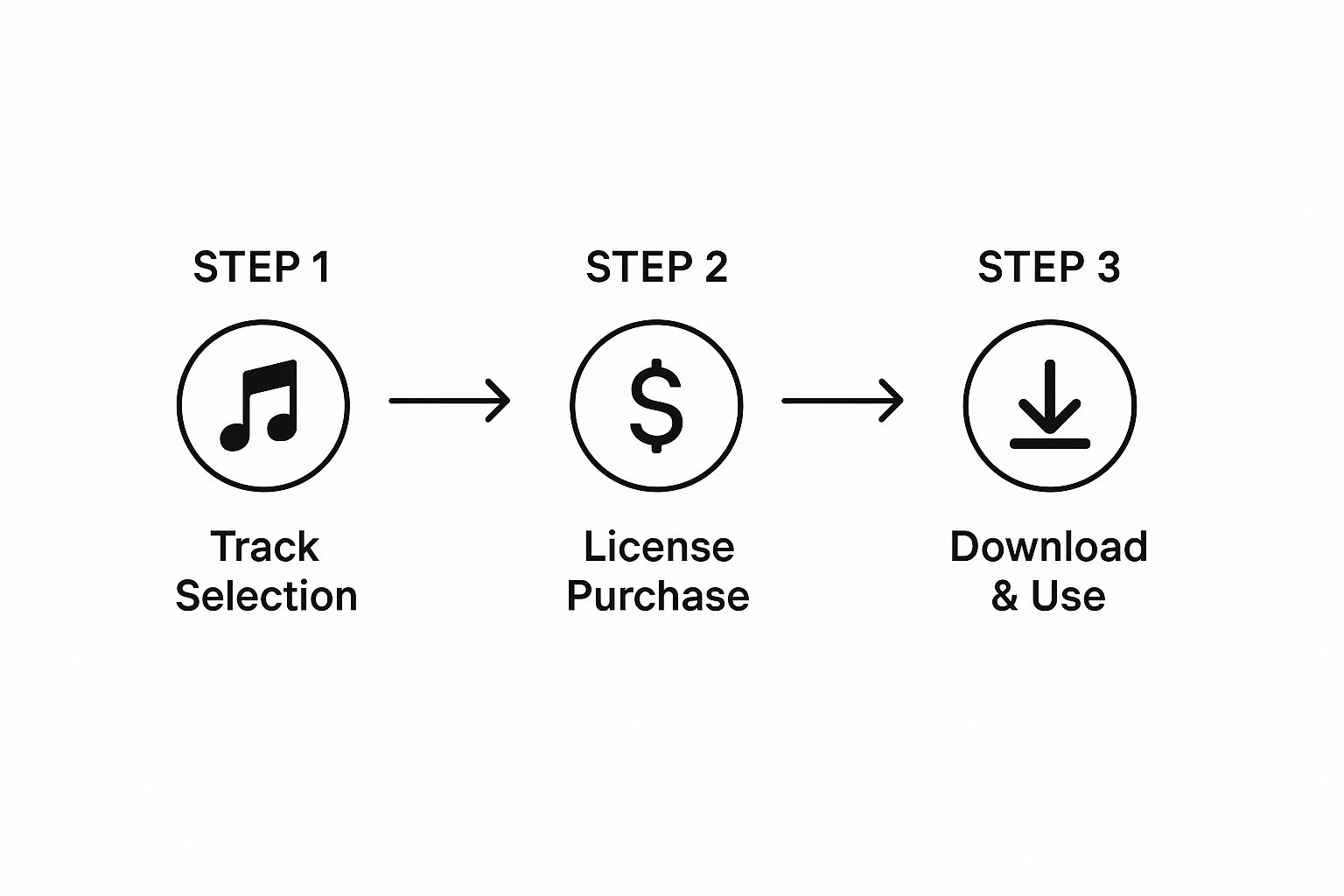
As you can see, it's a straightforward path from finding your track to using it legally.
Step 1: Find Your Perfect Track
First things first, you need to dive into a music library. A platform like OohYeah is a great starting point. Staring at a library with thousands of songs can feel like looking for a needle in a haystack, but this is where search filters become your secret weapon.
Instead of just hitting play on random tracks, you can instantly narrow the field:
- Search by Mood: What's the emotional core of your video? Is it inspiring and uplifting? Tense and suspenseful? Filtering by mood is the fastest way to find music that creates the right vibe.
- Filter by Genre: If you know you need a cinematic score, a chill lo-fi beat, or a high-energy rock anthem, genre filters will get you there in seconds.
- Refine by Tempo: You can even dial in the beats per minute (BPM) to match the pacing of your edit, whether it’s for a fast-cut action scene or a slow, emotional moment.
As you preview songs, you’ll probably hear an audio watermark—that "OohYeah" voiceover or sound effect layered on the music. Don't worry about it. That's just a standard security measure to prevent people from using the audio without a license. It disappears completely once you purchase the track.
Step 2: Choose the Right License for Your Needs
You've found "the one." Now comes the most critical part of the process: picking the right license. This isn't a one-size-fits-all deal. The license you need is tied directly to how and where you plan to use the music, and getting this wrong can cause major compliance issues down the road.
Most platforms offer a few tiers. For instance, a Standard License is usually perfect for web-based content like a YouTube video, a podcast, or posts on your social media channels. It covers the basics for most independent creators.
But if your project is bigger, you'll likely need an Extended License. Think paid advertising campaigns, broadcast TV, indie films, or embedding the track in an app or video game. The key is to read the license terms carefully. Taking a minute to double-check that your use case is covered will give you complete peace of mind.
Step 3: Finalize and Secure Your Assets
With the right track and license in your cart, you're ready to check out. This isn't just a simple transaction; you're participating in the booming intellectual property market. In fact, music licensing is projected to grow into a USD 6.44 billion industry, fueled by the massive demand for legal audio in digital content. You can explore more data on this expanding market to see just how big it is.
Once you complete the purchase, you’ll get two crucial downloads:
- The High-Quality Audio File: The clean, unwatermarked track (usually a WAV or MP3 file) that you can drop right into your project.
- The License Certificate: This PDF is your proof of purchase. It's the official document that proves you have the rights to use the music.
Pro Tip: The moment you download these files, create a dedicated folder for your project's assets and save both the audio track and the license certificate there. This simple habit is an absolute lifesaver. If you ever get a copyright claim from an automated system like YouTube's Content ID, you'll have your proof ready to go, allowing you to dispute and clear the claim in minutes.
Frequently Asked Questions About Royalty Free Music
Even when you've got a handle on the basics, the world of royalty free music can still throw a few curveballs your way. Let's clear up some of the most common questions that pop up for creators every day. Getting these details straight is the key to using music with confidence.
Think of this as your go-to guide for those nagging "what if" scenarios. We'll cover everything from monetizing your YouTube channel to what happens if you cancel a music subscription.
Can I Monetize My YouTube Videos With Royalty Free Music?
Yes, you absolutely can. In fact, this is one of the biggest reasons creators rely on royalty free music. When you get a license from a trusted source, you’re buying the rights to use that track in your monetized videos without worrying about copyright strikes or losing your ad revenue.
Your license is your proof. If YouTube’s Content ID system automatically flags a track—which can happen from time to time—you just show them your license certificate to resolve the claim. Good music platforms have a simple process for this, so you can clear things up fast and keep your video making money.
This peace of mind is huge. It means you can pour your energy into creating great content instead of constantly looking over your shoulder for a copyright claim to derail your hard work.
What's The Difference Between a Standard and an Extended License?
The main difference boils down to how big your project is and where it's going to be seen. Picking the right one is essential for keeping everything above board, especially as your audience grows.
Standard License: This is the workhorse for most online creators. It’s designed for web-based projects, covering things like your YouTube videos (even monetized ones), social media posts, and podcasts.
Extended License: You'll need this license when you're playing in the big leagues. Think broadcast TV commercials, feature films, or paid apps and video games where the music is part of a product for sale.
Always, always read the fine print before you download. The specific permissions can change from one site to another, so confirming you have the right license from the get-go saves a world of headaches later.
If I Buy a Royalty Free Track, Do I Own It?
No, and this is a really important point to understand. Buying a royalty free music license doesn't mean you own the song. The artist who created the music always holds the copyright and ownership of their work.
Here’s a good analogy: it’s like renting an apartment. You have the right to live there and use the space according to your lease agreement, but you don't own the building. A music license is your legal permission slip to use the track in your projects as defined by the license terms, without having to pay ongoing fees (royalties) every time it’s played. You're a licensee, not the owner.
What Happens If My Music Subscription Ends?
This is a huge question for anyone using a subscription service, and the answer is usually good news. With most reputable platforms, any music you used in projects while your subscription was active is licensed forever.
That means any video you published during your membership is covered for good, even after you cancel. You won't get hit with copyright claims on your old content. What you can't do is use those tracks in any new projects after your subscription expires. For that, you’d need to either renew your plan or buy a license for that specific track. While this perpetual licensing for past work is the industry standard, it’s always smart to double-check the platform's terms of service.
Ready to find the perfect, legally-safe soundtrack for your next project? Explore the massive, curated library at OohYeah and discover thousands of high-quality tracks to elevate your content. Start your search on OohYeah today!