8 Iconic Punk Rock Tattoo Ideas & Their Meanings
Explore 8 iconic punk rock tattoo ideas, from band logos to political symbols. Get inspiration, symbolism, and tips for your next punk rock tattoo.
May 20, 2026
Music Marketplace Advisor
Buying & SellingMost punk tattoo roundups show you the same handful of flash sheets, but they skip the essential question. Why does one punk rock tattoo feel lived-in and honest while another looks like costume jewelry on skin?
That gap matters because punk has never just been a look. Punk rock emerged as a distinct music genre in the mid-1970s, and its visual culture moved quickly into tattooing as a form of nonconformity. A key milestone came in October 1976, when The Damned released “New Rose,” widely cited as the first UK punk rock band single, and that public identity helped lock punk imagery into the broader culture via Wikipedia's punk rock history. By the late 1970s, tattoos weren't just decorating punk bodies. They were part of the identity system itself.
That's why a good punk rock tattoo isn't just about picking a skull or a safety pin. It's about understanding what the symbol says, how it ages, and whether it still feels like you when the trend cycle moves on.
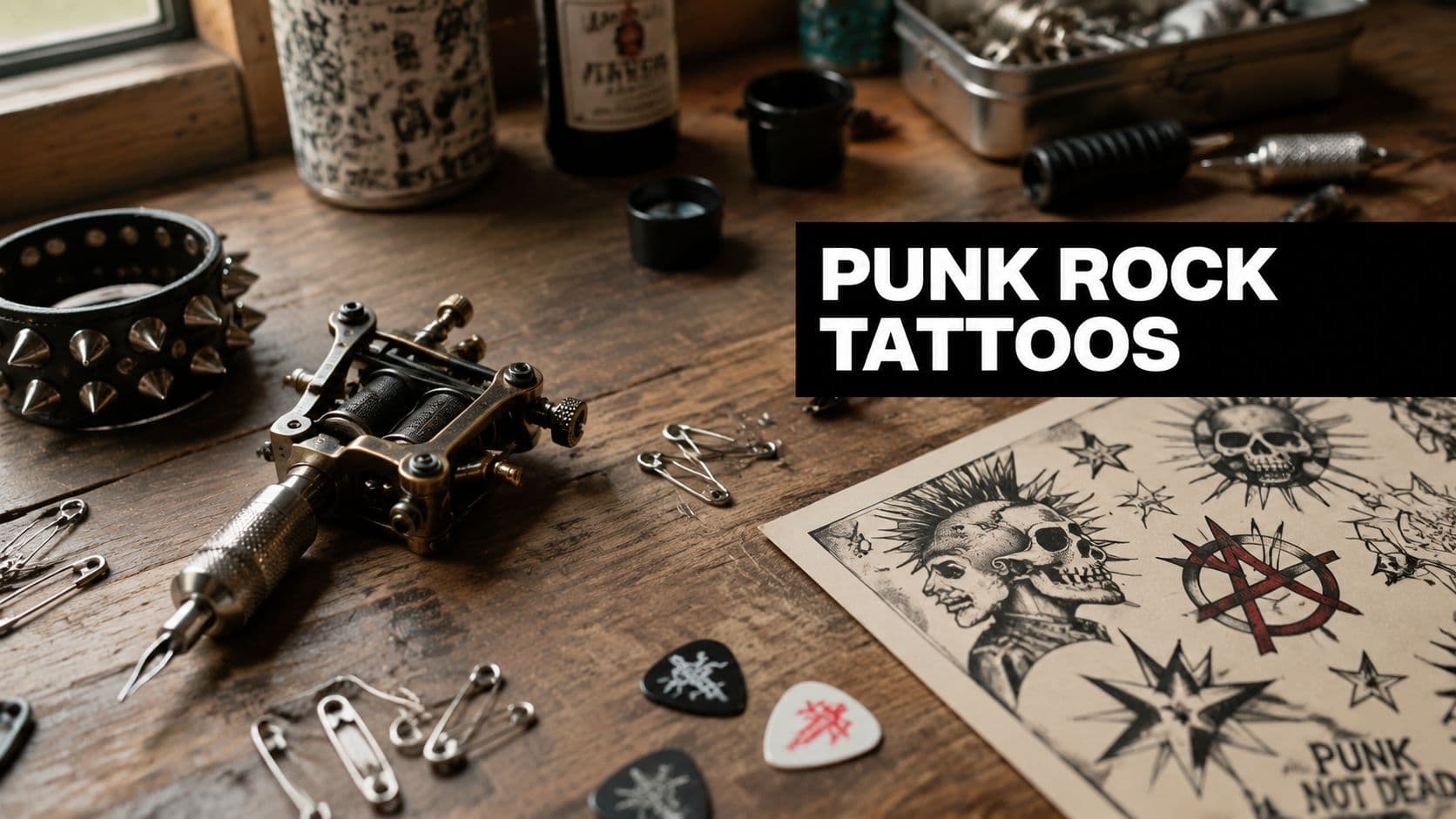
The eight ideas below are the foundation pieces. Some are loud, some are stripped down, and some only work if you bring your own history to them. If you want custom inspiration before you book, browse these AI-generated punk concepts and then hand the strongest references to a tattooer who knows the culture, not just the stencil printer.
1. Band Logo and Album Art Tattoos
Band tattoos are the most direct form of punk devotion. They can also be the easiest to get wrong.
A logo like the Ramones eagle, Black Flag bars, Dead Kennedys lettering, or a Sex Pistols-inspired ransom-note composition works because it already carries visual authority. The risk is that people treat these as simple copy jobs. They're not. A punk rock tattoo built from band imagery needs clean line discipline, correct spacing, and enough contrast to survive years of wear.

If you're a musician, there's another angle. Fans often want tribute tattoos that reflect not just the band, but the era, record, or live energy that changed their life. That's where custom framing helps. You can build a logo into torn-paper borders, flyers, roses, microphones, or a back patch layout instead of dropping a flat symbol onto the arm.
What works and what doesn't
What works is commitment to the original visual language. If the source art is blunt and aggressive, don't over-decorate it with soft shading and ornamental filler. If the logo relies on harsh geometry, keep it harsh.
What doesn't work is shrinking detailed album art too far. Fine print, tiny faces, and dense poster-style compositions blur faster than people expect. A design that looks perfect on a phone screen can become unreadable on skin if the artist doesn't simplify it.
- Choose strong source material: Bring the cleanest version of the logo or album art you can find.
- Plan for expansion: Forearm, upper arm, calf, and thigh placements leave room for future records, lyrics, or tour references.
- Keep contrast high: Black-heavy designs usually outlast fragile grey details in punk iconography.
For artists building community, fan tattoos can become part of your visual identity if you share them carefully. A page like Ramones on OohYeah! shows how band-centered fandom can keep feeding merch, story, and visual culture long after the first listen.
Practical rule: If the tattoo only works because people already know the band, the execution has to be exact.
2. DIY Punk Aesthetic and Safety Pin Designs
The safety pin is one of the purest punk symbols because it came out of necessity, style, and attitude at the same time. It reads fast, tattoos well, and doesn't need a speech attached to it.
That simplicity is why it gets abused. A safety pin tattoo can look sharp and loaded with meaning, or it can feel like a stock symbol picked off a mood board. The difference usually comes down to context. Add hand-drawn lettering, rough placement, chain links, patchwork framing, or a phrase that matters to your own scene, and it starts to feel personal instead of borrowed.

A lot of people think “DIY” means “bad on purpose.” It doesn't. Punk aesthetics can be rough, but rough and careless aren't the same thing. Good tattooers know how to fake the rawness while still building a design that heals clean and reads from a distance.
Making rough style look intentional
Handmade-looking tattoos need control. Uneven lettering, distressed lines, and crude-looking icons have to be placed with intent or they'll just look technically weak.
I usually tell clients to decide what part of the tattoo should feel improvised and what part needs structure. Maybe the pin is crisp, but the lettering looks hand-scrawled. Maybe the chain is symmetrical, but the surrounding marks feel like xerox grit. That contrast sells the piece.
- Keep the symbol small only if it's simple: A plain safety pin can hold up at smaller scale. Add text or texture and it needs more room.
- Use your own words sparingly: A band name, lyric fragment, or personal slogan works best when it's short.
- Avoid fake distress overload: Too many scratches and “aged” effects can make the tattoo read muddy instead of raw.
A convincing DIY punk rock tattoo looks like it came from a real life, not a costume rack.
3. Anarchist and Political Punk Symbols
Political tattoos carry more weight than style tattoos. They follow you into every room, whether you meant them to or not.
The circle-A, clenched fist, anti-war imagery, and broken-crown motifs have deep roots in punk because punk has always attracted people who reject hierarchy, control, and official narratives. But these are not neutral graphics. If you wear them, people will read them as statements. That's the point, and it's also the responsibility.
New York played an early role in making the punk-tattoo connection visible in the United States. Fun City Tattoo, one of NYC's first legitimate walk-in tattoo shops that merged fine art with hardcore and punk, was established by Shawn in the mid-1980s and moved to Saint Mark's Place in 1989, a sign that punk tattooing had become commercially sustainable and culturally visible in a major city as described in Vice's history of Fun City Tattoo.
Know the symbol before you wear it
A political punk rock tattoo should come from conviction, not just aesthetics. That's true whether you're getting a classic anarchist mark or a band-linked symbol with ideological baggage.
Before I tattoo anything political, I want to know why the client wants it. Not to interrogate them. To make sure they won't hate explaining it later. Some symbols have different meanings in different places, and some combinations can read very differently than intended.
- Research the local read: A symbol that feels obvious in one scene may carry different baggage somewhere else.
- Think about visibility: Hands, neck, and face placements make every interaction a declaration.
- Build a complete statement: Pairing a political symbol with lyrics, tools, flowers, or banners can sharpen the meaning.
Fans of melodic political punk already understand how imagery and message feed each other. That's part of why Bad Religion on OohYeah! remains a useful touchpoint for people who connect music with worldview, not just sound.
4. Skull and Crossbones with Punk Modifications
Skulls belong to tattooing in general, but punk gave them a different flavor. Less pirate romance. More sneer, damage, gallows humor, and ugly truth.
A standard skull tattoo won't automatically read punk. To push it there, you need the right mutation. Mohawks, liberty spikes, studded collars, cracked teeth, safety pins through the cranium, crossed drumsticks, torn banners, rough stencil treatment. Those choices move it out of generic dark flash and into punk territory.

The Misfits skull is the obvious reference point for a lot of clients, and it's still strong. But if you don't want to look like you stopped at the first page of search results, ask for a custom skull that carries punk attitude without directly lifting a famous mark.
Give the skull a point of view
Skulls work best when they stand for something specific. Mortality. Survival. A band era. A period of your own life. The more specific the story, the less likely the tattoo is to feel generic.
A well-built punk skull can also anchor a larger sleeve. It plays nicely with roses, daggers, broken microphones, chains, and torn flyer textures. What doesn't work is piling every “edgy” element into one design. Punk imagery should hit hard, not ramble.
A skull gets stronger when you decide whether it's mocking death, surviving it, or dancing with it.
If you want to study how different artists handle skull composition, contrast, and attitude, this roundup of top skull tattoo talent is useful for comparing approaches before you book.
5. Lightning Bolts and Electric Energy Symbols
Lightning bolts are deceptively hard to do well. Everyone thinks they're simple until the tattoo lands flat.
A bolt needs motion. It has to feel like it struck, not like it was clip-art dropped onto skin. In punk, that charge can stand for volume, speed, creative shock, or the jolt of hearing the right band at the right time. For musicians, it also works as branding because it reads instantly on posters, merch, and skin.
Why bolts work for performers
This style suits singers, guitarists, DJs, and bands that want a symbol more flexible than a full logo. You can run a bolt down the forearm, break it into a pair on the hands, or weave it through a microphone cord, guitar neck, snare stand, or amp stack.
The best versions usually stay bold. Heavy black, clean negative space, and a shape with real tension. If you over-render electricity with too many wisps and tiny sparks, the piece starts looking more comic-book than punk.
A few directions that work well:
- Geometric bolt: Good for minimalist branding and smaller placements.
- Weathered bolt: Adds grit through texture without losing readability.
- Integrated bolt: Best when merged with an instrument or lyric banner instead of floating alone.
This is also one of the easiest punk rock tattoo ideas to over-polish. Leave some edge on it. If the design feels too sleek, it can lose the aggression that made the symbol worth choosing.
6. Barbed Wire and Bondage Imagery
This category has history, but it needs maturity. Barbed wire, leather-coded motifs, restraint imagery, padlocks, and chainwork came into punk through fashion, provocation, and anti-respectability. They can still work. They just need intention.
A lot of weak versions come from people chasing transgression without understanding what they're pointing at. If your only reason for getting barbed wire is “it looks hardcore,” that usually shows. If it connects to punk fashion history, personal experience, sexual politics, or a clear era of music and style, the tattoo gains weight.
The practical issue is that these designs can slide into cliché fast. Armbands are the classic example. They can still look good, but they need spacing, depth, and enough anatomical flow to avoid that dated, copy-paste feel.
Avoiding the cliché trap
The answer usually isn't to abandon the motif. It's to reframe it. Break the wire, wrap it through a lyric, pair it with a lock that has actual symbolic meaning, or treat chainwork as part of a larger composition instead of a standalone edge signal.
Placement matters a lot here. A thigh, rib, chest, or upper arm piece gives the design room to breathe. Tight wraparound placements can look great on day one and crowded later if the anatomy shifts.
- Ask for movement: Static barbed wire looks decorative. Tension and pull make it feel alive.
- Decide how explicit you want to be: Bondage-coded details can read very differently depending on visibility.
- Think long-term: Provocative imagery should still feel like yours when you're older and less interested in proving anything.
This kind of punk rock tattoo works best when it says more than “I wanted something dangerous.”
7. Musical Instruments and Guitar-Integrated Designs
For musicians, this is often the most honest option. No borrowed politics. No secondhand rebellion. Just the thing you built your life around.
Instrument tattoos only work if the artist respects anatomy and hardware. A Telecaster that doesn't look like a Telecaster, a bass with impossible proportions, or a snare that reads like a random drum shape will bother you forever if you know gear. Punk can be rough, but your instrument still needs to look structurally believable.
Make it your instrument, not just an instrument
The strongest pieces come from specifics. The beat-up bass you toured with. The guitar model you wrote your first real songs on. The amp knobs you always set the same way. Even a cable, pick, pedal, or broken string can tell more truth than a generic full instrument drawing.
This style also gives you room to blend music with punk iconography. A guitar neck can become a dagger. Drumsticks can cross behind a skull. An amp can be wrapped in torn flyer texture. A microphone can sit inside a lightning bolt.
I like these tattoos best when they show the wear of actual use. Road tape, dents, sticker outlines, handwritten set-list fragments, and strap-lock details all help. Those marks feel lived-in. Clean showroom-perfect gear often feels too polished for punk unless that contrast is the whole concept.
Your most authentic punk tattoo might be the tool you kept picking up when everything else was falling apart.
8. Vintage Band Merchandise and Concert Poster Designs
Poster tattoos are for people who love punk as printed matter as much as sound. Flyers, bootleg tees, ticket stubs, record inserts, old merch graphics, pasted-wall typography. That visual language is a huge part of the culture.
The danger is detail overload. Poster art often looks incredible on paper because paper can hold tiny text, dense halftones, and layered composition. Skin can't do all of that at the same scale. Good tattooers know when to preserve the spirit of the print and when to simplify for longevity.

This category has become more culturally visible in a broader way too. The Punk Rock Museum in Las Vegas opened an on-site tattoo shop and began taking bookings on May 15, which shows how tattooing is being treated as a core part of punk culture experience rather than a side attraction through the museum's tattoo booking page.
How to turn print into a lasting tattoo
Start with one focal element. Maybe it's a ticket date, a tour title, a central face, or the ripped typography from a flyer. Build around that. If you try to force the entire poster into a small space, the tattoo will lose clarity.
Readable text is the hardest part. Many want more words than skin should carry. If the text must matter ten years from now, enlarge it or cut it. There's no trick around that.
For bands and fans alike, vintage merch tattoos also create a bridge between identity and branding. A revived shirt graphic or old flyer treatment can inspire both skin art and present-day visual campaigns. That's part of why pages like The Clash on OohYeah! still feel relevant as reference points for enduring visual language.
If you want to get your head into the printed side of the culture before sketching a piece, this video is a useful mood-setter.
A final practical point matters here. Tattooing isn't just design. It's materials and safety. A small 5 × 5 cm tattoo typically uses about 0.5 to 1.5 mL of ink, and a recent heavy-metal analysis found measurable concentrations of chromium, nickel, copper, arsenic, zinc, manganese, cadmium, and lead in multiple tattoo and permanent-makeup ink samples, with some products exceeding risk thresholds for nickel-related lifetime cancer risk in this published ink safety analysis. If you're commissioning a detail-heavy blackwork flyer piece, ask what ink line the shop uses and whether the artist can talk clearly about sourcing and safety documentation.
8-Point Comparison of Punk Rock Tattoo Motifs
| Tattoo Style | Implementation Complexity 🔄 | Resource & Time ⚡ | Expected Outcomes 📊 | Ideal Use Cases 💡 | Key Advantages ⭐ |
|---|---|---|---|---|---|
| Band Logo and Album Art Tattoos | Medium, accurate replication and copyright checks 🔄 | Medium, experienced artist; possible licensing/time for detail ⚡ | High recognition and long‑term fan engagement 📊 | Fan tributes, merch tie‑ins, community showcases on OohYeah! 💡 | Strong cultural connection; marketable fan content ⭐ |
| DIY Punk Aesthetic & Safety Pin Designs | Low, simple, intentionally rough linework 🔄 | Low, quick sessions, minimal equipment ⚡ | High authenticity and DIY credibility; ages well visually 📊 | Independent artists and fans seeking authentic punk look 💡 | Fast, flexible, cost‑effective; highly adaptable ⭐ |
| Anarchist & Political Punk Symbols | Low–Medium, simple symbols but require contextual care 🔄 | Low–Medium, basic execution; research time for meaning ⚡ | High ideological signaling; can polarize or attract niche fans 📊 | Politically active artists; value-driven community building 💡 | Clear messaging; builds aligned, engaged audience ⭐ |
| Skull & Crossbones with Punk Modifications | Medium–High, needs unique treatment to avoid cliché 🔄 | Medium–High, shading/detailing requires skilled artist ⚡ | High visual impact and timeless punk identity 📊 | Centerpiece tattoos, bold branding, sleeve elements 💡 | Versatile interpretations; instantly recognizable ⭐ |
| Lightning Bolts & Electric Energy Symbols | Low, geometric shapes, clean lines 🔄 | Low, quick and scalable across sizes ⚡ | Moderate–High energy symbolism; versatile for merch 📊 | High‑energy musicians, simple visible accent tattoos 💡 | Clean, durable design; easily combined with other motifs ⭐ |
| Barbed Wire & Bondage Imagery | Low–Medium, placement and wrap planning required 🔄 | Medium, careful execution for comfort and realism ⚡ | High edginess; can be provocative or limit opportunities 📊 | Artists pushing boundaries, provocative branding, armband tattoos 💡 | Strong rebellious visual impact; clearly punk‑aligned ⭐ |
| Musical Instruments & Guitar‑Integrated Designs | High, requires anatomical accuracy and composition skill 🔄 | High, detailed work, longer sessions and touch‑ups ⚡ | High personal/professional resonance; strong storytelling 📊 | Musicians showcasing craft; merch and signature designs 💡 | Deeply personal and industry‑appropriate; conversation starter ⭐ |
| Vintage Band Merchandise & Concert Poster Designs | High, text, fine detail and layout complexity 🔄 | High, large area, multiple sessions, expert lettering ⚡ | High nostalgia and historical storytelling; collectible appeal 📊 | Longtime fans commemorating shows; vintage merch reproduction 💡 | Deeply meaningful, highly sharable fan memorabilia ⭐ |
Commissioning Your Rebellion From Idea to Aftercare
Choosing a design is the fun part. Commissioning it well is the part that separates a tattoo you're proud of from one you spend years trying to explain.
Start with the artist, not the concept. A tattooer can love blackwork and still be the wrong fit for punk imagery if they don't understand punk's visual language. You want someone who gets the difference between bold and clumsy, between raw and unfinished, between homage and lazy imitation. If you're bringing band references, give them clean files, old flyers, album art, and photos of patches or jackets you wear. That gives them a vocabulary to work from.
Style choice matters more than people think. Blackwork is often the safest route for a punk rock tattoo because it keeps contrast high and fits the photocopy, patch, stencil, and logo traditions of the scene. Neo-traditional can work too, especially for skulls, roses, daggers, and instruments, but it needs restraint. If you push too much decorative polish into punk material, the tattoo can lose its bite. Fine line usually isn't the first style I'd recommend for punk-heavy graphics unless the artist has a very clear plan for longevity.
Be honest in the consult. Tell the artist what part of the tattoo is sacred and what part can change. Maybe the Black Flag bars must stay exact, but the surrounding frame can evolve. Maybe the safety pin is essential, but the lettering should be custom. That kind of clarity gives the tattooer room to solve the design without stepping on the meaning.
One hard truth: If you want tiny text, distressed texture, portrait detail, and a full poster composition in one small tattoo, something will have to give.
Healing is where a lot of bold punk work either stays sharp or falls apart. Follow the artist's aftercare instructions exactly. Keep it clean. Don't over-moisturize. Don't pick. Don't treat a fresh tattoo like a souvenir you can take straight into a pit. Saturated black and strong linework need calm healing if you want them to stay crisp.
For musicians, there's also a bigger opportunity. Tattoos can become part of your artist branding when they come from your actual community. Fan-designed flash, lyric-based symbols, or merch-inspired motifs can create a shared visual identity that travels from stage to skin to social post. The business side supports that idea too. The global tattoo market was valued at USD 2.43 billion in 2025 and is projected to reach USD 5.99 billion by 2034, with a projected 10.67% CAGR over 2026 to 2034, while Europe held a 33.14% regional share in 2025 according to Fortune Business Insights. That doesn't mean every punk motif should be commercialized. It means serious demand exists around tattoo culture, especially in mature markets where alternative aesthetics already have durable buying power.
A punk rock tattoo should still feel true when the shirt is gone, the tour is over, and the scene has changed around you. If it carries your taste, your history, and your values without trying too hard, you picked the right one.
If you're a band, solo artist, or fan community building a visual identity around punk culture, OohYeah gives you a practical place to turn that energy into something lasting. Use it to share merch-inspired flash, connect directly with supporters, test artwork that could live on skin as well as shirts, and build a tighter world around your music without handing the relationship to a middleman.