
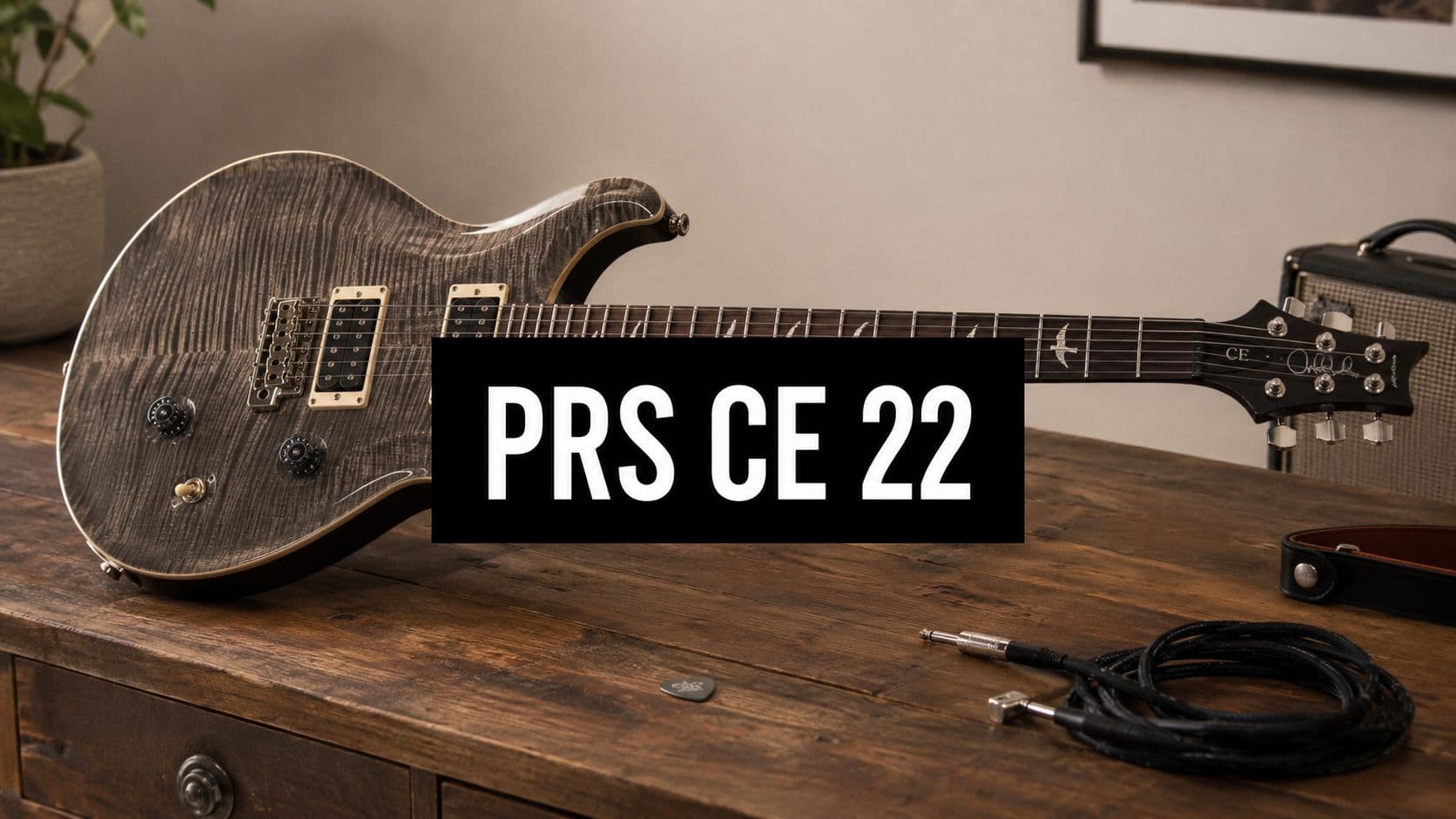
PRS CE 22 Explainer: A Modern Player's Guide for 2026
Explore the PRS CE 22 in detail. This guide covers specs, tone, playability, and how it compares to the CE 24 for players seeking a versatile bolt-on classic.
July 1, 2026
Music Marketplace Advisor
Buying & SellingYou're probably in one of two spots right now. Either you've played enough guitars to know that “versatile” usually means “a little bland,” or you're staring at the PRS catalog wondering where the CE models fit between the company's set-neck classics and more familiar bolt-on territory.
That's where the PRS CE 22 gets interesting. It isn't just a CE 24 with two fewer frets, and it isn't a Custom with a different neck joint. It solves a specific problem for players who want PRS build quality and balance, but don't want to give up the quicker response and attack that bolt-on guitars tend to deliver.
The current buzz comes from the 2025 Limited Edition, but the appeal of the CE 22 runs deeper than limited-run excitement. For a lot of working players, this is the PRS that makes the most sense when you need one guitar to cover clean rhythm parts, edge-of-breakup lead work, and gain sounds that still keep note separation intact.
The PRS CE 22 A Bridge Between Worlds
A lot of players end up chasing two different guitars for the same rig. One handles articulate rhythm work and has enough snap to stay lively under a clean amp. The other covers thicker humbucker tones without turning everything into a midrange blur. The PRS CE 22 sits right in that overlap.
That's why this model has always made practical sense. The CE platform gives you the familiar response of a bolt-on neck, but it still feels like a PRS in the hands. You get the body shape, upper fret access, trem feel, and overall polish people expect from the Maryland-built line, but the attack is a little more immediate and the personality is a little less polite.
The recent version also matters because it brought back a layout a lot of players never stopped wanting. The PRS CE 22 Limited Edition, announced on April 29, 2025, is a run of exactly 1,000 units worldwide and marks the return of the 22-fret configuration to PRS's mainstay bolt-on line, according to PRS Europe's launch announcement.
The CE 22 makes sense for the player who likes PRS refinement but still wants the guitar to push back a little.
That last part matters. Some PRS models feel almost too controlled for players coming from older bolt-on instruments. The CE 22 keeps more of that quick, lively edge. It still tracks cleanly under gain, still records well, and still has the ergonomic feel PRS does better than most builders, but it doesn't smooth off every corner.
If you've been bouncing between a Fender-style bolt-on and a set-neck PRS or Gibson-style instrument, the CE 22 is one of the few guitars that bridges those instincts instead of forcing you to pick one camp.
Understanding The Bolt-On Classic DNA
The CE name means Classic Electric, and the “classic” part starts with the neck joint. PRS built its reputation on set-neck instruments, so the CE line has always stood apart inside the family.

Why the neck joint matters
A bolt-on maple neck changes how the guitar responds under the pick. Notes tend to speak faster. The front edge of the attack feels more defined. Chords separate a little more easily when you're playing with a clean or mildly driven amp.
That doesn't automatically make bolt-on better. It just makes it different.
With the CE 22, that bolt-on construction is paired with a mahogany back and figured maple top, which is why the guitar doesn't drift into thin or overly sharp territory. PRS states that this combination gives the CE 22 its distinct character, where the bolt-on design adds “snap and sustain” while the mahogany and maple preserve warmth and clarity, as described on the official PRS CE 22 Limited Edition product page.
What that feels like in real use
The easiest way to understand the CE 22 is to stop thinking in brand categories and think in playing situations.
- Clean rhythm parts: The bolt-on attack helps chords stay defined.
- Edge-of-breakup lead work: Notes bloom, but the front of the note still stays intact.
- High-gain rhythm: The mahogany and maple keep things full, while the neck construction prevents the low mids from getting too cloudy.
That's the CE trick. It doesn't sound like a traditional Fender-type guitar, and it doesn't sound like a set-neck PRS Custom either. It lives in the middle.
Practical rule: If you want a guitar that softens your picking and adds natural thickness, a set-neck PRS may fit better. If you want the guitar to reflect your right hand more immediately, the CE layout usually wins.
What works and what doesn't
What works is the balance. The CE 22 has enough bite to keep funk, pop, country-leaning rhythm, and layered studio parts from getting lost. It also has enough body to make humbucker leads feel complete.
What doesn't work for every player is the expectation that it will behave like a Custom 22 with a different neck attachment. It won't. The response is firmer and more percussive. For some players, that's the whole point. For others, it can feel less forgiving.
Anatomy of a Workhorse The CE 22 Specs
A CE 22 usually proves itself halfway through a long set. You stop noticing the neck, the trem, and the tuning because nothing is getting in your way. That is the point of this spec sheet.

The core build
The Limited Edition pairs a mahogany body with a figured maple top, a bolt-on maple neck, and a rosewood fretboard with 22 frets and hollow bird inlays. PRS also gives it the shallow violin carve and the company's familiar 25-inch scale. Those choices are not random. They place the CE 22 in a very specific part of the PRS family.
The body recipe keeps the guitar recognizably PRS. The bolt-on neck changes the response enough that it behaves more like a fast, articulate working instrument than a softer-edged set-neck model. That matters if you are comparing it to a Custom 22, but it also matters if you are trying to decide whether the CE 22 is the better long-term buy for the way you typically play.
The 25-inch scale is a big part of that. It splits the difference between Fender and Gibson territory in a useful way. String tension feels even, bends still come easily, and the wound strings do not get floppy when you dig in. On a guitar meant to cover a lot of ground, that balance helps.
Neck feel and fretboard geometry
PRS lists the CE 22 Limited Edition with a 10-inch fretboard radius on the official CE 22 Limited Edition product page. In practice, that radius is one reason the guitar feels broad-shouldered without feeling old-fashioned.
Here is the practical effect.
- Rhythm players get a fretboard that stays comfortable during long chord-heavy sets.
- Lead players get enough room for bends and vibrato without the board feeling overly flat.
- Players who move between clean and gain sounds get a neck that stays predictable under different right-hand attacks.
If you regularly replace wear items or keep a touring spare kit, a good marketplace for guitar parts and accessories is useful to have on hand for setup parts, control hardware, and case-pocket fixes.
Hardware that earns its keep
The CE 22 Limited Edition uses a PRS patented tremolo, PRS locking tuners with wing buttons, and the expected PRS control layout for the model, as noted on the official product page referenced earlier. Those details directly affect whether the guitar feels trustworthy on stage.
The trem is stable enough for musical use, which is the right way to judge it. It is not a dive-bomb system, and players who treat it like one will hit the same limits they would on most non-locking setups. Used for chord shimmer, subtle pitch movement, and vocal-style phrasing, it does the job well. The locking tuners cut restring time and reduce one of the usual tuning trouble spots.
That is the workhorse test. Hardware should hold up under repeated use and ask for very little attention between songs.
Spec sheet reality check
The CE 22 works because the specs point in the same direction rather than chasing novelty. It has enough traditional PRS content to satisfy players who want the brand's fit and finish, and enough snap in the construction to attract players who usually want more immediate attack from a guitar. That middle position is also why limited CE runs, including the 2025 edition, tend to hold interest in the used market. They are not just collectible because they are scarce. They fill a lane in the PRS lineup that other models do not cover in quite the same way.
| Component | Practical effect |
|---|---|
| Mahogany back and maple top | Full lows and low mids, plus clearer note attack |
| Bolt-on maple neck | Quicker response and firmer pick definition |
| 25-inch scale | Balanced string tension and stable intonation feel |
| 10-inch radius | Comfortable for both chord work and expressive bends |
| PRS locking tuners and tremolo | Better tuning stability in regular live use |
Players who buy with their hands tend to understand the CE 22 quickly. The spec sheet reads cleanly, but the value is in how little you have to fight the instrument once the set starts.
Vintage Voice Meets Modern Versatility
A lot of guitars look flexible on paper and then fall apart the minute a set asks for real range. You start on a clean intro, move to edge-of-breakup rhythm, then need a lead sound that still keeps some body. The CE 22 handles that shift better than many PRS models that sit either further toward vintage sweetness or further toward modern precision.
The electronics are a big reason why. PRS paired the CE 22 Limited Edition with 58/15 LT pickups, and as noted in Premier Guitar's coverage of the CE 22 Limited Edition, that package includes a three-way toggle and push-pull coil split. On the bench and through an amp, the result is a guitar that stays articulate without sounding thin or overly polite.
What the 58/15 LT set actually gives you
These pickups suit players who control gain with their hands and the guitar's volume knob. They have enough output for rock, but they do not flatten the attack the way a hotter set can. Pick lightly and the note opens up. Dig in and the CE 22 pushes back with more bite, not just more compression.
That matters in everyday use:
- Clean and edge-of-breakup parts: Chords keep their shape, and inner notes still speak.
- Lead work in blues, roots rock, and classic rock: Notes stay rounded, with enough top-end detail to cut without turning sharp.
- Layered recording sessions: The guitar takes EQ well and usually needs less cleanup than darker, thicker humbucker guitars.
The word vintage gets thrown around too loosely, so it helps to be specific. On the CE 22, vintage mostly means lower output, better note separation, and a little more room for the player to shape the result.
The controls are more useful than they first appear
The three-way toggle is familiar. The push-pull tone control is what makes the guitar cover more ground than a straight two-humbucker setup would suggest.
Here is the practical breakdown:
- Bridge humbucker: Tight enough for driven rhythm, but still open enough for expressive lead lines.
- Middle position: Often the best live setting if one guitar has to cover a whole set.
- Neck humbucker: Warm, vocal, and one of the clearest reasons some players prefer a 22-fret PRS.
The split sounds are good tools, not magic tricks. They will not replace a Strat or Tele for a player whose whole approach depends on true single-coil response. They do give you cleaner, leaner textures that help on pop gigs, worship sets, cover bands, and studio dates where bringing one guitar is the practical call. If you want a lower-cost PRS reference point for that wider do-it-all lane, a used PRS SE Custom with tremolo shows how PRS approaches versatility at a different price tier.
I would put the CE 22 in the sweet spot for players who want one guitar to handle a lot of real work without feeling generic.
Where the CE 22 sits in the PRS family
This model fills a specific gap. Core McCarty-style instruments usually lean further into thickness and vintage bloom. The CE 24 reaches faster for modern attack and extended upper-register playing. The CE 22 keeps the bolt-on snap of the CE line, but the pickup voicing and 22-fret layout pull it toward a more mature, less clinical sound.
That matters for buying decisions. A CE 22 does not just appeal to players who want a different fret count. It appeals to players who like the PRS build standard but do not always connect with the more compressed or more polished feel some PRS guitars can have.
That also helps explain the long-term interest in limited runs like the 2025 model. Scarcity matters, but only when the guitar itself fills a lane people keep coming back to. The CE 22 has that advantage. It is a bolt-on PRS with a distinct voice, and that usually gives limited editions better staying power than special finishes on otherwise interchangeable models.
If your rig depends on the pickups doing half the work for you, there are hotter and more aggressive choices. If you want a guitar that responds to touch, cleans up properly, and still covers a broad gigging range, the CE 22 earns its place fast.
CE 22 vs CE 24 Decoding The Key Difference
The usual shorthand is simple. CE 22 for vintage feel, CE 24 for modern range. That's directionally true, but it leaves out the part that matters most: the extra two frets also change the neck pickup position.

The CE 22 places the neck pickup in a spot that tends to sound warmer and fuller. The CE 24 shifts things to accommodate the longer fretboard real estate, and that usually gives the neck voice a slightly tighter, more focused quality. Neither is better in the abstract. They just serve different players.
For a current point of comparison, the broader PRS used market includes instruments like this PRS SE Custom with tremolo listing, which can help frame how different PRS families target different budgets and use cases.
PRS CE 22 vs. CE 24 at a Glance
| Feature | PRS CE 22 | PRS CE 24 |
|---|---|---|
| Fret count | 22 frets | 24 frets |
| Upper-register access | More traditional range | More extended lead range |
| Neck pickup character | Fuller, warmer, more vintage-leaning | Slightly tighter and more modern-leaning |
| Overall feel | Classic PRS meets bolt-on immediacy | Sleeker, more modern PRS voice |
| Best fit | Players who live on neck and middle sounds | Players who want added range and a sharper edge |
A quick demo can help if you're hearing this difference more than reading it.
Who usually prefers each one
The CE 22 usually wins over players who spend real time on neck pickup tones. If your clean intros, blues phrases, melodic leads, and lower-gain solos live there, the 22-fret layout has a strong advantage.
The CE 24 usually suits players who want a little more reach and a more contemporary PRS feel. If your vocabulary includes a lot of upper-register lines, progressive parts, or modern fusion phrases, those extra frets are more than a spec-sheet talking point.
The difference isn't “can you use two more frets.” The difference is whether you prefer the sound and feel created by the pickup placement that comes with them.
What I'd tell most buyers
Buy the CE 22 if tone from the neck position matters more than access to the highest notes. Buy the CE 24 if your playing style regularly uses those top frets and you prefer a slightly leaner, more immediate neck voice.
That's the fork in the road.
Is The PRS CE 22 Your Perfect Match
The PRS CE 22 isn't for everyone, and that's a good thing. Its appeal gets clearer when you think in player types rather than generic “versatility.”
The player coming from bolt-ons
If you've spent years on Strat or Tele-style instruments and every set-neck guitar feels a little too soft on the front of the note, the CE 22 makes a strong case. The bolt-on response will feel more familiar under your right hand, but the humbuckers and PRS body recipe give you a broader, thicker voice when the gig needs it.
This player usually loves the CE 22 quickly. It feels less like learning a new language and more like moving to a better-equipped dialect.
The PRS fan who wants more attack
Some long-time PRS players love the ergonomics and consistency of the brand but still want a little more cut and air. The CE 22 fits that niche well. You keep the comfort, the trem feel, the fretwork standard, and the balanced scale length, but the guitar answers with a bit more urgency.
That makes it especially attractive if a Custom-style PRS feels polished but slightly too smooth for your band mix.
The working musician who needs one reliable guitar
This may be the strongest use case. If you're covering sessions, club dates, theater work, worship sets, or mixed-genre freelance gigs, the CE 22 behaves like a dependable tool.
It gives you:
- Usable clean sounds: Chords stay articulate.
- Gain tones with note separation: Lead lines don't collapse into mush.
- Enough control flexibility: You can move between broader humbucker sounds and leaner split textures without changing guitars.
A good one-guitar solution doesn't have to do everything perfectly. It has to do the important jobs well without creating new problems.
Who should probably pass
If your playing depends on very high-output pickups, very modern voicing, or constant use of the highest register, the CE 22 may not be your best fit. The CE 24 or a more overtly modern platform probably makes more sense.
The same goes for players who buy almost entirely by collector status and rarely care about day-to-day use. The CE 22 can be collectible, especially in limited form, but its real strength is that it's a player's guitar first.
The best match is someone who wants PRS build quality, bolt-on immediacy, and a neck pickup voice that still sounds rich and musical. That combination narrows the field quickly, and the CE 22 occupies it well.
A Smart Guide to Buying Your CE 22
Buying a CE 22 is easier if you decide up front whether you're shopping for a tool, a collectible, or a little of both. Too many buyers blur those categories and end up dissatisfied for reasons that have nothing to do with the guitar itself.

If you're buying to play
Focus on condition, setup history, fret life, trem behavior, and whether the guitar still has the feel that makes the CE line special. A great CE 22 should feel lively acoustically before you ever plug it in. It should also return to pitch sensibly, have controls that operate cleanly, and show no signs of neglect around the neck joint or hardware.
Shopping the broader electric guitar marketplace can help you compare examples and spot the difference between clean player-grade instruments and listings aimed more at collectors.
A few practical checks matter more than finish hype:
- Inspect the tremolo use history: Heavy wear isn't always bad, but instability is.
- Check fret condition: A premium guitar with tired frets becomes a negotiation, not a trophy.
- Play every switch position: The value of a CE 22 is tied to versatility. Dead spots in the controls undercut that immediately.
If you're buying the 2025 Limited Edition
The attraction is obvious. The model is limited, visually appealing, and tied to a configuration many players missed. The official launch materials also make the exclusivity clear, including the specific finish options and the worldwide cap covered earlier in this guide.
But scarcity has a trade-off that guitar marketing rarely discusses carefully enough.
According to the angle documented in this discussion around resale behavior for hyper-limited guitar runs, the “1,000 units worldwide” limitation can drive initial FOMO, yet very limited runs can also suffer from low market liquidity, making them harder to sell quickly even when brand prestige remains high.
Scarcity versus liquidity
Collectors and players often treat rarity and value as if they're the same thing. They aren't.
A rare guitar may hold interest. It may command attention. It may even remain desirable. But if only a narrow slice of buyers wants that exact configuration at the moment you need to sell, the instrument becomes less liquid than a more common, broadly understood model.
Rare doesn't always mean easy to move. Sometimes it means waiting for the right buyer.
That doesn't make the Limited Edition a bad buy. It just means you should be honest about your goal.
| Buying mindset | Best approach |
|---|---|
| Player first | Buy the example that feels best, regardless of collector chatter |
| Collector first | Prioritize originality, finish preference, and documentation |
| Hybrid buyer | Accept that rarity can support appeal while still slowing resale |
The smart buy is the one that matches your intention. If you want a bolt-on PRS with a richer neck voice and serious all-around utility, the CE 22 stands on its own. If you want a financial asset first, be cautious about assuming rarity alone will make the exit easy.
If you're tracking down your next guitar, listing gear you no longer use, or building a direct relationship with fans around your music and merch, OohYeah gives artists a music-first platform to sell, promote, and grow without the usual middleman clutter.