A Guide to Promoting Independent Music
Discover how to succeed at promoting independent music. This guide offers real-world strategies on branding, digital distribution, and connecting with fans.
October 2, 2025
Music Marketplace Advisor
Buying & SellingLong before you drop your first track or spend a dime on promotion, the real work begins. Getting this groundwork right is what separates artists who connect from those who just make noise. It's all about building a solid foundation: a strong, authentic brand, a crystal-clear picture of your ideal listener, and a professional Electronic Press Kit (EPK) that opens doors.
Building Your Foundation for Music Promotion

This early stage isn’t about chasing streams; it's about crafting a compelling identity that makes people want to press play. Think about the artists you love. Their music is just one piece of a bigger puzzle—a world they've built with a distinct visual style, a story, and a unique perspective. That’s your first job.
Define Your Artist Brand
Your brand is more than a cool logo or a specific color palette. It’s the emotional heartbeat of your music, translated into a consistent identity that people can latch onto.
Ask yourself a few key questions:
- What's my story? Are you a raw storyteller, a political commentator, or someone creating a world for listeners to escape into?
- What's my visual aesthetic? Does your music feel like gritty, black-and-white photos or polished, cinematic videos? This will guide everything from your album art to your social media feed.
- What do I stand for? Authenticity? Rebellion? Unfiltered joy? Your core values will attract fans who see the world the same way.
Pinpoint Your Ideal Listeners
Once your brand starts to take shape, you have to figure out who you're talking to. And no, the answer isn't "everyone." Getting specific is a superpower; it lets you aim your efforts where they’ll actually land.
Forget broad demographics like "people aged 18-30." Dive deeper into psychographics—the attitudes, interests, and lifestyles of the people who will truly resonate with your work.
Your ideal listener isn't just someone who likes your genre. They're a person who connects with your story, gets your lyrical references, and hangs out in the specific corners of the internet (and the real world) where your music would feel right at home.
Knowing this helps you answer the important questions. Do they find new music on TikTok? Through niche Spotify playlists? Or are they still reading local music zines? Your entire promotional strategy hinges on these details. For a deeper dive, check out our guide on how to market your music as an independent artist.
Create a Professional Electronic Press Kit (EPK)
Think of your EPK as your digital resume or your professional handshake. When you’re reaching out to a blogger, playlist curator, or venue booker, a sharp, well-organized EPK signals that you’re serious and makes their job a whole lot easier. It needs to be a one-stop-shop for everything they might need.
Before you start your outreach, make sure you have all your key assets in order. This checklist is your pre-flight check to ensure you're ready for takeoff.
Your Pre-Promotion Checklist
| Checklist Item | Why It Matters | Key Action |
|---|---|---|
| Artist Brand Guide | Ensures consistency across all visuals and messaging. | Finalize your logo, color palette, and a one-sentence brand mission. |
| Ideal Listener Profile | Helps you target your promotion with precision. | Write a one-paragraph description of your perfect fan. |
| Completed EPK | Makes you look professional and ready for opportunities. | Gather your bio, photos, and music links into a single, polished package. |
| High-Quality Assets | Poor quality reflects poorly on your music. | Have high-resolution photos and mastered audio files ready to go. |
Having these elements buttoned up means you can move quickly and confidently when opportunities arise.
There’s never been a better time to be an independent artist. Believe it or not, over 50% of music consumed on major platforms now comes from indie or unsigned artists. This massive shift is happening because of accessible technology and the power of direct-to-fan marketing, making a strong foundation more crucial than ever. Building these core assets—your brand, audience profile, and EPK—is how you position yourself to make the most of this incredible opportunity.
Getting Your Music on Spotify, Apple Music, and Beyond
Think of uploading your music to streaming platforms as the modern-day equivalent of pressing your first vinyl record. It’s a huge milestone, for sure. But it’s not the finish line—it’s the starting block for your entire digital strategy.
The first real step is getting your music from your hard drive to platforms like Spotify, Apple Music, and Amazon Music. This is where digital distributors come in. They’re the middleman, and picking the right one depends entirely on your release schedule and budget.
Choosing Your Digital Distributor
For most independent artists, the choice boils down to a couple of major players: DistroKid and TuneCore. They both get your music on all the important platforms, but they charge for it in different ways.
- DistroKid: Works on a yearly subscription. You pay one flat fee and can upload as much music as you want. If you’re constantly creating and releasing singles, this is a no-brainer.
- TuneCore: Traditionally uses a pay-per-release model. This can be more cost-effective if you’re only putting out a single or an EP once a year and don't want a recurring charge.
So, how do you choose? If you’re a band dropping a new track every six weeks, DistroKid’s model is going to save you a ton of money. If you’re a solo artist who has poured two years into a single album, TuneCore's one-time fee might make more sense.
If you want to go deeper on this, we've got a whole guide on the best strategies for independent music distribution that breaks it all down.
Setting Up Your Artist Profiles for Success
Once your distributor sends your music out, your next job is to claim your artist profiles. An empty profile with a generic avatar just looks unprofessional. You want to create a space that pulls listeners in and makes them want to learn more about you.
Head over and sign up for Spotify for Artists and Apple Music for Artists. These are your dashboards, your mission control for each platform.
Here’s your immediate to-do list:
- Get Professional Photos: Upload high-resolution images for your profile and header banner. They should match the vibe of your press kit and social media.
- Write a Real Bio: Don't just list your influences. Tell your story. What’s your sound? What makes you, you? Give people a reason to connect.
- Link Everything: Add your Instagram, TikTok, website—wherever you live online. Make it effortless for a new fan to find you everywhere else.
Getting that little blue checkmark—becoming a verified artist—is a huge deal. It’s a stamp of legitimacy that tells playlist curators and fans you’re serious, and it unlocks a bunch of powerful promotional tools.
This isn't just admin work. You're turning a simple music page into a hub for your entire brand.
Use Your Streaming Data to Make Smarter Moves
The real magic behind these artist dashboards is the data. You can see who is listening, where they live, and how they found you. This is pure gold for your marketing.
See a random spike in listeners from Berlin? That’s your cue to run some targeted social media ads in that city for your next release. Maybe even start looking at venues there for a future tour. Did a feature on a specific music blog send hundreds of new listeners your way? You know that relationship is worth nurturing.
The numbers don't lie. Global recorded music revenues have hit $29.6 billion, marking a full decade of growth. And where is that money coming from? Streaming now accounts for over 85% of that total. This isn't a trend; it's the core of the business now. You can see more on the state of the music industry on 1stdropmusic.com.
One of the most powerful tools at your disposal is Spotify's playlist pitching feature. Inside Spotify for Artists, you can submit an unreleased song directly to their editorial team. This is your shot to tell them about the track's genre, mood, and the story behind it. Getting your song on a major editorial playlist can be a career-defining moment, introducing your music to millions of potential fans overnight.
Building an Engaged Online Community
Your online presence is so much more than just a digital billboard for your next single. Think of it as the virtual green room where your fans get to hang out. If you really want to promote your music effectively, you have to move beyond just posting "new music out now." It's about pulling back the curtain and inviting people into your world.
When you build a real community, you get more than just streams. You get fans who buy your merch, show up to your gigs, and become your most vocal supporters. It all starts with being smart about where you spend your time online and creating content that’s genuinely you.
For any indie artist, a solid online community is non-negotiable. While you can find great social media marketing strategies for other industries, the core principles are the same for musicians: create real value and build relationships.
Choosing Your Platforms Wisely
Don't fall into the trap of thinking you need to be everywhere at once. Spreading yourself too thin is a fast track to burnout and a feed full of mediocre content. The smarter move is to focus your energy where your ideal listeners are already hanging out.
- Instagram: This is your visual diary. Use Stories and Reels to share a behind-the-scenes look at your studio sessions, post a photo of handwritten lyrics, or talk about the real-life story that inspired a song.
- TikTok: It’s a powerful discovery engine. The algorithm can get your sound in front of millions of new ears almost overnight. But remember, what works here is creativity and consistency, not just a slick, high-budget music video.
- Discord or Geneva: These are perfect for creating a true inner circle. They let you build a dedicated space for your die-hard fans to connect directly with you and each other, far from the noise of public timelines.
Pick one or two of these and really master them before you even think about adding another. It’s always quality over quantity.
To help you decide where to focus your efforts, think about what each platform is really good for.
Social Media Platform Strategy for Musicians
| Platform | Primary Use Case | Content Focus | Target Audience |
|---|---|---|---|
| Visual Storytelling & Community Building | Behind-the-scenes, Reels, artist lifestyle | Millennials & Gen Z | |
| TikTok | Music Discovery & Virality | Short-form video, trends, raw performance clips | Gen Z & Younger Millennials |
| Discord | Deep Community & Direct Engagement | Exclusive content, Q&As, fan-to-fan chat | Superfans, core audience |
| Updates & Event Promotion | Tour dates, official news, long-form video | Gen X & Millennials |
This table is just a starting point. The key is to find the platform that feels most natural for your brand of artistry and allows you to connect with the people who will truly resonate with your music.
Your Website Is Your Home Base
Let's be clear: social media platforms are rented space. Their algorithms, rules, and entire existence can change in a heartbeat, and you could lose your connection to your audience overnight. That’s why having your own professional website isn't a "nice-to-have"—it's the single most important asset in your digital arsenal.
Think of your website as the central hub for your entire career. It’s the one place online you have 100% control. This is where you house everything that matters: your tour dates, official merch store, electronic press kit (EPK), and, crucially, your email list.
Owning your audience data is the ultimate power move for an independent artist. An email list gives you a direct, unfiltered line of communication to your fans that no social media platform can ever take away.
This direct line is exponentially more valuable than a passive social media following. The chart below really drives this point home, showing the massive difference in engagement between email and social media.
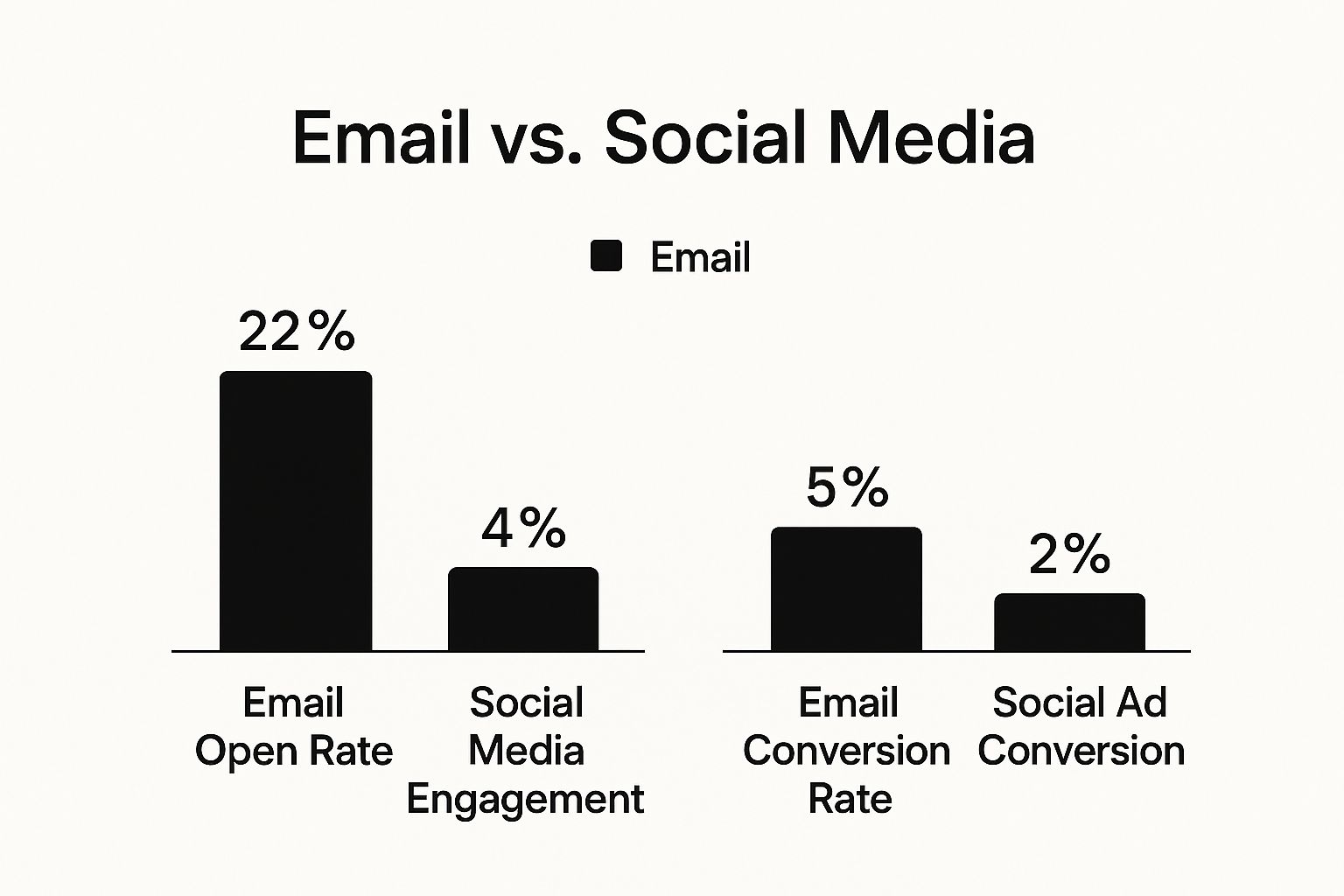
The numbers don't lie. Email marketing consistently delivers far higher open and conversion rates, making it an incredibly reliable tool for driving real action from your fans.
Create Content That Connects
Here's a secret: the content that works best isn't always the most polished. Fans are hungry for authenticity. They want a peek into the creative process and a chance to connect with the human being behind the music.
Stuck on what to post? Try some of these ideas:
- Show the work. Post a quick video of you trying to nail a tricky guitar riff or a picture of your lyric notebook. That kind of vulnerability makes your art feel real and relatable.
- Ask for their opinion. Use an Instagram Stories poll to let fans vote on a new t-shirt design or the cover art for your next single. When they feel like part of the journey, their loyalty deepens.
- Share the unglamorous side. People love seeing what really goes into being a musician—loading gear into a tiny venue, the chaos of soundcheck, or the late-night celebratory pizza after a great show.
This approach changes your online presence from a simple promotional megaphone into a compelling story that people actually want to follow. To get more ideas on this, you should check out our deep dive on how to build a loyal fan base as an independent artist. By consistently sharing your journey—the good, the bad, and the messy—you build a community that's invested not just in your next release, but in your entire career.
Getting Your Music Heard on Playlists and Blogs
Pitching your music can feel like shouting into the void. You pour everything into a track, meticulously craft an email, hit send, and… crickets. For most independent artists, this part of the game feels like a mysterious, gatekept world. But it’s not magic; it's a skill you can build with the right strategy.
Real success here isn't about getting lucky. It comes down to smart research, genuine personalization, and a healthy dose of persistence. So, forget about blasting a generic template to every music blog you can find—that’s a one-way ticket to the trash folder. The goal is to build real connections with the people who are already looking for music just like yours. Think of it as DIY PR.
Finding the Right People to Pitch
Before you even think about writing your pitch, you have to know who you’re talking to. The mission is to find curators and writers who have a history of featuring artists in your specific lane. Sending your hyperpop banger to a blog that only covers acoustic folk is a waste of your time and theirs.
Start by digging into the platforms where your ideal listeners already hang out.
- Scour Spotify Playlists: Look for playlists—both user-generated and independent—that feature artists who sound like you. Check the playlist description or the curator's profile. Sometimes they'll list an email or a submission link right there.
- Hunt for Niche Music Blogs: Simple Google searches like "[your genre] music blog" or "new indie artist reviews" can unearth some gems. Websites like Hype Machine and Indie Shuffle are fantastic for finding smaller, influential blogs that are often way more approachable than the big-name publications.
- Follow the Breadcrumbs: Found a blog that fits your vibe? Great. Now, look at the artists they've recently covered. Go to those artists' Spotify pages and see what playlists they’ve landed on. This creates a powerful network effect, connecting you to a whole web of potential contacts all centered around your unique sound.
Crafting a Pitch That Actually Gets Opened
Let's be real: curators and editors are drowning in emails. Yours needs to stand out for the right reasons. Your pitch is your first impression, and it might be your only one, so every single element has to count.
It all starts with the subject line. Keep it clear, professional, and to the point. No all-caps, no clickbait. Something like "Submission: [Artist Name] - [Song Title] (For fans of [Similar Artist])" gives them everything they need to know at a glance.
Once they open it, the structure of your email is crucial.
- Personalize Your Intro: Address the person by name. Show you’ve done your homework by mentioning a recent article they wrote or a specific song on their playlist that you genuinely connected with. It makes a world of difference.
- Keep It Short and Sweet: Get right to it. Introduce yourself, describe your sound in one compelling sentence (e.g., “My new single blends the lo-fi beats of J Dilla with the ethereal vocals of FKA Twigs”), and drop a private streaming link. SoundCloud is still the industry standard for this.
- Provide the Essentials: Close out your email with a single link to your EPK (Electronic Press Kit). This is where they can easily find your bio, press photos, and social media links if they want to dig deeper, keeping your initial pitch clean and uncluttered.
The golden rule of pitching? Make their job as easy as possible. A short, personalized email with a clear streaming link and an easy-to-find EPK shows you're a professional who respects their time.
Understanding the Playlist Ecosystem
Not all playlists are created equal. Knowing the different types will help you focus your energy where it counts and set realistic expectations.
You’re playing a long game here, and understanding the field is half the battle.
Types of Playlists to Target
| Playlist Type | Description | How to Pitch |
|---|---|---|
| Editorial Playlists | Curated by the in-house teams at Spotify, Apple Music, etc. These are the holy grail. | You have to submit directly through your Spotify for Artists or Apple Music for Artists dashboard, ideally 3-4 weeks before your release date. |
| Algorithmic Playlists | Generated by the platform's AI for each user (think Discover Weekly and Release Radar). | These are triggered by user data. Your job is to drive early streams, saves, and shares from your core fans to get the algorithm's attention. |
| Independent Curators | Created by bloggers, influencers, record labels, and passionate music fans. This is where you have the most direct control. | This is where your email pitching skills come in. Research them and send those personalized pitches. |
When you're starting out, your main focus should be on those independent curators. Building relationships with them can create a ripple effect. Strong performance on their playlists can trigger the algorithmic ones and eventually get you on the radar of the official editorial teams. This is a marathon, not a sprint, and every single placement is a win.
Connecting with Fans Through Live Shows
Even with all the focus on streams and follower counts, nothing beats the raw energy of a live show. It's still one of the most powerful ways to promote your music. Digital connections are great, but the real magic happens in that shared space between you and an audience. This is where you turn a casual listener into someone who truly cares about your music.
It’s about more than just playing your songs. It’s about creating an entire experience. From nervously stepping onto an open mic stage to crafting a performance that people talk about for weeks, every show is a chance to build your story in the real world.
Securing Your First Gigs
Breaking into your local music scene is a step-by-step process. You’re not going to headline the best venue in town overnight. You start small, prove yourself, and build relationships from the ground up.
- Start with Open Mics: These are your training grounds. They’re low-pressure, perfect for working out the kinks in new songs, getting comfortable on stage, and meeting other musicians who are in the same boat.
- Support Other Artists: Look for local bands in your genre who are a few steps ahead of you. Reach out and offer to open for them, even if it’s for free at first. It's a killer way to get in front of an audience that's already wired to like your kind of music.
- Build Relationships with Venues: Be professional but persistent. A short, sharp email with a link to your EPK is all you need to start. Follow up, but don't be a pest. Once you land that first gig, be the easiest artist they've ever dealt with—show up on time, be cool to the staff, and promote the hell out of the show.
Designing Merch That Sells
Your merch table isn't just a side hustle; it’s a physical piece of your brand and a real source of income. People buy merch because they want to support you directly and feel like they're part of your inner circle. To make that happen, you need to create stuff they’ll actually want to own.
Don't just slap your logo on a cheap black t-shirt and call it a day. Think about designs that are cool in their own right, maybe drawing from your lyrics or album art. A great shirt design becomes a conversation starter, turning your fans into walking advertisements.
Don't just sell products; sell pieces of your story. A t-shirt with a unique graphic tied to a fan-favorite song will always outsell a generic logo tee. It creates a deeper sense of connection and exclusivity.
Offer a few different options. Stickers and buttons are cheap and easy for anyone to pick up. High-quality hoodies or limited-run screen-printed posters can bring in a much better profit margin. The key is to have something at every price point so no one feels left out.
Turning a Show Into an Experience
Anyone can get on stage and play through their songs. The artists who stick with you are the ones who create an unforgettable night. Your live show is your opportunity to bring your music to life in a way a recording simply can't.
Think about the entire vibe of the show, from the moment people walk in the door to the final note you play. How do you make it feel special?
- Engage with the Audience: Actually talk to the people in the room. Tell a quick story behind a song or give a shout-out to the other bands. Those small moments of connection make a huge performance feel intimate.
- Craft a Deliberate Setlist: A good setlist has a natural flow. You want to build energy, have a few powerful emotional moments, and end on a high note that leaves everyone buzzing. Don't just play your songs randomly.
- Invest in Your Stage Presence: This doesn't mean you need synchronized dance moves. It just means being confident and physically connecting with the music you’re playing. The crowd can feel your energy, and they'll give it right back to you.
Networking in Your Local Scene
Honestly, some of your best opportunities will come from the relationships you build offline. Your local scene is a whole ecosystem of artists, venue bookers, promoters, and sound engineers. Becoming an active, supportive part of that community is one of the smartest things you can do for your career.
Go to other local shows. Buy the opening band's t-shirt. Find the promoter and thank them for putting on the event. These simple gestures build a reputation for being a serious, supportive artist who’s good to work with. Those are the connections that lead to better gig offers, cool collaborations, and a network of people who are genuinely rooting for you.
Understanding Your Music Revenue Streams
Getting your music heard is one thing, but building a career that actually pays the bills? That's a whole different ball game. For most independent artists, the business side of music feels like a foreign language, but getting a clear picture of where your money comes from is the first real step to turning your art into a sustainable living.
It all starts with a concept you absolutely have to get your head around: music publishing. This is just a fancy term for managing the copyright of your songs—the actual melodies and lyrics you wrote. Every single time your track is streamed, played on the radio, or used in a YouTube video, it’s supposed to be generating publishing royalties. Royalties that belong to you.
Collecting the Royalties You've Earned
So, how do you actually get that money? You need to sign up with a Performance Rights Organization (PRO). If you're in the US, your main options are ASCAP, BMI, and SESAC. These groups are the ones who track public performances of your music and make sure you get paid.
Seriously, registering your songs with a PRO is non-negotiable. If you skip this, you’re literally just letting money you’ve already earned disappear into thin air.
Think of your PRO as your personal collection agency for music royalties. They ensure that when your song gets played in a coffee shop in another country or streamed by a new fan, you get paid for your creative work.
And this isn't just pocket change. The independent music publishing world has blown up. By 2023, it was valued at a massive €2.57 billion globally—a 5.7% jump from the year before. Indie publishers now command a 26.3% chunk of the total market, which shows just how much opportunity there is for artists who take their publishing seriously. You can dig into the full report over at the official IMPF website.
Diversifying Your Income Beyond Streaming
Look, streaming royalties are important, but putting all your eggs in that one basket is a recipe for a very unstable career. The artists who really thrive are the ones who build multiple income streams that work together.
Think about branching out into these areas:
- Sync Licensing: This is the holy grail for many. It's when your music gets "synced" to visual media—think TV shows, movies, ads, or even video games. A great sync placement can mean a nice upfront paycheck and, more importantly, expose your music to a whole new world of listeners.
- Merchandise Sales: Merch isn't just a revenue stream; it's your brand in the real world. Selling t-shirts, vinyl, hats, or whatever else you can dream up is a fantastic way for fans to support you directly.
- Direct Fan Support: Platforms like Bandcamp, Patreon, and Ko-fi have been game-changers. They let your core fanbase support you directly with one-off tips, monthly subscriptions, or by buying exclusive content. This builds a much deeper connection and a more predictable income.
Deciding which platform is right for you takes a bit of homework. If you're looking at the subscription model, this article comparing Ko-fi and Patreon for creators is a great place to start. Building these direct-to-fan relationships is how you create a long-term career on your own terms.
At OohYeah, we're building an ecosystem where artists can manage all their revenue streams in one place. From selling tracks and merch commission-free to offering exclusive subscriptions, our platform is designed to put more money back in your pocket. Take control of your career and start building a sustainable future at https://oohyeah.app.