Promote Music on Instagram Like a Pro
Ready to promote music on Instagram? Our guide covers expert strategies for Reels, content creation, and fan engagement to help you get discovered.
October 1, 2025
Music Marketplace Advisor
Buying & SellingThink of your Instagram profile as the front door to your music career. It's often the very first interaction a potential fan, A&R rep, or booking agent will have with you. A professional profile picture, a sharp bio that nails your sound, and a powerful link-in-bio aren't just nice to have—they're the foundation of turning casual scrollers into dedicated fans.
Building Your Profile to Capture Attention
Your Instagram profile is your digital stage. In the split second it takes someone to land on your page, they're making a judgment call: "Is this artist worth my time?" Every single element has to work together to scream "yes." It’s less about just having an account and more about crafting a cohesive brand identity that makes people stop, look, and most importantly, listen.
Getting this right means you need to build a killer Instagram profile. This isn't just about a cool photo; it's about strategically creating a professional vibe that instantly tells people who you are and what your music is all about.
Crafting a Professional First Impression
Let's start with the basics people see first: your username and profile picture. Your username needs to be clean, memorable, and as close to your artist name as possible. Ditch the extra numbers or underscores—they just make you harder to find.
Your profile picture should be a high-resolution shot that captures your artistic vibe. Whether it’s a professional headshot, a stylized band photo, or a crisp logo, it has to be instantly recognizable. Keep in mind it'll be cropped into a circle, so make sure your face or the key subject is dead center.
Finally, don't sleep on your display name (the bold text under your pic). It’s searchable! Use your artist name plus a keyword like "Singer/Songwriter" or "Indie Rock" to help new listeners discover you.
Writing a Bio That Converts
You get 150 characters. That's it. Your bio needs to be a short, punchy pitch that hooks people immediately. Don't just say "I make music." Tell a story.
Here are a few angles that work wonders:
- Nail Your Sound: Get descriptive. "Dreamy synth-pop for late-night drives" is way more compelling than just "Pop."
- Show Off Your Wins: Mentioning a new single, a cool collaboration, or a quote from a blog builds instant credibility. Think: "New single 'Midnight Blur' just hit 50k streams!"
- Give a Clear Call to Action (CTA): Tell people exactly what to do next. A simple "↓ Listen to the new EP below ↓" is a direct command that guides traffic right where you want it.
Your bio isn't just a description; it's a direct-response marketing tool. Every word should guide a potential fan toward an action—listening to a song, buying a ticket, or signing up for your email list.
Unlocking a Creator or Business Account
If you’re still on a personal account, you’re playing with one hand tied behind your back. Switching to a Creator or Business account is a must for any serious artist. It's free and instantly unlocks a suite of powerful tools.
You get access to:
- In-depth Analytics: See who your fans are (age, location, gender) and when they're online. This is gold.
- Contact Buttons: Let people email or call you right from your profile.
- Promotion Tools: Unlock the ability to run targeted ads and reach thousands of new listeners who fit your fan profile.
Essential Instagram Profile Components for Musicians
To pull this all together, think of your profile as a machine with several interconnected parts. Each one needs to be fine-tuned to convert visitors into fans. This table breaks down exactly what to focus on.
| Profile Element | Optimization Strategy | Why It Matters |
|---|---|---|
| Username (@handle) | Make it identical to your artist name. Keep it simple and searchable. | Consistency across platforms makes you easy to find and remember. |
| Profile Picture | Use a high-quality, on-brand photo or logo. Ensure it's clear even as a small circle. | This is your digital face. It needs to be professional and recognizable. |
| Display Name | Your Artist Name + a searchable keyword (e.g., "Indie Pop Artist"). | Improves your chances of appearing in search results for your genre. |
| Bio | Craft a compelling, 150-character pitch. Include your sound, a recent win, and a strong CTA. | Your elevator pitch. It has seconds to convince someone to stick around. |
| Link-in-Bio | Use a smart link tool (like OohYeah) to house multiple links to music, merch, and tickets. | It's your only clickable link! Maximize its potential to drive traffic. |
| Account Type | Switch to a free Creator or Business account immediately. | Unlocks analytics, contact info, and the ability to run ads—non-negotiable for growth. |
Getting these elements right is the foundational work that makes all your other marketing efforts—your Reels, your Stories, your ads—so much more effective. A polished profile is the difference between a passing glance and a new fan.
Crafting Content That Truly Connects
A slick profile might get people to knock on your door, but it’s your content that convinces them to come inside and stay a while. To really move the needle with your music on Instagram, you have to think beyond just posting your album art. Think of your content as the bridge that turns a casual listener into a true fan.
Each format—Reels, Stories, and your main feed—serves a totally different purpose in building that connection. This isn't just about shouting your music into the void; it's about building a world around your sound and giving people multiple entry points into your journey as an artist.
Reels: Your Ultimate Discovery Engine
Let's be clear: Instagram Reels are your single most powerful tool for reaching people who have never heard of you. The algorithm is literally built for discovery, serving your videos up to users who don’t follow you but have shown interest in similar artists or sounds.
But what actually makes a Reel work for a musician? It’s rarely a polished, 15-second clip from your music video. People connect with the process, the personality, and the story behind the art.
Here are a few ideas you could literally film today:
- Show the Songwriting Spark: Grab your phone and film yourself figuring out a new chord progression or jotting down lyrics. It pulls back the curtain on the creative process and makes the final song feel so much more personal.
- Break Down a Single Lyric: Pick one powerful line from your song and just talk about the story behind it. This adds an incredible layer of depth and gives fans a whole new way to appreciate your work.
- Jump on a Trend (with Your Music): Find a trending Reel format or sound and put your own spin on it, but use your track as the soundtrack. It's a clever way to slide your music into conversations that are already happening.
With over 2.5 billion monthly active users, Instagram is a massive stage. Reels are especially powerful, with some seeing a visibility boost of up to 22%, which can be your ticket to landing on the coveted Explore page.
Stories: Where You Build Community and Hype
If Reels are for finding new fans, Instagram Stories are for nurturing the ones you already have. They’re casual, immediate, and perfect for building a real, two-way relationship with your audience. Their 24-hour lifespan encourages you to be authentic and unpolished.
Don't just post—interact. Fire up a Q&A about your upcoming EP, run a poll asking fans to pick your next cover song, or create a quiz about your musical influences. These simple features spark genuine engagement.
Think of your Stories as the daily backstage pass to your career. It's where you can be yourself, share the small wins, and make your fans feel like they're part of your inner circle.
This is also ground zero for building hype. Use the countdown sticker for your next single drop or ticket sale. Share shaky, behind-the-scenes clips from the studio or soundcheck. These small moments create a slow burn of anticipation, making your big announcements feel like a community event. This is a perfect example of how social media can boost an artist's career by creating those direct, meaningful interactions.
Your Feed: The Curated Story of You
Your main Instagram feed is your digital art gallery. It’s the lasting, professional snapshot of your brand as an artist. While Stories disappear, your feed is what people see when they’re deciding whether to hit that "Follow" button.
A strong feed is a balancing act between professional content and authentic moments. It shouldn’t be an endless wall of promo graphics.
Try mixing in these types of posts to keep things dynamic:
- High-Quality Visuals: Professional live shots, press photos, and creative portraits that nail your aesthetic.
- Behind-the-Scenes Glimpses: Short videos from the studio, soundcheck, or a day spent writing new material.
- Personal Touches: Share what you're listening to, a story that inspired a song, or a book you’re reading. It humanizes you.
- Fan-Generated Content: Did a fan create an amazing Reel with your song? Reshare it! This is free content for you and makes your fans feel genuinely valued.
Ultimately, your content strategy should be a healthy ecosystem. Reels bring new people in, Stories turn them into friends, and your feed solidifies who you are as an artist. When you use each format for its unique strengths, you create a powerful system that doesn't just promote your music—it builds a lasting community around your sound.
Expanding Your Reach with Smart Tactics
Great content is your foundation, but getting it in front of the right people is what really sparks growth. To effectively promote your music on Instagram, you have to think beyond your current followers. This is where two of the most powerful organic growth levers come into play: hashtags and collaborations.
Think of hashtags as signposts that guide potential new listeners straight to your music. A smart hashtag strategy isn't just about slapping popular tags on a post; it's about making your sound discoverable. Likewise, collaborations are a fantastic way to tap into new, ready-made communities, introducing your music to an audience that's already eager to listen.
Getting Hashtags to Work for You
Hashtags are the lifeblood of discoverability on Instagram. When you use them right, they act like a search engine, connecting your content with people who are actively looking for exactly what you create. The trick is to use a thoughtful mix that targets different kinds of potential fans.
Forget just using massive, generic tags like #music—your post will get buried in seconds. Instead, think in tiers.
- Broad Genre Tags: Start with your top-level descriptors. Think #IndiePop, #SingerSongwriter, or #ElectronicMusic. These help Instagram’s algorithm get a basic understanding of where your content fits.
- Niche Community Tags: Now, get more specific. Dig into the subgenres or communities where your music truly belongs, like #DreamPop, #Chillwave, or #LofiProducer. There's far less competition here, and the audience is much more dedicated.
- Branded Tags: This is crucial. Create a unique hashtag for your artist name or a project, like #YourArtistNameLive or #YourAlbumTitle. It encourages fans to use it and lets you easily find all the content they create around your music.
One of the best ways to get started is to do a little recon. Check out artists who have a similar vibe to you and see what hashtags they're using on their most engaged posts. It’s a direct line to finding communities that will probably dig your sound, too.
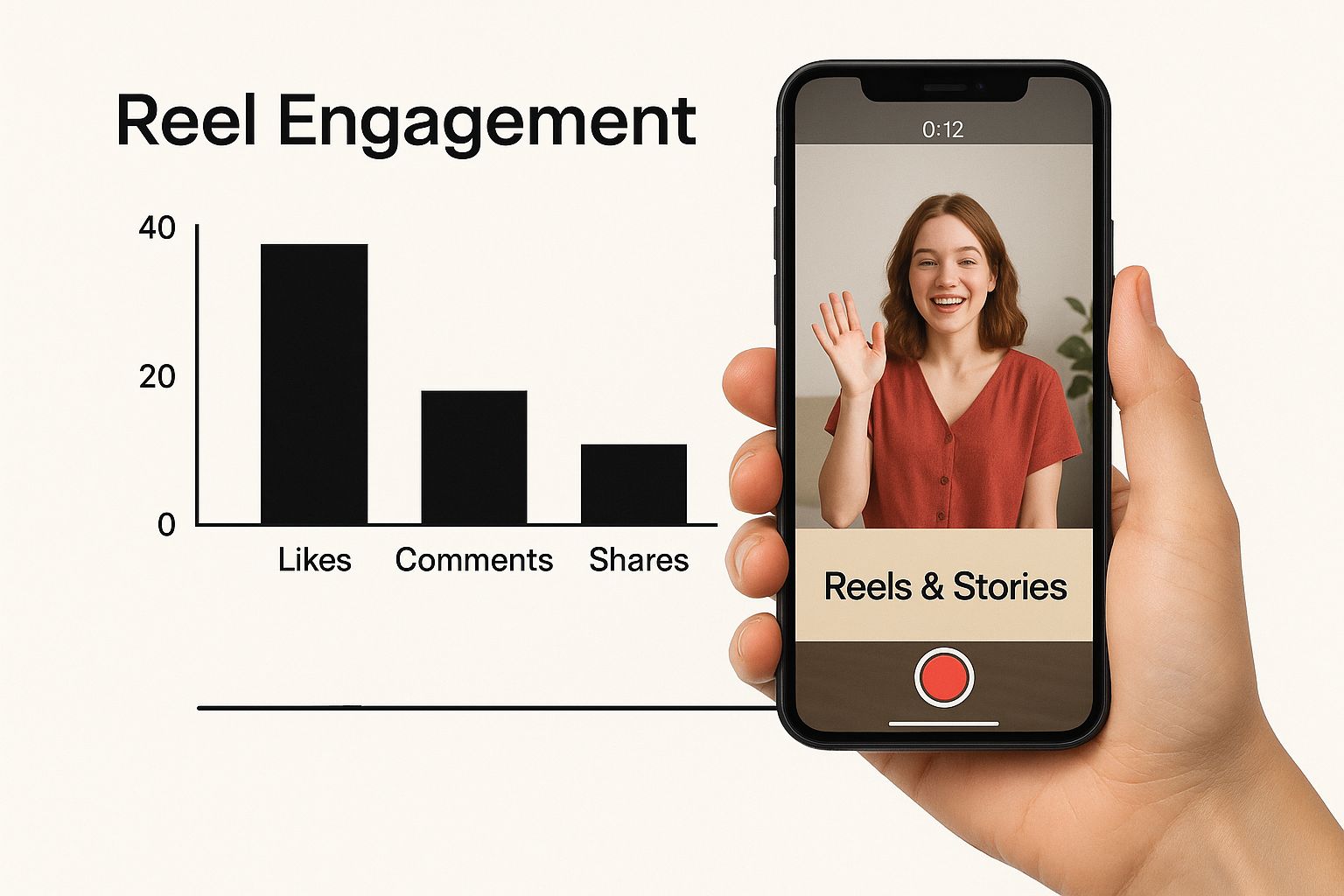
As this shows, your visual strategy with Reels and Stories is central to grabbing attention, and the right hashtags make sure those videos land in front of fresh eyes.
This isn't just busywork; the right tags can seriously move the needle. In fact, using a strategic set of hashtags can boost post engagement by up to 70%. That’s a massive lift for any artist trying to be heard.
A mix of hashtag types is essential for a balanced strategy. Here’s how you can think about building your own set.
Hashtag Strategy Comparison for Musicians
| Hashtag Type | Purpose | Example for an Indie Pop Artist |
|---|---|---|
| Broad | Reaching a wide audience, general categorization. | #IndieMusic, #NewMusic, #PopArtist |
| Niche/Community | Connecting with a targeted, passionate fanbase. | #DreamPop, #BedroomPop, #SynthPopVibes |
| Location-Based | Attracting local fans and industry connections. | #BrooklynMusic, #LAIndie, #LondonMusicScene |
| Branded | Building community and tracking user-generated content. | #ArtistNameMusic, #NewAlbumName, #ArtistNameTour2024 |
| Content-Specific | Describing the post itself to attract specific searches. | #AcousticCover, #LiveLooping, #StudioSession |
By blending these different types, you cast a wide yet targeted net, giving yourself the best chance to be discovered.
The Power of Smart Collaborations
Collaborating is one of the fastest ways to grow your audience because it’s a direct introduction to someone else's community. And I'm not just talking about landing a feature with a huge artist. Micro-collaborations can be incredibly powerful.
Think outside the box—you don't have to just partner with other musicians. Teaming up with creators in other niches can expose your sound to whole new worlds.
- Go Live with a Fellow Artist: Host a joint Instagram Live with another musician in your genre. You could chat about your creative process, perform a song together, or do a Q&A. When you go live, both of your audiences get notified, instantly cross-pollinating your fanbases.
- Create a Collaborative Reel: Find a dancer, a visual artist, or a filmmaker whose work you admire. Ask them to create a piece of content with your song as the soundtrack. When they post it, your music gets an authentic, engaging showcase in front of all their followers.
- Connect with Playlist Curators: Many influential playlist curators are active on Instagram. Start by genuinely engaging with their content to build a relationship. A simple share of your new track in their Instagram Story can drive hundreds of new listeners directly to your profile.
The key to a great collaboration is a genuine value exchange. You're not just asking for a shoutout; you're bringing your talent to the table to create something cool that benefits both of your audiences. It's all about community over competition.
These collaborative efforts are a cornerstone of a solid growth plan. You can see how they fit into the bigger picture in our complete guide on how to market your music as an independent artist. By combining a sharp hashtag game with smart partnerships, you build a powerful system for organic growth that constantly brings new listeners your way.
Turning Followers into a Loyal Fanbase
It's easy to get caught up in the numbers—likes, views, follower counts. But let's be honest, those are vanity metrics. They might look impressive on the surface, but they don't buy tickets, stream albums, or sell merch. The real value in your music career comes from the die-hards, the true fans who show up for you and champion your work. If you want to effectively promote music on Instagram, you have to stop broadcasting and start building a real community.
This is how you turn passive scrollers into a dedicated, loyal fanbase. It’s about ditching the one-way street of self-promotion and starting a genuine two-way conversation. When your audience feels seen and heard, they get emotionally invested in your journey, creating a bond that no algorithm can ever replace.
Spark Real Conversations
Your comment section and DMs? That's where the magic happens. Don't just heart a comment and move on—actually reply with something thoughtful. If someone says they love your new track, ask them what their favorite lyric is. If a fan shoots you a DM with a question, take a minute to answer it personally.
This kind of direct engagement pays off in two huge ways:
- It makes each fan feel individually seen, forging a powerful personal connection.
- It tells the Instagram algorithm that your content is creating meaningful interactions, which can give your posts a nice visibility boost.
I always think of every interaction as planting a seed. A simple, personal reply can easily turn a casual listener into a super-fan—the kind who not only streams your music but tells all their friends about it. That's grassroots marketing at its best.
Beyond just replying, use your captions to actively start conversations. Instead of the old "New song out now!" line, ask an open-ended question related to your track's theme. For example, if your song is about a road trip, you could ask, "What's the best road trip song of all time? Drop it in the comments!" This simple tweak turns a promo post into a community chat.
Empower Fans with User-Generated Content
One of the most effective ways to build a community is to make your fans part of the story. User-generated content (UGC) is an absolute goldmine for this. You should be actively encouraging your followers to use your music in their own Reels and Stories.
Here’s how to get the ball rolling:
- Create a simple challenge: Launch something low-pressure, like asking fans to share a video of their favorite chill spot using your new ambient track.
- Make your sound easy to find: When you post a Reel with your song, give the audio a clear, recognizable title so it’s a breeze for others to find and use.
- Celebrate their creations: This is the most important part. When a fan uses your sound, re-share their Reel to your Story. Make sure you tag them and add a personal note of thanks.
This small act of amplification makes your fans feel like they're collaborating with you. Suddenly, you’re not just an artist they follow; you’re someone they’re creating with. It fosters a powerful sense of belonging and turns your followers into active advocates for your music. For a deeper dive, check out our guide on how to build a loyal fan base as an independent artist for more strategies.
Go Beyond the Music
Finally, remember that your fans connect with you, the person, not just you, the musician. Don't be scared to show other sides of your personality. Use Instagram Stories to share what you’re listening to, what books you're into, or a quick behind-the-scenes glimpse of life outside the studio.
That kind of authenticity builds trust and makes your artistic journey feel much more relatable. When people feel like they know the person behind the music, their support becomes so much more meaningful. They're no longer just consuming a product; they're cheering for someone they feel a real connection to. And that connection is the ultimate goal when you promote music on Instagram.
Ready to Hit the Accelerator? A Musician's Guide to Instagram Ads
Organic growth is absolutely the soul of building a real community, but let's be honest—sometimes you need to give it a push. While your organic strategy helps you build deep connections, a smart, targeted ad budget is how you get your music in front of thousands of potential new fans, and fast.
This isn't about spending a fortune. It's about strategically using Instagram Ads as a high-precision tool to fast-track your growth.
Imagine putting the best 15-second hook of your new song directly into the feeds of people who already follow artists with a similar vibe. That’s the real magic here. You stop hoping the algorithm will find you and start actively putting your music where it belongs: in front of your ideal listeners.
Setting Up Your First Campaign
Jumping into Instagram Ads is way more approachable than it sounds. You don’t need a massive budget or a marketing degree to get started. The secret is to start small, test everything, and learn what resonates with your audience.
First things first: what’s the goal? Before you spend a dime, you need a clear objective for your ad. Instagram’s Ads Manager gives you a bunch of options, but for musicians, a few really stand out:
- Traffic: This is your go-to for driving people off-platform. Use it to send them straight to your Spotify profile, a new YouTube video, or your OohYeah page.
- Video Views: If your main goal is just getting your music heard and your face seen, this is it. Instagram will optimize the campaign to show your video to as many people as possible.
- Engagement: Want to build social proof? This objective focuses on getting likes, comments, and shares on the ad itself, making your post look more credible and popular.
With a goal in mind, you can move on to the most important part: audience targeting. This is where you can get incredibly specific. Target users based on their location, age, and—most importantly—their interests. You can zero in on people who follow certain artists, genres, or even music festivals.
The biggest mistake I see is trying to reach everyone. A hyper-targeted campaign is always better. Spending $20 to reach 1,000 people who are almost guaranteed to like your genre is far more effective than spending that same $20 to reach 10,000 who probably won’t care.
Crafting an Ad That Actually Stops the Scroll
Your ad’s creative—the actual video or image—is what makes someone pause their endless scrolling. For musicians, short-form video is everything.
The data doesn’t lie. Dynamic content like Reels consistently outperforms static images, with some studies showing Reels ads can drive 27% higher engagement. This makes video an absolute must for showcasing your sound and personality.
Here’s a quick checklist for a video ad that works:
- Hook them in 3 seconds flat. Start with a visually compelling shot or the most energetic part of your song. No long, slow intros.
- Design for sound-off viewing. Most people watch Stories and Reels without audio at first. Use on-screen text or captions to get your message across.
- Have a crystal-clear Call to Action (CTA). Tell people exactly what you want them to do next. Use simple, direct phrases like "Listen on Spotify" or "Watch the Full Video."
To see what world-class creative looks like, it’s always a good idea to study some successful social media advertising campaigns for inspiration.
Making Sense of the Numbers (and Getting Better)
Once your ad is live, the work isn't over. Now it's time to watch the data and figure out what’s working. Don't let all the metrics intimidate you; just focus on the numbers that tie back to your original goal.
If your objective was Traffic, the key metric is your Cost Per Click (CPC). This tells you how much you're paying every time someone clicks your link. A low CPC is a great sign that your ad is hitting the mark. If it's high, it might be time to tweak your video or your audience targeting.
On the other hand, if your goal was Video Views, keep an eye on your Cost Per ThruPlay. This shows what you're paying for each person who watches at least 15 seconds of your ad—a fantastic indicator of how engaging your creative is.
Running ads is all about continuous improvement. Test different video clips. Experiment with different audience interests. Try out various CTAs. With every campaign, you'll gather more data and get smarter, turning paid promotion into a reliable engine for growing your fanbase.
Got Questions? We’ve Got Answers.
When you're trying to figure out how to promote music on Instagram, a lot of questions pop up. It’s easy to get bogged down in the details—how often to post, what music you can legally use, which stats actually matter. Getting these things right is what separates a strategy that works from one that falls flat.
Let’s clear up some of the most common questions artists ask.
How Often Should I Be Posting, Really?
This is the classic question, and the answer isn't a magic number. It's all about finding a sustainable rhythm that keeps you in front of your audience without burning them out (or burning you out). Consistency beats frequency every single time.
If you’re looking for a solid starting point, here’s a schedule that works for most artists:
- Reels: Aim for 2-4 per week. Think of Reels as your discovery engine; they’re your best shot at getting in front of people who haven’t heard of you yet.
- Stories: Post 3-7 days a week, often multiple times a day. This is where you build your relationship with your existing fans. Keep it casual, behind-the-scenes, and personal.
- Feed Posts: Plan for 2-3 per week. These are your high-quality, "official" posts that build your brand and have a longer shelf life than a Story.
The golden rule? Don't sacrifice quality for quantity. It’s far better to post three incredible pieces of content each week than seven rushed, uninspired ones.
Can I Use Copyrighted Music in My Posts?
This is a huge point of confusion, and for good reason. The rules can be tricky. Instagram does have licensing deals that let you use popular songs from their built-in music library for Reels and Stories. That part is pretty straightforward.
The gray area appears when you're dealing with your own edits, unreleased music, or cover songs.
Using a track from Instagram’s music library is generally safe for personal use on the platform. But if you upload a video that includes a cover song or an uncleared sample you edited in yourself, you're entering risky territory. Your safest bet is to always stick with your own original music or sounds from the official library.
When it comes to ads or sponsored content, the rules get even tighter. To avoid having your content muted, removed, or your account flagged, only use music where you own 100% of the rights. No exceptions.
What Metrics Should I Actually Be Tracking?
It's tempting to obsess over likes and follower counts, but those are just vanity metrics. They don't tell you the whole story. To really gauge whether your music promotion is hitting the mark, you need to dive into your Instagram Insights (you'll need a Creator or Business account for this).
Forget the surface-level stuff and focus on the numbers that show real growth and connection:
- Reach: How many unique accounts saw your post? This is your best indicator of how well your content is spreading beyond your current follower base.
- Engagement Rate: This is the big one. It's calculated by adding up your likes, comments, saves, and shares, then dividing by your follower count. A high rate tells the algorithm that your content is valuable and worth showing to more people.
- Saves: When someone saves your post, it's a huge compliment. It means your content was so good they want to come back to it later. This is a powerful signal to the algorithm.
- Profile Visits: Did your Reel or post make someone curious enough to check out your profile? This is a crucial step in turning a casual viewer into a dedicated follower.
Watching these key metrics over time will show you exactly what's resonating with your audience. You can stop guessing and start making decisions based on what the data tells you.
Ready to turn your Instagram into a powerful hub for your music? OohYeah provides the tools you need to create a stunning link-in-bio page, sell music and merch directly to fans, and build a sustainable career. Take control of your music business.