Popular Music in Puerto Rico: A Complete Guide
Explore popular music in Puerto Rico, from bomba and salsa to reggaeton and Latin trap, plus tips for artists and industry professionals.
July 27, 2026
Music Marketplace Advisor
Buying & SellingPuerto Rico has become one of the most disproportionate music powerhouses in the world. If the island were counted as its own country, it would rank as the third-largest exporter of top 10 singles worldwide in 2023, with 45 hits according to the island music reference. That number reframes popular music in Puerto Rico as more than a local story, it's a global production system with deep roots and unusually strong export power.

The reason this matters for artists and industry professionals is simple. Puerto Rico didn't jump from folk tradition straight into global pop by accident, it built a long cultural bridge from bomba and plena into salsa, then into reggaetón and Latin trap. Contemporary coverage has even described Puerto Rico as one of the four new capitals of pop music, which tells you how far the island's influence has traveled in the same music overview.
For readers who want the music-business version of the story, that arc is the essential lesson. The island is not just producing hits, it's showing how a distinct local sound can stay rooted in identity while scaling worldwide. A broader Puerto Rican music guide at OohYeah Magazine fits into that bigger picture because the central question isn't whether Puerto Rico matters, but how its sound keeps reinventing itself without losing the thread.
Why Puerto Rico Matters in Global Music
Puerto Rico matters because its music ecosystem turns a small geographic footprint into outsized cultural reach. The point is not just that the island produces hits, it is that it repeatedly converts local identity into music that travels, adapts, and keeps its character as it moves outward.
That matters for anyone studying popular music in Puerto Rico because the island behaves less like a local scene and more like a relay station. A song can begin in neighborhood performance culture, pass through dance floors and radio, then reappear on global platforms without losing the pulse that made it feel Puerto Rican in the first place. For artists and industry professionals, that is a useful model. It shows how a scene can stay rooted while still speaking to listeners far beyond its home market.
The island's reputation also changed at the level of cultural branding. Contemporary industry coverage has described Puerto Rico as one of the four new capitals of pop music. That framing matters because it moves the conversation away from a narrow regional label and toward a broader view of influence, especially for readers who still know the island mainly through older genre categories.
A small island with a large output
The best way to understand Puerto Rico's reach is to avoid treating it as a single-genre story. The island's popular music has moved from Afro-Caribbean roots into salsa, then into the streaming-era dominance of reggaetón and Latin trap. That progression is not a chain of disconnected trends. It works more like a river system, where each channel keeps feeding the next one while carrying the same water, current, and sediment.
For independent artists, that continuity is the first lesson. A scene with that kind of history does not build global relevance by copying outside formulas. It builds it by keeping recognizable local traits alive while letting new styles take shape around them.
The infrastructure behind that continuity is practical, not abstract. It includes audiences, venues, radio habits, diaspora networks, and a long memory for dance music. It also includes the ability to absorb outside influences without flattening local character. The result is a scene that can sound unmistakably Puerto Rican even when it is reaching listeners far from the island.
A broader Puerto Rican music guide at OohYeah Magazine fits into that bigger picture, because the core question is how a local sound keeps renewing itself without breaking its own thread.
Why this article starts with scale
A lot of writing about popular music in Puerto Rico starts with genre names and stops there. That misses the strategic value of the island's musical history. Scale matters because it explains why the same cultural engine keeps producing new commercial waves without erasing the older ones.
Once that is clear, the next questions become more useful. How did the older local forms survive? What did salsa carry forward? How did reggaetón and Latin trap inherit that foundation while speaking to a new generation? For independent artists and industry teams, those questions are not just historical. They point to how a distinct sound can be developed, packaged, and released for modern direct-to-fan platforms without losing the identity that gives it weight.
The answer begins with the older roots that still shape the sound.
The Afro-Caribbean Roots That Still Shape the Sound
Before Puerto Rican music became a global export, it already had a community logic. Bomba, plena, jíbaro music, and danza formed a transculturated system built from African, Taíno, and Spanish influences rather than a single imported pop template as described in the National Assembly of State Arts Agencies resource. That matters because it explains why later genres on the island keep sounding layered, not generic.
Bomba and plena as social technologies
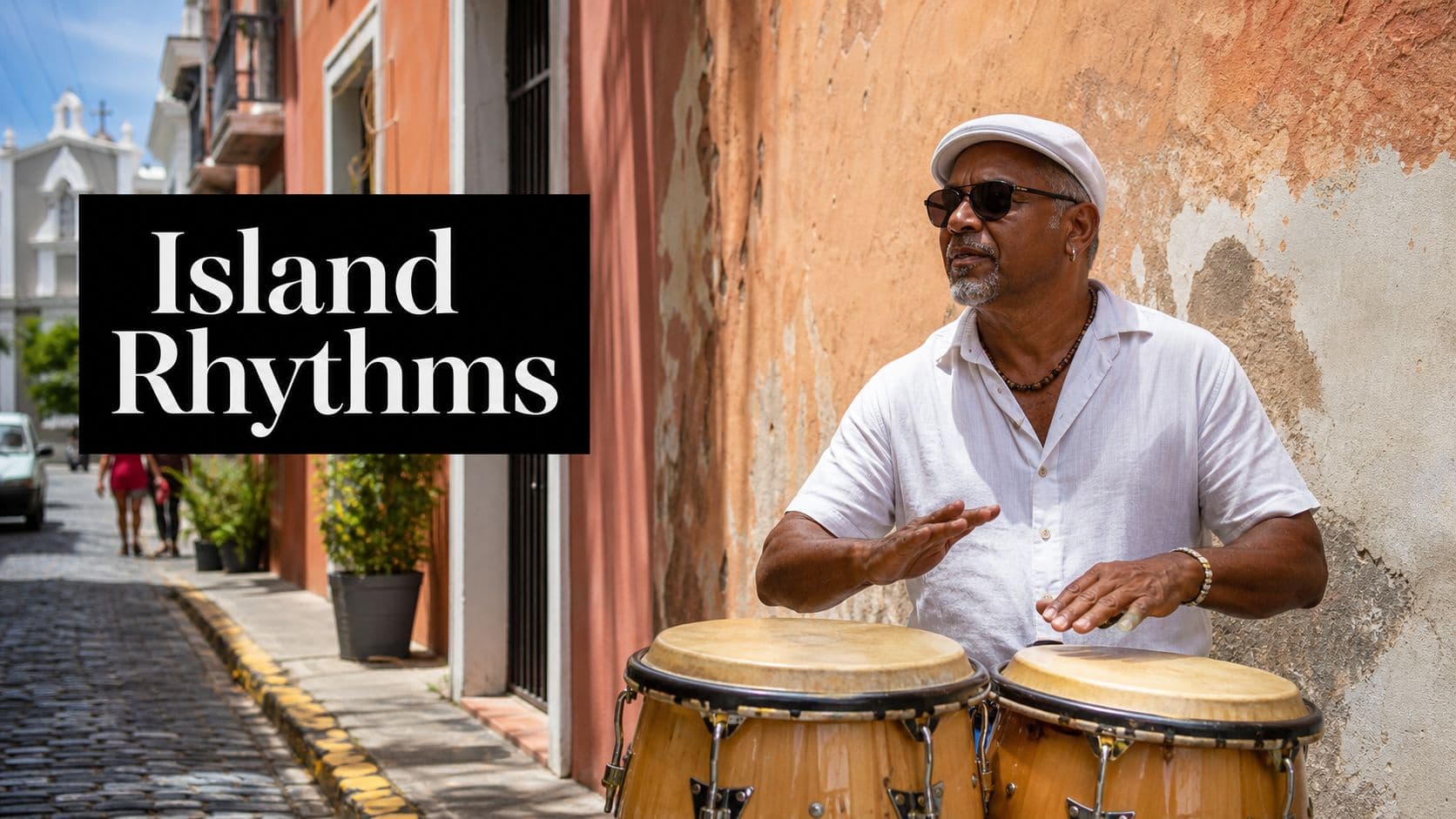
Bomba is often the easiest starting point for listeners to grasp because it places rhythm in the center of the room. In a bomba circle, the drummer and dancer are in conversation, and the dancer's movement can answer the drum in real time. That call-and-response energy is not a decorative feature, it's a social form. It turns performance into participation.
Plena works differently, but it has the same community orientation. Historically, it functioned like street-level reporting, with a pulse built for public narration and quick spread through neighborhoods. If bomba is a ritual of embodied rhythm, plena is the voice of the block, a genre that can carry gossip, commentary, humor, and grief without losing its danceable core.
A good way to hear the difference is this. Bomba feels like a body-led conversation, while plena feels like a sung newspaper with a drum section.
Jíbaro music and danza in the same family
Jíbaro music kept the mountain identity of the island visible, especially in settings where rural heritage mattered. Danza, by contrast, brought a more formal nineteenth-century salon sensibility into the story. Together, they show that Puerto Rican popular music has never been one thing. It has always been a set of related practices, each serving a different audience and occasion.
That's where many newcomers get confused. They hear a modern Puerto Rican hit and assume the island's music history begins with whatever genre is currently trending. It doesn't. The older forms survive in attitude, phrasing, and rhythmic instinct. You can hear it in the emphasis on communal participation, in the way stories are told through music, and in the fact that dance is still tied to identity rather than just nightlife.
For songwriters and producers, the lesson is practical. If you want Puerto Rican influence to feel real, don't paste a cliché on top of a beat. Study the social role the older genres played first, then decide what that role looks like in a modern track.
How Salsa Carried Puerto Rico to the World Stage
Salsa became the genre that many outsiders still associate most closely with Puerto Rico because it translated local dance energy into a worldwide language. The island's music tradition already had the rhythmic and communal pieces salsa needed, so the genre didn't land as a foreign import. It sounded like an extension of what was already there, only amplified for bigger stages and larger audiences.
What made salsa travel
The core salsa toolkit is easy to describe once you know what to listen for. The montuno piano pattern creates forward motion. The tumbao bass line keeps the groove grounded. The coro-pregón structure, the exchange between lead singer and chorus, turns each song into a live conversation. Those elements helped salsa carry the energy of older Puerto Rican forms into clubs, recordings, and touring circuits.
Salsa's reach also depended on diaspora circulation. Puerto Rican musicians, especially in New York, helped shape the sound as it developed in club culture and then fed it back to the island. That back-and-forth relationship made salsa more than a genre. It became a transnational identity marker.
Why dancers still use salsa as a reference point
If you want a modern listening test, hear how salsa still functions in social dance settings. A resource like the best Latin dance clubs in Philadelphia shows how the genre remains alive outside Puerto Rico, not as nostalgia, but as a living dance practice. That's important because salsa's endurance is one reason Puerto Rican music kept a foothold in international nightlife long before streaming platforms became dominant.
The genre also gave Puerto Rican artists a model for prestige. It showed that island musicians could compete on equal footing with other Caribbean and Latin American scenes. That prestige mattered commercially, but it mattered culturally even more. Salsa taught audiences to hear Puerto Rico as a place that could define, not just absorb, a major popular form.

By the time salsa matured into multiple styles, it had already done its biggest job. It proved that Puerto Rican music could be both distinctly local and internationally legible. That proof became the foundation for the next wave.
The Underground-to-Mainstream Pipeline
The jump from salsa to reggaetón looks sudden from far away, but locally it was gradual and messy. Puerto Rican hip-hop emerged as an underground subgenre in the late 1980s and early 1990s, with mixtapes helping distribute it before streaming existed as noted in the Puerto Rican hip-hop reference. That DIY distribution culture matters because it created a pathway from niche scenes to mass-market visibility.
Mixtapes, clubs, and the early digital logic
Mixtapes weren't just a format, they were a business model. They moved tracks through networks of DJs, neighborhoods, and clubs, letting artists build followings before radio or major labels paid attention. In practical terms, that meant the audience helped test the music in public long before a formal release strategy existed.
Reggaetón formed inside that environment. Spanish-language rap met dancehall riddims, club systems, and local street culture, producing a style that sounded immediately urban and unmistakably Caribbean. The important point is not that this happened in a neat sequence. It didn't. Scenes overlap, and genres blur before they get named.
What looks like a genre from the outside often began as a circulation pattern first.
That serves as the bridge to today's platforms. Short-form video, streaming algorithms, and direct fan communities now do some of the work that mixtapes once did. They let artists test hooks, build identity, and find audiences without waiting for a gatekeeper to approve the release.
Why this matters for current strategy
Many artists still think the old pipeline was just historical color. It wasn't. It shows how Puerto Rican music has repeatedly moved from local experimentation to broader dominance by using the best available distribution channel of the moment. In the mixtape era, that channel was physical circulation. Today, it's platform circulation.
That's why modern release planning should be built around discoverability, not just completion. If an artist understands how the underground built the mainstream in Puerto Rico, they're less likely to waste time chasing a single big moment. They'll build a sequence of smaller ones that add up to something larger.
Reggaetón, Latin Trap, and the Modern Global Takeover
Reggaetón and Latin trap didn't erase Puerto Rico's older music. They condensed it into a form that could move through global pop systems at speed. That's why the island can now be seen as a major engine of contemporary Latin music, not just a birthplace of one style. The shift is easier to understand if you listen for what stayed the same.
What survived from the older tradition
The first thing that survived is call-and-response energy. Even when a reggaetón hook is minimalist, it still invites a crowd response. The second is rhythmic insistence. The genre's percussive spine keeps the body oriented toward movement, much like the older dance forms that made community participation central.
The third is narrative swagger. Plena's storytelling habit didn't disappear, it changed clothes. In reggaetón and Latin trap, the storytelling is often compressed, stylized, and more personal, but it still relies on vivid scene-setting and a strong point of view. That's part of why Puerto Rican artists feel specific even when their music travels globally.
Why the global audience still hears Puerto Rico in the sound
One reason the modern genres crossed over so effectively is that they can absorb outside influence without losing their center. Dembow brings in a Jamaican lineage. Trap adds darker textures and more introspective tone. Pop and R&B widen the melodic frame. But the core delivery, rhythmic confidence, and local verbal style keep pulling the music back toward Puerto Rico.
Many listeners often misunderstand this point. They hear global polish and assume the local identity has been diluted. In practice, the opposite often happens. The more precisely Puerto Rican artists control the blend, the more exportable the record becomes.
That balance explains why names like Daddy Yankee, Bad Bunny, and Residente matter so much in the broader conversation. They don't just represent popularity, they represent a mature export system that knows how to translate place into scale. The music is global, but the coding is still local.
Reading the Local Market Before You Release a Track
Puerto Rico's listening habits give artists a clear starting point before a release goes live. An island poll reported by Caribbean Business, WOSO Radio, and Gaither International found that 90% of Puerto Ricans listen to music, which means music is part of daily life for nearly everyone as reported here. For independent artists, that is a reminder to treat the island as an active listening culture, not a passive audience.
What the listening mix suggests
The same survey found that 31% preferred ballads or romantic music, while 26% chose salsa. Those preferences matter because they show that older emotional and dance traditions still sit near the center of everyday taste. A release plan that assumes Puerto Rican listeners only want the newest club record misses a large part of the market.
The format data points in the same direction. 68% of respondents said they listen on home radios, 12% on car radios, and 10% on CD players. That pattern suggests a listening environment shaped by shared rooms, commuting, and familiar physical formats, not only by headphones and app feeds as reported here.
| Music Format Preferences Among Puerto Rican Listeners | Share of Listeners |
|---|---|
| Home radios | 68% |
| Car radios | 12% |
| CD players | 10% |
Three practical release decisions
- Build for broad rooms, not just private listening. Home radio dominance suggests mixes should hold up on speakers in kitchens, living rooms, and other shared spaces.
- Keep ballad and salsa audiences in view. Those styles still represent real demand, even in a reggaetón-driven era.
- Do not treat the island as a trend-only market. A mature audience often responds to songs that feel familiar, well-made, and emotionally clear.
For independent artists, that makes hybrid positioning a strength rather than a compromise. A track can nod to tradition without sounding retro, much like a new arrangement of a familiar standard. A campaign can respect local habits while still aiming for broader digital reach.
A marketplace view of the island audience can sharpen that strategy further, especially when artists are deciding which formats, bundles, or fan offers make sense before release. A marketplace view for release planning helps artists compare what they are offering with how local listeners are likely to discover and share it.
Promoting Puerto Rican-Influenced Music in 2026
A strong promotion plan for Puerto Rican-influenced music has to do two jobs at once. It has to earn attention in algorithmic spaces, and it has to respect the island's older radio-and-songcraft habits. That's why a hybrid strategy beats a one-channel approach.
Start with discovery, then earn the deeper fan relationship
Short-form video is now one of the fastest ways to get a hook into circulation. A dance-ready chorus, a memorable one-line refrain, or a beat-switch moment can become the entry point that gets a listener to search the full track. Playlist pitching still matters too, because curated placement gives new music a chance to live beside related sounds instead of fighting for attention alone.
Once discovery happens, the work begins. Direct-to-fan tools let artists convert casual listeners into people who follow, buy, and return. The OohYeah services page is a good example of how an artist-first platform can combine streaming, sales, and fan interaction in one place, which matters when a release needs both reach and ownership.
Use community features as part of the campaign
Promotion is stronger when it feels like a conversation. Voice notes, direct messages, and community posts give artists a way to extend the story behind a song without turning every interaction into an ad. That's especially useful for music with Puerto Rican roots, where cultural context often deepens the listening experience.
Promotional rule: don't separate marketing from belonging. The most durable fans usually arrive through repeated contact, not one viral moment.
The advantage of a commission-free, artist-controlled model is that it gives creators more room to test offers, pricing, and content without handing every decision to a middle layer. That matters for independent artists who need sustainable growth more than a single spike. It also matters for managers and promoters who want a clearer path from attention to revenue.
The best 2026 strategy is simple to state, even if it takes discipline to execute. Use short-form content for discovery, radio and playlist logic for context, and direct fan tools for retention. Puerto Rican-influenced music has always traveled best when it keeps one foot in community and one foot in the wider market.
What the Whole Story Means for Artists and Fans
The big lesson in popular music in Puerto Rico is that nothing important here starts from zero. Every era has kept something from the last one, whether that's rhythmic conversation, communal storytelling, or the instinct to make music that people can dance to together. That's why the island's influence keeps expanding without losing its sense of origin.
For independent artists
If you make music with Puerto Rican influence, your job isn't to copy a genre template. Your job is to understand the lineage well enough to borrow responsibly from it. Dembow, salsa piano, ballad emotion, and trap texture can all sit in the same creative world if the arrangement has a clear point of view.
For industry professionals
The discovery pipeline is no longer limited to radio offices and label halls. Talent now emerges through platform behavior, fan communities, and rapid feedback loops that can resemble the old mixtape era in spirit, even if the tools are different. If you're doing A&R, artist management, or promotion, you need to track where people are gathering, not where they used to gather.
For fans
Supporting the music directly now matters in very practical ways. Buying from commission-free marketplaces, subscribing to artists, and showing up for local showcases all help preserve the ecosystem that makes the next wave possible. If you want a deeper craft lens on how artists keep listeners engaged across formats, Flexwork's storytelling guide is a useful complement to the musical history here.
The future of Puerto Rican popular music will keep depending on that same pattern, old energy translated into new formats. As long as creators keep carrying the communal force of bomba and the narrative drive of plena into modern production, the island's influence won't just continue, it'll keep compounding.
OohYeah gives artists a direct way to stream, sell, and market music without giving up control of the relationship with fans. If you're building Puerto Rican-influenced music or helping artists grow around it, visit OohYeah to see how commission-free sales, fan interaction, and creator-first tools can support the next release.