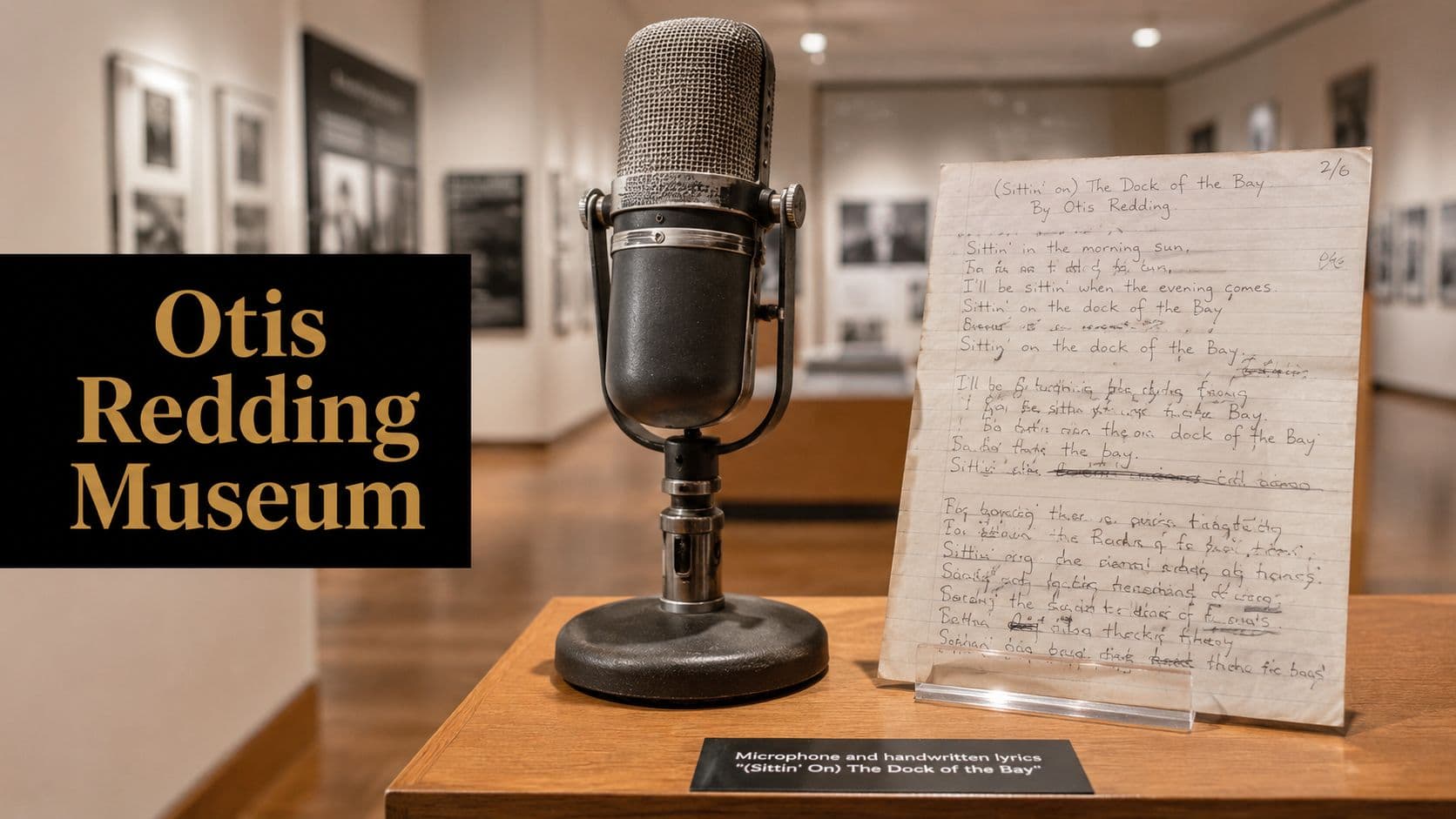
The Otis Redding Museum: A Complete Visitor's Guide
Planning a trip to the Otis Redding Museum in Macon, GA? Get hours, tickets, exhibit details, and tips to explore the legacy of the King of Soul.
July 17, 2026
Music Marketplace Advisor
Buying & SellingA friend once told me that the first time he heard Otis Redding, he pulled his car to the curb and let the song finish before moving again. That's the right way to arrive at the Otis Redding Museum too. Not in a rush, but ready to listen.
The Enduring Voice of Soul Music
Some singers sound good on record. Otis Redding sounds alive. His voice doesn't sit politely in the speakers. It reaches, pleads, shouts, consoles. Even if you came to him through a greatest-hits playlist or a parent's worn-out favorite, you probably remember the moment his singing stopped feeling like old music and started feeling immediate.
That's what makes the Otis Redding Museum more than a stop on a travel itinerary. In Macon, Georgia, his legacy has a street address, a front door, and rooms filled with evidence that a human being stood at the center of all that sound.

Why the place matters
Music fans talk about pilgrimages for a reason. Some places hold more than memorabilia. They hold context. Standing in a room devoted to Otis Redding in his home state changes the scale of the story. The records aren't just famous records anymore. They become the output of a working artist from Georgia whose songs still travel farther than most careers ever do.
For fans, the museum offers that intimate jolt of recognition. For musicians, it offers something else. Proof that style and sincerity can live in the same body. That stage power means more when it comes from emotional truth. That a song can feel handmade and monumental at the same time.
Practical rule: Go with one or two Otis songs already in your head. The museum experience deepens when you're carrying the music with you.
What this visit gives you
A good museum tells you what happened. A great one makes you feel the stakes. The Otis Redding Museum does both, and it does it in a city that understands music as part of its civic identity.
If you love soul, Southern music history, or the anatomy of a great performer, this is sacred ground. If you make music yourself, it can feel even more personal. You don't just leave with admiration. You leave with a sharpened sense of what an artist's life can still mean long after the microphone goes quiet.
The Heart of a Legacy Museum History and Significance
On Cotton Avenue in Macon, Otis Redding's story stops feeling like a chapter in music history and starts feeling local, lived, and close enough to touch. The street itself matters. You are standing in the city that shaped him, hearing his legacy in the same place where family, community, and ambition were never separate things.
The museum carries that family imprint. It exists within the work of the Otis Redding Foundation, so the experience has a living current running through it. The rooms honor a singular artist, but the larger mission reaches past remembrance and into music education, creative development, and young people finding their own voice. That gives the museum unusual weight. Memory is being cared for by people who still believe music can change a life in the present tense.

More than preservation
Some music museums preserve the remains of greatness. This one preserves a chain of influence.
That distinction matters in Macon. Otis Redding is not framed only as a finished legend whose work has been safely placed behind glass. His museum sits inside a wider effort to keep creative opportunity active in the same community that gave him his start. For a fan, that deepens the emotional charge. For a young songwriter or performer, it changes the lesson entirely. The past is not sealed off. It is still feeding the future.
You can feel that significance in three directions at once:
- It keeps Redding's legacy grounded in place. Macon is part of the story, not just the map pin.
- It preserves the human scale of an icon. The museum brings visitors back to the working artist behind the immortal songs.
- It ties tribute to creative continuation. The foundation's broader work helps connect a historic legacy with the next generation of musicians.
A legacy recognized far beyond Georgia
Macon gives the museum its emotional center, but Redding's reach has always stretched far past city limits. A strong example came when the Grammy Museum in Los Angeles mounted a dedicated exhibit that ran through September 2016, as noted in Biography's account of Otis Redding. Recognition on that scale confirms what soul fans already know. His voice belongs to American music history, not only to regional memory.
That wider recognition makes the Macon museum feel even more meaningful. National institutions can honor Otis Redding's impact. His hometown can hold the story at eye level.
Why working artists should care
There is a practical lesson here for musicians who are still building. Redding's legacy did not begin with legacy. It began with songs, performance, discipline, risk, and a bond with listeners strong enough to outlast fashion and time.
That is why the museum can hit current artists so hard. You walk in to honor a giant of soul and walk out thinking about your own standards. What are you making that will last. What are you building in your city. How do you connect craft with community.
That same creator-first belief shows up in modern tools built for independent artists, including OohYeah's approach to helping artists own the relationship with their audience. In that sense, the museum is not only a memorial. It is a quiet challenge to make work that deserves to be carried forward.
Inside the Museum Key Exhibits and Artifacts
Walk into the Otis Redding Museum and the distance between icon and individual starts to collapse. The rooms don't ask you to admire a vague legend. They ask you to stand close to the texture of a career. Fabric, paper, photographs, awards. The objects do what good soul music does. They make emotion tangible.
One of the most arresting sights is the stagewear. Performance clothes always tell the truth on some level. They show how an artist wanted to be seen when the lights hit.

The power of stage presence in still form
A displayed suit can do something strange to your sense of time. On a hanger or mannequin, it's silent. But if it belonged to a performer like Redding, you can almost reconstruct the movement around it. The heat of the stage. The tightness of a live band. The split second before a singer leans into a phrase and changes the room.
That's part of the museum's gift. It takes garments and turns them back into motion in your mind. You don't just register style. You register intent. Soul wasn't casual. It was meticulously crafted, sweated through, and delivered to the back row.
Artifacts that feel personal
The most affecting music museums usually combine public triumph with private evidence. You move from signs of stardom to traces of ordinary life, and the artist becomes fuller.
At the Otis Redding Museum, visitors can expect the kind of materials that make a career feel handmade and lived-in:
- Stage outfits and performance pieces that evoke the physical force of Otis Redding onstage.
- Photographs and family materials that shift the emphasis from legend to lineage.
- Career memorabilia and awards that mark recognition without draining the story of its intimacy.
- Personal items and written materials that suggest process, not just fame.
None of that lands as a sterile catalog when you're in the room. It feels cumulative. You start to understand that charisma on record rested on labor off record.
A museum artifact works best when it makes you ask not “What is this?” but “What day of his life did this belong to?”
Gold records and the sound of arrival
There's a special kind of electricity around records, plaques, and career honors. They represent success, yes, but they also capture thresholds. Somebody heard the song. Then more people heard it. Then the wider culture couldn't ignore it anymore.
In that sense, display cases full of recognition pieces are less about bragging rights than momentum. They show the mechanics of ascent. For younger artists, those pieces can feel instructive. Every honor on the wall once began as a recording session, a rehearsal, a risk, a decision to keep going.
If you want a moving visual preview before you visit, this video adds another layer of context:
The room as a portrait
What stays with many visitors isn't a single object. It's the assembled portrait. A museum like this turns fragments into a voiceprint. Clothes suggest confidence. Photos reveal tenderness. Awards show reach. Memorabilia fixes a once-fleeting career in place long enough for us to study it.
That assembled feeling matters because Otis Redding's artistry was never only one thing. He could sound urgent and vulnerable in the same breath. A museum display, at its best, can mirror that layered quality.
Here's how different visitors often read the same room:
| Visitor | What stands out first | What lingers after |
|---|---|---|
| Lifelong fan | Recognition of songs and image | The nearness of the personal story |
| Casual listener | The visual charisma of the exhibits | A deeper respect for the breadth of his legacy |
| Working musician | Clues about performance and discipline | The seriousness behind every public triumph |
Why the details matter
A handwritten note, a family photograph, a performance outfit behind glass. None of these sing on their own. Together, they remind you that immortal music comes from mortal days. Someone got dressed. Someone traveled. Someone revised a line. Someone stood under pressure and delivered.
That's why the Otis Redding Museum doesn't feel like a warehouse of old things. It feels like a conversation between effort and memory. Every artifact answers the same question in a different way. What does devotion to music look like when it leaves marks on the physical world?
A Source of Inspiration for Fans and Musicians
For a fan, the Otis Redding Museum can feel like a homecoming even if you didn't grow up in Macon. You walk in carrying songs. You walk out carrying a person. That shift matters because fandom deepens when admiration meets context.
For musicians, the experience can land even harder. Museums often flatten artists into achievement. This one pushes in the opposite direction. It restores the work behind the aura. When you see the physical remains of a career, you're reminded that art doesn't arrive polished from the heavens. Somebody built it through repetition, conviction, and taste.
What artists can take from the visit
A visit like this can sharpen your creative instincts in practical ways:
- Guard your emotional core. Redding's music still hits because it sounds emotionally available, not over-defended.
- Treat presentation as part of the art. Stagewear, photographs, and visual identity all contribute to how audiences remember a performer.
- Build something that lasts beyond the release cycle. Songs are one layer. Legacy also depends on values, relationships, and stewardship.
Those lessons gain extra force because the museum serves a larger purpose. As noted in a video about the foundation's role in Macon, the museum at 339 Cotton Avenue acts as a cultural anchor for the Otis Redding Foundation's mission to nurture aspiring musicians. That changes the meaning of a visit. The legacy on display isn't frozen. It's feeding active work around music and opportunity.
Fans get memory. Creators get a challenge
There's a reason some musicians leave museums energized and a little unsettled. The artifacts ask silent questions. Are your songs honest enough? Are you giving your audience something recognizable and unmistakably yours? If your career ended up summarized in one room someday, what would those objects say about your standards?
For creators: Don't only admire the finished legacy. Study the habits and choices that made it possible.
That's where the Otis Redding Museum separates itself from a simple nostalgia trip. It offers reverence, but it also offers instruction. You can honor the past and still feel pushed toward your own next draft, next rehearsal, next better performance.
Planning Your Visit Logistics and Local Tips
If you're making the trip, lock down the practical details first. The Otis Redding Museum is located at 339 Cotton Avenue, Macon, Georgia 31201, and it's open Monday through Friday from 10:00 AM to 5:00 PM. It is closed on weekends, and regular admission is $8, according to the official museum information from the Otis Redding Foundation. For school visits or large groups, the museum asks visitors to contact [email protected] about group rates.

The essentials at a glance
| Detail | What to know |
|---|---|
| Address | 339 Cotton Avenue, Macon, Georgia 31201 |
| Hours | Monday through Friday, 10:00 AM to 5:00 PM |
| Weekend access | Closed on weekends |
| Admission | Regular entry is $8 |
| Group visits | Contact [email protected] |
| Phone | (478) 742-5737 |
How to plan the day well
Because the museum keeps weekday hours only, timing matters. If you're traveling in from outside Macon, build your day around an earlier arrival rather than treating the museum as a late-afternoon add-on. Soul history deserves more than a rushed final hour.
A few simple strategies help:
- Arrive ready to linger. Give yourself time to read, look closely, and let the rooms breathe.
- Call ahead if you need specifics. The listed phone number is useful for practical questions before you go.
- Sort out group plans in advance. Schools and larger parties should email rather than assume walk-up arrangements.
If you're traveling for music history, weekday structure isn't a small detail. It shapes the whole rhythm of the trip.
Make a day of Macon music
The smartest way to visit the Otis Redding Museum is to treat it as the center of a wider Macon music day. The city rewards listeners who want more than one stop. Other well-known landmarks often enter the conversation, including The Big House and Capricorn Sound Studios, both of which help place Redding's museum within a broader local tradition of Southern music making.
Even without overpacking your schedule, it's worth leaving room to walk downtown, absorb the setting, and connect the museum visit to the streets around it. Cotton Avenue doesn't feel abstract once you've been there. It becomes part of the memory.
For artists and collectors who like pairing travel with music commerce, fan engagement, and creator-focused discovery, the OohYeah marketplace offers a modern complement to that same music-first mindset.
Beyond the Museum Walls Deepening Your Connection
The Otis Redding Museum matters because it gives permanence to feeling. Songs can seem weightless when they stream past us all day. A museum restores gravity. It tells you that a voice this powerful came from a life with places, objects, family, work, and community attached to it.
That's why the visit shouldn't end at the exit. If the museum moves you, keep going. Read deeper. Listen more carefully. Follow the thread from the recordings to the larger story.
Where to continue
A strong next step is the Otis Redding Foundation itself. The museum makes more sense when you understand the living work around it. That broader frame turns remembrance into responsibility.
Then go back to the music with intention. Don't just shuffle the familiar track everyone knows. Spend time with the albums, the live performances, the pacing of his phrasing, the way he could bend a line until it sounded half-spoken and wholly felt.
A simple post-visit approach works well:
- Revisit essential recordings with the exhibits still fresh in your mind.
- Look for documentaries and biographies that place the songs inside the arc of his life.
- Pay attention to influence. Listen for Redding's fingerprints in later soul, R&B, rock, and singer-songwriter traditions.
Why the connection lasts
Some museums impress you for an afternoon. The Otis Redding Museum can change how you hear music afterward. It narrows the gap between art and artist, then widens your sense of what legacy can be.
If you care about the future of music as much as its history, keep that curiosity active. Read artist stories, study creative careers, and stay close to platforms that take musicians seriously. OohYeah Magazine is one place to continue that conversation from a creator-focused angle.
If the Otis Redding Museum reminds you why music matters, OohYeah is worth a look. It gives artists a place to stream, sell, and connect directly with fans while keeping control of their work, and it gives music lovers a closer path to the creators they believe in.