Build a Musicians Press Kit That Gets You Booked
Stop guessing what bookers and media want. Our guide breaks down how to build a modern musicians press kit that opens doors and gets you noticed.
September 25, 2025
Music Marketplace Advisor
Buying & SellingThink of a musicians press kit as your professional resume for the music industry, neatly bundled into one digital package. It’s your go-to tool for landing on the radar of booking agents, journalists, and festival programmers—the people who can move your career forward.
What a Modern Musicians Press Kit Actually Does
Let's be clear: we're not talking about the old-school method of mailing bulky folders stuffed with paper clippings. Today’s Electronic Press Kit (EPK) is a sleek, shareable, and living document that acts as your digital handshake. It’s not just a random collection of your stuff; it’s a thoughtfully designed presentation that tells your story and sells your music at a glance.
A truly effective press kit goes beyond just listing your achievements. It instantly builds your credibility and signals to everyone that you're a serious professional. When a busy venue manager or blogger opens your EPK, they get everything they need without having to hunt for links or download clunky files. That respect for their time is what gets you noticed.
The Power of a Professional First Impression
The music industry moves fast. Key decision-makers are swamped with emails and submissions every single day. Your EPK has to slice through that noise by being organized, visually sharp, and complete.
It’s the central hub for your most critical assets:
- Your Story: A compelling artist bio that grabs them from the first sentence.
- Your Sound: Your best tracks, ready to stream instantly.
- Your Look: High-resolution photos and videos that define your brand.
- Your Proof: Press clippings, past achievements, and all your contact details.
This organized approach is also fundamental to growing your audience. If you want to dive deeper, we have a whole guide on building a fanbase to sell your music that you'll find useful.
A killer EPK works for you 24/7. It’s your silent representative, opening doors you never thought possible. It's what separates the hobbyists from the pros ready for the big leagues.
In the end, a modern musicians press kit is your most powerful storytelling tool. The numbers don't lie: with over 85% of artists using EPKs, a well-put-together kit can increase your chances of getting media coverage and gigs by more than 40%. It’s not just a nice-to-have; it's an essential investment in your career, and you can learn more about the impact of a professional press kit to see just how crucial it is.
7 Essential Components for Your Musicians Press Kit
Putting together a powerful press kit is all about gathering the right ingredients. Each piece has a specific job to do, and when they all work together, they paint a picture of a polished, professional artist who's ready for the next level. Don't think of it as just ticking boxes on a checklist; you're actually curating your best work to make a promoter's or journalist's life a whole lot easier.
The real goal here is to give them everything they could possibly need in one slick, easy-to-use package. We're talking more than just a quick bio and a couple of songs. Industry pros need high-quality, ready-to-go assets they can grab for articles, show posters, and social media blasts without having to chase you down for them.
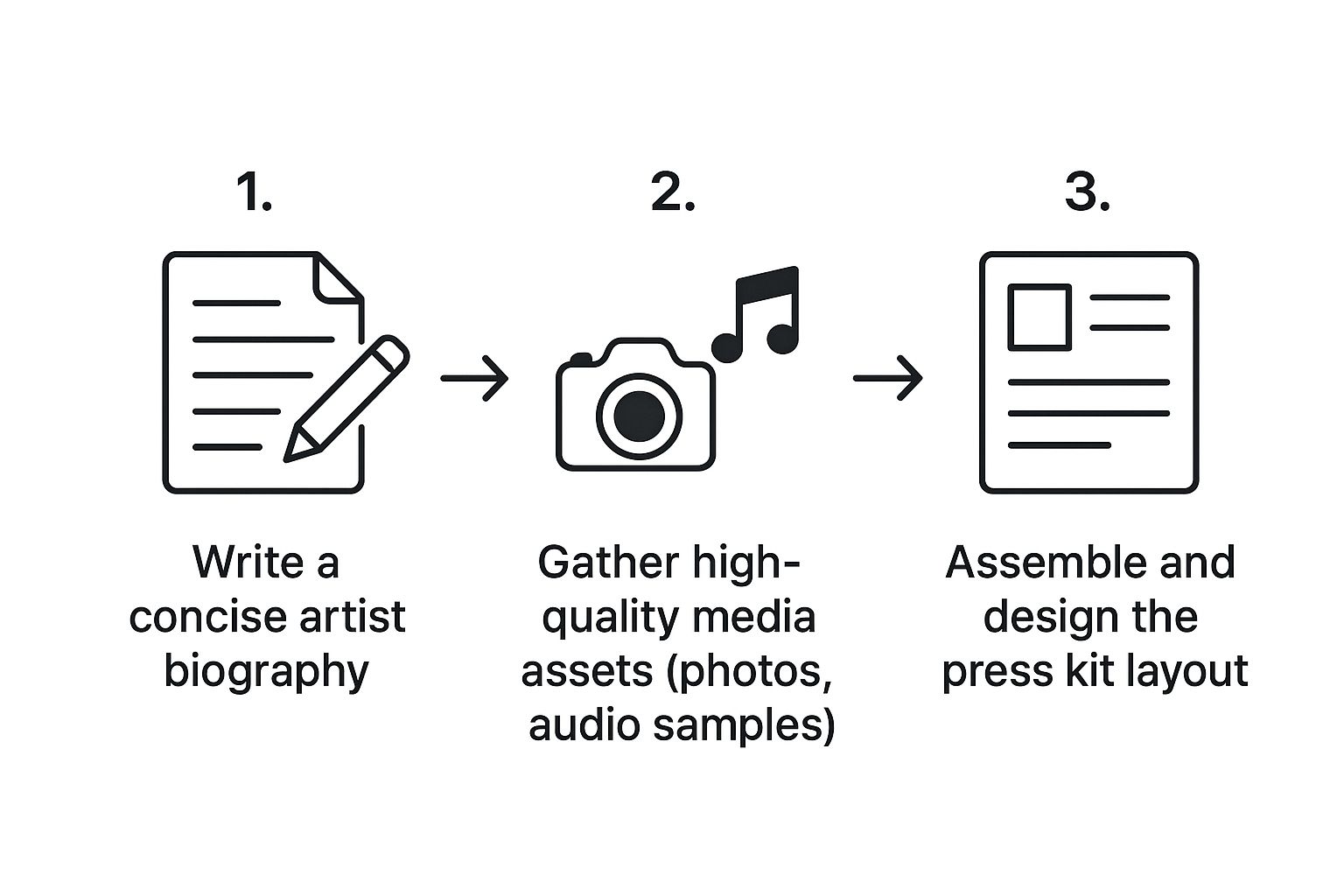
This workflow is a great roadmap. It shows you how to build your kit logically: first, get your story straight, then pull together your media, and finally, package it all up professionally. Following a clear path like this means you won't forget something crucial.
Your Core Media Assets
Okay, let's start with your photos. One good headshot isn't going to cut it. A promoter pulling together a festival poster or a blogger writing a feature needs options. You should have a folder ready with a solid mix of professional shots.
- High-Resolution Press Photos: Make sure you have both landscape (horizontal) and portrait (vertical) options.
- Live Performance Shots: Nothing sells a show like a photo that captures your energy on stage.
- Band/Group Photos: These are key for establishing your visual brand and aesthetic.
Next, your music. Resist the urge to send them your entire back catalog. Instead, carefully pick 3 to 4 of your absolute best tracks—the ones that perfectly capture your current sound. These need to be high-quality and easy to stream. No one has time to download massive files for a first listen. These tracks are your musical handshake, so make them count.
Think of your EPK as a snapshot of your career right now. Every photo, every song, and every word should tell a single, compelling story about who you are as an artist.
The Power of Video and Written Content
In this day and age, video is a must-have. A killer music video is great for showing off your creative vision, but for booking agents, a well-filmed live performance video might be even more valuable. It’s direct proof that you can command a stage and put on a great show, which is what they care about most. Having at least one of each demonstrates both your artistic depth and your live chops.
Finally, your artist bio is the glue that holds all of this together. We'll get into the nitty-gritty of writing a compelling bio later, but for now, make sure you have a few versions on hand: a short one-paragraph blurb and a longer version of 3+ paragraphs. This flexibility is gold, as different opportunities will have different needs. Plus, well-written content is a huge asset when you want to attract fans to your music profiles, giving new listeners a story to connect with.
To help you keep track, here’s a quick-reference guide to the core components every artist needs in their press kit.
Essential Musicians Press Kit Checklist
This table breaks down the must-have elements, their purpose, and what a good example looks like in practice.
| Component | Key Objective | Best Practice Example |
|---|---|---|
| Artist Bio | Tell your story and connect with the reader. | Have short, medium, and long versions ready for different uses. |
| High-Res Photos | Provide professional, versatile images for promotion. | A downloadable folder with both live and press shots (portrait & landscape). |
| Your Best Music | Showcase your sound and songwriting. | Embed a private SoundCloud or Disco player with 3-4 of your strongest tracks. |
| Music/Live Videos | Demonstrate your artistic vision and performance ability. | Include one official music video and one high-quality live performance video. |
| Press & Reviews | Build credibility with social proof. | A "press" section with pull-quotes and links to articles from blogs or magazines. |
| Notable Achievements | Highlight your career milestones and successes. | A bulleted list of festival appearances, opening slots, awards, or streaming numbers. |
| Contact Info | Make it easy for people to reach you or your team. | Clearly list contact info for booking, press, and management. |
Think of this checklist as your foundation. Once you have these core pieces polished and ready to go, you'll be prepared for any opportunity that comes your way.
Writing a Bio That Actually Gets Read
Your artist bio is the heart of your press kit. It’s more than just a list of accomplishments; it's the story that hooks a journalist, a booking agent, or a festival programmer and makes them want to listen to your music. This is your first real chance to connect with them on a human level.
From my experience, the biggest mistake artists make is having only one bio. A sprawling, detailed story is great for your website, but a venue promoter needs something they can copy and paste into an event listing right now. You need to be prepared.
One Story, Three Lengths
Think of your bio like a wardrobe—you need an outfit for every occasion. Having three distinct versions ready to go means you're never scrambling for the right words.
The "Elevator Pitch" Bio (1 Paragraph): This is your quick-hitter. In just a few sentences, it needs to nail your genre, drop a key achievement, and describe your sound in a way that sparks curiosity.
The "Standard" Bio (2-3 Paragraphs): Here, you can breathe a little. This version adds more color, touching on your biggest influences, your backstory, and maybe a significant collaboration. It gives essential context without bogging the reader down.
The "Deep Dive" Bio (4+ Paragraphs): Save this one for your website or the main page of your EPK. This is where you can truly unpack your artistic journey, your philosophy, and all the major milestones that have shaped you.
Remember, your bio isn't a resume—it's your story. Grab their attention from the first sentence. Always write in the third person; it feels more professional and makes it easy for the press to use.
When you're writing your bio and other parts of your press kit, weaving in some solid SEO content writing tips can make a huge difference in how easily people find you online.
And please, avoid the clichés. Ditch phrases like "a sound all their own." Instead, get creative and use vivid language that truly describes your music. Your story is unique, so let your personality come through.
Choosing Visuals and Audio That Stop the Scroll
Let's be real: in a sea of social media posts and endless emails, you have maybe two seconds to grab a promoter's attention. Your photos and music are the first things they'll see and hear, so they have to be absolutely stellar. This isn't just about having something to show; it's about presenting your art with the professionalism it deserves in your musicians press kit.
This starts with your photos. A single, grainy headshot just won't do. Journalists and editors are looking for variety to fit different layouts, from a website banner to a small feature in a zine. Give them options.
Your photo gallery should feel like a complete toolkit for anyone covering you:
- Polished Headshots: These are the classic, professional shots. Make sure they clearly show your face and your vibe.
- Live Performance Photos: Nothing sells a show like a great live photo. These pictures prove you have stage presence and can captivate an audience.
- Creative & Candid Shots: Show off your personality! These are the photos that tell a story and are perfect for feature articles or blog posts.
Pro tip: always include a mix of vertical and horizontal shots, and throw in at least one black-and-white option. By handing over a folder of high-res, ready-to-go images, you’re making their job incredibly easy. That small step makes a huge difference in getting that feature.
Curating Your Sonic Signature
When it's time to add your music, fight the urge to include your entire back catalog. Quality over quantity is the name of the game here. You want to hand-pick 3-4 of your absolute best tracks that truly define your current sound. Think of it as a highlight reel, not a deep dive.
Make listening as simple as possible. Embed your tracks using a clean, familiar player like SoundCloud or a professional delivery service like Disco. The goal is to get them listening instantly, without having to download a thing. Nobody has time for that.
A booking agent once told me they skip any EPK that forces them to download audio files. Make it effortless for them to hear your music within five seconds of opening your press kit.
Finally, video is no longer optional. You need a great music video that showcases your artistic vision. But for landing gigs, what’s even more crucial is a high-quality live performance video. This is your proof. It shows promoters, bookers, and festival organizers that what you do in the studio translates to a killer live show—and that’s exactly what they need to see before they’ll bet on you.
Getting Your Press Kit Into the Right Hands
You’ve poured your heart into creating an incredible press kit. Now, how do you make sure the right people actually see it? The way you package and deliver your EPK is just as critical as the music and photos inside.
A dedicated EPK page on your website is non-negotiable—it's your central hub. But don't forget about having a clean, easily shareable PDF version ready to go for direct pitches. It's a classic for a reason.

Resist the urge to blast your kit out to every email you can find. That "shotgun" approach is a fast track to the spam folder. Your strategy needs to be targeted and personal. Do your homework and find the specific people who matter: the journalist who just reviewed a band in your genre, the booking agent for that venue you've been dying to play, or the programmer for a festival that fits your vibe.
When you reach out, personalize every single email. A simple line mentioning an article they wrote or a show they booked shows you're not just another artist spamming their inbox. It proves you've done your research and respect their time.
Mastering Your Outreach
Getting your foot in the door is an art form. The real goal isn't just to ask for a feature or a gig—it's to build a genuine connection.
- Pitching to Venues: Your live performance video needs to be front and center. Highlight your past show dates and any data you have on crowd draw. You need to instantly prove you can put on a professional show that people will show up for.
- Reaching Out to the Press: This is where your artist bio and press quotes do the heavy lifting. Lead with your unique story. If you're struggling to frame your narrative, our guide on how to write a press release that gets your music noticed is a great resource.
- Finding Collaborators: Show off your range. Point them to tracks that demonstrate your versatility and link to your most active social media profiles so they can see your community firsthand.
With a polished kit in hand, the next phase is all about networking and visibility. Learning how to build relationships with key media contacts and get on relevant PR lists is what separates artists who get noticed from those who don't.
Think of your EPK as less of a resume and more of a key. It's designed to unlock specific doors, but its power is directly tied to how well you target your outreach.
This isn't just theory; a strategic approach gets results. As music streaming continues to dominate, artists with well-crafted EPKs see, on average, a 20% higher growth in monthly listeners. And if you have your sights set on bigger stages, know that major industry events like the NAMM Show often require EPK submissions, with over 70% of showcases using them as a primary selection tool.
Answering Your Press Kit Questions
Putting together your press kit always brings up a few last-minute questions, no matter how prepared you are. Let's tackle some of the most common ones I hear from artists so you can send yours out with total confidence.
The big one is always about timing: "How often should I update my EPK?" The best way to think about your press kit is as a living, breathing document. Any time something significant happens in your career—you drop a new single, land a killer review, or book an exciting run of shows—it's time for a refresh.
If things are a bit quieter, you should still give it a once-over at least every six months. You'd be surprised how quickly links can break or information becomes dated.
Should I Bother Including Quotes from Small Blogs?
Yes, you absolutely should. A great quote is powerful social proof, no matter where it comes from. Honestly, a heartfelt, glowing review from a passionate local blogger can sometimes say more about your music's impact than a one-line mention in a major publication. It proves that real people are genuinely connecting with what you're doing.
The real goal here is to show momentum. When a journalist sees a collection of quotes, even from smaller outlets, it builds a compelling picture. It tells them you're an artist who is actively making moves and generating buzz, giving them a ready-made story to jump on.
Another question I get all the time is about length. Is more always better? The answer is a hard no. Your press kit needs to be your highlight reel, not your entire life story. Keep it lean and focused on what's happening now. A busy promoter or blogger doesn't have time to dig through your history from three years ago; they need to know who you are today.
And finally, what about your streaming numbers? If you've got stats worth sharing, don't be shy. Hitting over 50,000 streams on a new track or landing on a popular playlist is solid, concrete proof that you have a growing audience. For booking agents and festival programmers, that kind of data is gold—it shows you can pull a crowd.
Ready to build a professional press kit that gets you noticed? OohYeah provides all the tools you need to showcase your music, manage your assets, and connect directly with the industry. Get started today at https://oohyeah.app.