Music of the Revolutionary War: A Guide for Creators
Explore the music of the Revolutionary War, from battlefield signals to protest songs. Learn its history and how modern artists can adapt these timeless works.
July 15, 2026
Music Marketplace Advisor
Buying & SellingYou're probably here with one of two goals. You want to understand the music of the War of Independence beyond the usual costume-drama clichés, or you're a working musician looking for old material that still feels alive, flexible, and usable.
Both are good reasons to stay.
The sound world of the American Revolution wasn't decorative. It carried orders, shaped identity, and helped people remember what side they were on. If you write songs, score video, build sample packs, arrange folk material, or hunt for public-domain inspiration, this era offers a surprising lesson. Some of the most effective music wasn't “new” at all. It was familiar, portable, and strategically repurposed.
That makes it oddly modern. Independent artists still do the same thing now. They borrow forms, flip references, build community through recognizable sounds, and turn cultural memory into something listeners can immediately grasp. The independence era did that with fifes, drums, tavern songs, parlor tunes, and rewritten lyrics. We do it with DAWs, playlists, hooks, and genre hybrids.
More Than Just a Tune The Sound of Revolution
A battlefield during the War for Independence had its own soundtrack. Smoke hung in the air. Men moved in formation. Officers had to direct large groups under pressure, and ordinary speech wasn't enough. In that environment, music stopped being a luxury and became a tool people depended on.
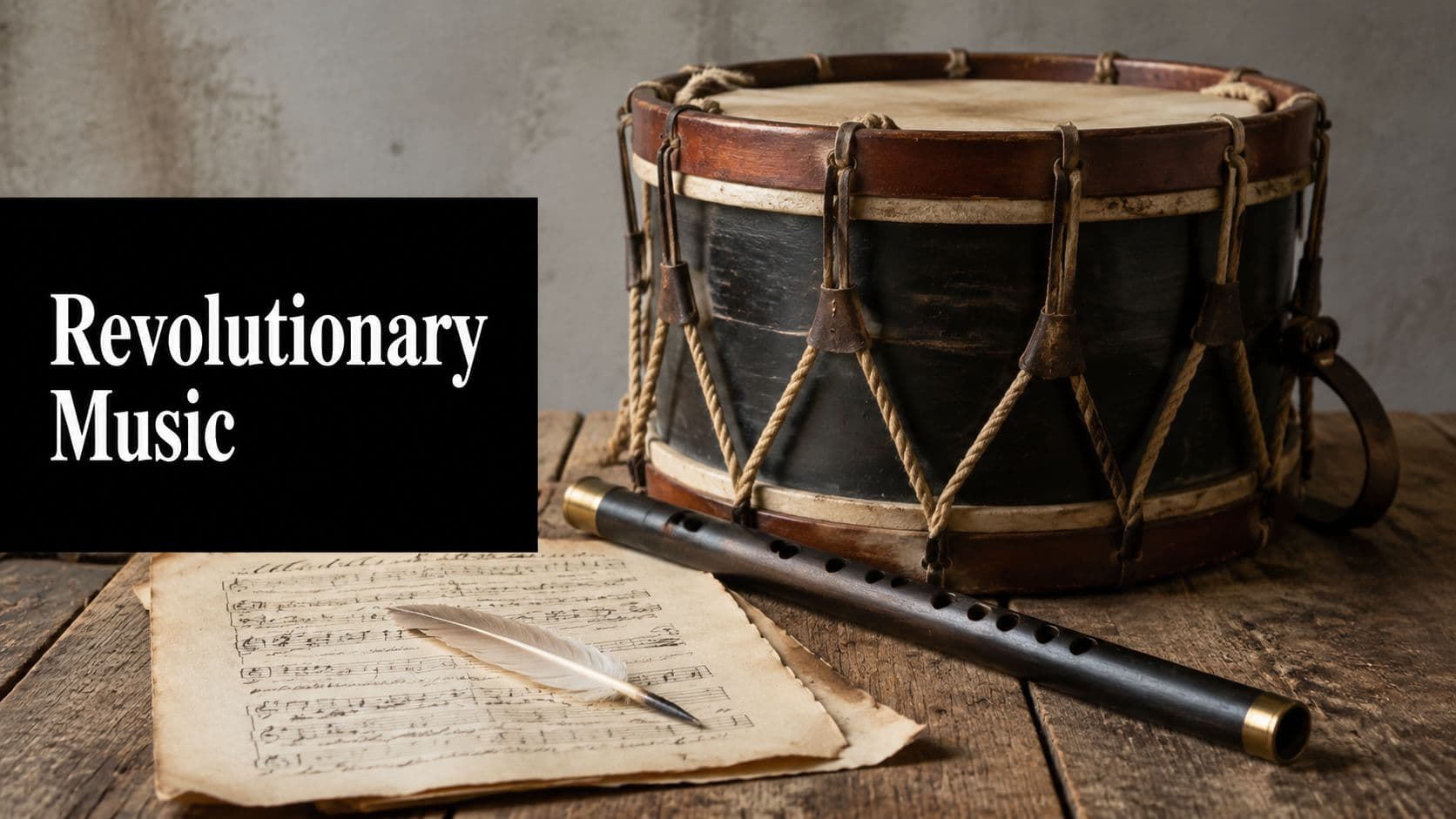
The first sound many people picture is the drum, and for good reason. The drum's pulse organized bodies in motion. Beside it, the fife cut through noise with a sharper, thinner line that could carry commands where speech failed. On the field, those sounds meant action. In camp, they marked routine and discipline. In public life, songs carried arguments, loyalties, and mockery.
That's the first key to understanding the music of the American Revolution. It wasn't one thing.
Two kinds of power
Some music told soldiers what to do. Other music told civilians what to believe. One worked through signal and rhythm. The other worked through memory and emotion.
Practical rule: When you study historical music, ask what job it performed before you ask whether it sounded beautiful.
That question changes everything. A fife tune on a march had a different purpose from a patriotic song sung in a tavern. A formal ensemble playing for officers belonged to another social world again. If you blur those together, the period becomes fuzzy fast.
For modern creators, this split is useful. It reminds you that music can carry function, not just mood. A piece can coordinate movement, mark ritual, frame identity, or sharpen a political message. The American patriots understood that at a gut level, even if they didn't use our modern language for branding, virality, or audience retention.
Why artists should care
This material matters now because it exposes a creative principle that still works. The strongest music often meets people where they already are. It gives them a rhythm they can follow or a tune they already half know.
That was true in military camps. It was true in political song. It's still true in contemporary music making.
The Battlefield's Rhythm Section
A battlefield needed more than courage. It needed timing.
In the American War for Independence, music on campaign worked in two different lanes. Digital History at the University of Houston notes the distinction between field music and military bands. If you miss that split, the whole sound world of the period gets blurry.

Field music meant command
Field music handled the urgent work. Drummers and fifers set marching cadence and signaled actions that had to be understood fast, often in noise, fear, and confusion. George Washington's Mount Vernon explains that fife and drum corps functioned as a practical communication system for troops in motion.
That point matters. These players were not there to decorate the scene. They helped make coordinated movement possible.
For a modern musician, the closest comparison is a click track crossed with stage cues. The rhythm kept bodies together. The short melodic calls told people when to shift, turn, or prepare. Clarity beat complexity every time.
Military bands meant ceremony
Military bands served a different audience and a different setting. They used larger wind instruments such as bassoons, clarinets, French horns, and oboes, and they were associated with parade ground display, formal occasions, and entertainment for officers rather than split-second signaling in combat.
That clears up a common mistake. Many listeners picture one grand ensemble doing everything. In practice, the battlefield depended on the leaner, sharper sound of fife and drum, while fuller bands belonged to ceremony and status.
| Type | Typical players | Main purpose |
|---|---|---|
| Field music | Drummers and fifers | Cadence and tactical signals |
| Military bands | Players of larger wind instruments | Parades, ceremony, officer entertainment |
What modern creators can learn from this
This is useful history for artists because it shows how sound changes when the job changes.
- Write for the space: Field music used piercing tones and firm rhythm because those elements could cut through chaos.
- Keep signals short: A pattern people recognize instantly is stronger than a clever phrase they have to decode.
- Match instruments to purpose: Music for motion, ceremony, film scoring, or sync placement should not all be built the same way.
If you want to adapt this material for your own work, start by asking what role the track plays. Is it driving movement in a video scene? Framing a historical podcast? Supporting a game trailer? That question should shape tempo, orchestration, and drum tone before you worry about polish.
And if you are building a period-inspired marching sound, the physical feel of the instrument matters too. Attack, projection, and decay all change with the setup, which is why some players studying this tradition pay close attention to specialized marching drum heads.
For independent artists, there is a business lesson here as well. Historical source material becomes more usable when you separate function from ornament. Once you hear that difference, you can adapt public-domain military cues into sample packs, sync-friendly underscore, educational content, or live performance concepts that feel grounded instead of generic.
The battlefield treated music as working infrastructure. That idea still has teeth for creators now.
Songs of Protest and Patriotism
Away from the battlefield, music fought a different kind of war. It shaped opinion. It spread arguments. It made politics easier to remember.
The most effective songs of the period often didn't depend on original melodies. Instead, writers took tunes people already knew and fitted them with new words. That practice let a political message travel quickly because the audience didn't need to learn a new musical language first.

Familiar melody, new message
Historian Diane Taraz notes that both British and American forces adapted popular British stage melodies into new verses that promoted patriot feeling or loyalty to the crown, as discussed in Songs of the American Revolution from Illinois Public Media. The power came from familiarity. A known melody gave listeners a ready-made structure for memory, participation, and emotional reaction.
That's why this technique worked so well. The tune had already done part of the cultural labor. It already lived in people's ears.
For creators today, this should sound familiar. A recognizable frame lowers resistance. People enter the work faster. They understand the emotional code earlier. In the eighteenth century, that could mean sarcasm, patriotism, or mockery landed harder because the melody felt socially shared.
Why this spread so effectively
A rewritten song had several advantages:
- It was easy to sing: No one had to learn a difficult new melody from scratch.
- It traveled socially: Taverns, gatherings, homes, and camps could all become performance spaces.
- It sharpened identity: Singing the same words to the same tune made allegiance public.
One subtle point often gets lost. Patriotic songs weren't just reflecting events. They were helping create a political atmosphere. Singing together doesn't merely express agreement. It can produce it.
A familiar tune can smuggle in a new idea faster than a speech can.
The home front heard the war too
The music of the War for Independence didn't stay with troops in uniform. Civilians heard it, repeated it, and adapted it. That matters because revolutions depend on more than armies. They depend on stories people are willing to repeat in ordinary life.
Here's a simple way to think about these songs:
| Function | How the song worked |
|---|---|
| Propaganda | Framed one side as righteous, brave, or legitimate |
| Mockery | Ridiculed opponents through satire and irony |
| Unity | Let communities perform shared belief in public |
| Memory | Helped events and slogans stick through repetition |
If you write political music now, there's a direct lesson here. Don't only ask what your lyrics say. Ask whether your listeners can carry them away after one hearing.
A Deeper Listen to Revolutionary Music
You open a songbook from the 1770s expecting a shelf of brand-new wartime anthems. Instead, you keep hearing familiar melodic shapes wearing new words. That surprise matters. It changes how you study the period, and it changes how you borrow from it as a working artist.
A useful set of liner notes on songs from the independence era makes this point clearly. Very little entirely new music was written for the conflict. Many political songs used fresh lyrics set to tunes people already knew, as noted in this liner notes PDF on music from the War of Independence.
That means the story is not only composition. It is adaptation.
Listen for function before authorship
Modern artists are often trained to prize originality above all else. Eighteenth-century audiences often prized recognition first. A known melody worked like a shared template. It let singers focus on the new message because the musical road was already familiar under their feet.
“Yankee Doodle” is the clearest example. Its power comes from cultural reversal. A tune that could carry mockery could also be claimed, repeated, and turned into a badge of belonging. If you produce music now, you already know this mechanism. Context can flip meaning faster than melody changes.
The same listening habit helps with songs such as “The Liberty Song” and “Chester.” Instead of asking only, “Is this a famous text?” ask a more practical question. What job did this song perform for the people singing it?
A small field guide for creators
Use this table as a studio-minded listening map rather than a museum label.
| Song Title | Primary Function | What to listen for |
|---|---|---|
| Yankee Doodle | Identity, morale, public belonging | How repetition and social context changed the tune's meaning |
| The Liberty Song | Protest, persuasion | Clear text delivery and a form built for group uptake |
| Chester | Communal and patriotic singing | A sturdy, hymn-like profile that supports shared singing |
| Reveille | Camp routine, signaling | Musical clarity over ornament, function over display |
| Retreat | Camp routine, signaling | How a short tune can organize time and behavior |
Many modern recreations miss the mark, sorting everything from the era into one vague “historic” mood. But these pieces did different work. Some persuaded. Some organized. Some helped people feel that they belonged to the same cause.
How to study the material like a songwriter or producer
Try a four-part pass with any piece from the period:
- Identify the job. Was it meant to rally, mock, instruct, worship, or mark a daily routine?
- Track the carry. Could a crowd learn it quickly, remember it, and repeat it without paper?
- Separate tune from text. Ask whether the melody was borrowed, then notice what the new lyrics changed.
- Test the modern use. Decide whether you want the tune's contour, the lyrical strategy, or the social feeling of communal singing.
That last step is where history becomes usable craft.
If you are an independent artist, this material offers more than atmosphere. Much of it sits in the public domain, which gives you room to arrange, record, sample, score for film, build educational content, or release themed projects without the licensing barriers attached to newer songs. For more ideas on connecting historical material to audience strategy and creative direction, the essays in OohYeah magazine are a helpful companion.
The best question is not “Is this old?” It is “What made this song spread?”
Answer that, and you start hearing the music of the independence era the way its first audiences did. Not as a frozen artifact, but as working material.
Instruments and Performance of the Era
The instruments of this period created a sound world that's leaner, woodier, and more direct than many modern listeners expect. If you want to recreate or adapt the music convincingly, instrumentation matters as much as melody.

The core military sound
Start with the fife and the side drum. The fife produced a bright, penetrating tone that worked outdoors. The drum supplied pulse, signal, and physical coordination. Together, they formed a compact sonic system built for distance and clarity rather than warmth.
That's why modern performers often get the style wrong when they over-orchestrate too early. If your arrangement begins with lush pads, cinematic toms, and heavy low end, you've already left the eighteenth century behind.
A more convincing approach starts small:
- Fife or piccolo-like voice: Keep articulation crisp and direct.
- Dry snare or rope-tension style drum tone: Favor attack over sustain.
- Limited harmonic padding: Let melody and rhythm carry the piece.
Beyond the camp and parade ground
Not all music of the era was military. Civilian life brought in other textures.
The fiddle drove dancing and social music. In wealthier homes, keyboard instruments such as the harpsichord supported more refined domestic performance. Formal military bands added winds like oboes, clarinets, bassoons, and French horns for ceremonial occasions, producing a broader and more blended sound than field music.
That means “authenticity” depends on context. A tavern tune, a camp signal, and a parlor performance shouldn't sound like they came from the same ensemble.
If you work in production, arrangement, or sound design, that contextual thinking matters more than collecting period labels.
Performance style matters too
The way musicians played was part of the sound. Phrasing had to serve movement, signal, or communal singing. Ornament could appear, but utility often ruled. Group performance also mattered. Much of this repertoire lived in shared spaces, not in isolated headphone listening.
For artists developing historically informed projects, professional support can help when you're translating old material into modern releases, visuals, or live presentation. Creative teams that need that kind of help can explore artist support services built for working musicians.
A short performance example can help your ear lock onto the texture and discipline of the style:
A useful shortcut for modern production
If you don't have period instruments, don't force a museum reconstruction. Build an equivalent palette.
Use breathy flute patches with little vibrato. Choose snare samples with taut response. Keep reverb restrained. Let the arrangement feel physical, communal, and exposed.
That gets you closer to the spirit of the era than a glossy historical stereotype.
Bringing History to Your Music Today
For independent artists, War of Independence-era music offers something rare. It gives you strong themes, recognizable cultural texture, and public-domain material that you can reshape without getting trapped in a licensing maze. That makes it fertile ground for releases, sync-friendly tracks, concept EPs, educational content, and live reinterpretations.

Where to start looking
Begin with archives and collections that preserve early American songs, lyrics, and tune books. The Library of Congress is an obvious starting point. University collections and museum resources can also help, especially when you want scans of old notation, lyric sheets, or contextual notes.
As you research, don't only collect “famous” titles. Collect fragments.
A drum pattern can become a beat. A melody contour can become a hook. A period phrase can become the seed of a chorus. A pamphlet title can become your track name. This material works best when you treat it as raw creative stock, not just heritage display.
Four adaptation paths that actually work
Here are practical ways to use this repertoire without sounding trapped in reenactment:
- Build a faithful acoustic arrangement: Use fife-like melody, hand percussion or tight snare, and unpolished ensemble vocals.
- Flip the material into another genre: A modal tune can become indie folk, punk, ambient, hip-hop, or metal if you keep the core contour intact.
- Sample the rhetoric, not just the notes: Independence-era language has bite. Even a short phrase can frame a modern track.
- Write new lyrics over an old melodic shape: That follows a period-appropriate creative logic. The era itself relied heavily on adaptation.
Historical music becomes artistically useful when you stop asking, “How do I preserve it?” and start asking, “What can it still do?”
Think in projects, not isolated songs
A single track can work, but this material often shines in a larger concept. You could create:
| Project type | Possible angle |
|---|---|
| EP | Reimagined protest songs with modern production |
| Instrumental pack | Fife, drum, and folk-inspired loops for scoring |
| Live set | Acoustic reinterpretations with brief historical framing |
| Content series | One song, one story, one arrangement approach per episode |
That project-based approach also gives you more ways to monetize. You're not limited to streaming. You can release stems, scores, sample packs, educational breakdowns, or exclusive alternate versions.
Distribution and selling
Once you've built a body of work, presentation matters. Give listeners context. Explain the source material, your adaptation choices, and the emotional throughline. People respond when they feel invited into the process.
If you want a place to sell tracks, merch, or artist offerings around a concept release, a creator-focused platform like the OohYeah marketplace can help you package the music as more than a one-off upload.
The larger point is simple. The music of the War for Independence isn't just something to study. It's something you can actively use.
The Enduring Echo of Revolutionary Music
A tune from the war can still feel current if you hear it the way people of that period heard it: as a tool, a signal, and a public statement all at once. That is why this body of music still matters. It shows what happens when sound is woven directly into daily life, political struggle, and collective memory.
That lesson matters to artists now.
Music from the American War of Independence reminds us that songs do jobs. They rally a crowd, sharpen a message, mark belonging, and carry emotion farther than a speech often can. If you write, produce, score, or perform, that should sound familiar. You are working with the same basic materials. Melody, rhythm, repetition, and association still shape how people feel and what they remember.
For historians, this repertoire opens a window onto the fears, hopes, and arguments of early America. For independent musicians, it offers raw material. A public-domain melody can become a new composition. A lyric idea from that period can spark a concept record, a sync-ready cue, a folk arrangement, or a sample-based piece with real historical weight behind it.
The key is to listen past costume-drama stereotypes. Listen for function. A marching pulse works like a modern click track for group movement. A familiar tune carrying fresh words works like a meme format or a remix template. Once you hear that, music of the independence era stops feeling distant and starts feeling usable.
Its echo lasts because the human need behind it lasts. People still gather around songs to argue, mourn, celebrate, persuade, and remember. The tools have changed. The instinct has not.
If you approach music from that period with curiosity and craft, you are not borrowing a museum piece. You are joining a long chain of artists who took shared material and made it speak to their own moment.
If you're ready to turn historical inspiration into releases, merch, direct fan support, or a deeper artist storefront, OohYeah gives musicians a place to stream, sell, and build community without losing control of how their work reaches listeners.