Music Distribution Services Comparison for Independent Artists
Explore our definitive music distribution services comparison. We analyze fees, royalties, and artist tools to help you choose the best platform.
December 31, 2025
Music Marketplace Advisor
Buying & SellingPicking a music distribution service used to be a simple box-ticking exercise to get your music on Spotify. Not anymore. Today, it’s one of the most critical decisions you'll make for your career. This music distribution services comparison will show you that the right partner does far more than just upload your tracks—it becomes the command center for your entire music business, directly impacting your income, marketing power, and how you connect with fans.
Why Your Music Distributor Is Your Most Important Partner
The music industry has changed for good. Independent artists now have a direct line to a global audience, which has completely transformed the role of a distributor. We’re long past the days when their only job was to get your files onto digital stores. The best services out there today are packed with tools designed to help you actively build your career.
The numbers back this up. The global Music Distribution Service Market was valued at 2.807 billion USD and is expected to hit 7.86 billion USD by 2035. With independent artists claiming about 46.7% of the recorded music market in 2023, the real winners are the platforms that provide powerful analytics and marketing support without taking a huge cut.
Moving Beyond Basic Delivery
Knowing effective music promotion strategies is one thing, but your distributor is who helps you put them into action. A truly great partner gives you the data you need to know who’s listening, where they are, and what’s resonating, so you can pitch to the right playlists and sharpen your marketing. They are the essential link between your music and your listeners.
Beyond promotion, the right platform helps you build a career that lasts. That means looking past streaming royalties and creating multiple income streams while nurturing a real relationship with your audience. If you're serious about this, understanding why building a fanbase is essential for selling music is non-negotiable.
Your distributor shouldn't just be a pipeline to streaming services. It should be an ecosystem that empowers you to sell merch, offer subscriptions, and communicate directly with the people who support your work.
Key Criteria for Your Decision
To make a smart choice, you need to weigh your options against a consistent set of criteria. This guide will get into a detailed side-by-side comparison, but here's a quick look at what really moves the needle.
| Evaluation Criteria | Key Question for Artists | Why It Matters |
|---|---|---|
| Revenue Model | How do I get paid, and what fees are involved? | Determines your net income and financial sustainability. |
| Artist Tools | What tools are available to help me market my music? | Impacts your ability to grow your audience and engagement. |
| Monetization Options | Can I sell more than just streams and downloads? | Unlocks diverse income streams like merch and subscriptions. |
| Ecosystem Integration | Does the platform unify my career management needs? | Saves time and creates a seamless experience for you and your fans. |
Establishing Your Core Comparison Criteria

When you're comparing music distributors, it’s easy to get fixated on the price tag. But making a smart decision means looking past the annual fee, which can often hide a world of hidden costs or missing features. To really figure out which service fits your career, you need to evaluate them on a few critical pillars.
Think of it this way: you’re not just looking for a pipeline to Spotify. You're looking for a genuine partner that can help you grow. We'll break down the four key areas you need to dig into to find the right one.
Revenue and Fee Structures
Let's talk about the money first, because it's where most artists get tripped up. Distributors generally fall into two camps: those that charge a flat annual fee for unlimited uploads, and those that charge a one-time fee for each single or album. If you're constantly in the studio, that annual fee model probably makes more sense. If you're only releasing a big project every couple of years, paying per release might be better.
But don't stop there. The real devil is in the details—specifically, the commission rate. You'll see a lot of services advertising that you keep "100% of royalties," but that means 100% of what the distributor gets from the stores, not 100% of the total money your music earned. For instance, a service like CD Baby takes a 9% commission on top of their upfront fees, and that can really start to eat into your earnings over the life of your catalog.
Finally, check out the payout process. How fast do you get your money, and what's the minimum balance you need before you can cash out? These little things make a big difference to your cash flow.
Distribution Reach and Speed
Where will your music actually go? Sure, every major service will get you onto Spotify and Apple Music, but what about the rest of the world? You need to know if they cover key international markets like China through NetEase or if they deliver to the places where music goes viral, like TikTok and Instagram. Leaving those platforms out means you're leaving potential fans on the table.
Speed is another huge factor. "Time-to-live"—how long it takes for your music to show up in stores after you hit 'submit'—can vary wildly. Some distributors, like DistroKid, are known for getting tracks live in just a day or two. Others can take a week or more. If you're trying to coordinate a big release campaign, that delay can be a deal-breaker.
Choosing a distributor isn’t just about getting on the big platforms; it’s about ensuring your music is available everywhere your potential fans are, as quickly as possible. This is a foundational element of the best strategies for independent music distribution that can define a release's success.
Artist Tools and Analytics
Just throwing your music online and hoping for the best isn't a strategy. The best distributors act more like partners, giving you the tools to understand who's listening and how to reach them. A good analytics dashboard is non-negotiable. It should show you listener demographics, where in the world your music is popular, and which playlists are giving you the most traction. This data is pure gold for planning tours or targeting your social media ads.
Beyond data, look for built-in marketing features. Do they help you build pre-save campaigns? Do they offer playlist pitching tools or give you a clean "hyperfollow" page to gather all your links in one place? These are the features that help you actively market your music instead of just passively distributing it.
Long-Term Flexibility
The distributor that's perfect for you today might hold you back tomorrow. As your career grows, your needs will change, so you need to pick a service that can grow with you. Before you commit, find out how easy it is to issue a takedown or move your catalog somewhere else without losing your hard-earned stream counts.
Also, look at what else they offer down the line. Can you easily add services like publishing administration or video distribution when you're ready for them? Using resources that provide detailed comparisons of various music platforms, like Dailyplaylists can give you a better sense of these long-term pathways. You want a partner who’s ready for your next move, whatever it may be.
At a Glance Comparing Leading Music Distributors
This table provides a high-level snapshot of how top services stack up against the core evaluation criteria, offering a quick reference before our deeper analysis.
| Feature | DistroKid | TuneCore | CD Baby | OohYeah |
|---|---|---|---|---|
| Primary Fee Model | Annual Subscription | Per-Release & Annual Plans | One-Time Per Release | Flexible Tiers |
| Royalty Commission | 0% | 0% (on new plans) | 9% | 0% |
| Typical Speed | Very Fast (1-3 days) | Fast (2-5 days) | Moderate (1-2 weeks) | Fast (2-4 days) |
| Key Tools | HyperFollow, Splits | YouTube Monetization | Sync Licensing, Physical | Fan CRM, Direct Sales |
This quick comparison highlights the fundamental differences in approach. While some prioritize speed and simplicity, others focus on a wider array of services or, like OohYeah, integrate unique tools for fan engagement and direct monetization. Now, let's dive deeper into each one.
A Look at the Big Three in Digital Distribution
When you start digging into any music distribution services comparison, you'll inevitably run into the big three: DistroKid, TuneCore, and CD Baby. These platforms practically invented the blueprint for getting independent music online and have been the go-to for millions of artists. But they are far from interchangeable. Their fee structures, artist tools, and core philosophies are worlds apart, meaning the "best" one for you really depends on what you're trying to accomplish.
Instead of just rattling off features, let's put these services into real-world contexts. My goal here is to show you how each platform actually performs for different types of artists, so you can see which one truly aligns with your needs.
DistroKid: For the Artist Who Never Stops Creating
DistroKid shook up the industry with a simple, brilliant pitch: pay one flat annual fee and upload all the music you want. This was a game-changer for producers, beatmakers, and rappers who live in the studio and drop new tracks constantly.
If you're releasing music every month, paying a fee for every single upload just isn't sustainable. DistroKid completely removes that financial friction. They're also known for being incredibly fast—it's not uncommon to see your music hit major stores within 24-48 hours. For artists trying to jump on a trend or stick to a tight promo schedule, that speed is everything.
Of course, there's a catch. If you ever stop paying the annual fee, your music comes down. The only way to prevent that is to pay an extra "Leave a Legacy" fee for each release, which can feel like a hidden cost if you ever decide to move your catalog elsewhere.
The Bottom Line on DistroKid: Speed and volume are the name of the game here. It's built for artists who prioritize getting a lot of music out into the world quickly without needing a ton of bells and whistles for each release.
Another thing to watch out for is their payment splitting feature. It sounds great on paper, but it requires every collaborator to have their own DistroKid account or forces you to cover a $10/year fee for each person. On a track with a few co-writers and a session player, those costs can add up fast.
TuneCore: For the Artist Running a Business
TuneCore has come a long way, evolving from its old per-release model to a tiered subscription plan that directly competes with DistroKid. But where TuneCore really flexes its muscles is in the depth of its data and reporting. For any artist who's serious about building a business around their music, these analytics are pure gold.
Let's say you're mapping out a tour or launching a targeted ad campaign. TuneCore gives you granular data on who is listening, where they are, and which tracks are resonating most. This is the kind of insight that lets you make smart, strategic decisions instead of just throwing money at marketing and hoping for the best.
Their publishing administration service is another huge plus. If you're a songwriter hoping to get your music placed in TV shows, films, or ads, you need a solid publishing partner. TuneCore’s add-on helps you collect songwriting royalties that standard distribution completely misses, giving you a more complete income stream all in one place. The platform can feel a bit more corporate and less intuitive than DistroKid's, but the power under the hood is undeniable.
CD Baby: For the Artist Building a Legacy
As the original indie distributor, CD Baby started with physical CDs and successfully pivoted to digital. Their model is now the outlier: a one-time fee per release, no subscriptions. This makes them a fantastic choice for artists who work at a slower pace, like a band that spends two years perfecting an album.
You pay once, and your music stays up "forever" without any recurring charges. For artists who want to put their work out there and not have to think about annual fees, this is a huge relief. It’s perfect for legacy projects or for creators who aren't chasing a relentless release schedule.
The trade-off is that CD Baby takes a 9% commission on your digital revenue. That might not sound like much, but it adds up over the life of a popular release. For an artist with a catalog that generates significant streaming income, that 9% can easily become more expensive than a yearly subscription fee would have been.
Today’s music industry is a digital-first world. Streaming now drives 69% of global recorded music revenues, and a staggering 88.3% of all distribution happens online. With over 100,000 new tracks hitting platforms like Spotify every single day, the tools and support your distributor provides are more critical than ever. You can dig deeper into these numbers by checking out the full report on the global music market.
Side-By-Side: Which One Is Right for You?
To make it even clearer, let's break it down by a few common scenarios.
The Beatmaker Releasing Weekly Tracks: Go with DistroKid. The unlimited uploads and lightning-fast delivery are tailor-made for a high-output strategy where speed is a top priority.
The Band Releasing a Debut Album: TuneCore is a strong contender here. The deep analytics will help them pinpoint their audience for tour planning, and the publishing admin option sets them up for long-term songwriting revenue.
The Singer-Songwriter Releasing an EP Every Couple of Years: CD Baby offers total peace of mind. The one-time fee means the music stays online forever without the stress of recurring payments. The 9% commission is a fair price for that "set it and forget it" stability.
This music distribution services comparison shows there's no magic bullet. The right platform depends entirely on how often you release music, what your business ambitions are, and what you want to achieve in the long run. While these three are the established leaders, it's worth remembering that newer platforms are always emerging, often with even more to offer.
Moving Beyond Distribution: The Rise of Artist-Centric Ecosystems
The old model of music distribution is a simple, one-way street. You pay a fee, upload your tracks, and they pop up on streaming services. It gets your music out there, sure, but it often leaves you feeling disconnected from your own audience, chasing fractions of a penny per stream in a vast numbers game.
But a different approach is taking hold, one built around what we call an artist-centric ecosystem. These platforms look beyond just shipping files to Spotify. They aim to be a unified headquarters for your entire career, integrating distribution with direct-to-fan sales, community tools, and real monetization options. They’re designed to solve problems that a purely transactional distributor was never meant to tackle.
Your Career Hub, Not Just a Delivery Service
Think about having a single dashboard where you can push your new single to streaming platforms and sell a limited-run vinyl pressing. A place where you can offer exclusive behind-the-scenes videos to paid subscribers and chat directly with your most dedicated fans. That's the promise of an artist-centric ecosystem.
Instead of just acting as a pipeline to stores owned by other companies, these platforms become your digital home base. They operate on the understanding that a real music career is built on multiple income sources and genuine fan relationships, not just a high stream count.
An artist-centric ecosystem isn't just about getting your music heard; it's about owning your audience. When you can sell directly to fans, you control the price, you keep more of the money, and you build a direct line of communication that social media algorithms can't touch.
Services like OohYeah are a perfect example of this shift in thinking. By bundling standard distribution with a commission-free marketplace for merch, digital downloads, and fan subscriptions, they give artists the tools to build a business that can actually support them. This completely changes the dynamic—you're no longer just renting an audience on Spotify; you're building and owning a direct relationship with your community.
Solving the Revenue and Control Puzzle
Traditional distributors do one thing, and they often do it well: they get your master recordings into digital stores. But they offer little to no help with all the other things that make an artist's business run. This is where the ecosystem model really shines.
Let’s walk through a common scenario. You’re an artist using a standard distributor and you want to sell t-shirts with your new album. That means you need separate platforms—one for distribution, another for e-commerce (like Shopify or Bandcamp), and yet another for your email list. Each one has its own fees, its own learning curve, and its own silo of data.
An integrated platform like OohYeah brings all of that under one roof.
- Commission-Free Sales: You can sell merchandise, high-resolution audio files, or exclusive videos right from your profile and keep 100% of the revenue. That’s a massive departure from other platforms that skim a percentage off your merch or download sales.
- Subscription Models: Create a reliable, recurring income stream by launching a fan club. You can offer tiered perks like early access to tickets, members-only livestreams, or a private community chat.
- Direct Communication: Talk to your supporters through direct messages and community posts without having to fight for their attention on a crowded social feed. That direct connection is priceless for building loyalty that lasts.
This model is especially powerful right now. The global music streaming market is expected to hit $47.06 billion by 2025, with streaming making up nearly 89% of the industry's revenue. With over 600 million paid music subscribers worldwide, fans have clearly shown they're willing to pay for direct access and unique experiences—a trend that platforms built for direct monetization are perfectly positioned to meet. You can dig deeper into the growth of the streaming market at LiveMusicBlog.com.
Transactional vs. Relational: A Head-to-Head Look
To really get a feel for the difference, let’s put the two models side-by-side. The question isn’t which one is “better,” but which one actually fits your long-term goals as an artist.
| Aspect | Traditional Distributor (e.g., DistroKid) | Artist-Centric Ecosystem (e.g., OohYeah) |
|---|---|---|
| Primary Goal | Get music onto DSPs as efficiently as possible. | Build a sustainable, multi-faceted music business. |
| Revenue Focus | Streaming royalties (minus store cuts). | Diversified streams (merch, subs, downloads, tips). |
| Fan Relationship | Indirect; mediated by streaming platforms. | Direct; artist owns the communication channel. |
| Tools Offered | Distribution, basic analytics, pre-save links. | Distribution, Fan CRM, e-commerce, community tools. |
| Artist Control | Limited to the master recording's distribution. | Full control over pricing, products, and fan interaction. |
Opting for an ecosystem is a strategic move. It's for the artist who sees their music as the core of a larger brand, wants to cultivate a true community, and values financial independence over simply racking up stream counts. A traditional distributor might be the perfect way to get your first single out, but an artist-centric platform is where you go to build a legacy.
How to Choose the Right Distributor for Your Career Stage
Picking the right partner from a sea of music distribution services isn't a one-size-fits-all deal. What works for a beatmaker dropping tracks every week will probably be a poor fit for a band that spends two years perfecting an album. The real secret is matching a service’s strengths with your career stage, your goals, and how you actually work.
This means you have to look past the sticker price. A flat annual fee might look tempting, but if you're gearing up for a major release and need serious support and deep analytics, it's going to fall short. On the flip side, a commission-based service loaded with features might be total overkill if you're just starting to build your catalog.
For the Prolific Creator Releasing Frequently
Do you basically live in the studio? If you're a producer, beatmaker, or artist constantly pushing out new material, your main concerns are cost and speed. Paying a fee for every single upload just won't work when you're that prolific.
In this scenario, a distributor with an unlimited upload subscription model is the only logical choice.
Top Recommendation: DistroKid is the undisputed king here. Its whole business is built around one annual fee for unlimited uploads, which is perfect for high-volume creators. They’re also known for getting music live incredibly fast—often within 24-48 hours—which is a huge plus when you need to keep the momentum going.
Things to Keep in Mind: While the base model is great for volume, watch out for the add-ons. Things like splitting payments with your collaborators or making sure your music stays up after your subscription ends ("Leave a Legacy") will cost you extra. But if your goal is just cost-effective volume, nobody does it better.
For the Strategic Artist Building a Business
If you’re more methodical—planning big EPs or albums with marketing campaigns to match—your needs change. You’re less concerned about volume and more about data and tools. You need to know who’s listening, where they are, and what’s working so you can plan tours and target your ads. Your distributor needs to be less of a conveyor belt and more of a business partner.
This is where platforms with robust analytics and professional services really start to matter.
Top Recommendation: TuneCore has always been a strong choice for the business-minded artist. Their analytics dashboards give you the kind of granular data you need for smart planning. Plus, their publishing administration service is a must-have if you're serious about collecting every last royalty from syncs, radio play, and more.
An Alternative View: TuneCore's tools are powerful, no doubt, but they operate within the traditional distribution box. It’s a great setup for maximizing streaming income, but it doesn't do much to help you connect directly with your fans. To dig deeper into how different services align with various artist plans, check out our complete guide on choosing the right music distribution service.
The difference is pretty stark: a prolific creator needs an efficient pipeline to get music out, while a strategic artist needs a powerful toolkit to build a career. One is about speed and cost-per-release; the other is about data and long-term revenue.
For the Established Act with a Loyal Fanbase
Once you've built a solid audience, your focus has to shift. It's no longer just about finding new listeners. The real money and career stability come from deepening the relationship with the fans you already have and creating direct, reliable income streams. At this point, a standard distributor that just pushes your music to Spotify is actively holding you back.
What you need is a complete ecosystem that blends distribution with direct-to-fan sales and engagement.
- Top Recommendation: This is exactly where OohYeah comes in. We built our platform for artists at this stage because we know your most valuable asset is your dedicated fanbase. By letting you sell merch, digital downloads, and fan subscriptions—all commission-free and right from the same platform—we give you the tools to build a real business around your music.
This decision tree gives you a visual for the choice artists face when they're ready to move beyond just chasing streams.
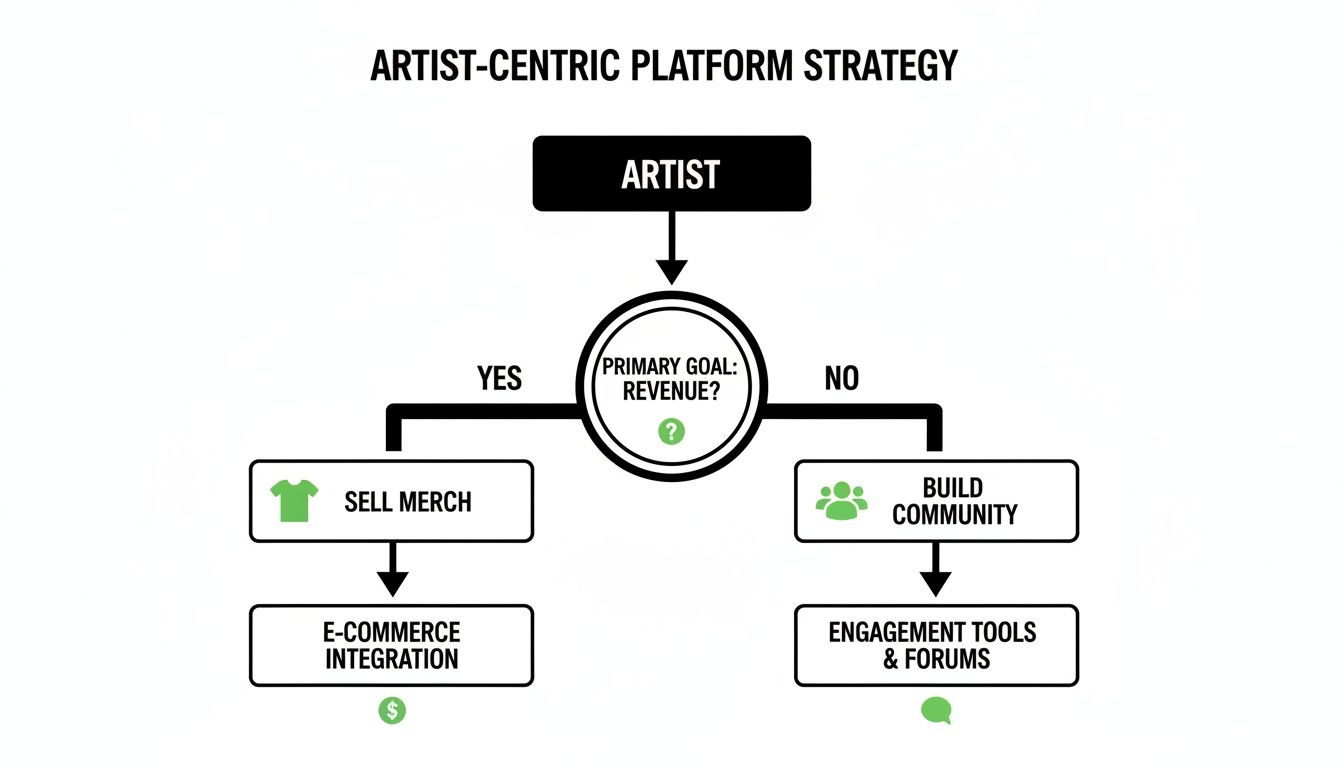
As the flowchart shows, platforms like OohYeah open up a direct path to monetizing fan loyalty through products and community—something traditional distributors simply weren't designed to do. The platform you choose should be a direct reflection of where you want to take your career.
Got Questions? Let's Talk Music Distribution.
Diving into music distribution for the first time? It's natural to have questions. Everyone does. Let's clear up some of the most common points of confusion so you can pick the right partner and get back to making music.
Can I Switch Distributors Later On?
Absolutely, but you need to be smart about it. Switching distributors isn't like flipping a switch; it requires a bit of planning to make sure your music doesn't vanish and your hard-earned stream counts don't reset.
The process involves telling your old distributor to take down your releases and then re-uploading everything with your new one. The golden rule here is to use the exact same ISRC and UPC codes for every track and album. This is non-negotiable if you want to keep your stats and playlist spots. Just be prepared for a brief period where your music might be offline, so check your current distributor's takedown policy before you make the jump.
What's the Real Difference Between a Distributor and a Publisher?
This is a big one, and getting it right is crucial for your career. Think of it this way: a distributor handles your master recording—the final audio file you bounce from your studio session. Their job is to get that specific recording onto platforms like Spotify and Apple Music and collect the money it earns from streams and downloads.
A publisher, on the other hand, deals with the composition itself—the melody and lyrics. They work to get your song used in movies, covered by other artists, or licensed for commercials, collecting a completely different set of royalties. While some distributors bolt on a publishing admin service, they are two fundamentally different jobs.
Distribution is about the sound you recorded. Publishing is about the song you wrote. To get paid everything you're owed, you'll eventually need both.
Do I Actually Keep 100% of My Royalties?
When a distributor claims you keep "100% of your royalties," it's true, but with a catch. They mean you get 100% of the money they receive from the stores. But before that money ever gets to your distributor, the streaming platforms have already taken their cut, which is often a pretty hefty slice of the pie.
So, you're getting 100% of what's left over. That's the standard model for streaming. But this is where direct-to-fan platforms like OohYeah change the game. When you sell a download or a t-shirt directly to a fan through our storefront, we take no commission. That means you're not just getting a piece of the pie—you're getting almost the whole thing.
Are Analytics and Marketing Tools Really That Important?
They’re everything. In a world where over 100,000 new tracks hit streaming services every single day, just having your music online isn't a strategy—it's a lottery ticket. Standing out requires a real plan, and that plan starts with data.
Good analytics show you who is listening, where they are, and how they discovered your music. That information is pure gold. It helps you target your social media ads, plan a tour, and find more people who will love what you do. A distributor that just uploads your tracks and walks away is doing you a disservice. The ones that provide powerful data and promotional tools are giving you a genuine shot at building a career.
Ready to stop just distributing and start building your career? OohYeah provides a complete artist ecosystem, combining distribution with commission-free merch sales, fan subscriptions, and direct communication tools. Take control of your music business today. Start building with OohYeah.