A Modern Artist's Guide to Music Distribution Services
Discover how music distribution services work, compare top options, and learn strategies to maximize your streaming revenue and reach as an independent artist.
January 18, 2026
Music Marketplace Advisor
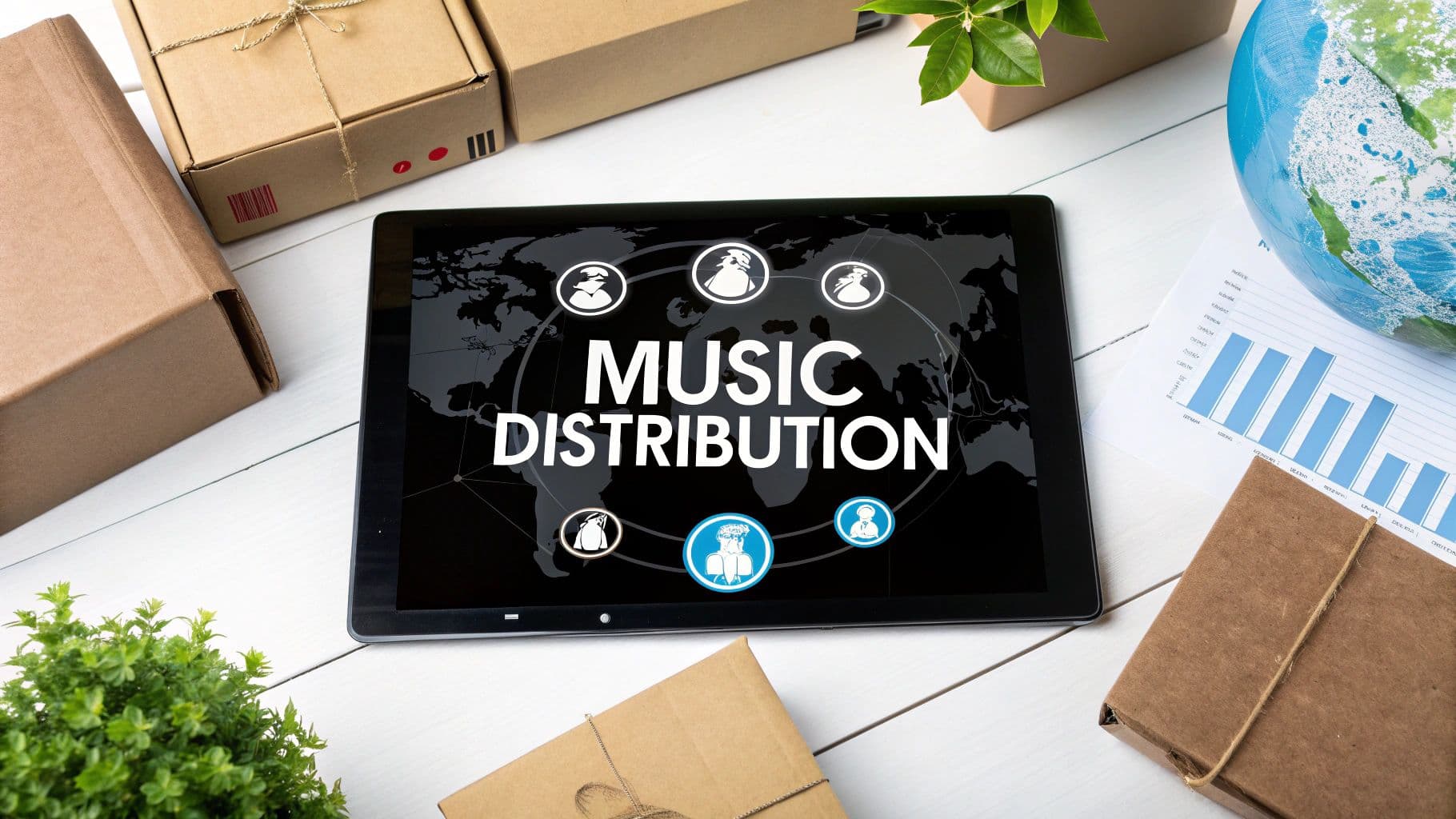
Buying & SellingThink of a music distribution service as the global shipping network for your songs. In the old days, you needed a record label to physically press and ship vinyl or CDs to brick-and-mortar stores. Today, you need a digital distributor to get your tracks from your studio computer to listeners on Spotify, Apple Music, and the hundreds of other digital storefronts worldwide.
Without them, your music is stuck on your hard drive. With them, it goes global.
What Are Music Distribution Services and Why They Matter
Simply put, a music distributor is your partner in the digital music supply chain. They take your mastered audio files, your album art, and all the crucial metadata—things like track titles, artist names, and songwriter credits—and deliver it all in the specific format each streaming service requires. This is what makes your music available for fans to discover, stream, and buy.
Can you imagine trying to individually contact Spotify, Apple Music, Amazon Music, and all the others just to get one song listed? It would be a logistical nightmare. Each platform has its own technical specs, legal agreements, and upload process. Music distribution services solve this huge problem by creating a single, easy-to-use portal for artists. They’ve already done the hard work of building the relationships and technical pipelines to all these platforms.
The Modern Musician's Essential Tool
In an industry where streaming is king, using a distributor isn't just a good idea—it's essential. The global music streaming market is a massive playground, on track to hit $46.7 billion in early 2025 with a subscriber base that topped 667 million in 2023. This explosion in digital listening gives independent artists unprecedented access to fans without needing a traditional record label deal.
This shift puts the power back in your hands, allowing you to build an audience on your own terms. A smart distribution strategy is the first real step toward building a professional career and a sustainable business from your music. By using these platforms, you can:
- Reach a Global Audience: Instantly make your music available in nearly every country on Earth.
- Earn Revenue: Collect royalties every single time your music is streamed or downloaded.
- Establish Legitimacy: Having your music on major platforms signals professionalism to fans, bloggers, and industry gatekeepers.
A great distributor doesn't just upload your files. They become the logistical backbone of your entire release strategy, ensuring your art gets where it needs to go and, just as importantly, that you get paid for your work. It’s the foundational step to sell your music online effectively.
How Your Music Travels the Digital Supply Chain
Ever wonder what happens after you hit 'upload'? It’s not magic. Getting your music from your studio into the ears of listeners worldwide is a carefully managed process, a kind of digital supply chain. Your song is the precious cargo, and your distributor is the expert logistics crew making sure it gets everywhere it needs to go.
The journey has a few key stops. Understanding these steps, starting with how to upload your music, is what separates a smooth release from a frustrating one. Let’s pull back the curtain on the four main phases.
Phase 1: Meticulous Preparation and Upload
It all starts with you. You’re responsible for handing over two critical pieces of the puzzle: the master audio file (almost always a high-quality WAV) and its corresponding metadata.
Think of metadata as your song's digital passport. It’s all the identifying info—artist name, song title, release date, genre, and the all-important ISRC code. The ISRC (International Standard Recording Code) is a unique, permanent fingerprint for your specific recording. It’s how Spotify, Apple Music, and everyone else tracks every single play to make sure the money finds its way back to you. Getting this right is absolutely non-negotiable if you want to get paid correctly.
Phase 2: Rigorous Quality Control
Once you submit everything, your track doesn't just instantly appear on playlists. First, it goes through a crucial quality control check by your distributor. A real person or a sophisticated system will scan everything you sent.
They’re looking for a few things:
- Audio Quality: Is the file corrupted or technically flawed?
- Artwork Specs: Does your cover art meet the strict dimension and content rules for each store? (Yes, they all have different ones).
- Metadata Accuracy: Is everything filled out completely and correctly?
This step is your safety net. It catches the small mistakes that could get your release rejected by the platforms, preventing embarrassing delays and ensuring you look professional from day one.
Phase 3: Global Delivery to Platforms
After your release gets the green light, your distributor gets to work. They package your audio, art, and metadata into a standardized format and securely deliver it to all the digital service providers (DSPs) you chose. We're talking about the giants like Apple Music and Tidal, but also hundreds of smaller, regional platforms you might not even know exist. This isn't just sending an email with a file attached; it's a direct, secure pipeline.
Think of your distributor as holding the digital keys to every major music platform. They have established, trusted delivery systems that ensure your music arrives exactly as intended, perfectly formatted and ready to go live on your release date.
Phase 4: Transparent Royalty Collection and Reporting
Now for the best part: getting paid. As people stream and download your music, every single platform generates an enormous amount of data and, hopefully, revenue. Your distributor’s job is to collect those earnings from all over the world.
They take the complex, often messy sales reports from each store, crunch the numbers, and translate it all into a clear statement showing what you've earned. They then deposit that money into your account. Beyond just the cash, they provide you with the analytics—who’s listening, and where—so you can make smarter decisions about your next tour, marketing push, or new release.
2. Choosing Your Path: Music Aggregators vs. Direct Deals
So, you've got your masterpiece recorded, mixed, and mastered. Now what? The next crucial step is figuring out how to get that music from your hard drive into the ears of listeners around the globe. This is where music distribution services come in, and you've basically got two main roads you can take.
Think of it like selling a product you've built. You could set up your own shop on a huge online marketplace like Etsy—giving you total control for a small fee. Or, you could land a deal to get your product into every Target store in the country, which would mean a bigger team behind you but also sharing a slice of the profits. Neither is inherently better; it all depends on your goals, your current career stage, and how hands-on you want to be.
The Power of Music Aggregators (The DIY Route)
For most independent artists starting out, music aggregators are the answer. Companies like TuneCore, DistroKid, and CD Baby have completely changed the game. They operate on a simple, do-it-yourself model, providing the digital pipeline to get your music onto hundreds of streaming services and online stores.
The beauty of this model is its accessibility. You typically pay a small, flat fee per release or a yearly subscription, and in exchange, you usually keep 100% of your royalties. This is huge for artists who want to maintain complete creative and financial control. You call all the shots—from your release date to your cover art to your marketing plan—without anyone else's approval.
The bottom line? Aggregators have leveled the playing field. They give any artist, anywhere, a straightforward and affordable way to achieve global distribution. The power is truly in your hands.
The process is generally the same no matter which service you choose. It boils down to a simple, four-step journey from your studio to your fans' playlists.
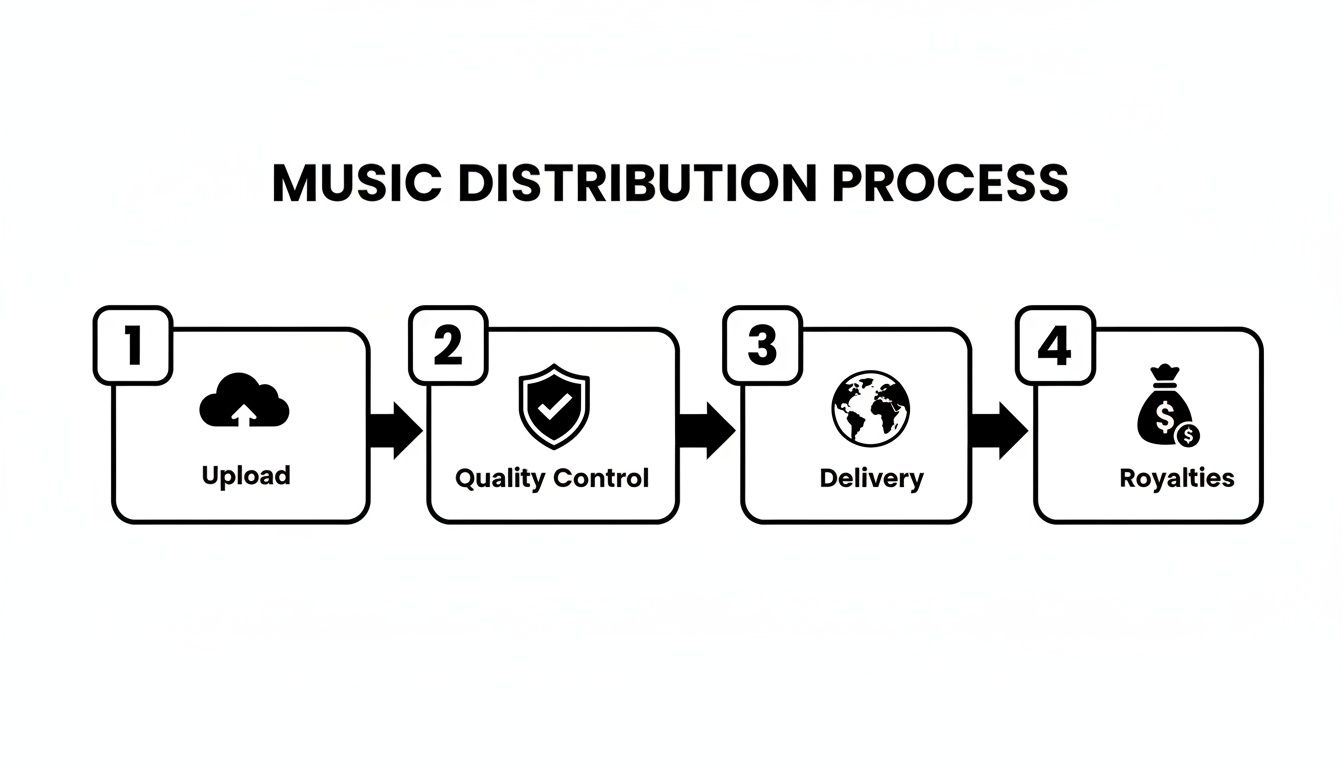
This workflow is the core of what these platforms do: they handle the technical logistics so you can focus on the music.
The Partnership Path: Direct Deals and Label Services
The other path is to pursue a direct deal with a more selective distributor or a record label. This isn't about simply uploading your tracks through a web portal; it's about building a genuine strategic partnership. These opportunities are typically reserved for artists who already have some serious traction—a solid fanbase, a history of strong streaming numbers, and a clear brand.
Unlike the flat-fee model of aggregators, these deals almost always work on a revenue-share basis. The distributor or label will take a percentage of your earnings, which could be anywhere from 15% to 50% (or even more). But in return for that cut, they bring a lot more to the table. A direct deal often comes with a whole support system.
What kind of support?
- Marketing & Promotion: Think dedicated teams pitching your tracks to influential playlist editors, landing you press coverage, and pushing for radio play.
- Financial Support: This can include an advance—an upfront payment against your future royalties—to help you fund a new album or a tour.
- Industry Expertise: You get access to a team of experts who can provide guidance on release strategy, branding, and long-term career planning.
Going this route means trading a percentage of your revenue and some of your independence for a powerful team dedicated to pushing your music to the next level.
To help you visualize the trade-offs, here’s a quick comparison of the two main distribution models.
Music Aggregators vs. Direct Deals: A Comparison for Artists
| Feature | Music Aggregators (DIY Services) | Direct Deals & Label Services |
|---|---|---|
| Accessibility | Open to all artists, regardless of career stage. | Highly selective, typically for established artists. |
| Cost Structure | Low-cost flat fees (per-release or annual). | No upfront fee, but a percentage-based revenue share. |
| Royalties | Artists typically keep 100% of their royalties. | Artists share royalties, often 50% to 85%. |
| Control | Full creative and business control remains with the artist. | Artist gives up some control over marketing and strategy. |
| Support Services | Primarily focused on digital delivery and royalty collection. | Includes extensive marketing, promotion, and strategic support. |
| Best For | Independent artists, DIY creators, and those starting out. | Artists with proven momentum seeking to scale their careers. |
Ultimately, choosing the right path requires an honest look at where you are in your musical journey and where you want to go. For a deeper dive into making this choice work for you, check out our guide on the best strategies for independent music distribution.
How You Get Paid: A Look at Royalties and Pricing
Alright, your music is out there. Now for the most important question: how does the money find its way back to you? The financial side of distribution can feel a bit tangled at first, but it really comes down to a couple of standard ways distributors handle their pricing. Figuring out which one fits your career goals is a crucial step.
Your Money, Your Choice
One of the most popular setups is the flat-fee model. Think of it like renting a spot on the digital shelf. You'll either pay a yearly subscription for unlimited uploads or a one-time fee per release. The biggest upside? You keep 100% of your royalties. This is a fantastic deal for artists who are consistently putting out new music and want to keep every penny they earn in the long run.
Another route is the commission-based model, sometimes called revenue sharing. With this, you skip the upfront cost. Instead, your distributor takes a cut of what your music earns—usually somewhere between 10-30%. This can be a lifesaver for new artists just starting out, as it means you don't have to spend money before you make any. Plus, it gives the distributor a real incentive to push your music, since they only make money when you do.
It's good to remember that a stream isn't just a stream. The actual payout can change based on a bunch of factors—where the listener is, if they're a premium subscriber, and the specific deal the platform has with your distributor. This is exactly why getting clear, transparent royalty reports from your partner is non-negotiable.
Following the Money Trail
Your distributor is your primary collector for one specific type of royalty: the money earned from your master recordings (the actual "play" on Spotify, Apple Music, etc.). But that's not the only way your music makes money.
There are a couple of other streams you need to be aware of:
- Performance Royalties: These come from when your song gets played in public—think radio, TV shows, or even a coffee shop. Organizations like ASCAP or BMI are the ones who collect this for you.
- Mechanical Royalties: This is the money earned anytime your song's composition is reproduced, which includes streams and physical sales. Some distributors offer publishing administration services to help you collect this, but it's often a separate thing to manage.
Paid streaming now makes up a massive 57.1% of the entire music industry's revenue. With the market expected to grow by another $53.49 billion by 2029, the opportunity is huge. You can dig into more stats about music streaming's financial growth on explodingtopics.com. Picking the right distributor and pricing plan is what puts you in the best position to turn those streams into a real, sustainable career.
Your Checklist for Selecting the Right Music Distributor
Making the right choice here can genuinely shape your career's trajectory. Don't think of this like picking a utility provider; it's more like bringing on a crucial business partner. This partner is handling your art, your data, and your money. A great one can supercharge your growth, but a bad one will just throw up roadblocks.
To make a smart, confident decision, you have to look past the flashy marketing slogans. Use this checklist as your guide to cut through the noise and compare different music distribution services, making sure you land on one that truly fits your goals as an artist.
Financial Transparency and Royalties
First things first: follow the money. How a distributor handles your earnings says everything about their business model and their priorities. You need absolute transparency.
- Fee Structure: How do they charge you? Is it a flat annual fee, a one-time cost per release, or do they take a commission? Dig into the fine print for hidden fees, like charges for taking a song down or adding new stores later.
- Royalty Splits: Do you really keep 100% of your royalties, or does the service take a slice? If they do take a percentage, what are you getting in return? Are they actively pitching your music for placements or providing high-level marketing support?
- Payment Speed and Thresholds: How fast do they pay out? Some platforms are quicker than others. Also, check if there's a minimum balance you have to hit before you can actually withdraw your cash.
Platform Reach and Release Speed
Where your music ends up and how fast it gets there are two of the most important logistical questions you can ask. You need a wide net to catch all potential listeners, and you need speed to stay nimble with your release strategy.
Your music deserves to be everywhere your fans are. Don't settle for a distributor with a limited network. The goal is global reach with zero friction, ensuring your release day is a worldwide event, not a regional one.
Take a good look at their network. Do they deliver to all the big players like Spotify, Apple Music, Amazon Music, and Tidal? What about key international platforms? Just as important is their turnaround time. A good service can get your music live within a few days to a week, but you should always build in more lead time just in case.
Support and Added Value
Finally, what happens after your music is live? The best music distribution services don't just drop your files and disappear. They offer the tools and support you need to actually build your career.
- Customer Support: When something goes wrong on release day, can you reach a real person who can help? Check out reviews or even send a test query to see how responsive their support team is.
- Analytics and Data: What kind of data do they give you? Deep insights into who's listening and where they are is marketing gold. You need this to make smarter decisions.
- Extra Features: Do they offer valuable add-ons? Look for things like sync licensing opportunities, YouTube Content ID to claim ad revenue, or built-in playlist pitching tools. These aren't just perks; they're potential new income streams.
Picking a distributor is a huge decision. For a complete breakdown, you can learn more about how to choose the right music distribution service in our detailed guide.
Building Your Career Beyond Traditional Distribution
Getting your music onto Spotify and Apple Music is a massive step, but it’s really just the beginning. Think of it as opening the door. A solid release through your distributor creates a fantastic discovery funnel, but the real work—and the biggest opportunity—is turning those casual listeners into a genuine community you can talk to directly.
It's all about moving from renting an audience on someone else's platform to building your own. Streaming gets your music heard, but direct-to-fan platforms give you control. These tools don't replace your distributor; they work alongside it, letting you forge deeper connections and open up new income streams that aren't dependent on tiny per-stream payments.
Turning Listeners Into Lifelong Supporters
The strategy is simple: use your streaming presence as the first handshake. When someone finds your song on a playlist, you need a clear path to guide them deeper into your world. That means creating a central hub—like your OohYeah page—where they can find everything about you in one place.
This hub is where you can offer so much more than just a song. You can sell exclusive merch, provide high-quality downloads, or even launch a fan club with subscriptions for behind-the-scenes access. This approach is how you transform a passive listener into a true supporter who's invested in your journey as an artist.
The modern music industry is a crowded space. Building a direct connection with your audience is no longer a bonus—it's the core strategy for creating a sustainable career and standing out from the noise.
Consider this: in 2025, streaming services held 253 million tracks. Independents were responsible for 96.2% of the 106,000 new tracks uploaded every single day. But here’s the kicker: a staggering 88% of all tracks on these platforms received 1,000 or fewer plays. This really highlights why direct fan engagement is no longer optional for artists who want to build a real following. You can dive deeper into these numbers in this report on the crowded streaming market.
New Frontiers in Artist Monetization
Beyond the tried-and-true methods of selling merch and music, new models are popping up that give artists even more command over their work. For artists looking into the future, it's worth understanding how these new systems operate. A great starting point is this guide to the fundamentals of Blockchain Development, which can shed light on how these emerging platforms are built.
When you add a direct-to-fan strategy to your distribution plan, you start capturing more of the value you create. You’re not just passively collecting stream royalties anymore; you’re actively building an independent business around your art, giving your career the financial legs it needs to last.
A Few Common Questions We Hear All the Time
Diving into music distribution for the first time? It's natural to have questions. You're focused on the music, and the business side can feel a little daunting. Let's clear up a few of the most common hurdles so you can move forward with confidence.
How Long Does It Really Take for My Music to Go Live?
This is probably the number one question we get, and the answer is crucial for your release strategy. While some distributors might promise a quick turnaround, the smart move is to plan for a lead time of at least 2-4 weeks.
Think of it this way: rushing your release is like sprinting to a marathon finish line before the race even starts. That two-to-four-week buffer gives your distributor time to run quality control checks and, more importantly, gives platforms like Spotify and Apple Music enough time to process your files and queue them up for release day. It’s the professional standard for a reason.
Treat your release date like a non-negotiable deadline. Building in that buffer is the single best thing you can do to ensure your music shows up everywhere it's supposed to, right on schedule, without any of that last-minute "why isn't it live yet?!" panic.
Can I Switch Distributors Without Losing My Streams?
Yes, absolutely! The fear of losing your hard-earned stream counts or that coveted playlist spot is real, but you can switch music distribution services without your numbers taking a hit. The catch? You have to be meticulous.
The whole process hinges on providing the exact same metadata to your new distributor. Any tiny difference can make the streaming platforms think it's a brand new song, which splits your data. To make it a seamless transition, you need to match everything perfectly:
- The original ISRC codes: This is the most critical piece. The ISRC is like a digital fingerprint for your recording, and it's what ties all your stream counts together.
- The original UPC for the release: This is the barcode for your album or EP.
- Identical audio files, artwork, and song titles: No "V2" in the file name, no slightly different master, no alternate cover art. It has to be a perfect match.
What's an ISRC Code, and Why Do I Need One?
An ISRC (International Standard Recording Code) is a unique, permanent identifier for a specific sound recording. It's the backbone of the digital music industry, allowing every single play, download, and purchase of your track to be tracked accurately across hundreds of platforms worldwide.
Simply put, without an ISRC, you can't get paid.
The good news is you don't have to figure this out on your own. Any reputable distributor will automatically generate ISRC codes for your tracks when you upload them, handling one of the most essential (and often confusing) parts of the process for you.
Ready to take control of your music career? With OohYeah, you get more than just distribution. You get a direct-to-fan platform to sell music, merch, and build a community you own. Get started with OohYeah today and turn your listeners into lifelong supporters.