Music Distribution for Independent Artists
Master music distribution for independent artists. This guide offers proven strategies to choose a distributor, prepare your release, and market your music.
August 27, 2025
Music Marketplace Advisor
Buying & SellingGetting your music onto platforms like Spotify and Apple Music is the backbone of being an independent artist today. The whole game revolves around partnering with a distributor who acts as the middleman, sending your tracks to all the major streaming services and then making sure you get paid. Think of them as the essential link between your finished song and a worldwide audience.
Why Independent Music Distribution Is Everything Right Now
The balance of power in the music industry has completely flipped. It’s no longer all about the major labels; the power is now firmly in the hands of creators like you. You don't need a massive record deal to get your music heard across the globe. All it takes is the right distribution partner and a smart plan.
This shift gives you an incredible amount of control over your art, your release dates, and—most importantly—your money.
By 2025, independent artists have hit a massive milestone. It's estimated that over 50% of all music streamed worldwide now comes from unsigned creators. That’s a huge departure from the old days when the big labels ran the show. If you're curious, you can dig deeper into how the music streaming landscape is changing the game for independent artists.
The New Rules of the Game
This new era of music distribution operates on a completely different set of principles. Success isn't about who you know or getting past some gatekeeper. It's about your ability to build a genuine connection with an audience.
This direct-to-fan model has some serious perks:
- Total Creative Freedom: You call the shots. Your music sounds how you want it to sound, and your brand looks how you want it to look. No suits involved.
- Full Ownership of Your Work: You keep your master rights and copyrights. These are your most valuable assets as a musician, period.
- Higher Royalty Percentages: With fewer hands in the pot, a much bigger slice of the streaming revenue comes directly to you.
- Direct Access to Data: You can see exactly who's listening, where they are, and which of your songs are hitting the hardest. This data is pure gold.
The real goal of modern music distribution isn't just to upload a song. It's about building a sustainable career on your own terms. It's about turning your art into a business that you own and control.
To make this happen, you have to think beyond just hitting "upload." It demands a strategic approach to choosing the right partners, prepping your music professionally, and marketing it like you mean it. This guide is your roadmap to making the smart decisions that will build a career with real staying power.
Choosing Your Music Distribution Partner
Think of your distributor as more than just a pipeline to Spotify and Apple Music; they’re a core partner in your music career. Picking the right one is a make-or-break decision that affects your income, your reach, and your ability to grow. This isn't about finding the cheapest service—it's about finding the right business model that fits where you are today and where you want to be tomorrow.
It really comes down to two main approaches. You have the flat-fee subscription model, used by services like TuneCore and DistroKid. You pay them a set fee every year, and in return, you keep 100% of your royalties. If you're consistently releasing music and have an audience that's starting to grow, this can be a fantastic deal because your costs stay the same while your earnings can scale up.
Then there's the commission-based model. These services often don't charge anything upfront to get your music out there. Instead, they take a cut of your streaming revenue, usually somewhere around 15%. This is a great entry point if you're just starting out and want to test the waters without spending money before you've earned any.
Evaluating Key Features That Actually Matter
Beyond how you pay, the real difference between distributors lies in the tools they give you. It's easy to get sidetracked by flashy promises, but you need to focus on what will actually move the needle for your career.
First, dig into their analytics dashboard. A good distributor gives you clear, detailed data: where your fans are, which playlists are sending you traffic, and who is listening. This isn't just about vanity metrics; it's the raw data you need to plan a tour, target your social media ads, and make smarter marketing decisions.
Don't overlook customer support. Seriously. When something goes wrong with a release—and sooner or later, it will—you need a support team that's responsive and actually helpful. I always tell artists to check forums and reviews to see what others are saying about a service's support. A slow or useless support team can turn a simple problem into a nightmare that costs you momentum and money.
This decision tree helps visualize how your own situation should guide your choice.
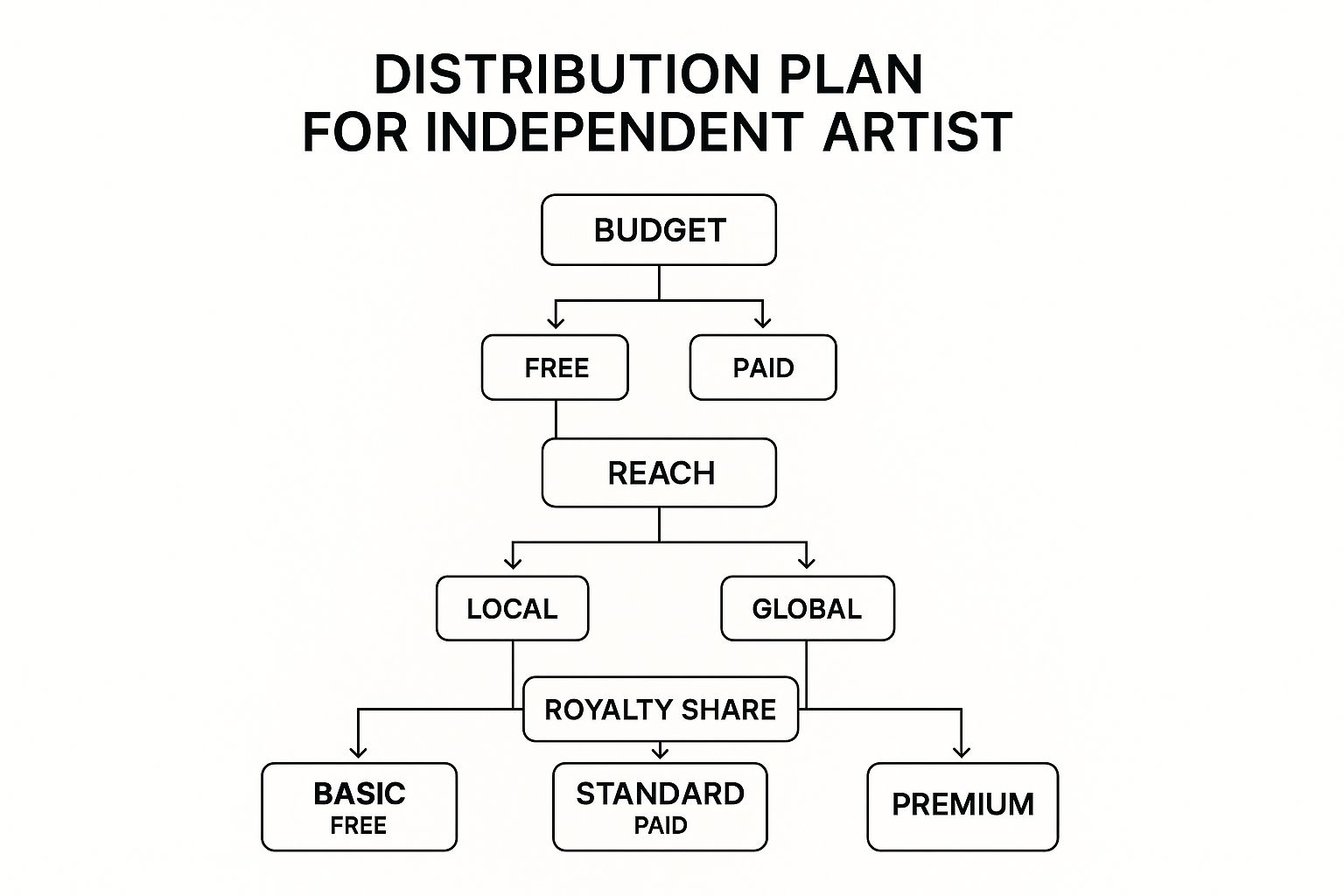
As you can see, your budget and goals point you toward a specific type of plan. There's no single "best" option, only the best one for you.
Comparing Top Music Distributor Models
To make this even clearer, let's break down the common distributor models side-by-side. Seeing the fee structures and target artist for each can help you quickly identify which path makes the most sense for your current situation.
| Model Type | Typical Cost | Royalty Split (Artist's Share) | Best For |
|---|---|---|---|
| Annual Subscription | $20 - $50 per year | 100% | Artists with a consistent release schedule and growing fanbase. |
| Commission-Based | 0% upfront fee | 85% - 90% | New artists releasing their first tracks or those on a tight budget. |
| Per-Release Fee | $10 - $30 per single/EP | 100% | Artists who release music infrequently (e.g., one single per year). |
| Boutique/Label Services | Varies (often custom) | 70% - 85% | Established artists needing hands-on marketing and industry support. |
This table highlights the trade-offs. You can pay less upfront and share more of your revenue, or invest in an annual fee to maximize your long-term earnings.
Advanced Services and Emerging Models
Some distributors are evolving beyond simple delivery and are starting to offer services that can be a huge advantage for ambitious artists.
- Playlist Pitching: Many platforms now have built-in tools that let you submit your music directly to their contacts at Spotify, Apple Music, and other major streaming services. This won't guarantee a spot, but it gets your foot in the door.
- Sync Licensing: Look for distributors with a dedicated sync department. They'll actively pitch your music for placement in films, TV shows, ads, and video games—a massive potential revenue stream.
- Marketing Tools: A good partner will provide assets to help you launch your music, like pre-save campaign builders and custom landing pages that consolidate all your streaming links.
Choosing a distributor isn't a life sentence. It’s about finding the best fit for where you are right now. As your career grows, your needs will change, and you can always migrate to a different service later.
The world of music distribution for independent artists is always changing. New models are popping up, like services such as Amuse that use data analysis to offer artists advances on future royalties without taking any ownership of their masters.
Ultimately, the goal is to find a partner whose services can grow alongside your career. For a more detailed look at specific platforms and what they offer, our guide on how to choose the right music distribution service is the perfect next step. A little bit of homework now will pay off in a big way down the road.
Getting Your Music Ready for a Professional Release
A great release isn't just about uploading a track at the last minute. It's built on a foundation of careful preparation. Think of this stage as your pre-flight checklist—getting the technical and administrative details right is the only way to guarantee a flawless launch where your music sounds pro and you actually get paid. Honestly, getting this part right is non-negotiable for any serious independent artist today.
First things first: the audio file itself. Every streaming service has its own technical specs, and trying to upload a low-quality MP3 is just asking for your release to be rejected. You should always export your final master as a high-resolution WAV file. The standard is 16-bit, 44.1 kHz, but higher is even better. This preserves the full dynamic range and clarity you worked so hard to achieve in the studio.
Your cover art is just as critical. It's the very first thing people see, and platforms like Spotify and Apple Music have surprisingly strict guidelines. If you don't follow their rules, you can end up delaying your entire release.
Artwork and Audio: The Nitty-Gritty Specs
- Artwork Dimensions: It has to be a perfect square. The minimum size is 3000 x 3000 pixels. No exceptions.
- File Format: Stick with high-quality JPG or PNG files, always in RGB color mode.
- Content Rules: Your artwork can't have any website URLs, social media handles, or streaming platform logos. It must be original work that doesn't mislead listeners.
- Audio Quality: Like I mentioned, a 16-bit, 44.1 kHz WAV file is the industry standard for digital distribution.
Beyond the final master, the quality of your vocal recordings makes a huge difference. If you're still dialing in your setup, there are great resources on choosing the best microphone for recording vocals that can have a massive impact on your final sound.
Let’s Talk Codes and Royalties
Once your files are polished and ready, you have to deal with the metadata. This is the behind-the-scenes stuff that lets your music get tracked and paid for around the world. Most distributors will assign these codes for you, but you absolutely need to know what they are.
An ISRC (International Standard Recording Code) is like a unique fingerprint for each song. A UPC (Universal Product Code), or barcode, identifies the entire project, whether it's a single, EP, or album. Without these codes, there's no way to accurately track sales and streams across all the different platforms.
The single most overlooked step for new artists? Registering their work with a Performing Rights Organization (PRO). This is how you collect your performance royalties—the money you're owed every single time your music is played in public.
Don't Forget Your Songwriting Royalties
This is a big one. Registering your songs with a PRO like ASCAP, BMI, or SESAC (if you're in the US) is a completely separate process from distribution, but it's absolutely vital.
Your distributor collects the royalties for the master recording. Your PRO, on the other hand, collects the royalties for the underlying song composition—the lyrics and melody you wrote.
If you skip PRO registration, you are literally leaving money on the table. This is the crucial step that separates artists who just put music out from those building a sustainable career. To dig deeper into launch strategies, check out our guide on the https://oohyeah.app/posts/best-practices-for-releasing-new-music-online.
By getting these technical and administrative tasks out of the way upfront, you’re paving the way for a smooth, professional, and profitable release day.
Your Release and Marketing Playbook
Getting your music uploaded is just crossing the starting line. The real race begins now, and it’s all about strategy. A great song can easily get buried in the noise without a smart marketing plan to back it up. Let's talk about how to turn your next release day from a simple drop into a genuine, career-building moment.
The biggest mistake I see artists make? Rushing the release. You need to give yourself a proper runway. Plan for at least four to six weeks from the day you upload to your release date. This window is your secret weapon—it gives you the breathing room to build real excitement and get all your promotional ducks in a row.
Building Your Release Timeline
A solid timeline is your best friend. It keeps you from scrambling at the last minute and makes sure you don’t miss any key opportunities. Think of it less as a checklist and more as a crescendo, building momentum day by day.
Here’s a battle-tested timeline you can adapt:
- 4-6 Weeks Out: This is go-time for submission. Get your final, mastered track to your distributor. This buffer ensures it gets processed and delivered to all the streaming platforms without a hitch. This is also your prime window to pitch your song directly to Spotify's editors through your Spotify for Artists portal.
- 3 Weeks Out: Kick off your pre-save campaign. Announce the release date, share the artwork, and push that pre-save link everywhere—social media, your email list, your website. This is the first real call to action for your core fanbase.
- 1-2 Weeks Out: Start your outreach. This is when you hit up music blogs, influencers, and independent playlist curators. Personalize every single email or DM. Make it easy for them to say yes by including a private streaming link and a short, compelling story about the track.
- Release Week: It’s all about content. Drip out behind-the-scenes videos, lyric snippets, and countdown posts. On release day itself, be present. Go live on Instagram, jump into your comments, and thank everyone who’s listening and sharing.
A well-defined social media posting strategy playbook can be a lifesaver here, helping you map out your content and keep the narrative consistent.
Pre-Saves and Playlist Pitching
Never underestimate the power of a pre-save. When a fan pre-saves your track, it’s not just a nice gesture—it’s a powerful signal to the algorithms. It tells Spotify and Apple Music that people are anticipating your release, which can seriously boost your visibility on day one. Plus, it’s a great way to gauge how much buzz you’re actually building.
Pitching through Spotify for Artists is just as crucial. You get one shot per track to get your music in front of Spotify’s official curators, so make it count.
- Tell the story behind the music. What inspired it?
- Briefly mention your marketing plans (even small ones!).
- Carefully tag the right genres, moods, and instruments.
Don’t just drop your music and hope for the best. A strong pre-save campaign and a thoughtful playlist pitch are the two most effective things you can do to give your song a fighting chance. It’s about building anticipation, not just posting a link.
DIY Marketing That Actually Works
Let's be real: it’s crowded out there. In 2023, independent labels poured a staggering $1.5 billion into marketing, and 87% of them admit it's getting harder than ever for new artists to cut through the noise. This just means you have to be smarter and more targeted with your approach.
You don't need a huge budget to make an impact. The key is to find your niche and connect with people who will genuinely love what you do. Forget trying to reach everyone. Instead, reach out to smaller music bloggers who cover your specific sound, find TikTok creators in your genre, or hit up local and college radio shows.
A handful of passionate supporters who champion your music will do more for you than a thousand passive listeners ever could. This is how you turn a simple distribution deal into a strategic career move.
Understanding Your Royalties and Analytics
Getting your music onto platforms is a huge step, but the real work starts after you hit "publish." This is where you shift from being a creator to being the CEO of your music career. The two most critical assets you have now are the money you earn and the data you collect.
Let's talk royalties first. It can feel like a tangled web, but it’s actually pretty straightforward. Your distributor is your partner for collecting master royalties—the money generated every time someone plays your specific recording. Then you have performance royalties, which are tied to the song's composition (the lyrics and melody) and are collected by your PRO whenever your song is played publicly.
To put it in perspective, a single Spotify stream usually nets an artist somewhere between $0.003 to $0.005. It’s not much, which is precisely why understanding every single income source is crucial for building a sustainable career.
Decoding Your Analytics Dashboard
Beyond the cents and dollars, your distributor's analytics dashboard is where the magic happens. This is raw, unfiltered feedback from the people who are actually listening to your music. Forget just looking at the total stream count; that’s a vanity metric. The real value is in the stories the data tells you.
Your dashboard, along with tools like Spotify for Artists and Apple Music for Artists, will give you a powerful look under the hood.
- Audience Demographics: Who's listening? Where are they? If you suddenly see a spike in listeners in a city you've never even heard of, that's not just a cool fact—it's a potential tour stop or a target for your next ad campaign.
- Top Playlists: This shows you exactly which playlists are driving your streams. Are they big editorial lists or smaller, user-curated ones? This intel is gold for figuring out who to pitch your next single to.
- Listener Engagement: Keep an eye on saves and playlist adds. A stream can be passive, but when someone saves your track, they’re telling you they want to hear it again. That’s a fan.
Your data isn't just a report card; it's a road map. Use it to see what's resonating with people so you can lean into it. The lessons you learn from one release should directly fuel the marketing plan for the next.
Turning Data into Actionable Decisions
So, how does this look in the real world?
Imagine your analytics show a surprise fanbase growing in Brazil, and you see that most of them found you through a popular lo-fi study playlist. That's your cue. You could start reaching out to Brazilian music bloggers, try using some Portuguese hashtags on Instagram, or maybe even look for a Brazilian artist to collaborate with on a remix.
This is how you stop guessing and start making strategic moves. It helps you invest your time, energy, and limited marketing budget where it will actually make a difference.
For a deeper dive into all the ways you can earn, our guide on how independent artists make money from music breaks it all down. Ultimately, getting comfortable with your numbers is what separates a hobby from a career in music distribution for independent artists.
Answering Your Big Distribution Questions
Even the most well-thought-out release plan hits a few snags. It’s totally normal to have questions pop up along the way, and getting them answered upfront can save you a ton of headaches later. Think of this as your go-to guide for navigating those common hurdles.
What if I Want to Switch Distributors Down the Road?
Yes, you can absolutely switch, and artists do it all the time for better deals or features. The most important thing is to manage the transition smoothly so you don't lose your stream counts and playlist spots.
Here's how it works: you'll initiate a takedown from your current distributor and then re-upload everything with the new one. The golden rule here is to use your original ISRC codes for every single track. This is the only way platforms like Spotify know it's the same song, which is crucial for keeping your stats intact. Make sure you understand the takedown process for both services to keep your music offline for as little time as possible.
How Much Time Should I Give for My Release to Go Live?
This is a big one. While some distributors promise a super-fast turnaround, you should always plan to submit your music at least 2-4 weeks before your release date.
That buffer isn’t just about waiting for a system to process your files. It’s your strategic window for promotion. This is when you can pitch to editorial playlists using Spotify for Artists and run a pre-save campaign to build hype. Rushing a release means you're throwing away your best marketing tools before day one.
Your music is technically copyrighted the moment you create it. But formally registering that copyright gives you a public record of ownership and is what you'll need if you ever have to take legal action to protect your work.
Do I Have to Copyright My Music Before I Distribute It?
You don't have to register a copyright before you distribute, but it’s a smart move for protecting your work in the long run.
Formal registration, which you’d do through an official body like the U.S. Copyright Office, is what gives you the legal muscle to defend your ownership if someone ever infringes on your music.
Ready to take full control of your releases, sales, and marketing all in one place? OohYeah offers a complete ecosystem built for independent artists to succeed. Learn more and get started at https://oohyeah.app.