A Guide to Metal Record Labels for Independent Artists
Discover how metal record labels operate. Our guide for independent artists covers key labels, deal structures, and how to get your music heard.
December 26, 2025
Music Marketplace Advisor
Buying & SellingSo, you've written a killer album and you're ready to take on the world. What's next? For many metal bands, the answer is a record label. These are the strategic partners that can help you fund, produce, and distribute your music on a global scale.
Think of them as specialized mission control centers for your career. They provide the resources and industry connections to get your music off the ground and into the ears of fans everywhere, launching you from the local scene to the international stage.
What Is a Metal Record Label

To an independent metal artist, a record label can feel like some unapproachable, monolithic gatekeeper holding all the keys. It’s time we put that myth to rest.
A modern metal record label is less a gatekeeper and more a strategic partner. They're a dedicated team with the know-how to amplify your music and your brand.
You’ve built the rocket (your music). The label provides the launchpad, the fuel, and the navigation system to get it into orbit. Their job is to invest in your vision and handle all the complex logistics that turn great songs into a real, sustainable career.
The Core Functions of a Label
At their heart, metal record labels manage four critical areas of an artist's career. Each one takes a massive weight off your shoulders, letting you focus on what you do best: creating and performing.
- Funding and Investment: This is the big one. Labels put up the cash for recording, mixing, and mastering a professional-quality album. These costs can easily run into the thousands, a huge barrier for most bands.
- Production and A&R: The label’s A&R (Artists & Repertoire) team is there to help sharpen your sound. They can connect you with the right producers and engineers, making sure the final album is as strong as it can possibly be.
- Marketing and Promotion: Once the record is finished, the label’s marketing team takes over. They build a full campaign, handling everything from press coverage and radio play to digital ads and social media strategy.
- Distribution and Logistics: A label gets your music to the fans. They manage the manufacturing of physical copies like vinyl and CDs and handle digital distribution to all the streaming services and online stores.
A record label's primary function is to transform artistic potential into commercial reality. They bridge the gap between creation and consumption by providing the infrastructure, investment, and industry knowledge that most independent artists lack.
Majors vs. Independents in Metal
The metal world is really built on two different kinds of labels. On one side, you have the major label imprints—these are smaller branches of massive corporations like Universal or Sony. They have deep pockets, but they aren't as common in the niche-driven world of metal.
The true lifeblood of the genre has always been the independent labels. These are nimble, focused operations often started by people who are just as passionate about metal as you are. From pioneering death metal to obscure black metal, these indie labels are the ones cultivating specific sounds and building loyal communities around their artists. For a deeper dive into the business side of things, our guide on how the music industry works breaks it all down.
Part of navigating a label partnership today also means understanding the digital space, including the complex world of licensing and distribution decisions on streaming platforms.
But remember, the traditional route isn't the only one anymore. A new path has opened up. Platforms like OohYeah now give artists the power to build their own mission control. This modern approach lets you keep total creative and financial control while still accessing the tools you need to succeed, completely challenging the old-school label model.
Exploring the Titans of the Metal Scene
The world of metal record labels is a sprawling, diverse ecosystem. You've got your globe-spanning giants, your fiercely independent specialists, and everything in between. For any artist trying to find the right partner—or even just trying to build a competitive career on their own—understanding this landscape is non-negotiable.
Let's break it down into a few key categories. Think of this as a map of the metal industry. Each label is its own territory, with a unique culture and sonic identity. Knowing the terrain is the first step to figuring out where your band fits in.
The Legacy Giants
Some names are just synonymous with metal. They are the institutions that shaped the genre for decades, breaking legendary bands and setting the standard for what heavy music could achieve, both commercially and artistically.
Roadrunner Records is the classic example. It started out pushing extreme Dutch metal and grew into an absolute powerhouse, launching the careers of icons like Sepultura, Slipknot, and Type O Negative. Though it's now part of the major label system, its history proves the power of taking a chance on heavy, boundary-pushing music.
These giants obviously have massive resources and global reach, but getting onto their roster is incredibly competitive. They built their reputations by defining entire movements, from thrash to nu-metal, and they’re always looking for the next big thing.
The Independent Powerhouses
If you want to find the real heart of the modern metal scene, look no further than the independent powerhouses. These are the labels founded by die-hard fans and musicians who saw a gap in the market and decided to fill it themselves. They operate with a passion and a direct line to the underground that the majors often lack.
Nuclear Blast, for instance, has become a global force in everything from power metal to melodic death metal, signing massive acts like Nightwish and Behemoth. They're living proof that an independent spirit can achieve major-label influence without selling out or compromising.
Then there's Metal Blade Records, another absolute titan. For over four decades, this label has been a foundational pillar for extreme metal.
Metal Blade Records stands as a pillar of independent metal success since its 1982 founding in Agoura Hills, California, boasting a roster including Killswitch Engage, Cannibal Corpse, Whitechapel, Amon Amarth, and The Black Dahlia Murder—key players in death, black, and traditional heavy metal subgenres that drive the label's global clout. Discover more about the biggest players in the industry from The Metal Verse.
These indie forces blend the raw passion of the underground with serious business savvy, making them the perfect home for countless established and rising artists.
This screenshot from the official Metal Blade website showcases the label's commitment to its current roster, featuring new releases and tour announcements prominently.
The clear focus on artist promotion and direct-to-fan sales underscores how even legacy independents prioritize building a strong community around their music.
The Niche Specialists
Beyond the bigger players, a vibrant community of niche specialists is absolutely thriving. These labels are the lifeblood of the deep underground, dedicating themselves to very specific subgenres and cultivating scenes that might otherwise get ignored.
- Relapse Records has built its legendary reputation on grindcore, death metal, and all forms of experimental heavy music.
- Profound Lore Records is the go-to for some of the most critically acclaimed and forward-thinking black and doom metal acts out there.
- Willowtip Records has carved out a space championing hyper-technical and progressive death metal, earning respect as a genuinely "forward-thinking label."
These specialists are more than just businesses; they are curators. If your band operates in a hyper-specific genre, signing with a niche label means you're partnering with a team that truly gets it—they live and breathe the same music you do.
Getting a handle on these different tiers gives you a solid foundation, whether you’re shopping a demo or drawing inspiration to build your own brand on a platform like OohYeah.
So, a record deal has landed on your desk. This is it—the moment every metal band grinds for. It's the validation, the sign that the riffs, the sweat, and the countless hours in the practice space are finally paying off. But don't pop the champagne just yet. This is where the road forks, and the path you choose now will define your career.
Signing with a major label versus an independent one is one of the most critical decisions an artist can make. It's not just about a signature on a piece of paper; it's about defining the entire trajectory of your music.
The Major Label Machine vs. The Independent Spirit
Think of it this way: a major label is a high-speed bullet train. It’s powerful, it’s fast, and it has a predetermined track straight to the biggest stations in the world—global radio, massive playlists, and prime-time media. You'll get there with incredible speed and resources.
An independent label, on the other hand, is a souped-up 4x4 van. It might not be as fast, but it can go anywhere. You're in the driver's seat, choosing the scenic routes, connecting with die-hard communities in niche towns, and building a journey that’s uniquely yours.
Neither is inherently better, but they offer vastly different rides.
Before diving deeper, let's lay out the core differences. This table breaks down the fundamental trade-offs you'll face when weighing your options.
| Feature | Major Label | Independent Label |
|---|---|---|
| Budget & Resources | Massive. Access to top-tier producers, studios, and marketing campaigns. | Limited. Relies on smart, targeted spending and grassroots efforts. |
| Creative Control | Minimal. The label often has final say on sound, artwork, and direction. | High. Artists are signed for their unique vision and are encouraged to maintain it. |
| Artist Attention | You are one of many. Focus is on top-selling acts; it's easy to get lost. | You are a priority. A smaller roster means dedicated, personalized support. |
| Deal Structure | Often complex 360 deals that take a cut of all revenue streams. | More artist-friendly. Typically focused on record sales, offering better royalty rates. |
| Distribution & Reach | Global powerhouse. Unmatched physical and digital network. | Strong in niche markets. Often relies on third-party distributors for wider reach. |
| Marketing | Broad, mainstream approach. Focus on hitting the charts and mass media. | Targeted and community-focused. Leverages deep knowledge of specific subgenres. |
As you can see, the choice boils down to a classic dilemma: scale versus control. Both paths can lead to success, but they define success very differently.
What Signing to a Major Really Means
Major labels are corporations built to create global hits, and they have the muscle to do it. When you sign with a major metal imprint, you’re plugging into a worldwide distribution network, a marketing team with connections you could only dream of, and a budget that can fund slick music videos and support slots on massive tours.
But there’s always a catch, and it’s usually in the fine print. Major label contracts are notoriously dense. They often demand ownership of your master recordings in perpetuity and a piece of everything you earn—merch, touring, publishing—through what’s known as a 360 deal. You become a small part of a very large machine, and if your album doesn't hit their commercial targets, the machine moves on to its next big bet, leaving you behind.
The Independent Partnership
Indie labels are a different breed entirely. The relationship is less of a corporate contract and more of a genuine partnership, one founded on a shared obsession for a specific sound—be it technical death metal, atmospheric black metal, or old-school thrash.
With an indie, you get far more creative freedom. They signed you because they love what you do, not because they see you as raw material to be molded into a pop-metal crossover. The deals are almost always more favorable, with higher royalty splits and shorter contract terms. On an indie roster, you’re a big fish in a small pond, getting focused attention from a team that lives and breathes your scene.
Of course, the trade-off is resources. An indie’s budget won't compete with a major's, and their reach is often more grassroots than global. Their power lies in super-serving a dedicated fanbase, not in dominating the mainstream.
The ground is shifting beneath the industry’s feet. A few years back, a study showed that independent labels’ share of chart-topping albums jumped from 24.4% to 39.4% in just three years. In the streaming world, major releases on Spotify charts dropped from 78.5% to 63.5% in a single year. The message is clear: independents are gaining serious ground. You can dig into the numbers with these insights on major versus non-major label performance.
The Third Path: Forging Your Own with OohYeah
There's another option now, one that barely existed a decade ago: the path of true independence. Forget choosing a vehicle—this is about building your own from scratch. Platforms like OohYeah give you the tools to run your own music business, completely on your own terms.
This model offers the best of both worlds. You get the global reach of a major via digital distribution while keeping 100% of your creative control and your money. That’s something no label, major or indie, can offer. You set your own prices, sell directly to the people who support you, and keep every dollar.
By building your career on a platform like OohYeah, you stop being just an artist and become an entrepreneur. You call the shots, making decisions based on your vision and your direct connection with your fans. Whether you stay independent forever or leverage your success to negotiate a killer deal down the road, you're the one in command.
How to Decode Modern Record Deals
Let's be honest, record deals can feel like they're written in a language you don't speak. They’re dense, intimidating, and packed with clauses that will define your career for years to come. But they aren't some arcane secret reserved for industry lawyers. The single best way to protect yourself and build a real career is to understand exactly what you’re signing.
Think of a record deal as a business partnership, not a lottery ticket. Every single line—from royalty splits to who pays for the music video—maps out who owns what, who pays for what, and how everyone makes a living. If you don't know the basics, you're signing away your future with your eyes closed.
Advances and Recoupment: The Label's Loan
The first thing that trips up most bands is the advance. An advance is basically a loan the label gives you to cover recording costs, tour support, or just to live on while you make the album. It’s designed to free you up creatively without financial pressure.
But here’s the critical part: an advance is 100% recoupable. This means you won’t see a single cent in royalties until the label earns back every dollar of that advance from your share of the record's profits. If they gave you $20,000, your music has to earn that $20,000 back for the label before you get your first royalty check. It’s a business loan, period.
A common misconception is that an advance is free money. In reality, it's a debt against your future earnings. If an album underperforms, the artist may never "recoup," meaning they won't receive royalties from that record, even if it generated revenue for the label.
This is a good time to look at the different paths an artist can take today. The landscape isn't just about getting a major label deal anymore.
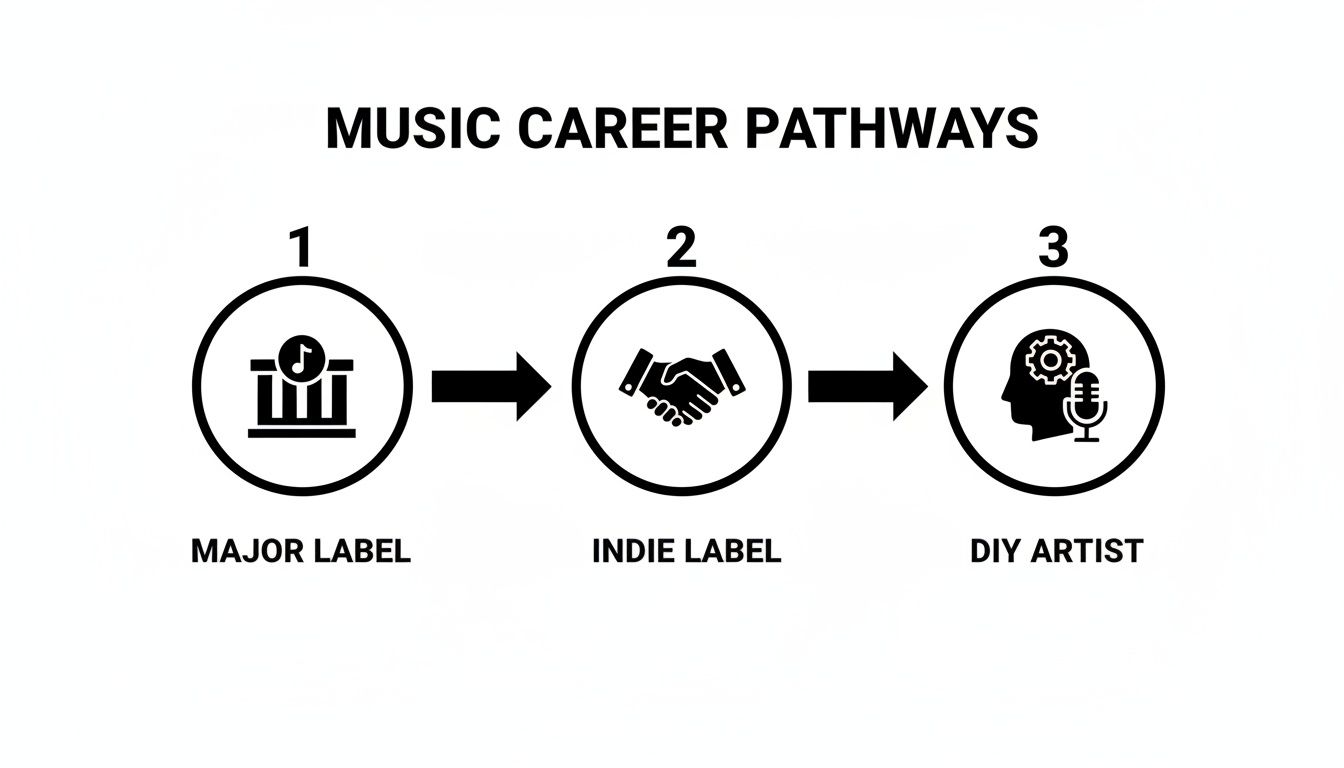
As you can see, the DIY route has become a totally viable and competitive option, standing right alongside the traditional indie and major label structures.
Royalty Splits and Key Deal Types
Okay, so let's say your record is a hit and you've recouped that advance. Now, the royalties start flowing. A typical artist royalty rate might be somewhere in the 15-20% range, but this number can be all over the place. The label takes the rest to cover its own expenses and turn a profit. You absolutely have to understand how they define "net revenue," because they deduct a lot of costs before your percentage is even calculated.
Most metal labels offer a few common types of deals:
- Traditional Royalty Deal: This is the classic model. The label pays for everything (recording, marketing, distribution) and, in return, they own the master recordings. You get a royalty percentage once they've recouped their investment.
- Licensing Deal: A great option if you can fund the recording yourself. You deliver a finished master to the label, which then "licenses" it for a set period. Since their risk is lower, your royalty rate is much higher (often up to 50%), and you get the rights to your masters back when the term expires.
- Distribution Deal: Here, the label’s job is purely to get your music into stores and onto streaming platforms. You pay them a fee or a cut of the sales, but you keep total ownership and creative control.
At the heart of all these agreements is the ownership of what you create. It's a complex world, but getting a basic grasp of intellectual property protection is non-negotiable for any serious artist.
The Controversial 360 Deal
In recent years, the 360 deal has become more common, and it’s a tricky one. In this setup, the label gets a cut of all your income streams—not just album sales. We're talking about revenue from your tours, merch sales, publishing royalties, and even sponsorship deals.
Their argument is that their marketing efforts are what build your entire brand, so they deserve a piece of everything that brand generates. For you, it means giving up a slice of every single dollar you earn as an artist. It's a massive trade-off that you need to think long and hard about.
This is where a platform like OohYeah comes from a completely different mindset. It's built to sidestep these complex deals entirely. The model is simple: you connect directly with your fans and keep 100% of the money you earn from your music, merchandise, and their support. It puts the financial control and power right back where it belongs—with you.
Getting Your Demo Heard by the Right People
Having a killer album is only half the battle. The other, arguably harder, half is getting it into the right hands. This is where a smart, professional approach separates the bands that get signed from the ones that get ignored.
Simply carpet-bombing every label email address you can find is the fastest way to get your demo deleted. You have to be targeted. Think of your submission as a business proposal: you're approaching potential investors (the label) with a product (your music) and a business plan (your band's future). A sloppy, unprofessional proposal gets tossed immediately, no matter how great the music is. Your job is to make a case so compelling they have to listen.
Building Your Submission Package
Before you even think about writing an email, you need to get all your assets in order. The core of this is your Electronic Press Kit (EPK). This is your band's professional resume, a one-stop shop for everything a label needs to know.
A solid EPK, whether it's a clean webpage or a slick PDF, absolutely must include:
- Your Best Music: Lead with your three strongest, professionally mixed and mastered tracks. This isn't the time for rough demos or half-baked ideas.
- A High-Quality Band Photo: Shell out for a professional shoot. Your photo needs to reflect your band's image and vibe.
- A Concise Bio: Tell your story. Who are you? What kind of metal do you play? What makes you different? Keep it tight and interesting.
- Links to Socials and Streaming: Make it easy for them to find you online with clear links to your active profiles.
This package has to look and sound professional from top to bottom. It shows you take your career seriously, which makes a label much more likely to take you seriously.
The Art of the Submission Email
With your EPK ready, it's time to write the perfect email. The name of the game is clarity and respect for the A&R person’s time. These people get hundreds of emails a week, so yours needs to stand out by being efficient and well-researched.
Here’s a simple, effective template:
- A Specific Subject Line: Use a format like:
SUBMISSION: [Your Band Name] - [Your Subgenre]. For example: SUBMISSION: Serpent's Kiss - Technical Death Metal. - A Short, Personal Introduction: If you can find a name, use it. Briefly state who you are and why you're contacting their label specifically. Mentioning a band on their roster you admire shows you’ve done your homework.
- The "Elevator Pitch": In a sentence or two, nail down your sound. Use clear comparisons like, "For fans of Gojira and Meshuggah."
- The Link to Your EPK: Provide one clean link. Never, ever attach large audio files directly to the email.
- A Professional Closing: Thank them for their time and consideration.
This targeted approach screams professionalism and shows you have a genuine interest in partnering with that specific metal record label.
Proving Your Value with Data
Now, for the game-changer. A great demo is a guess; data is proof. An independent artist who can show a real track record of sales and fan engagement is infinitely more attractive to a label. This is where building your career on a platform like OohYeah before you shop a deal can completely change the conversation.
When you approach a label not just with great songs but with hard numbers—X amount of downloads, Y dollars in merch sales, and a mailing list of Z dedicated fans—you're no longer just an artist. You are a proven business opportunity.
Think about Metallica's mind-boggling dominance, racking up a staggering 180 million equivalent album sales worldwide. That's the kind of massive commercial potential labels dream of, and it highlights the importance of multi-format success, which you can start building on your own. You can discover more insights about top metal sales on ChartMasters.org. By proving you can already move units and build an audience, you take a huge amount of risk off the table for any label. For more on this, check out our guide on how to market your music as an independent artist.
Finally, here’s a massive red flag to watch out for: never pay a label to listen to your demo. Legitimate metal record labels make money by investing in artists, not by charging them submission fees. Any "label" asking for cash upfront is not a real partner and should be avoided at all costs.
Forging Your Own Path Without a Label

The classic dream of getting signed to a big metal label isn't the only way to build a real career anymore. For the savvy independent artist, the tools to carve out a global footprint are right at your fingertips. This isn't about waiting around for some A&R scout to anoint you; it's about seizing control and building your own metal empire from the ground up.
When you go this route, you’re not just a musician—you’re an entrepreneur. Instead of borrowing a label's infrastructure, you build your own. That means you keep 100% control over your music, your brand, and, most importantly, your money.
Building Your Direct-to-Fan Ecosystem
The heart of modern independence is forging a real, direct connection with your audience. An ecosystem like OohYeah gives you the command center to build and grow that relationship, turning casual listeners into a loyal fanbase that funds your art directly. It’s your mission control, run entirely by you.
Setting up your own digital storefront is the essential first move. Think of it as your home base where fans can buy your music, snag exclusive merch, and get special content without a middleman taking a huge slice of the pie.
- Music and Merchandise: Sell high-quality digital downloads, limited-edition vinyl, and custom-designed shirts directly from your own space. You set the prices and keep the revenue, instead of settling for fractions of a penny from streaming.
- Exclusive Content: Give your core fans a reason to invest in you. Offer behind-the-scenes studio footage, early access to new singles, or even a members-only EP.
By creating a one-stop shop for everything you do, you make it easy for fans to support you while maximizing your income. It's a powerful shift that puts financial control squarely back in your hands. To dive deeper into this model, our complete guide explains how independent artists make money from music in the current scene.
Using Data to Drive Growth
Going it alone gives you access to a resource labels often guard closely: your audience data. Knowing who your fans are, where they live, and what they respond to is absolute gold for smart, strategic growth.
Instead of just guessing what to do next, analytics give you a clear roadmap. You can see which songs hit the hardest, which merch designs fly off the shelves, and which cities have the most listeners—perfect for planning tours and targeted promo campaigns.
This is about more than just making great art; it's about building a sustainable business around it. By cultivating a loyal community and making data-backed decisions, you create your own momentum. You'll build a proven track record of sales and engagement that gives you massive leverage, whether you stay independent forever or decide to partner with a label on your own terms.
Frequently Asked Questions
When you're trying to break into the metal scene, the world of record labels can feel like a maze. Let's tackle some of the most common questions that come up for artists trying to find their footing.
Do I Really Need a Record Label to Succeed in Metal?
Honestly? No. A label can be a huge amplifier, bringing money, connections, and marketing muscle to the table. But they are absolutely not the gatekeepers they once were.
Today, you have all the tools you need to handle your own global distribution, sell directly to the people who love your music, and build a real following without signing away a piece of your art. Many bands now choose to build a solid career on their own first. They prove their worth with actual sales numbers and a dedicated fanbase, which gives them all the leverage if a label comes knocking later.
What Is the Biggest Mistake Bands Make When Contacting Labels?
By far, the most common—and fatal—mistake is sending a lazy, untargeted submission. If you're blasting your tech-death demo out to a label that has only ever signed atmospheric black metal, you're not just wasting your time; you're showing you haven't done the most basic homework.
A targeted, professional approach is everything. Always tailor your submission to the specific label. Show them you know their roster, understand their sound, and actually see how your band fits in. It proves you respect their time and are serious about your career.
This single step will immediately set you apart from the massive pile of generic emails they get every single day.
How Much Do Artists Actually Make from a Record Deal?
This is where things get tricky, as earnings can be all over the map depending on your deal. A standard royalty rate might look like 15-20% of net revenue, but here’s the kicker: you won’t see a dime until the label has recouped its entire investment.
Every dollar they spend on recording, marketing, video production, and tour support gets paid back from your share of the profits first. This means a record could be selling well and making the label plenty of money, while you're still waiting to break even. It’s a harsh reality, and it's precisely why keeping a higher percentage of your income through direct-to-fan sales is so vital for survival.
Ready to take control and build your music career on your own terms? With OohYeah, you can sell music and merchandise directly to your fans and keep 100% of the revenue. Sign up today and start building your metal empire.