A Musician's Guide to License for Cover Songs
Learn how to legally get a license for cover songs. Our guide covers mechanical licenses, costs, and common mistakes for your next music release.
October 11, 2025
Music Marketplace Advisor
Buying & SellingSo, you've put your own spin on a classic tune and you're ready to share it with the world. Before you hit "upload," there's one crucial step you absolutely can't skip: securing the right license. For any audio-only release, that means getting a mechanical license for cover songs. Think of it as the foundational legal permission that allows you to distribute your track on platforms like Spotify or Apple Music while ensuring the original songwriter gets paid for their craft.
Decoding Your First Cover Song License
When you decide to record and release a cover, you're tapping into another artist's copyrighted work. A cover song license is really about fairness and respect. It's the system that guarantees the original creators—the songwriters and their publishers—earn royalties whenever another artist reproduces their musical composition.
This isn't some new-fangled internet rule; the system has deep roots. The idea of a mechanical license was first baked into U.S. copyright law way back with the 1909 Copyright Act, and later modernized by the 1976 Copyright Act. This legal framework gives artists the green light to record and sell their own versions of existing songs.
Fast forward to today, and mechanical licensing is a cornerstone of a global music industry valued at over $100 billion. With North America making up about $40 billion of that in 2024, it's clear these agreements are a massive part of the business.
The Two Licenses Every Artist Must Know
For most independent artists, the world of licensing really boils down to two key types. Getting the distinction right from the start will save you a world of headaches down the road.
Let's quickly compare the two main licenses you'll encounter.
Comparing Key Music Licenses for Artists
This table breaks down the two most important licenses for any artist releasing a cover song.
| License Type | Primary Use | When It Is Required | Typical Licensor |
|---|---|---|---|
| Mechanical License | Audio-only reproduction and distribution of a musical composition. | For releasing a cover song on streaming services (Spotify, Apple Music), digital downloads (iTunes), or physical formats (vinyl, CDs). | Music publishers or a collective rights organization like The MLC in the U.S. |
| Synchronization (Sync) License | Pairing a musical composition with visual media. | For creating a music video for YouTube, using the cover in a TikTok or Instagram video, or placing it in a film or commercial. | Directly from the music publisher; this is a one-on-one negotiation. |
Understanding this distinction is the key to staying compliant and protecting your work.
Here’s a more detailed look:
Mechanical License: This is your go-to for audio-only releases. If you're planning to sell downloads, press vinyl, or get your cover onto streaming platforms, you need a mechanical license. It covers the right to reproduce and distribute the song itself.
Synchronization (Sync) License: The game changes the second you add visuals. A sync license is mandatory for pairing a song with moving images. This includes everything from a YouTube music video and a TikTok post to using the track in an indie film.
The most common mistake I see new artists make is assuming a mechanical license covers their YouTube video. It doesn't. You need both: a mechanical license for the audio and a sync license for the video.
Why This Is More Than Just Paperwork
It helps to understand that you're entering into the foundational Licence Agreement when you secure these rights. This is about more than just paying a fee; it’s a professional courtesy that honors the creative work that inspired you in the first place. Properly licensing your covers shows you respect the songwriting community.
On the flip side, skipping this step can bring serious consequences. You could face takedown notices from streaming platforms, copyright strikes on your YouTube channel, or even legal action from a publisher.
Getting your licenses in order protects you, supports your fellow creators, and solidifies your reputation as a serious musician. If you want to get a broader view of how these agreements fit into an artist's career, you might find our guide on https://oohyeah.app/posts/understanding-music-licensing-how-it-can-boost-your-revenue helpful.
Licensing for Spotify, YouTube, and Beyond
Where you plan to release your cover song changes everything. An audio-only stream on Spotify plays by a different set of rules than a music video on YouTube, and understanding that distinction is critical for a smooth release.
For audio-only platforms—think Spotify, Apple Music, and Amazon Music—your main concern is the mechanical license. Here's the good news: the major streaming services usually handle the payment of mechanical royalties to publishers and songwriters themselves. This takes a massive administrative weight off your shoulders.
But you're not completely off the hook. You still have to make sure your distributor (like DistroKid or TuneCore) correctly flags your track as a cover song during the upload process. This is the crucial step that tells the platforms who to pay. If you mess this up, you're looking at potential disputes and long payment delays.
The Shift to Video Platforms
Things get a lot more complicated the moment you add a visual element. For platforms like YouTube, TikTok, and Instagram, a mechanical license just won't cut it. You've now entered the world of the synchronization (sync) license.
A sync license gives you the right to pair a song with moving images. So, anytime you make a music video for your cover, post a live performance clip, or even use the track in a quick social media video, you technically need a sync license.
Here's the tricky part: Securing a sync license means negotiating directly with the song's publisher. Unlike mechanical licenses, which are compulsory, publishers have no obligation to grant you a sync license. This makes the whole process much more difficult and uncertain.
Navigating YouTube's Content ID System
YouTube has a powerful, automated system called Content ID that constantly scans every video for copyrighted material. When you upload your cover song, it’s almost guaranteed that Content ID will flag it and place a claim on your video for the original copyright owner.
So, what does that actually mean for your video?
- Monetization: The copyright holder can decide to run ads on your video and collect all the revenue. You won't see a dime.
- Blocking: They might block your video in certain countries, or even worldwide.
- Takedown: While it's less common for a straightforward cover, a formal takedown notice is possible. This results in a copyright strike against your channel, which is a serious problem.
Getting a handle on the legal side of things is non-negotiable, so it’s worth digging deeper into understanding the nuances of using copyrighted music on YouTube to stay out of trouble.
The music industry's pivot to streaming has made all of this even more complex. In fast-growing markets like Latin America, streaming now makes up a staggering 87.8% of recorded music revenues. This digital-first reality means more covers are being released than ever before, fueling a global digital music copyright service market projected to hit $15 billion by 2025. You can find more details on this global music revenue shift in recent industry reports.
The bottom line is this: while streaming services have made audio licensing easier, video platforms require a much more proactive approach. Always assume you need a sync license for any video content and be ready to deal with systems like Content ID to keep your release compliant.
How to Actually Get a Mechanical License
Getting the legal side of your cover song sorted might sound intimidating, but it’s actually become a straightforward part of the release process. Thanks to a few great online services, you can handle all the licensing in less time than it takes to mix a track. Think of them as the middleman—they do the heavy lifting of tracking down publishers and handling the paperwork, all for a small fee.
The two go-to services for independent artists in the U.S. are Easy Song and Songfile, which is run by the Harry Fox Agency. Both get you to the same finish line, but they're built for slightly different users. Easy Song is fantastic for anyone new to this, with a super clear interface and great support. Songfile is more of an industry-standard tool, a bit more direct and often preferred by artists who've been through the wringer a few times.
This infographic lays out the basic journey you'll take with an online licensing service.
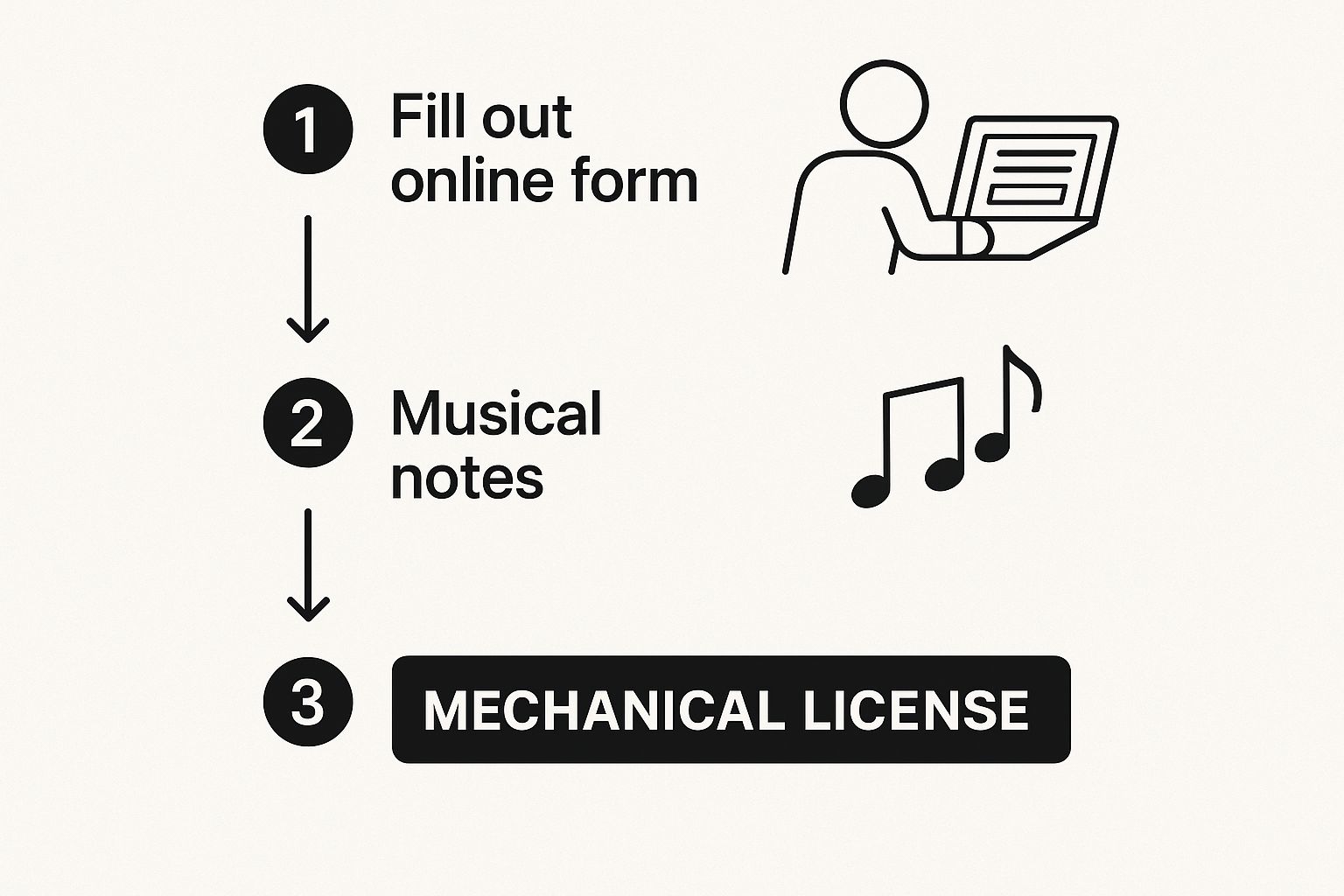
As you can see, it's a manageable workflow, moving you from song selection to final payment without any major headaches.
Get Your Ducks in a Row First
Before you even head to a licensing website, do yourself a favor and get all the necessary information together. It’ll make the whole application a breeze. You can't just throw a song title into a search bar and hope for the best; accuracy is everything. It ensures the right people get paid for their work.
You’ll need to nail down these details:
- Original Song Title: Get it exactly right, subtitles and all.
- Original Songwriter(s): Every single person credited with writing the song needs to be on your list.
- Original Performing Artist: This helps the service pinpoint the exact composition you're covering.
- Publisher Information: The service can usually dig this up for you, but having it ready will speed things along. You can find this by searching the public databases on ASCAP or BMI.
Take your time here. I’ve seen simple typos in a songwriter’s name cause major delays or even result in an invalid license. Always double-check your info against a reliable source, like the U.S. Copyright Office's public records or one of the PRO databases.
Filling Out the Online Application
Once your information is collected, the application process itself is surprisingly simple. You'll create an account on the service of your choice, search for the song, and plug in the details you gathered.
The most crucial part is estimating your distribution numbers. The service needs to know how many copies of your cover song you plan to sell or distribute. You'll have to provide an estimate for:
- Digital Downloads (sales on iTunes, Amazon Music, etc.)
- Physical Copies (CDs, vinyl records)
- Interactive Streams (Spotify, Apple Music, etc. often handle these royalties, but it’s important to be aware of this category)
The service uses these numbers to calculate the statutory royalty fees you owe to the publisher. You pay this amount upfront, along with a small administrative fee to the service for their work.
What happens if your song blows up and you sell way more than you expected? No problem. You just go back to the service and purchase a license for the additional units. It's that simple. For a more detailed breakdown, our full guide on how to get a mechanical license walks you through every single stage.
Which Cover Song Licensing Service Is Right for You?
Choosing between the main players can be tough if you don't know what to look for. This table breaks down the key differences between Easy Song and Songfile to help you decide which one fits your project and budget.
| Service | Best For | Processing Time | Typical Fees |
|---|---|---|---|
| Easy Song | Beginners, complex cases, or artists wanting full-service support. | 1-2 business days | $16.99 one-time fee per song, plus royalties. |
| Songfile | Experienced artists, bulk licensing, and those on a tight budget. | Can be instant, but up to 5-10 days if research is needed. | $12 one-time fee per song, plus royalties. |
Ultimately, both services are excellent and will get you the license you need. Easy Song provides more hand-holding, which is invaluable for your first few times. Songfile is a more direct, no-frills tool that’s perfect once you know the ropes. You can’t go wrong with either.
Breaking Down the Costs and Royalties
So, what’s this actually going to cost you? It's the first question everyone asks, and thankfully, the answer isn't as complicated as you might fear. For a standard audio-only cover song, you don't have to haggle with a publisher. The price is already set by law.
This is all thanks to the U.S. statutory mechanical royalty rate. Think of it as a fixed, government-mandated fee you pay the original songwriter and publisher every time someone buys or downloads a copy of your version. For artists like us, it creates a predictable and transparent cost for releasing a cover.
Understanding the Statutory Rate
This rate is determined by a panel of judges called the Copyright Royalty Board, and they update it every few years. As of now, for physical releases (like vinyl and CDs) and permanent digital downloads, the rate is 12.4 cents per track or 2.38 cents per minute of playing time—whichever amount is greater.
Why the two options? It’s a way to make sure compensation is fair for both a two-minute punk track and a sprawling ten-minute epic. For most standard-length songs, that 12.4 cents per copy is what you'll be paying. For example, any song under five minutes and 12 seconds will fall under the 12.4-cent rate.
The most important thing to remember is that you pay this royalty for every single unit you plan to distribute. If you're pressing 100 vinyl records of your cover, you owe 100 times the statutory rate. Getting this calculation right upfront is crucial for budgeting your release.
Calculating Your Licensing Fees
Let's walk through a real-world scenario. Imagine you're putting a four-minute cover song on your new EP. You're planning to press 500 vinyl records and you're hoping for at least 1,000 digital downloads from your Bandcamp page.
Here’s how the math shakes out:
- Vinyl: 500 copies x 12.4 cents/copy = $62.00
- Downloads: 1,000 copies x 12.4 cents/copy = $124.00
Your total mechanical royalty payment comes out to $186.00. On top of that, the service you use to secure the license, like Easy Song or Songfile, will charge a small administrative fee for their work, which is usually around $12 to $17 per song.
For a deeper dive into all the potential expenses, our guide on how much it costs to cover a song breaks it down even further.
These small transactions are part of a massive industry. The global market for music licensing services, which covers everything from indie covers to blockbuster film scores, was valued at over $100 billion in 2024. As more content is created, the need for properly licensed music is only going to grow.
What About Streaming?
But what happens when your song is on Spotify or Apple Music? This is where things get a bit easier for you. The streaming platforms themselves are responsible for paying mechanical royalties from their revenue pool directly to publishers.
You don’t have to calculate and pay for every stream. Your only job is to make sure you correctly identify your track as a "cover song" when you upload it through your distributor (like DistroKid or TuneCore). They’ll handle the rest of the metadata so the right people get paid.
Common Mistakes Artists Make with Cover Songs
When it comes to cover song licensing, I see artists run into the same handful of problems over and over again. It's an area filled with bad advice and persistent myths. Let's walk through the most common traps so you can steer clear of them and protect your music.
One of the biggest misconceptions I hear is the "30-second rule." This is the idea that you can use a small snippet of a song without getting permission. Let me be perfectly clear: this is completely false. There is no magic number, no safe time limit. Even a two-second sample can land you in hot water for copyright infringement.
Another huge one is thinking a mechanical license has you covered for a YouTube video. It absolutely doesn't. That mechanical license only gives you rights for the audio recording. The second you sync that audio to any kind of video—even just a static image of your album art—you’ve entered synchronization (sync) license territory. Skip this step, and you risk YouTube demonetizing your video, taking it down, or hitting your channel with a copyright strike.
Altering the Original Song Too Much
Putting your own stamp on a cover is the whole point, right? But there’s a creative line that, if crossed without permission, can create a legal headache. If you change the fundamental melody or core lyrics too drastically, your song might not even be considered a cover anymore.
Legally, you've created what's known as a derivative work.
A derivative work isn't covered by a simple mechanical license. It requires you to negotiate directly with the song's publisher for permission, which is a far more involved and expensive process. Publishers have every right to say no, and frankly, they often do.
So, how do you make a song your own without turning it into a derivative work? Focus your creativity on these areas:
- Arrangement: Feel free to change the instrumentation, switch up the tempo, or even reimagine the song in a completely different genre.
- Performance Style: This is all you. Change the vocal delivery, the dynamics, and the overall emotional feel of the track.
- Production: Get creative with effects, mixing styles, and sonic textures to give it a unique sound.
Stick to these aspects, and you can create a truly original-sounding cover that still qualifies for a standard mechanical license.
Believing "Credit" Is a Substitute for a License
This last one is a classic. I often see artists assume that just by giving credit to the original songwriter, they've done their due diligence. While it's good practice and shows respect to mention the original writers in your liner notes or video description, it has zero legal weight.
You can post everywhere that your amazing rendition of "Hallelujah" was written by the great Leonard Cohen, but if you haven't secured the proper license, you're still infringing on his copyright. It's that simple.
The only way to legally release your cover and ensure the original creators get paid for their work is to secure the correct license for cover songs. Learning from these common missteps will keep you out of trouble and let you focus on what you do best—making incredible music.
Answering Your Lingering Cover Song Licensing Questions
Even with a solid grasp of the basics, you'll inevitably run into those tricky "what if" scenarios. Let's tackle some of the most common questions I hear from artists, giving you quick, practical answers to clear up any final confusion before you share your music with the world.
What About Playing Covers Live?
This one comes up all the time. Your band is playing a gig at a local club, and you throw in a cover of a crowd favorite. Do you need to get a license for that?
The short answer is no, you don't. The responsibility for public performance rights falls on the venue owner or promoter. They're the ones who pay for blanket licenses from Performance Rights Organizations (PROs) like ASCAP and BMI. Those agreements cover all the music performed in their space, including your live cover. So, you can rock on without worry.
What if I Can’t Find the Music Publisher?
Okay, this is a legitimate roadblock. You've got your heart set on covering a specific song, but you're hitting a wall trying to figure out who actually owns the publishing rights. It can be frustrating, but it's not a dealbreaker.
Services like Easy Song are built for this exact situation; their team will do the detective work for you as part of their fee. If you’re committed to the DIY route, your best bet is to start digging through the public databases of the U.S. Copyright Office or the PROs (ASCAP, BMI, and SESAC).
Just remember, "I couldn't find them" won't hold up as a legal excuse if you release an unlicensed track. The responsibility to secure the proper license for your cover song always falls on you, the artist releasing it.
How Long Does it Take to Get a License?
Worried this will hold up your release schedule for weeks or months? Don't be. The process is surprisingly fast these days.
- Using online services: When you go through a platform like Songfile or Easy Song, you can often get your proof of licensing back in just one or two business days.
- Instant approvals: For many popular songs already in their catalogs, the license can be granted almost immediately after you complete the payment.
This efficiency means you can easily work licensing into your production timeline without causing major delays.
Do These Licenses Work Everywhere?
This is a critical point that often gets overlooked. You secure a U.S. mechanical license. Does that mean you're covered for sales and streams in the UK, Japan, or anywhere else?
Absolutely not. Mechanical licenses are territorial. The license you get in the United States is only valid for distribution and sales within the United States.
If you're aiming for a global release, you'll need to sort out international licensing. Thankfully, this isn't as complicated as it sounds. Most modern digital distributors, like DistroKid or TuneCore, have built-in processes to handle this. They often deduct the necessary international royalties and pay the publishers on your behalf. Just be sure to check your specific distributor’s policy on how they handle global cover song releases.
Ready to manage your music, merch, and fan connections all in one place? OohYeah provides the tools you need to build your career on your own terms. Start building your ecosystem today at https://oohyeah.app.