Jamaican Dancehall Music: History, Sound & Culture 2026
Dive into Jamaican dancehall music! Discover its history, vibrant culture, unique sound, and tips for artists on creation and monetization.
July 18, 2026
Music Marketplace Advisor
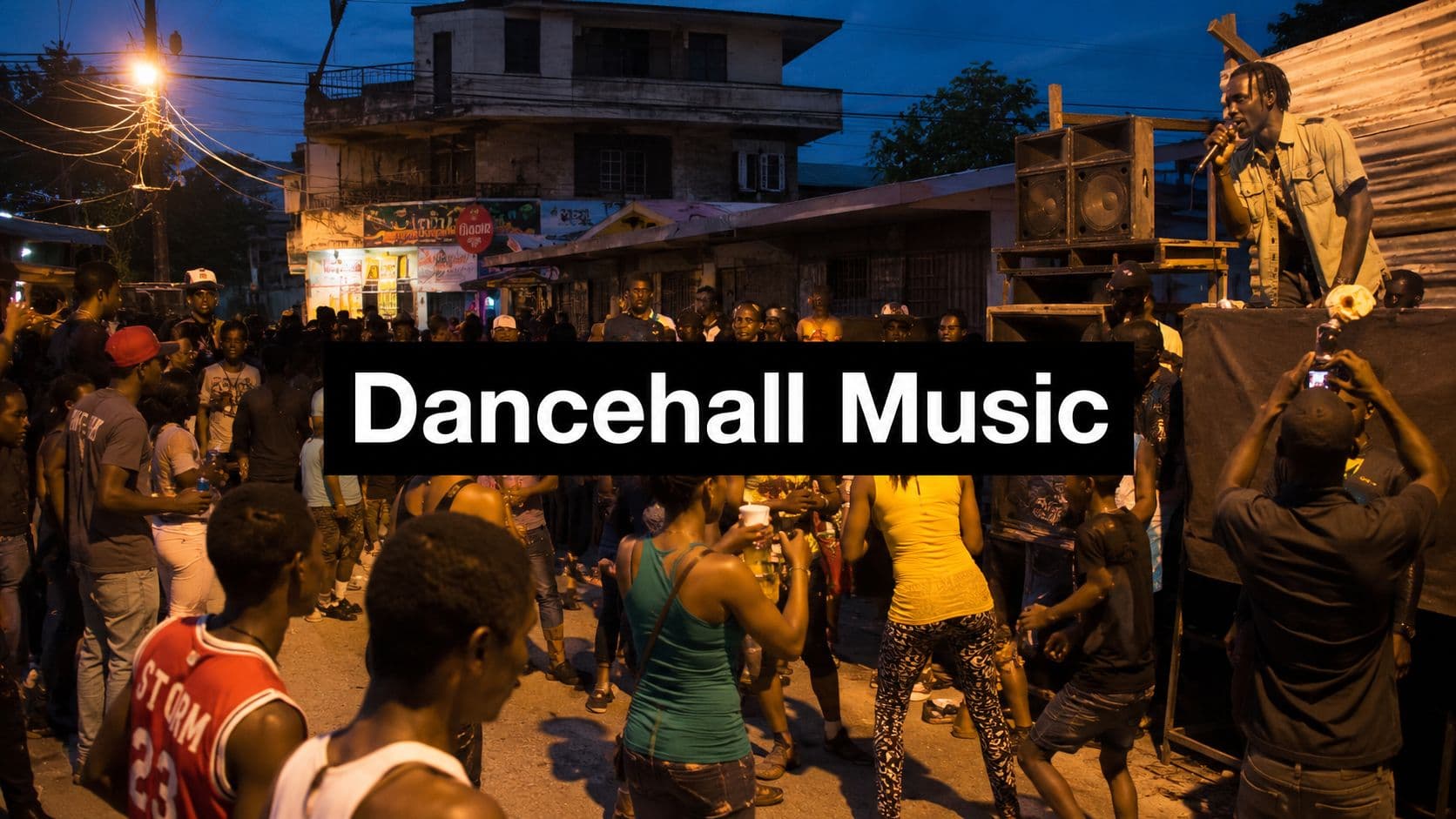
Buying & SellingThe selector drops, the speaker stack growls, and before the first full lyric lands, the crowd already knows the riddim. In that moment, Jamaican Dancehall music doesn't feel like a genre label. It feels like a public language made of bass, timing, swagger, and survival.
Introduction The Pulse of the People
A late-night street session in Kingston tells you more about dancehall than any dictionary can. You hear the low end first. Then the deejay steps in, not floating over the beat in a polished pop style, but striking it like percussion, line after line, phrase after phrase, until the whole space moves as one body.
That's the heart of Jamaican Dancehall music. It isn't only recorded sound. It's a live social force shaped by sound systems, neighborhood identity, dancers, selectors, producers, and artists who know how to command attention with rhythm as much as melody. When people first encounter dancehall, they often hear its energy before they understand its structure. That's normal. The music is designed to hit the body immediately.
What makes dancehall powerful is how many roles it plays at once. It's party music. It's street reportage. It's style culture. It's verbal art. It's also one of Jamaica's most influential musical exports, even when global listeners don't realize where many of today's rhythms, cadences, and vocal approaches come from.
For new artists, that history matters because it changes how you create. If you treat dancehall like just another playlist category, you'll miss its engine. If you understand its culture, its production logic, and the business realities around it, you can build work that feels rooted instead of borrowed.
Dancehall rewards artists who understand pulse, space, and personality. Technical polish helps, but identity carries the song.
The Origins of Jamaican Dancehall
Dancehall began in a place, not just a playlist category. In late-1970s Kingston, the center of gravity was the dance. People gathered around towering sound systems, and the music had to work in real time. If a record felt too distant, too slow to grab the room, the crowd let you know immediately.
That pressure changed the music.
Dancehall grew from reggae, but it answered a different social job. Roots reggae often carried spiritual reflection, political witness, and the feel of a full band performance. Dancehall kept the Jamaican sense of rhythm and bass weight, then pushed the focus toward immediacy, repetition, and direct crowd response. The result was music built to function like live dialogue between selector, deejay, speaker box, and audience.
In other words, dancehall did not erase reggae. It narrowed the lens. It brought the street session, the neighborhood voice, and the physical act of dancing closer to the center.

From roots meditation to dancefloor urgency
A newcomer can easily get confused here. If reggae is the foundation, why does dancehall feel so different?
The answer is emphasis. Roots reggae often gave songs room to breathe through slower grooves, live instrumentation, and themes of resistance, faith, and history. Dancehall tightened the frame. It gave more room to the deejay's rhythmic speech, to stripped-down patterns that hit harder on a big sound system, and to lyrics about daily survival, romance, fashion, rivalry, humor, and social status. In many Jamaican communities, that shift made the music feel closer to the tempo of ordinary life.
A useful comparison comes from film. Roots reggae often works like a wide shot that shows the whole social scene. Dancehall often works like a close-up. You hear personality, pressure, swagger, and local detail right in your face.
The rise of the deejay and the sound system economy
Sound system culture helped shape more than the sound. It reshaped the business model.
At a dance, the person who could command attention over a riddim became invaluable. That gave the deejay a new kind of centrality. Instead of treating the vocalist only as a singer delivering a fixed song, dancehall prized artists who could toast, chat, boast, improvise, provoke laughter, and build tension with timing alone. A great deejay worked like both drummer and storyteller. The voice carried rhythm as much as meaning.
That live demand changed production habits too. Producers, selectors, engineers, and promoters needed material that could travel fast through the circuit of local dances. One strong riddim could support many songs by different artists, each version offering a new angle, a new hook, or a new personality. For new independent artists, that history matters financially. Dancehall has long shown that value does not always start with expensive, one-off compositions. It can start with a reusable musical foundation, a distinct vocal identity, and a smart release strategy around versions, dubs, performances, and rights splits.
Shared riddims were not only an artistic choice. They were a practical revenue system.
Technology changed the texture and the market
By the mid-1980s, digital production pushed dancehall into a new phase. The best-known turning point is usually tied to the “Sleng Teng” era, when producers and artists embraced the sharper, more synthetic feel of affordable keyboards and drum machines. As the British Library's overview of Jamaican music history explains, digital dancehall marked a major shift in Jamaican popular music, changing both the sonic palette and the speed of production process: https://www.bl.uk/articles/the-history-of-jamaican-music-in-the-20th-century
That matters for two reasons.
First, the sound changed. Digital patterns created harder edges, tighter repetition, and more space for the voice to cut through. On a large sound system, that translated into impact. The bass and drum programming were not trying to imitate a live band perfectly. They were trying to move bodies and carry authority in the dance.
Second, the economics changed. Digital tools lowered some production barriers and made it easier to build tracks quickly, version them, and test them in the street before they spread further. That lesson still applies to independent artists now. Mainstream audiences may adopt a dancehall rhythm, a patois phrase, or a vocal cadence faster than the original creators get paid for it. Artists who study dancehall's origins can learn a harder but more useful lesson. Culture moves first, but income follows structure. If you control your masters, document your splits, clear your samples, and treat each riddim as intellectual property rather than just content, you stand a better chance of turning influence into actual earnings.
Dancehall's origins sit at that intersection of culture and system. Neighborhood demand shaped the style. Sound systems shaped the performance rules. Digital tools changed the texture. Artists and producers then turned all of it into a repeatable creative economy that the wider music business still borrows from.
The Anatomy of the Dancehall Sound
A dance can tell you what a genre values before a single lyric lands. In dancehall, the body gets its instructions early. The drum pattern gives clear footing, the bass adds weight, and the voice enters like a lead performer stepping into a lit circle. If you are trying to understand why dancehall feels so immediate, start with the architecture of the riddim.
A riddim works like a reusable musical foundation. Producers build it to be sturdy, memorable, and open enough for different artists to voice their own songs on top. That design choice is one reason dancehall became such a powerful local industry model. One strong riddim can generate multiple recordings, multiple performances, and multiple revenue opportunities, but only if the producer and artists treat it like an asset and document ownership properly.
According to this technical breakdown of dancehall structure, dancehall usually sits in a midtempo zone, with many classic riddims living in a range that feels steady, forceful, and easy to move to. Newer hybrids may feel slower through half-time phrasing or faster through double-time programming, but the central idea stays the same. The groove must feel physical before it feels decorative.

Start with the drum pattern
Many new listeners hear the family resemblance between reggae and dancehall, then miss the point where the road splits. The drums explain a lot. Dancehall usually places the kick and snare in a more direct, grounded pattern than roots reggae's one-drop feel, which creates a stronger sense of forward pull and bodily impact.
Here is the difference in plain language:
| Style | Kick emphasis | Snare emphasis | Feel |
|---|---|---|---|
| Roots reggae one-drop | Less direct downbeat weight | Backbeat with more space around it | Floating, spacious |
| Dancehall | Stronger downbeat drive | Clear backbeat punctuation | Firm, physical, driving |
A producer can learn a lot from that contrast. Roots reggae often leaves more air around the groove. Dancehall tightens the grid so the deejay can attack it with precision and the crowd can catch it instantly.
Bass adds pressure, not clutter
Dancehall bass is powerful because it is disciplined. It often supports the drums with short, repeated figures and heavy low-end presence instead of busy melodic movement. In practical terms, the bass is there to deepen the groove and make the riddim feel larger on a sound system.
That is where many beginners lose the plot. They add too many notes, too many fills, or too much harmonic movement. Dancehall usually gets stronger when the low end repeats with confidence. If the drums are the skeleton, the bass is the muscle.
For independent producers, this restraint has business value too. A bassline that is simple, distinct, and memorable is easier to recognize across versions, easier to perform live, and easier to anchor as part of a producer brand. Simplicity is not a lack of craft here. It is product design.
The voice rides rhythm first
Dancehall vocals often center on toasting, a speech-driven, rhythmically sharp delivery in Jamaican Patois. The deejay is not floating above the beat. The deejay is working inside it, striking syllables like percussion and using timing, tone, humor, menace, or swagger to claim space.
If the term ostinato feels academic, strip it down to its job. It is a repeating musical figure. Dancehall uses that repetition to create a stable runway for vocal personality.
- Singers stretch melody across the groove
- Dancehall deejays shape rhythm with language
- Many standout records combine both approaches
Producer's shortcut: If a riddim feels weak, mute a few layers before adding new ones. Space often gives the vocal more authority than extra instrumentation does.
One riddim, many songs
Scholars of Jamaican popular music have long noted that the riddim system is one of dancehall's defining production methods. This ethnomusicology overview from Oxford Research Encyclopedias describes Jamaican popular music as a culture shaped by versioning, reuse, and performance practice. In dancehall, that means one riddim can support many distinct vocal cuts.
That approach is musically smart and economically smart.
A producer builds core infrastructure once, then creates room for multiple artists, alternate mixes, clean versions, dub plates, performance edits, and licensing paths. Artists still need their own angle, hook, and identity. The shared riddim does not erase originality. It shifts the creative challenge. Instead of asking, “How different can the beat be?” dancehall often asks, “How unforgettable can your voice be over familiar ground?”
For artists trying to earn from their work, this lesson matters. A great riddim is not just content for a release day. It can become a catalog asset. Register the composition. Register the sound recording. Track splits early. If multiple performers voice the same riddim, make those agreements clear before momentum arrives. Dancehall has always shown that reuse can build culture. Independent artists need to make sure it also builds income.
Pioneers and Modern Icons of Dancehall
Dancehall history makes more sense when you hear it as a relay. One era doesn't erase the last one. Artists inherit a language, sharpen parts of it, then pass it on with new slang, new production choices, and new ambitions.
Foundation voices
The early wave of deejays helped define what commanding a riddim could sound like. Artists such as Yellowman and Eek-A-Mouse showed that presence mattered as much as technical vocal beauty. Their phrasing, humor, eccentricity, and crowd control turned dancehall performance into a recognizable art form.
They also widened the idea of who could become memorable. In dancehall, a distinctive voice could beat a conventionally “perfect” one. Character wasn't a bonus. It was the whole game.
Golden age authority
As the genre grew, performers like Shabba Ranks and Super Cat brought heavier international visibility to dancehall's rougher edges and star power. Their work made clear that dancehall could be street-rooted and globally magnetic at the same time.
This era pushed several qualities forward:
- Command: The vocal stance grew bolder and more declarative.
- Image: Artist identity became inseparable from style, posture, and charisma.
- Crossover possibility: International audiences began hearing dancehall not as a niche local sound, but as major contemporary music.
A useful listening habit is to pay attention to confidence as a musical element. In dancehall, authority is part of the arrangement.
Digital-era crossover leaders
Later stars such as Beenie Man and Sean Paul helped many listeners outside Jamaica identify dancehall immediately, even if they didn't know the full lineage. Their records traveled widely because they kept the genre's rhythmic core while adapting delivery, hooks, and polish for broader commercial spaces.
That balancing act is harder than it sounds. If an artist smooths every rough edge, the music can lose its center. If the artist refuses every crossover instinct, the song may struggle to travel. The best crossover dancehall artists understand what must stay intact.
A dancehall record can become more accessible, but if the pulse, phrasing, and attitude disappear, it stops feeling like dancehall.
Modern complexity and new generations
Modern artists such as Vybz Kartel changed the conversation again by pushing lyricism, productivity, vocal identity, and cultural influence in ways that significantly shaped later dancehall. Around him and after him, newer generations have continued stretching the genre in multiple directions at once.
Some artists lean harder into melody. Others intensify street realism. Some absorb trap textures, global pop structure, or club-focused production. The point isn't that there's one “correct” modern dancehall lane. The point is that the genre remains alive because artists keep testing its boundaries without abandoning its core grammar.
Here's one way to hear the lineage:
| Era | What artists emphasized | Lasting impact |
|---|---|---|
| Foundation | Deejay presence and live command | Established vocal identity as a central force |
| Golden age | Star power and global recognition | Expanded dancehall's public reach |
| Digital crossover | Hook craft and international adaptability | Put dancehall in broader pop circulation |
| Modern era | Hybridization and lyrical individuality | Keeps the form evolving |
If you're studying the catalog as a new artist, don't just ask who is famous. Ask who changed the role of the voice, the beat, the image, or the audience.
The Culture Beyond the Music
Dancehall isn't complete when you isolate the audio file. The culture lives through movement, styling, and speech. If you strip those away, you still have songs, but you don't have the full force of the form.

Dance turns the riddim into public conversation
Dancehall choreography isn't decoration added after the song succeeds. Dancers help interpret records, attach movement to rhythm, and translate local energy into something visible and repeatable. A move can help a tune spread because it gives the crowd a physical way to participate.
That's why dance crews and dance spaces matter so much. They don't merely respond to the music. They actively shape which songs feel alive in public.
If you host dance-oriented events, details like layout, lighting, and crowd flow change how people engage with rhythm. Even outside Jamaica, practical event planning resources such as 1021 Events' ultimate party essentials are useful because dancehall depends on physical response. The room has to invite movement.
Fashion is part of the performance
Dancehall style has always communicated rank, daring, fantasy, and self-invention. Bold color, statement pieces, sharply curated streetwear, and high-visibility looks all fit the culture because dancehall doesn't ask people to disappear into the background.
Fashion in this space does several jobs at once:
- Signals identity: Artists and dancers announce who they are before they speak.
- Supports spectacle: The scene values visibility, contrast, shine, and movement.
- Creates memory: A look can become part of a song's cultural life.
This is one reason dancehall keeps influencing visual culture far beyond music. It teaches a broader lesson about branding too. In this genre, style isn't secondary to the art. It's one of the art's delivery systems.
Patois carries rhythm and identity
Jamaican Patois is the lifeblood of dancehall expression because it holds the music's cadence, humor, bite, and local intelligence. Translation can help newcomers understand meaning, but translation alone can't fully preserve the musicality of the phrasing.
Artists, fans, and industry people who want deeper cultural context should spend time with editorial spaces that center music communities, such as the OohYeah music magazine. Reading alongside listening helps you catch the social meaning behind the slang, references, and shifts in tone.
A performance clip makes this easier to feel in real time.
The more closely you study dance, dress, and language together, the more coherent dancehall becomes. None of them are side dishes.
Dancehall's Global Footprint and Evolution
A beat leaves Kingston, lands in London, gets rebuilt in Toronto, then returns through streaming playlists and viral clips with a new accent on it. That circular movement helps explain dancehall's worldwide reach. The sound travels fast. Credit and income do not always travel with it.
You can hear dancehall's fingerprints across pop, rap, club music, reggaeton, and parts of Afrobeats. The clues are often rhythmic rather than melodic. A vocalist clips phrases like a drummer placing snares. The beat leaves more space than a dense pop arrangement would. The groove carries the song's tension, then a hook arrives like a chant everyone already knows.
Billboard has covered how pop stars have drawn heavily from Caribbean styles, including dancehall, in crossover records that reached massive audiences. That pattern matters for two reasons. It shows how central Jamaican innovation has become to global music. It also shows why independent artists need to understand ownership, credit, and release strategy before their sound gets repackaged at a larger scale.
How dancehall travels across genres
Dancehall spreads the way a powerful slang phrase spreads. First, a local community uses it with full context. Then the wider public copies the surface features. In music, those surface features often include:
- Percussive vocal phrasing, where delivery is part rhythm section, part melody
- Riddim-first production, where the groove is the frame and every element serves it
- Call-and-response energy, even in recorded songs
- Bass-led tension, with repetition doing the heavy lifting
That is why dancehall influence can appear in songs that do not sound fully Jamaican in any strict sense. The architecture remains, even when the paint color changes.
Artists such as Rihanna and Drake often enter this conversation because their biggest records helped carry dancehall-derived cadence and groove into the center of global pop. For new artists, that is a useful lesson. Audiences around the world already understand this rhythmic language. The opportunity is real. So is the risk of becoming a reference point that other people monetize more effectively than you do.
Evolution inside the genre
Dancehall has never stood still. Early digital riddims rewired Jamaican music in one way. Later eras introduced harder drum programming, darker synth textures, trap-adjacent low end, and more melodic toplines. The core idea stayed consistent. Rhythm directs the body first, then the lyrics sharpen the record's identity.
Producers should study this like builders study blueprints. Some elements are structural. Pocket, swing, bass placement, and vocal attack shape whether a track feels rooted in dancehall. Other elements are decorative. A preset, a drum fill, or a trendy effect can change with the year.
That distinction matters if you want to make hybrid music that lasts longer than one algorithm cycle.
Global reach should lead to artist revenue
Here is the hard truth. Worldwide influence does not automatically produce fair pay for the culture that created it. Dancehall has helped feed the mainstream for decades, yet many originators and newer Jamaican artists still face a gap between cultural impact and actual earnings.
Independent artists can respond to that gap with discipline. Register splits early. Clear samples and co-writes. Keep clean metadata. Build direct audience channels instead of relying only on streaming platforms. If your track is built for short-form discovery, pair the release with a clear content plan. A practical resource like this TikTok strategy for music artists can help you turn a dance challenge, catchphrase, or memorable vocal pocket into attention you can track and convert.
The strongest dancehall creators study history and business at the same time. That balance is how a local sound becomes a global force without leaving its makers behind.
A Creator's Guide to Monetizing Dancehall Music
A young artist cuts a sharp dancehall single in a bedroom studio, posts the clip, and watches the comments light up from Kingston to London to Toronto. The excitement feels real because it is real. The problem starts later, when all that movement turns into very little money.
That gap has followed dancehall for years. The sound travels fast. The cash often travels elsewhere. If you are an independent artist, producer, or deejay, you need a plan that treats your music like culture and commerce at the same time.

Build income the way a sound system builds a session
A strong dancehall business works like a strong sound system. One speaker alone cannot carry the whole dance. You need several parts working together. Streaming can introduce the record, but direct sales, licensing, live bookings, merch, and fan memberships are what give the catalog weight.
Here are practical income lanes worth building:
- Direct music sales: Sell downloads, backing tracks, and bundles to supporters who want more than a stream.
- Premium versions: Clean edits, dub mixes, rehearsal cuts, and early-access releases give committed fans a reason to spend.
- Producer products: If you make riddims, sell beat licenses, stem packs, drum kits, or breakdown sessions.
- Fan subscriptions: Monthly support works best when people get regular value, such as unreleased songs, Q and A sessions, or private drops.
- Performance income: Dancehall still lives in live spaces. Paid appearances, hosting, and custom dub recordings can matter as much as digital royalties.
- Merch tied to identity: The strongest merch extends the world of the song. Catchphrases, visuals, and local references often beat generic logo tees.
Turn one song into a small catalog
New artists often release a track as if the song itself is the full product. It is only the center of the product. A dancehall single can branch into several offers, each serving a different listener or buyer.
A riddim works like a building foundation. The public hears the finished house, but the foundation can support more than one room. In business terms, that means a single release can produce multiple forms of value without feeling forced.
| Asset | Who it serves | Why it earns |
|---|---|---|
| Main single | General listeners | Creates discovery and replay value |
| Instrumental riddim | DJs, creators, vocalists | Opens licensing and reuse opportunities |
| Acapella or stems | Producers and remixers | Encourages collaborations and derivative works |
| Early demo or voice-note version | Core fans | Makes closeness part of the offer |
| Limited-run merch | Collectors and supporters | Turns a digital moment into a physical item |
A useful question is simple. What can this song do besides stream?
Own the road between listener and buyer
Many artists lose money in the space between attention and transaction. A fan hears the tune, wants to support, then has to search across five apps for the music, the merch, and the exclusive drop. Some give up.
Make buying easy. Put your products in one place. If you want a central home for tracks, exclusives, and artist offers, you can set up a direct-to-fan storefront through the music marketplace for independent artists.
That kind of structure matters even more in dancehall because exclusivity has always carried value. A supporter who loves your latest release may also pay for a personalized dub, a members-only version, or the raw riddim pack used to build the song.
Protect the money before you chase more of it
Revenue starts with rights. If the split sheet is missing, the metadata is wrong, or a co-writer was never cleared, money can sit unclaimed or go to the wrong place. For dancehall creators working with shared riddim traditions, fast collaborations, and cross-border features, those details are not paperwork on the side. They are part of the release.
Handle the basics early:
- Write down producer, writer, and performer splits before release
- Register works with the proper collection societies and distributors
- Clear samples, interpolations, and featured appearances
- Keep title, credits, ISRCs, and artwork consistent across platforms
- Save session files and proof of creation in case ownership is challenged
Independent artists who skip this stage often discover the problem after the song starts moving. By then, fixing it is slower, more stressful, and more expensive.
Make culture your advantage, not just your branding
The strongest dancehall artists do not sell a flattened version of the genre. They sell a point of view. That includes language, rhythm choices, visual identity, local ties, and the social energy around the music.
Fans can hear the difference between lived connection and costume. If your work is rooted in real community, your monetization should reflect that. Offer products that grow out of your actual practice. A producer can sell riddims. A sharp live deejay can sell dub plates. An artist with a strong following can host private listening sessions, dance tutorials, or members-only premieres.
Dancehall has already given the world a huge amount. Independent creators should build systems that let more of the value return to the people making the music.
Frequently Asked Questions About Dancehall
What's the difference between dancehall and roots reggae
Roots reggae often centers more meditative grooves, spiritual themes, and band-oriented arrangements. Dancehall usually feels more direct, rhythm-forward, and deejay-centered. If roots reggae often invites reflection, dancehall often demands immediate physical response.
What is clash culture
Clash culture is the competitive side of sound system and lyrical performance. Selectors, deejays, and crews test skill, exclusivity, crowd control, and nerve. It isn't just about aggression. It's about proving who can command the room under pressure.
Can you record over an existing riddim
Sometimes yes, but the key issue is permission and rights. The shared-riddim tradition can make outsiders assume every riddim is open for use. It isn't. Some riddims are licensed, some are privately controlled, and some require direct clearance from the producer or rights holder.
If you're unsure how platform rules, uploads, and artist support tools work before releasing music, the OohYeah FAQ is a practical place to review common questions.
Why is Jamaican Patois so important in dancehall
Because the rhythm of the language is part of the music. Patois carries humor, emphasis, social codes, attitude, and timing in ways that standard English often can't replicate. Even when listeners don't catch every phrase, they can still feel the force of the delivery.
Is dancehall only party music
No. Dancehall can be celebratory, confrontational, romantic, reflective, funny, or sharply observant. Its public image often comes from dance settings, but the lyrical range is much wider than that stereotype suggests.
Do you need to be Jamaican to make dancehall
You don't need to be Jamaican to be influenced by dancehall, but you do need respect, study, and honesty. Learn the history. Credit the source. Don't perform caricature. Bring your own truth to the music instead of wearing someone else's identity as a costume.
What should a new producer listen for first
Start with four things:
- The drum placement: Notice how the groove lands physically.
- The bass role: Hear how repetition creates authority.
- The vocal pocket: Focus on timing before melody.
- The riddim identity: Ask what makes one riddim worth multiple versions.
The fastest way to improve is to stop hearing dancehall as “simple.” It's economical, not empty.
If you're ready to turn inspiration into income, OohYeah gives artists a music-first space to stream, sell, market, and build direct relationships with fans without handing control to middlemen. For dancehall creators, that means a better chance to keep the culture strong and the business sustainable.