ISRC Codes Music Unlocked Your Guide to Royalties
Unlock the power of ISRC codes music. Our guide explains how to get them, use them for royalties, and avoid common mistakes to get paid for your tracks.
February 8, 2026
Music Marketplace Advisor
Buying & SellingAn ISRC, or International Standard Recording Code, is basically your song's unique digital fingerprint. It's a 12-character code assigned to one specific sound recording—whether that’s a studio track, a live version, or even a music video.
Think of it like a permanent, unchangeable passport for your music. This simple code ensures that every single stream, download, and radio spin gets tracked and, most importantly, credited right back to you.
The Most Important Code In Your Music Career
Here’s a great analogy: if your finished song is a car rolling off the assembly line, its ISRC is the Vehicle Identification Number (VIN). Just like a VIN makes a specific car identifiable anywhere on the planet, an ISRC makes your specific recording uniquely identifiable across every global music platform. This code is the critical link between your art and your income.
Without an ISRC, your music is practically invisible to the complex systems that collect and pay out royalties. All the major players—from Spotify and Apple Music to niche artist-focused marketplaces like OohYeah!—depend on isrc codes music to log plays and calculate what you’re owed. It’s simply non-negotiable for any artist who’s serious about building a sustainable career.
Differentiating Your Digital Identifiers
It’s really common for new artists to mix up ISRCs and UPCs (Universal Product Codes), but they serve completely different functions. An ISRC identifies a single track, while a UPC identifies a complete product for sale, like an EP or an album.
Here’s a quick breakdown:
- ISRC (International Standard Recording Code): This is tied to an individual sound recording, or what we call the "master." If you have a ten-song album, you'll need ten separate ISRCs.
- UPC (Universal Product Code): This is tied to a collection of recordings being sold as a single product. That same ten-song album would have just one UPC for the entire package.
The concept is simple but incredibly powerful: one code per unique recording. A live version, a radio edit, and a remix of the same song are all considered different recordings. That means each one requires its own separate ISRC.
Getting this right is fundamental to keeping your data clean and ensuring your financial reporting is accurate. First introduced back in 1986, the International Standard Recording Code has become the backbone of music identification. Today, the global database holds over 150 million unique ISRCs, each one working behind the scenes to enable precise royalty distribution. For a deeper dive into how these music codes work, OurGig provides excellent details.
Understanding ISRC and UPC
Let's break it down even further with a direct comparison. Once you nail this difference, you’re on your way to managing your music catalog like a pro and making sure every piece of your work is set up to earn revenue.
ISRC vs UPC At a Glance
| Identifier | What It Identifies | Key Purpose | Analogy |
|---|---|---|---|
| ISRC | A single sound recording (one song) | Tracks plays, streams, and sales for royalty collection | A car's unique VIN |
| UPC | A complete retail product (an EP or album) | Tracks sales of the entire product bundle | A barcode on a retail item |
So, while both codes are essential for getting your music out there, they track different things for different reasons. The ISRC follows the song itself, and the UPC follows the product it's sold in. Simple as that.
How ISRC Codes Turn Streams Into Royalties
Think of an ISRC code as the direct financial pipeline connecting your music to your bank account. Every single time your song gets played—whether it's streamed on Spotify, spun on the radio, or featured in a TV show—it generates a tiny piece of performance data. That data gets stamped with your track's unique ISRC.
Without that code, your music is essentially invisible to the global systems that collect and pay out royalties. It's like playing a sold-out show but forgetting to open the ticket booth. A song without an ISRC is a song that simply cannot earn money from the vast majority of modern revenue streams.
The Financial Journey of a Single Stream
Let's follow the money. Imagine your song is a package being shipped around the world. The ISRC is its tracking number, making sure everything it earns finds its way back to you. When someone hits play, the streaming service logs that listen against its ISRC. This log is then sent over to collection societies and your distributor.
This exact process happens billions of times a day across countless platforms. The ISRC is the one constant piece of data that ensures every individual play is correctly identified and paid out, no matter where on the planet it happened.
The numbers are staggering. Platforms like Spotify process over 100 billion streams monthly, and it’s the ISRC that allows for 99.9% accurate artist payouts. As global streaming soared to 4 trillion plays in 2024, this system was responsible for distributing $15 billion. On the flip side, distributors report that DSPs reject a staggering 25% of uploads that lack a proper ISRC. This can lock independent artists out of vital playlist exposure, where 70% of music discovery occurs.
Specific Royalties Tied to Your ISRC
Certain types of royalties are completely dependent on a correctly assigned ISRC. For any independent artist, getting a handle on these is fundamental to building a sustainable career. These aren't just industry buzzwords; they're real payment systems that only function with clean, accurate metadata.
Here are the key royalty streams that rely on ISRCs:
- Master Recording Royalties: These are generated any time your actual sound recording is used. Organizations like SoundExchange collect these royalties from non-interactive digital services (think Pandora or SiriusXM) and pay them to the master rights holders. The ISRC is the primary tool they use to identify your track.
- Digital Performance Royalties: Similar to master royalties, these are specifically for digital broadcasts. Your ISRC is what ensures that when your track is played on a digital radio station, you get your cut.
- Streaming Platform Payments: Every penny you earn from Spotify, Apple Music, and other platforms is calculated based on play counts tied directly to ISRCs. Your distributor relies on this ISRC data to know exactly how much to put in your account.
The Royalty Black Hole
When a song has a missing or incorrect ISRC, it creates what's known in the industry as a "royalty black hole." This is where your music is generating money, but that money has no identifiable owner. It often ends up in an escrow account, eventually getting paid out to the biggest rights holders based on market share. In short, your hard-earned cash goes to someone else.
Practical Application for Indie Artists
For an independent artist uploading to a platform like OohYeah!, correctly inputting your ISRC is one of the most important steps you'll take. It’s the final piece of the puzzle that connects your creative work to the platform’s payment and analytics systems. It’s what turns your streams into a real, viable career.
Of course, ISRC codes are crucial for tracking these traditional royalties, but smart artists are also exploring direct-to-fan monetization. For instance, many are finding that owning your own fan subscription platform can be an incredibly powerful way to build community and generate more predictable income. To learn more about how to make the most of every stream, check out our guide on maximizing streaming revenue.
How to Get and Assign ISRC Codes for Your Music
Alright, you get why ISRCs are so important—they're the financial DNA of your music. Now, let's get into the nitty-gritty of how you actually get your hands on them. For independent artists, this is a pretty straightforward process, but it starts with a key decision you'll need to make upfront.
You've got two main paths to choose from when it's time to get ISRC codes for your tracks. Each has its pros and cons, and the best route for you really hinges on your long-term goals as an artist and how much control you want over your catalog.
Your Two Main Options for Obtaining ISRCs
The first option, and the one most independent artists take, is to let your digital distributor assign ISRCs for you. The second, more hands-on approach, is to register directly with your country's ISRC agency and get your own unique Registrant Code.
Let's break down how each of these works in the real world.
- Through Your Distributor: Platforms like OohYeah!, DistroKid, or TuneCore will often generate and assign ISRCs to your songs for free as part of their distribution package. This is by far the easiest, no-fuss way to get your music out the door quickly.
- Directly from an ISRC Agency: You can also apply to become an ISRC Registrant yourself. In the United States, this is handled by the RIAA. It involves a one-time fee, but in return, you get a personal Registrant Code that lets you create your own ISRCs for every song you ever release.
While letting your distributor handle it is super convenient, owning your own Registrant Code gives you way more control. If you ever want to switch distributors, your self-generated ISRCs move with you, ensuring your stream counts and historical data stay perfectly intact. When a distributor gives you a code, it’s tied to their account, which can sometimes create headaches and data gaps if you decide to move your catalog later on.
You can dig deeper into this process in our guide on how to get an ISRC code.
A Quick Analogy
Think of it like a phone number. Getting an ISRC from your distributor is like getting a number from your cell provider—it works great, but it can be a hassle to port if you switch carriers. Getting your own Registrant Code is like owning the number outright; you can take it to any provider you want, anytime, no questions asked.
To help you decide, here’s a quick comparison of the two approaches.
Ways to Obtain ISRC Codes
| Method | Best For | Cost | Control Level |
|---|---|---|---|
| Via Your Distributor | Artists just starting out, or those prioritizing convenience and speed. | Usually free with distribution. | Low. The code is tied to the distributor's account. |
| Directly from Agency | Career artists, labels, or anyone planning to release a lot of music and wanting full catalog control. | One-time application fee (e.g., $95 in the U.S.). | High. You own the Registrant Code and can take it anywhere. |
Ultimately, choosing the right path depends on your specific needs. If you're releasing a single or just testing the waters, your distributor can handle it. If you're building a long-term career, investing in your own code is a smart move.
Embedding the ISRC Into Your Music Files
Once you have an ISRC, the next critical step is to embed it directly into your track’s metadata. This permanently attaches the code to the audio file itself, so any system that touches it can read its unique identity. This is almost always done during the final mastering stage.
Your mastering engineer can easily embed the ISRC into the metadata of your master WAV file. This information is stored in data chunks like the Broadcast Wave Format (BWF) or in the ID3 tags for MP3s.
If you’re doing this yourself, there’s specialized software that can help you edit this metadata before uploading. For most artists, though, this is all handled behind the scenes by your distribution partner.
How to Assign Codes on Platforms Like OohYeah
When you upload your music to a distributor, you'll see a specific field asking for the ISRC. Don't skip this! It's a make-or-break step in the release setup. On a platform like OohYeah!, for example, the upload form makes this process really clear.
- Navigate to the Upload Section: As you're setting up a new track or album, you’ll fill out the usual details like artist name and track title.
- Locate the ISRC Field: For each individual track, you'll find a dedicated field labeled "ISRC."
- Enter Your Code: If you have your own ISRC, just paste the 12-character code into this box. If you don't have one, you can simply select the option for OohYeah! to generate one for you.
By putting the correct code in that little box, you're essentially activating your track's ability to be tracked for every sale, stream, and play across the entire globe. It’s a small action that ensures your music’s identity is locked in from day one.
Using ISRC Codes on Distribution Platforms
Once you have your ISRC codes, it's time to put them to work. This is the moment where that 12-character string goes from being an abstract concept to a real, powerful tool that tracks your music, collects your royalties, and makes sure you get paid. Think of it like giving your song a passport before it travels the world.
When you're uploading a new track to a distributor like OohYeah!, you're not just sending an audio file into the ether. You're creating its official entry in a massive global music database. During that upload process, you'll see a specific field asking for the ISRC. This is arguably the single most important box you'll fill out.
The Dashboard Workflow for Adding Your ISRC
The good news is that the process is pretty straightforward and similar across most modern distribution platforms. It doesn’t matter if your distributor gave you the ISRC or if you're using one you got yourself—the application is the same. You’re simply telling the system, "This specific audio file is permanently tied to this specific code."
If you’re new to this, a detailed walkthrough can make all the difference. We've put together a full guide on how to upload music on OohYeah!, which covers all the metadata entry steps to ensure you get it right the first time.
Why This Step Is So Crucial
Entering an ISRC isn't just a technicality; it's the action that enables precise tracking from the very first stream. Without it, platforms can't accurately connect plays, sales, or other data back to your recording. Your music is essentially left to drift in a sea of untracked content, and you miss out on valuable data and royalties.
The flowchart below gives you a bird's-eye view of how an ISRC is obtained and applied to a master recording.
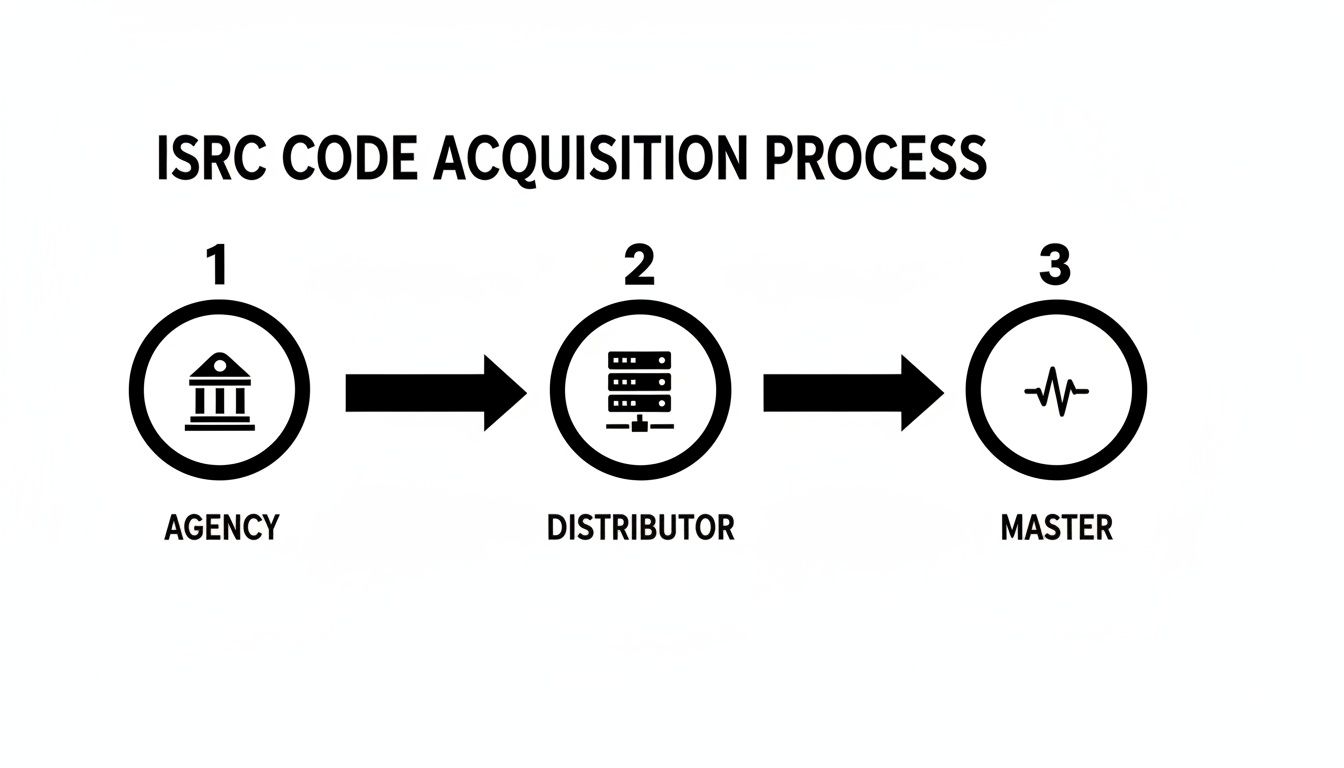
As you can see, the code originates from an official agency, gets assigned either through your distributor or by you directly, and is then permanently embedded in the master recording's data.
Unlocking Platform-Specific Benefits
Correctly applying your ISRCs does more than just get a song ready for release. It unlocks a whole suite of powerful tools inside your distribution platform—tools designed to give you a crystal-clear picture of your music's performance and help you make smarter career moves.
Here’s what a properly tagged track actually does for you:
- Granular Analytics: You can see exactly where your fans are, which countries are streaming your music most, track daily play counts, and spot which songs are starting to take off. This is pure gold for planning marketing campaigns or booking a tour.
- Accurate Sales Attribution: For platforms like OohYeah! that offer commission-free downloads, the ISRC ensures every single sale is correctly logged and credited to your account. No ambiguity, no lost revenue.
- Industry Visibility: A&R reps, managers, and promoters often dig through platform data to find the next big thing. A clean catalog with verifiable performance metrics makes an artist look far more professional and easier to track.
- Chart Eligibility: This is a big one. The sales and stream data tied to your ISRCs are what get reported to official charting organizations like Billboard. Without those codes, your plays simply won't count.
To make the most of your releases, it's also smart to explore the best platforms to sell digital products that fit your specific goals. Choosing the right partner maximizes the impact of your properly coded music catalog.
Ultimately, using ISRCs correctly is about so much more than checking a box. It's about taking professional ownership of your music's data, making sure you get paid for every play, and building a reliable foundation for a sustainable music career.
Common ISRC Mistakes and How to Avoid Them
While the isrc codes music system is built for precision, a simple human slip-up can have surprisingly big consequences. A minor error in how you assign or manage these codes can snowball into major headaches, from misallocated royalties to completely skewed analytics. Honestly, getting this right from day one is one of the most important things you can do for your catalog.
Think of an ISRC as a permanent fingerprint for a master recording. Once you've assigned a code to a specific master and pushed it out into the world, that connection is set in stone. Treating these codes with the respect they deserve is a non-negotiable skill for any serious artist or label.
To help you sidestep these common but costly traps, let's walk through the mistakes I see all the time and how to make sure you don't repeat them. Consider this your final pre-flight check before you release your music.
Reusing an ISRC for Different Versions
This is, without a doubt, the most frequent and damaging mistake I see. It’s easy to think, "it's the same song, just a little different," but in the eyes of the music industry, a new version is a completely new recording.
The golden rule is simple: never, ever use the same ISRC for multiple versions of a track. Every unique master recording gets its own unique ISRC.
- Radio Edit: It’s shorter. It needs a new ISRC.
- Acoustic Version: A totally different performance and recording. New ISRC.
- Instrumental or A Cappella: These are distinct assets. They each get a new ISRC.
- Live Recording: A live take from a show is its own unique master. It absolutely needs its own ISRC.
When you reuse a code, you're essentially telling the global music database that two different things are the same. This completely messes up your data, merging and confusing stream counts and making it impossible to know which version your fans are actually connecting with. Worse, it creates a nightmare for royalty societies, which can lead to payment disputes and long delays in getting your money.
Creating New ISRCs for Simple Remasters
Now for the other side of the coin: assigning a new ISRC when you don't need one. A true remaster involves polishing an existing master recording—maybe tweaking the EQ, adjusting compression, or boosting the overall volume—without fundamentally changing the audio itself.
A simple remaster does not require a new ISRC. The code should stay with the original recording because the core audio hasn't changed.
If you generate a new code for a simple remaster, you’re shooting yourself in the foot. You fracture the track's history, splitting its stream counts and sales data across two separate identities. This can kill your momentum on streaming platforms and erase the lifetime performance history of your recording. The goal is to keep all the plays for a single master consolidated under one code.
Forgetting to Embed the ISRC Correctly
Just having an ISRC isn't enough; you have to make sure it’s properly embedded in the metadata of the master audio file you send out. This means it needs to be part of the master WAV file you give to your distributor and any other format you create from it.
If the ISRC isn't embedded, some tracking systems won't see it, leading to gaps in your data and, you guessed it, lost royalties. Talk to your mastering engineer and confirm they've written the code into the BWF (Broadcast Wave Format) metadata. And when you’re uploading to a distributor like OohYeah!, always double-check that you’ve entered the code into the correct field. This last step ensures that digital fingerprint follows your music everywhere it goes.
Your Top ISRC Questions, Answered
Once you start digging into ISRCs, you're bound to have questions. Everyone does. Let's walk through some of the most common ones we hear from artists, so you can handle your music catalog like a pro and sidestep any expensive mistakes.
Think of this as your quick-reference guide for those tricky situations that always seem to pop up. Getting these details right from the start means your data stays clean, your royalties get paid, and you can get back to what matters most—making music.
Do I Need a New ISRC for a Remix or Remaster?
This is a big one, and the answer comes down to one simple idea: an ISRC is tied to a specific sound recording, not the song itself.
A remix is a whole new beast. You're adding new sounds, changing the structure, or creating a fundamentally different audio experience. Because of that, a remix always needs a new ISRC. This unique code lets you track its streams and sales completely separately from the original.
A remaster, however, is usually just a polish of the existing master recording. Think of it as adjusting the EQ, tweaking the volume, or adding a bit of compression to make it shine. Since the core performance hasn't changed, you should stick with the original ISRC. This keeps all your streaming history and sales data connected to that one recording.
Can I Really Get an ISRC for Free?
Yes, absolutely. For most independent artists, the easiest way to get ISRCs at no cost is through your digital distributor. Companies like OohYeah!, TuneCore, and others will generate and assign a unique ISRC to each track for you as part of their service.
This is a fantastic, hassle-free option when you're just starting out. But there's a catch: the codes they give you are usually tied to their company account.
If you're in this for the long haul, consider buying your own block of codes directly from your country's official ISRC agency (like the RIAA in the U.S.). It’s a one-time fee—around $95 in the United States—but it gives you total ownership. You become the registrant, and those codes are yours forever, even if you switch distributors down the line. This keeps your song's historical data and stream counts all in one place, no matter where your music lives.
What Happens if I Release Music Without an ISRC?
Trying to release a track without an ISRC today is like trying to mail a package with no address—it simply won't get where it needs to go. In the modern music world, it's a non-starter.
Here’s exactly what you'd be up against:
- Rejected by Stores: Spotify, Apple Music, and all the other major platforms will flat-out reject any upload that doesn't have an ISRC. It’s a mandatory field.
- No Royalties: Collection societies like SoundExchange and performance rights organizations have no way to identify your recording and pay you. You'd be leaving a huge chunk of your potential earnings on the table.
- No Tracking: You wouldn't be able to see your stream counts or sales figures. The data simply wouldn't be collected, leaving you completely in the dark.
- No Chart Eligibility: Official music charts, like those from Billboard, rely on ISRC data to track performance. Without a code, your track is invisible to them.
Bottom line: an ISRC isn't optional. It's the key that unlocks your ability to get paid, tracked, and taken seriously in the music industry.
How Can I Find the ISRC for a Song That's Already Out?
Need to track down the ISRC for one of your released songs? It happens all the time, especially when you're moving to a new distributor or registering your catalog with a PRO.
Luckily, there are a few reliable places to look.
- Check Your Distributor's Dashboard: This is your best first stop. Log into your distribution account, find your list of releases, and the ISRC should be listed right there next to the track title.
- Contact Your PRO: If you’ve registered the song with a Performance Rights Organization like ASCAP, BMI, or SESAC, they'll have the ISRC on file. You can usually find it in your online member portal.
- Use an ISRC Lookup Tool: A number of online databases exist to help you find this info. While some require a subscription, they can scan industry-wide records to pinpoint the code you need.
A pro tip: keep your own spreadsheet with all your tracks, their ISRCs, release dates, and other key metadata. Having your own organized record of your catalog will save you countless headaches down the road.
Ready to take control of your music career? OohYeah! provides a seamless platform to upload your tracks, assign ISRCs, and start earning from your art with commission-free downloads and direct fan engagement. Get started today and build a sustainable future for your music.