A Musician's Guide to ISRC Codes for Music Royalties
Our complete guide to ISRC codes for music explains how to get, use, and track your songs to secure every dollar you've earned from your streams.
February 6, 2026
Music Marketplace Advisor
Buying & SellingEver wondered how your song gets tracked across a dozen different platforms, from Spotify to TikTok to a local radio station? The magic behind it all is a simple but powerful code: the International Standard Recording Code, or ISRC.
Think of an ISRC as a permanent digital fingerprint for a specific audio recording. It's a unique 12-character code that gets attached to one, and only one, version of your track. This little string of letters and numbers is what ensures every stream, download, and broadcast is tallied up correctly so you get paid.
Your Music's Digital Fingerprint
Imagine trying to ship a package without a tracking number. It would be chaos, right? That’s exactly what the music industry was like before the ISRC became standard. It was a nightmare for everyone—artists, labels, and royalty organizations—to tell the difference between an album version, a radio edit, and a live recording of the same song.
The ISRC cuts through that confusion. It’s a universal identifier that gets embedded directly into your track’s metadata, following that specific recording wherever it goes. This is how platforms like Apple Music and Spotify know it’s your track being played, not someone else's cover or a different mix.
Why This Fingerprint Matters
A single song can have many different lives. Each one is a distinct recording, and to get paid for all of them, each one needs its own unique fingerprint.
Here are a few common examples:
- The Original Album Version: This is your primary master recording and gets its own ISRC.
- A Radio Edit: If you create a shorter, cleaner version for radio play, that's a new recording. It needs a new ISRC.
- An Instrumental Mix: A version of your song without vocals is a completely different asset, so it gets its own ISRC.
- A Remastered Track: Did you go back and improve the audio on an older song? That new master file requires a new ISRC.
Without a separate ISRC for each version, all the streaming and sales data would get hopelessly tangled. You'd be looking at messy analytics and, even worse, lost royalties. By giving each version its own ISRC, you create a clean, clear data trail for every single play. This is a fundamental part of a solid metadata strategy, which you can read more about in our guide on optimizing music metadata for streaming platforms.
First introduced by the IFPI way back in 1986 as ISO 3901, the ISRC has become the absolute backbone of the modern music industry. What started as a tool for physical products is now the essential digital fingerprint for a system that tracks over 150 million unique recordings worldwide.
How ISRCs Connect Your Streams to Your Bank Account
Let's think about your song's journey like a package you're shipping. When you upload a track with its ISRC, you've essentially slapped a permanent, scannable tracking number on the box. Every single time that song gets streamed on Spotify, added to an Apple Music playlist, or used in a TikTok video, that unique code gets scanned.
That "scan" creates a tiny data point—a single play. But billions of these scans happen every single day, all over the world. Digital platforms and rights organizations collect this mountain of data, and they use the ISRC to know exactly which recording was played. Without it, a stream is just an anonymous blip, completely lost in a sea of digital noise.
Tracing the Royalties from Play to Payout
All that data from the scans gets compiled into enormous reports. These reports are the very foundation of the royalty statements you receive. Every line item, whether it represents a thousand plays or a million, is tied directly back to the ISRC of your song.
You can see a simplified version of this process below. It shows how a song becomes a code, and that code acts as a unique digital fingerprint for tracking every single play.
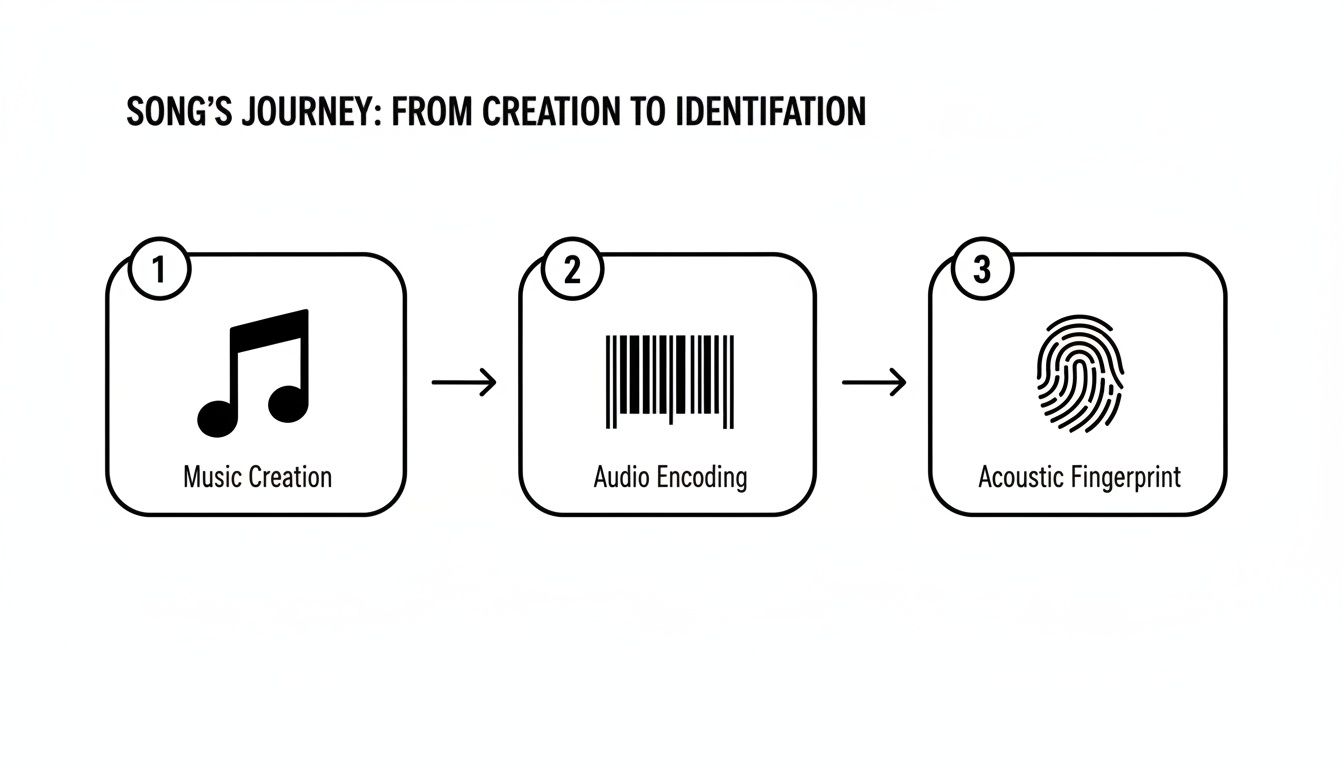
This simple flow—from music to code to fingerprint—is the engine that makes the entire royalty system work. It’s what ensures every play is counted and credited correctly. And this system operates on an absolutely colossal scale. Every one of the trillions of streams happening each year is linked to a 12-character ISRC, which is how the global music industry tracks and pays out for all that listening.
The Danger of Black Box Royalties
So what happens when a song is played without a proper ISRC? The money from that stream doesn't just vanish. It gets dumped into a massive, unclaimed pile of money known as "black box royalties." This is a huge pool of cash that distributors and collection societies simply can't match to the correct artist or rights holder.
This is a massive problem for independent artists. After a certain period, this unclaimed money is typically distributed to major labels and top publishers based on their market share—not to the artists who actually earned it. A simple typo or a forgotten code can literally send your hard-earned money straight into someone else's pocket.
"Unmatched royalties represent a significant loss of income for creators. Accurate metadata, with the ISRC at its core, is the single most effective tool an artist has to prevent their earnings from ending up in the black box."
When you look at things like how much YouTube pays creators, you quickly realize how critical these codes are for getting your fair share. For a closer look, you can read our guide on whether artists can really make money from streaming services. Remember, managing your data isn't just boring admin work; it's an essential part of building a real career in music.
Getting and Assigning ISRC Codes for Your Music

Alright, you get why ISRC codes for music are a must-have. So, how do you actually get your hands on them? For an independent artist, it really boils down to two main paths for securing these digital fingerprints for your tracks.
The route you choose will hinge on your long-term vision. Are you testing the waters with a single or two, or are you building a catalog that you want to control for years to come? Answering that question now will save you a world of administrative pain later on.
Your Two Main Options for Getting ISRCs
The most common path, especially for artists just starting out, is to get your ISRCs from your digital distributor. Services like DistroKid, TuneCore, or CD Baby will usually assign them automatically when you upload your music, often for free or a tiny fee. It’s the simplest, most hands-off way to get the job done.
The other route is for those who are in it for the long haul and want total control. You can apply to become an official ISRC Registrant through your national ISRC agency (in the U.S., that's the RIAA). This involves a one-time fee, and in return, you get your own unique Registrant Code. This code empowers you to generate your own block of ISRCs for every song you ever release.
Key Takeaway: Getting codes from a distributor is easy and typically free—perfect for your first few releases. Becoming a Registrant costs money upfront but gives you lifetime ownership and control, which is the pro move for serious artists and indie labels.
Making the Right Choice for Your Career
So, which is it? Let’s break down the real-world pros and cons before you decide how you'll get ISRC codes for your music.
Distributor-Assigned ISRCs:
- Pros: It’s almost always free and completely automated. You don’t have to do any of the admin work yourself.
- Cons: These codes are technically issued under your distributor’s account. If you ever decide to switch distributors, you have to be incredibly careful to transfer the original codes with your music, and frankly, that can be a messy process.
Becoming an ISRC Registrant:
- Pros: You own your unique Registrant Code for life. You have the ultimate say in how codes are assigned, which is a massive advantage if you’re managing a large back catalog or launching your own label.
- Cons: There’s an upfront cost (currently $95 in the U.S.). You're also on the hook for keeping a meticulous log of every single code you assign.
For most artists releasing their first project, letting the distributor handle it is a no-brainer. But if you're building a brand and a business around your music, investing in your own Registrant Code is an investment in your independence. We dive deeper into the process in our guide on how do I get a ISRC code.
Once you've got your codes, you can embed them in your master recordings. This is a critical step for making sure you get paid, especially when you start making music videos for Instagram and other visual platforms where your music will be tracked.
Cracking the Code: ISRC vs. UPC vs. ISWC
Jumping into the music business can feel like you’re trying to learn a whole new language, and it’s one filled with acronyms. When you start talking about ISRC codes for music, it’s incredibly easy to confuse them with other identifiers like UPCs and ISWCs.
But here’s the thing: knowing exactly what each one does is absolutely crucial for managing your music and, more importantly, getting paid for it. Think of it this way: if your new single is a car, the ISRC, UPC, and ISWC are like its VIN, license plate, and title. They all identify the same thing but serve completely different and non-negotiable purposes.
The ISRC: Your Recording’s Fingerprint
The ISRC (International Standard Recording Code) is the unique, permanent identifier for a specific sound recording. We're talking about the master version of your track—the final WAV or MP3 file that you upload and send out into the world.
Once you assign an ISRC to a recording, it sticks with that recording forever. Even if you release the same song on a different album later, that specific audio file keeps its original ISRC. It’s like a digital fingerprint.
The UPC: Your Product’s Barcode
The UPC (Universal Product Code) is the barcode for the product you're selling. Whether that product is a 12-track album, a 4-song EP, or even a single, the UPC identifies the entire package.
So, if you release a single, the UPC is assigned to the single as a whole. If that same song later appears on an album, the album will have its own, different UPC. The UPC tracks the sale of the package, not the individual song.
The ISWC: Your Song’s Copyright ID
Finally, there’s the ISWC (International Standard Musical Work Code). This code identifies the underlying musical composition—the song itself. It's connected to the lyrics, melody, and harmony that make up the song, regardless of who records it or how it's released.
A single song will only ever have one ISWC, but it could have dozens of different ISRCs if many artists record cover versions of it. The ISWC is what your Performing Rights Organization (PRO) uses to track and pay out your publishing royalties.
The core difference is simple: ISRC is for the recording, UPC is for the product, and ISWC is for the song. This separation is vital because it connects your work to two distinct royalty streams: master royalties (from the ISRC) and publishing royalties (from the ISWC). Getting this right ensures you collect every dollar you’ve earned.
To make it even clearer, let's break down these codes side-by-side. Each one plays a unique role in making sure your music is tracked properly and everyone involved gets paid correctly.
Music Identifier Codes at a Glance
| Identifier Code | What It Identifies | Analogy | Who Assigns It |
|---|---|---|---|
| ISRC | A specific sound recording (the master) | The VIN of a car | You or your distributor |
| UPC | The product being sold (album, EP, single) | The license plate on the car | You or your distributor |
| ISWC | The underlying musical work (the composition) | The car's title (proof of ownership) | Your PRO or publisher |
Understanding this "alphabet soup" is a huge step forward. It’s the behind-the-scenes framework that makes sure your creative work is treated as a professional asset in the music industry.
Common ISRC Mistakes and How to Avoid Them

It’s easy to think of ISRC codes for music as just another box to check during the release process, but a tiny mistake here can cause a massive ripple effect of data headaches and lost money down the line. Getting this right from day one is one of the smartest habits you can build as an artist.
Even a single typo can sever the connection between your song and its earnings, sending your royalties into the dreaded "black box" of unclaimed funds. The trick is to know where the common tripwires are so you can step right over them and make sure every single stream and sale is credited to your name.
Think of it this way: your ISRC is the foundation of your track’s financial life. If that foundation is cracked, the whole structure becomes unstable. Clean, accurate ISRC data is the bedrock of a sustainable music career.
Reusing Codes for Different Versions
This is probably the single most common mistake I see artists make: they reuse an ISRC for a different version of a song. Doing this completely undermines the entire point of the system, which is to give every unique recording its own permanent fingerprint.
A brand new ISRC is non-negotiable for any track that sounds even slightly different from the original master. This absolutely includes:
- Remixes: A remix is a brand new creation and needs its own ISRC. Period.
- Radio Edits: If you've shortened a track or censored a word, it's a new master. Give it a new code.
- Instrumentals and A Cappellas: Removing the vocals or the beat creates a fundamentally different audio file.
- Remasters: Even if you just tweaked the EQ, a new master file is a new recording in the eyes of the system.
When you reuse a code, you're telling the global music database that two different recordings are the same thing. This merges their data, makes it impossible to track performance accurately, and almost always leads to messy royalty disputes.
Remember the golden rule: one recording, one ISRC, for life. If you bounce a new master audio file for any reason, it needs a new ISRC. This one simple practice will save you from a world of tangled, inaccurate data.
Inconsistent Data Entry and Typos
Another classic problem is simple human error. A mistyped letter or a swapped number during the upload process can invalidate your ISRC or, worse, accidentally link your track’s data to someone else’s song. The risk is especially high if you're manually typing in codes you received from an ISRC Manager.
The fix is simple: always copy and paste. Move your codes from your master spreadsheet directly into your distributor's upload form. Then, before you hit "submit," give it one final look-over to make sure every character is correct. Consistency is your best friend here.
Not Keeping a Master Log
Flying blind without a central record of your assigned ISRC codes is just asking for trouble. It might seem manageable with your first few releases, but once your catalog starts to grow, it becomes nearly impossible to remember which code goes with which track—especially with all the different versions.
Do yourself a favor and create a simple spreadsheet from your very first release. This "master log" is your catalog's bible. It should have columns for:
- Track Title
- Version (e.g., Album Version, Radio Edit, Instrumental)
- ISRC Code
- Release Date
This little bit of organization will prevent you from ever accidentally reusing a code or losing track of an asset. It becomes especially critical if you ever decide to move your music to a new distributor. It's a small admin task that pays off in a huge way.
Frequently Asked Questions About ISRC Codes
Even when you feel like you've got the basics down, the music world has a knack for throwing curveballs. When it comes to managing your ISRC codes, specific situations can pop up and leave you wondering what to do next.
This final section is your go-to reference for those common head-scratchers. We’ll tackle the questions we hear artists ask all the time, from handling remasters to switching distributors, so you can handle your business with confidence.
Do I Need A New ISRC For A Remastered Track?
Yes, you definitely do. Think of it this way: a remastered version is a brand new audio file. Even if the changes are subtle, the master recording itself has been altered, which means it's technically a new product.
To keep everything clean on the backend, that new version needs its own unique ISRC. Reusing the old one would be a data nightmare, mashing together the stats and royalties for two different recordings. Always assign a fresh ISRC to a remaster to ensure every play is tracked and paid correctly.
Can I Keep My ISRCs If I Switch Distributors?
Not only can you, you absolutely must. This is a huge one. Your ISRC codes are permanently tied to your recordings, not to the company that happened to assign them. They are your track's digital fingerprint for life.
When you move your music to a new distributor like OohYeah, make sure you bring your existing ISRCs with you. This is the only way to preserve your stream counts, playlist placements, and all the history you've worked so hard to build. If a new distributor gives you new codes for the same tracks, it's like hitting the reset button—your song’s digital identity is wiped clean, and you start again from zero.
It's a common myth that ISRCs assigned by a distributor belong to them. They don't. The codes belong to the recording. Keep a master spreadsheet of all your tracks and their corresponding codes—it’s your catalog’s most important document and will save you massive headaches down the road.
Should I Get My Own ISRCs Or Use My Distributor's?
For artists just getting their feet wet, using the free codes from your distributor is perfectly fine and super convenient. It gets your music out there without any upfront cost.
However, if you're serious about building a long-term career or even starting your own label, getting your own Registrant Code directly from your national ISRC agency is the professional move. It gives you ultimate control and lifetime ownership over your catalog's data, which is invaluable as you grow.
Ready to take the reins of your music, merch, and fan community? Join OohYeah today and build your career on a platform that puts artists first. Start selling directly to your fans with zero commission at https://oohyeah.app.