ISRC Code Music A Complete Guide for Independent Artists
Unlock your music royalties with our guide to ISRC code music. Learn what an ISRC is, why you need one, and how to get it for your tracks.
February 5, 2026
Music Marketplace Advisor
Buying & SellingThink of an ISRC code as the unique, unchangeable digital fingerprint for one of your songs. It’s a simple 12-character code that ensures every single stream, sale, or radio spin of your track is tracked accurately across every platform on the planet. This is the mechanism that connects your music directly to your royalties.
Your Digital Fingerprint for Music Royalties

Here’s a good analogy: an ISRC code is like the barcode on a product at the grocery store. When that barcode gets scanned, the system knows exactly what item was sold, how much it cost, and who to pay for it. Without that barcode, the item is just an anonymous box on a shelf, impossible to track or sell.
Your ISRC code music identifier does the exact same job for your sound recordings. Every time your song plays on Spotify, gets bought on iTunes, or is featured in an Instagram Story, that unique ISRC is logged. This digital paper trail is absolutely essential for making sure all the royalties generated from those plays are funneled back to the right person—you.
Deconstructing the ISRC Code
That 12-character code isn't just a random string of letters and numbers; it's packed with information about the recording's origins. It's a globally recognized standard, so the structure is the same no matter where you are in the world.
Let's pull apart a sample ISRC code: US-S1Z-24-12345
- US: This is the two-letter country code. It tells you where the person or company who issued the code is based (in this case, the United States).
- S1Z: This is the registrant code, a unique three-character ID assigned to the entity—like your record label or distributor—that generated the ISRC.
- 24: These two digits represent the year of reference, which is the year the ISRC was assigned to the track (2024).
- 12345: This five-digit designation code is a unique number that the registrant assigns to that specific recording.
This structured system guarantees that no two sound recordings will ever have the same ISRC. That level of precision is what makes it so reliable for tracking plays and payments. To get the full picture, it's also worth getting a solid understanding music copyright to protect your work.
An ISRC is permanently assigned to a specific recording for life. Once it’s embedded in your track's metadata, it follows that recording everywhere it goes, from OohYeah to global radio stations.
At its core, this code is the foundation of your digital music business. It’s what turns a simple audio file into a trackable, monetizable asset. Without it, your streams are just numbers floating in the ether, completely disconnected from your bank account. Getting a handle on how this little code works is a critical first step for any artist serious about building a career. For more on this, check out our guide on how do independent artists make money from music.
Why Every Single Recording Needs an ISRC
Think of an ISRC (International Standard Recording Code) as the official birth certificate for your master recording. It’s not just a string of characters; it’s your track's unique identity in the global music ecosystem. Without it, your song is essentially invisible, making it incredibly difficult to track its performance, let alone get paid for it.
Assigning an ISRC is a fundamental step that signals to the entire industry—from streaming services to collection societies—that you're a professional. It's the key that unlocks everything from royalty payments to chart eligibility and the detailed analytics you need to build a career. On platforms like OohYeah, this code is precisely how we know who to pay when your music gets played.
Unlocking Your Royalties and Chart Potential
At its core, the ISRC is all about making sure you get paid. Every single time your song is streamed on Spotify, played on digital radio, or even used in an Instagram Reel, the ISRC is logged. This data is the lifeblood for collection societies and distributors, who use it to calculate and send you the royalties you've rightfully earned. No ISRC means no data, and no data means lost money.
But the ISRC's job doesn't stop at payments. It’s also your ticket to the big leagues.
- Chart Eligibility: Official charts like Billboard rely on ISRC data to track sales and streams. For a song to even be considered, it needs a valid ISRC so that services like Luminate can pull together performance data from hundreds of different sources.
- Global Tracking: Because the ISRC is a universal standard, it works everywhere. This means your music is tracked consistently across different countries and platforms, giving you a real shot at building an international audience.
This system is the backbone of modern music revenue. With streaming now accounting for a staggering 69.0% of total recorded music revenues worldwide, having a unique identifier for every track has never been more critical. In an industry driven by data, ISRCs give artists on OohYeah the power to capture revenue from every single play. You can find more industry stats in the IFPI Global Music Report.
The Critical Distinction: Sound Recording vs. Song
Here's one of the most common points of confusion for new artists: the difference between the sound recording and the underlying song. An ISRC is tied only to one specific version of a sound recording—the final master audio file you upload.
Key Insight: An ISRC identifies the recording itself (like the specific studio version of your track), not the composition (the lyrics and melody that make up the song).
Getting this right is crucial for managing your rights and your money. Here’s a simple breakdown of why it matters so much:
- Different Versions Need Different ISRCs: If you release a radio edit, an acoustic version, a live recording, or a remix of your song, each one is a brand-new sound recording. That means each version absolutely must have its own unique ISRC code.
- Separate Rights, Separate Codes: The rights to the sound recording (the "master rights") are completely separate from the rights to the musical composition (the "publishing rights"). The ISRC tracks the master, while a different identifier, the ISWC (International Standard Musical Work Code), tracks the composition.
Understanding this separation is fundamental to how the music business works. It ensures that the performers and master owners are paid (tracked by the ISRC), while the songwriters and publishers are also compensated for the use of their work. Platforms like OohYeah depend on this precise data to attribute earnings correctly to every single creator involved, preventing mix-ups and making sure everyone gets their fair share.
How to Get ISRC Codes for Your Music
So, you've finished your track and you're ready to get it out into the world. Before you do, there's one crucial step: getting an ISRC code. Think of it as your music's digital passport. Thankfully, this process isn't nearly as complicated as it sounds. You've got three main ways to get it done, and the right choice really just depends on your goals as an artist.
First things first, you need to be sure your track actually needs a new code. This handy flowchart breaks it down.
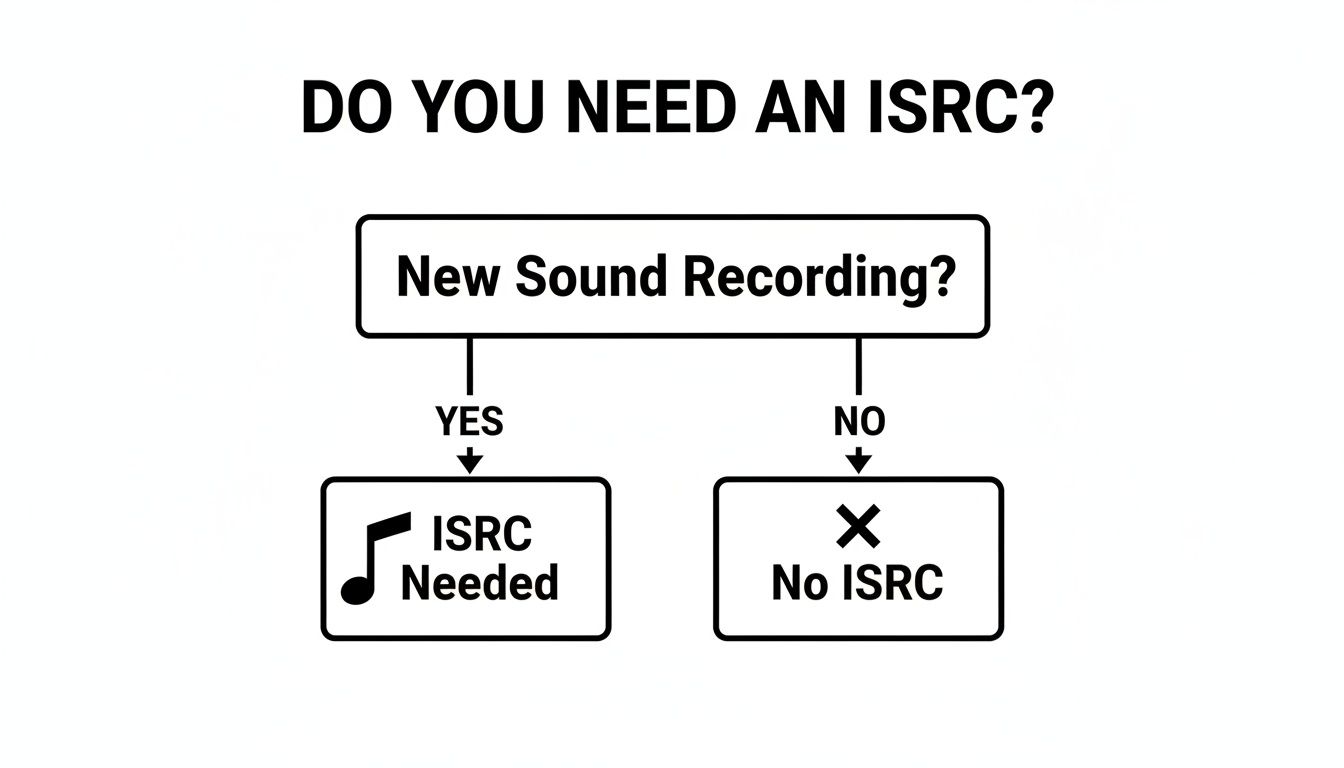
The bottom line is simple: if you’ve created a new sound recording—whether it’s the original version, a stripped-down acoustic take, or a killer remix—it needs its own unique ISRC.
Option 1: Go Directly to a National ISRC Agency
For serious record labels or prolific independent artists who plan on releasing a lot of music, this is the gold standard. Going straight to the source by registering with a national ISRC agency gives you maximum control over your catalog.
When you register this way, you’re given your very own registrant code—a unique three-character identifier that’s all yours. From that point on, you are in the driver's seat, assigning the final five-digit designation codes for every single track you release.
Here’s why you might go this route:
- Total Control: You own and manage your block of ISRC codes for life. No one else touches them.
- Brand Consistency: That registrant code becomes a permanent part of your brand's digital identity.
- Long-Term Efficiency: If you're releasing dozens of tracks a year, managing them yourself is far more streamlined.
The process starts with finding your country's official agency through the IFPI (International Federation of the Phonographic Industry). There’s usually a one-time fee to get your registrant code, but it’s a lifetime investment in your music business.
Option 2: Get ISRCs From Your Digital Distributor
This is, by a long shot, the most popular path for today's independent artists. When you use a digital distributor like TuneCore, CD Baby, or DistroKid to push your music to Spotify and Apple Music, they’ll handle the ISRC for you.
More often than not, they include this service for free as part of their distribution package. Your distributor has its own registrant code and simply assigns the next available number to your track when you upload it. It’s completely hands-off for you, which means you can stay focused on creating.
Your distributor essentially becomes your ISRC manager. They generate the code, embed it in the metadata, and make sure it’s delivered correctly to all the digital stores.
This method is perfect if you release music periodically and don't want to get bogged down in the administrative details. If you're getting your files ready, our guide on how to upload music can walk you through the entire preparation process.
Option 3: Let Your Platform Assign the Code
A third path is emerging that blends convenience and integration: getting an ISRC assigned directly by the platform you're using. Here at OohYeah, we built this right into our system to make life easier for creators. When you're setting up a new release in your dashboard, our platform can generate and assign a fully valid ISRC on the spot.
This approach gives you the "set it and forget it" simplicity of a distributor but keeps everything under one roof. No need to go to an agency or even a separate service—the ISRC code music assignment is just another seamless step in the release process. It's the ideal setup for artists who want to manage their entire career, from creation to royalty checks, all in one place.
ISRC Acquisition Methods Compared
Deciding which route to take can feel like a big step, so here’s a quick comparison to help you figure out what’s best for your situation.
| Method | Best For | Cost | Control Level |
|---|---|---|---|
| National Agency | Established labels & high-volume independent artists. | One-time application fee (varies by country). | High: Full ownership and management. |
| Digital Distributor | Most independent artists and small labels. | Usually free with distribution service fees. | Low: Distributor manages and owns the code. |
| Integrated Platform (like OohYeah) | Artists who want an all-in-one ecosystem for creation and release. | Often included in the platform's service. | Medium: Platform manages, but it's integrated with your workflow. |
Ultimately, there's no single "best" way—only the best way for you. Whether you value complete control, ultimate convenience, or a tightly integrated system, there's a clear path to getting your music properly registered and ready to earn.
Mastering Your Metadata for Maximum Payouts
An ISRC is a powerful identifier, but it’s only as good as the information tied to it. Think of the ISRC as a high-tech shipping container for your song; the metadata is the label slapped on the outside detailing what’s inside, where it came from, and where it needs to go. If that label is smudged, wrong, or missing key details, the container gets lost—and so do your royalties.
This information, known as metadata, covers all the essential facts about your track: the official artist name, the exact track title, genre, and every songwriter involved. Getting this data right isn't just boring admin work; it's a fundamental step in actually getting paid for your music.

Why Consistency Is Your Best Friend
Digital music systems run on exact matches. A tiny inconsistency in your metadata can create a whole separate, orphaned entry for your song on a streaming platform, causing plays and royalties to fall through the cracks. It's one of the most common—and most costly—mistakes an artist can make.
Imagine you release one song as "DJ Shadowfax" and another as "DJ Shadow Fax." A person knows it's the same artist, but to a data-crunching algorithm, those are two completely different creators. That simple error splits your streams, confuses listeners, and makes a mess of your royalty payments.
Key Takeaway: Treat your metadata with the same care you give your final mix. Consistency across every single release is the only way to ensure every stream, download, and play is correctly attributed back to you.
This means using the exact same spelling for your artist name, track titles, and collaborators on every platform, every single time. A small typo can have surprisingly large financial consequences over the life of a song.
Your Pre-Release Metadata Checklist
Before you even think about uploading a track, run through a quick metadata check. Making this a non-negotiable step in your release process will build a clean, reliable data trail for your entire catalog and save you from major headaches later. For a deeper dive, check out our detailed guide on how to optimize your music metadata for streaming.
Here's a simple checklist to run through for every release:
- Artist Name: Is it spelled identically to all your previous releases? No variations?
- Track Title: Is it formatted correctly (e.g., proper capitalization, no weird characters)?
- Featured Artists: Are they credited consistently and accurately?
- Composer/Songwriter Info: Have you listed all credited writers exactly as they're registered?
- ISRC Code: Is the correct, unique ISRC for this specific recording embedded?
Bridging the Gap Between Recording and Composition
One of the most critical metadata connections to get right is linking your recording (the master) to its underlying musical work (the composition). The ISRC identifies your recording, but a different code, the ISWC (International Standard Musical Work Code), identifies the song itself—the melody and lyrics.
Ensuring these two codes are linked in the data you provide is absolutely essential for a complete royalty picture. This connection guarantees that when your recording is played, both the master rights holders (tracked by the ISRC) and the publishing rights holders (tracked by the ISWC) get paid. It's the step that makes sure everyone from the performer to the songwriter gets their cut.
This linkage is helping to modernize music publishing, where global collections by CMOs have hit €11.7 billion. While data mismatches still happen, the industry is working hard to improve its infrastructure and make this process more seamless for creators.
Beyond just registering your work, it’s also smart to understand how to legally use music in your own video content. If you're creating promotional materials, knowing how to add music to videos without copyright claims can protect you. Ultimately, clean data is your best tool for building a sustainable career in music.
Using ISRC Data to Grow Your Career on OohYeah
An ISRC isn't just a string of letters and numbers you need to release a song. Think of it as your music's unique digital fingerprint. It's a powerful tool that connects your track directly to its performance data, turning raw numbers into real-world insights that can shape your entire career. This is where the ISRC code music system really proves its worth, especially on a platform like OohYeah.
When we link your track's ISRC to our analytics dashboard, we translate every stream and download into a clear story about who's listening and where. This data goes way beyond just calculating royalties—it’s a roadmap for making smarter decisions. You can finally stop guessing and start building your career on solid evidence.
Turning Analytics into Actionable Strategy
Your OohYeah analytics dashboard is built to give you an immediate, no-nonsense look at how your music is connecting with people. Because every single track has its own ISRC, we can deliver incredibly detailed data that helps you pinpoint exactly what's resonating. This is how you turn casual listeners into true fans.
Here’s how you can put this data to work:
- Identify Your Hits: See which songs are getting the most plays, saves, and shares. This is a direct signal of the sound your audience loves, helping you decide what creative direction to take next.
- Discover Your Audience: Find out exactly where your listeners are, from specific cities to entire countries. This geographic data is gold for planning a tour, running targeted ad campaigns, or reaching out to local influencers.
- Track Engagement Over Time: Watch how a song performs in the weeks and months after it drops. Did that playlist placement cause a spike? Knowing this helps you fine-tune your marketing playbook for your next release.
The OohYeah platform lays all this out for you in a simple, visual way.
This screenshot shows the clean interface of the OohYeah homepage, giving you a glimpse into the artist-centric ecosystem where your analytics live.
We give you easy-to-read charts and reports, making it simple to spot trends and make data-driven choices without needing a degree in analytics.
A Practical Example of Data-Driven Growth
Let’s say you just released a new single. You hop into your OohYeah dashboard and notice something interesting. The song is doing okay overall, but you see a huge number of streams coming from Austin, Texas. That's a powerful insight, and it's tied directly to that song's ISRC.
With this piece of information, you can launch a targeted micro-campaign.
- Run Geo-Targeted Ads: You could create a small social media ad campaign aimed only at users in the Austin area, pushing your new track and linking to your OohYeah profile.
- Contact Local Influencers: Start reaching out to Austin-based music bloggers, playlist curators, or even local radio stations. You can share the track and mention its local streaming success to grab their attention.
- Plan a Live Show: If that interest keeps up, you now have hard evidence that booking a gig in Austin is a smart move. You've validated that an audience is already there waiting for you.
This is how a simple ISRC code music identifier transforms from a technical formality into a strategic weapon. It’s no longer a background detail; it becomes the foundation of your marketing, helping you put your time and money where it will actually make a difference.
Ultimately, platforms that bake ISRC data directly into their artist tools empower you to be the CEO of your own career. At OohYeah, our goal is to give you more than just a place to host your music. We want to provide a complete toolkit that helps you understand your audience, sharpen your strategy, and build a real business around your art.
Common ISRC Mistakes and How to Avoid Them
Working with ISRCs is usually pretty simple, but a few common slip-ups can cause some serious headaches with your tracking and royalty payments down the line. Knowing what to watch out for is the best way to keep your music catalog clean and professional. Honestly, getting it right the first time will save you a world of trouble later on.
One of the biggest and most frequent mistakes we see is giving the same recording more than one ISRC. This usually happens by accident, maybe when an artist uploads the same song through a few different distributors over a period of time. What ends up happening is your song has a split identity, which confuses streaming platforms and splits your data and royalties between multiple codes.
Another major no-no is reusing an ISRC. Think of an ISRC as a permanent, unchangeable fingerprint for a single sound recording. It should never be recycled for a new track, even if the original song has been taken down. Reusing a code mashes together the data for two completely different songs, creating an administrative mess that's almost impossible to fix.
When to Assign a New ISRC
So, when does a new version of a song actually need a fresh ISRC? This is where a lot of people get tripped up, but the rule of thumb is straightforward: if you’ve changed the audio in any significant way, it needs a new code. This is how you make sure each unique piece of work is tracked on its own merits.
Here’s a quick guide to help you decide:
- A full remix? Yes. A remix is a brand-new creative work and absolutely needs its own ISRC.
- An acoustic or live version? Yes. These are completely different recordings, and each one gets a unique ISRC.
- A simple remaster? No. If you're just tweaking levels and EQ without fundamentally changing the audio, stick with the original ISRC.
- A radio edit (a shorter version)? Yes. Changing the length creates a new master recording, which requires its own ISRC.
The golden rule is this: one recording, one ISRC, for life. Following this ensures every single version of your music is correctly identified and gets paid properly.
Dodging these simple mistakes is a critical skill for any artist managing their own catalog. On platforms like OohYeah, accurate ISRC code music data is what makes the analytics and payment systems work. By treating each ISRC as a permanent, one-time assignment for a specific recording, you're building a solid foundation for your career, making sure every play is counted and every cent earned makes its way to you.
Frequently Asked Questions About ISRC Codes
As you start getting your music out there, you're bound to have some questions about ISRCs. It’s totally normal. Let's clear up some of the most common ones so you can manage your catalog with confidence and make sure every track is set up to succeed.
Do I Need a New ISRC for a Remix?
Yes, you absolutely do. Think of it this way: if the audio file is sonically different in any significant way, it needs its own unique ISRC. This applies to remixes, acoustic versions, live recordings, and even radio edits.
The only time you wouldn't need a new code is for a simple remaster where you're just tweaking the EQ or volume levels without fundamentally changing the recording. The same goes for small metadata corrections.
Can Independent Artists Get an ISRC Code?
Definitely. You don't need to be signed to a major label to get ISRCs. Independent artists have a few easy options.
Most artists get them automatically from their digital distributor, like TuneCore or CD Baby. You can also apply directly to your national ISRC agency or, if you’re using a platform like OohYeah, one can be assigned to you right when you upload your track.
What Is the Difference Between ISRC and ISWC?
This is a huge one, and getting it right is crucial for making sure everyone gets paid. The simplest way to remember it is:
- An ISRC (International Standard Recording Code) is for the recording. It’s the unique fingerprint for a specific master audio file.
- An ISWC (International Standard Musical Work Code) is for the composition. It identifies the underlying song itself—the melody and lyrics written by the songwriter.
One song (which has one ISWC) can have tons of different recordings (each with its own ISRC). For example, your original studio version, a live cut, and a dance remix are all the same "song" but are three different recordings.
Key Takeaway: The ISRC is for the master track, and the ISWC is for the song. Linking them correctly in your metadata is what ensures both the recording owners and the songwriters get their royalties.
Does an ISRC Code Ever Expire?
Nope, never. Once an ISRC is assigned to a sound recording, it’s permanent. It stays with that specific recording for its entire lifetime and never needs to be renewed or updated. It’s a forever ID.
Ready to take control of your music, data, and royalties in one place? With OohYeah, getting an ISRC is a seamless part of your release process, giving you the tools to build your career with confidence. Start releasing your music on OohYeah today!