A Modern Guide to Indie Music Promotion
Discover proven indie music promotion strategies to build your audience and grow your career. Learn to master streaming, social media, and direct-to-fan sales.
February 4, 2026
Music Marketplace Advisor
Buying & SellingGetting your music heard as an independent artist can feel like shouting into the void. It’s a crowded world out there, and the old-school path of chasing a record deal feels more like a lottery ticket than a real strategy.
But here’s the thing: that old path is crumbling. The gatekeepers who once held all the power are becoming less and less relevant. This isn't a challenge; it's the biggest opportunity indie artists have ever had. The barriers have come down, opening up a direct line between you and the people who will actually support your music.
This guide is your map for navigating that new reality.
The New Opportunity in Indie Music Promotion
For decades, the dream was to get signed. But today, the power has shifted dramatically. The direct-to-fan economy means you're no longer waiting for permission to build a career. You have the tools to take control, connect directly with listeners, and build a sustainable business around your art.
This isn't just a feel-good idea; the numbers back it up. Independent artists are not just participating in the market—they're starting to dominate it.
Believe it or not, over 50% of music streamed on major platforms now comes from unsigned artists. Even more impressive, these independent creators collectively generated 35% of the entire music industry's revenue. The game has fundamentally changed.
Your Path to a Sustainable Career
So, what does this new approach look like? Instead of pouring all your energy into chasing a contract, the focus shifts to building a genuine community around your music. This modern framework is built on a few core ideas:
- Direct Connection: Forget intermediaries. The goal is to build real, lasting relationships with the people who love your music.
- Creative Control: You call the shots. You maintain complete ownership over your sound, your brand, and your artistic vision.
- Financial Independence: You create your own income streams—from subscriptions to merch to direct sales—that go straight into your pocket.
The most powerful tool in your promotional arsenal is the direct relationship you build with your fans. Every email subscriber, every direct message, and every merch sale is a vote of confidence that bypasses the old industry machine.
This guide will walk you through the entire process, from establishing your brand and planning a release to actually making money from your music. Whether you're dropping your first single or looking to expand your existing fanbase, the principles here will show you how to build a career entirely on your own terms.
To get a better sense of how digital platforms fit into this puzzle, check out our deep dive on why music streaming is crucial for exposure.
Building Your Artist Brand Foundation

Before you even think about dropping your next single, we need to talk about your foundation. Promotion isn't just about shouting from the rooftops; it’s about having a compelling story to tell. Your artist brand is that story—it's what makes people lean in and listen in a world full of noise.
Without a solid brand, even the most brilliant music can fall flat. A strong foundation ensures everything you do, from an Instagram post to your album art, feels connected and authentic. It's how you turn a casual listener into a die-hard fan who gets what you're all about.
H3: Defining Your Unique Artist Identity
Your brand is so much more than a logo or a slick color palette. It’s the entire vibe. Think of it as the intersection of your sound, your look, and what you stand for. You have to start by asking some deep questions.
What’s the real message behind your music? How do you want people to feel when they press play? What makes your point of view different from every other artist out there? Getting honest with yourself here provides the blueprint for everything that comes next.
To keep it all consistent, it’s a game-changer to create brand guidelines for yourself. This document becomes your north star, guiding every visual and written decision you make.
H3: Identifying Your Ideal Listener
Here's a hard truth: your music isn't for everyone. And that's a good thing! Trying to appeal to the masses just waters down your message. The real goal is to find your people—the ones who will connect with your sound and story on a deeper level.
Think about this person. What are they into? Where do they hang out online and discover new music? Are they digging through vinyl crates for hidden gems or scrolling through TikTok for the next big thing? Knowing this helps you stop wasting energy and start reaching the right people in the right places.
A well-defined brand acts as a filter. It not only attracts the right audience but also gently repels those who wouldn't connect with your music anyway, allowing you to build a more passionate and engaged community.
Once you know who you're talking to, every promotional decision becomes clearer and far more effective. For a deeper dive, check out our guide on why artists should focus on branding and image.
H3: Assembling Your Professional Assets
Okay, you’ve defined your brand and you know who you're trying to reach. Now it's time to build your toolkit. Your professional assets are your digital handshake with the world—the first impression you make on fans, bloggers, and industry folks. They need to look sharp and be ready to go at a moment's notice.
Think about it: when a playlist curator or a music blogger stumbles upon your work, you want to make their job easy. A polished, complete set of assets shows you’re a pro who takes your career seriously.
Before you launch anything, make sure you have your promotional house in order. This checklist covers the non-negotiable assets you'll need to look professional and make a real impact.
Your Pre-Launch Promotional Checklist
| Asset or Task | Key Objective | Platform Integration |
|---|---|---|
| A Compelling Artist Bio | Tell your story, not just your history. Hook readers with your mission and vision. | Website "About" page, EPK, OohYeah profile, social media bios. |
| High-Quality Press Photos | Reflect your brand's aesthetic with professional shots (headshots, performance, lifestyle). | EPK, press releases, social media profiles, OohYeah gallery. |
| Electronic Press Kit (EPK) | Create a one-stop-shop for media, promoters, and collaborators with all key info. | A dedicated page on your website; link in your OohYeah bio. |
| Polished Album/Single Art | Design captivating, high-resolution artwork that aligns with your brand identity. | Upload to OohYeah, all streaming platforms, and social media. |
| Final Mastered Audio Files | Ensure you have high-quality .WAV and .MP3 files ready for distribution and press. | Ready for upload to OohYeah and your chosen distributor. |
Having these core elements locked down is the bedrock of your promotional strategy. It ensures that when opportunity knocks, you're more than ready to answer the door.
Mastering Your Key Promotion Channels
Alright, you’ve nailed down your brand. Now it's time to get your music out there and start making some noise. Think of these promotion channels as your distribution network. You don’t need to be everywhere at once—that’s a surefire way to burn out. The real trick is to be strategic and focus on the places where your potential fans are already hanging out.
The goal is to build an ecosystem where everything works together. Your social media, playlists, email list, and any press you get should all feed into each other, creating a flywheel that builds momentum and pulls people toward your central hub—your OohYeah profile. Let's move past just shouting about your music and start building real pathways for people to discover and connect with you.
Streaming Playlists: The Modern Mixtape
Getting your song on a big playlist can feel like hitting the jackpot. Suddenly, your music is in the ears of thousands of new listeners overnight. But this isn't about luck; it's about smart research and a professional touch. Forget the "spray and pray" approach of spamming every curator you find. The key is finding playlists where your music genuinely belongs.
Start by digging into playlists that already feature artists who sound like you. Look for the independent curators—the passionate music lovers who live to discover the next great thing, not just the massive editorial lists controlled by the streaming platforms themselves. These indie curators often have incredibly loyal followers and are far more approachable.
Once you’ve got your target list, your pitch needs to be personal and straight to the point. Here’s a simple way to frame it:
- Make a Connection: Show you've actually listened. Mention a specific song or artist you love from their playlist.
- Quick Intro: Say who you are and what your track is in a sentence or two.
- The Hook: Explain why your song is a perfect fit for their playlist's specific vibe and listeners.
- Make It Easy: Provide a direct, private link to your song. Never, ever send an attachment.
This kind of targeted pitch shows respect for the curator's time and skyrockets your chances of getting a listen, let alone a spot on their list.
Social Media: Building Your Community
Social media is a conversation, not a megaphone. The objective isn't to chase vanity metrics like follower counts; it's to build a real community of people who are genuinely invested in your journey. Here, authenticity is everything.
Instead of just posting "new song out now," share the story behind the music. Let people see your creative process, the gear you geek out on, the inevitable struggles, and the breakthrough moments of inspiration. This behind-the-scenes stuff creates a much deeper bond than any polished promo ever could.
Platforms like TikTok and Instagram Reels are absolute powerhouses for discovery right now. Short-form video gives you a canvas to share snippets of your music in creative, attention-grabbing ways. For a deep dive, check out our guide on promoting your music with short-form video. This is where a 15-second clip can turn into a viral moment that introduces your sound to a global audience.
Your social media should feel less like an advertisement and more like a backstage pass. Invite people into your world, and they'll be far more likely to stick around for the main event—your music.
And remember, always use your social channels to point followers back to your OohYeah page. That’s where they can go beyond just listening to actually supporting your career by buying merch or subscribing for exclusive content.
Email Lists: Your Most Valuable Asset
Think of it this way: if social media is like renting an apartment, your email list is owning the house. Algorithms change and platforms can vanish, but your email list is a direct line to your most dedicated fans. It's something you completely control, making it arguably the single most important tool for building a long-term career.
Start building your list from day one. Give people a compelling reason to sign up—a free download, an exclusive demo, a discount on merch, or early access to tickets. Make your sign-up form impossible to miss on your website, your OohYeah profile, and in your social media bios.
When you email your list, always provide real value. Don't just send sales pitches.
- Share personal stories and updates from the studio or the road.
- Offer exclusive content they can't get anywhere else.
- Ask for their opinion on new song ideas or T-shirt designs.
- Give them first dibs on new releases and limited-run items.
This turns your email list from a simple marketing channel into a thriving fan club. These are the people who will buy your albums, share your music, and show up when you play a show in their town.
Press Outreach: Getting The Right People to Listen
Getting a write-up from a music blog or online publication can give you a massive shot of credibility and expose you to a whole new audience. Just like with playlist pitching, the secret is targeted, thoughtful outreach. Zero in on blogs that cover your specific genre. A thoughtful feature on a small, respected blog that speaks directly to your ideal listener is often way more valuable than a passing mention on a huge, generic site.
Let's be real about the financial side of things. The industry is tough, with 77.8% of independent artists earning less than $15,000 annually from their music. Data from AMWorldGroup shows that breaking through is a huge challenge. On top of that, 53.3% of artists on Spotify have fewer than 500 monthly listeners. These numbers aren't meant to discourage you; they're meant to underscore why a smart, strategic promotional plan across all these channels is so essential.
When you pitch a blogger, be professional and give them everything they need right away. An effective press email includes:
- A short, compelling subject line.
- A brief, personalized introduction.
- A link to your EPK (Electronic Press Kit).
- Direct streaming links to your music.
- A high-quality press photo.
By getting a handle on these four key channels—playlists, social media, email, and press—you're not just promoting a song. You're building a powerful, interconnected system where each part strengthens the others, helping you find your audience and build a sustainable career on your own terms.
Executing a Flawless Release Timeline
Let’s be real: a killer track that nobody hears is just a great practice session. A truly successful release isn't a happy accident; it’s a carefully orchestrated campaign. Think of it like a movie premiere. The studio doesn't just drop the film out of nowhere. They spend months building hype with trailers, interviews, and press tours so that by opening night, there's a line around the block.
Your music deserves that same strategic rollout. A well-structured timeline is what separates a forgettable drop from a career-defining moment. It helps you build genuine anticipation, coordinate all your moving parts, and avoid that last-minute panic.
Breaking down your release into clear phases turns a massive, overwhelming task into a series of manageable steps.
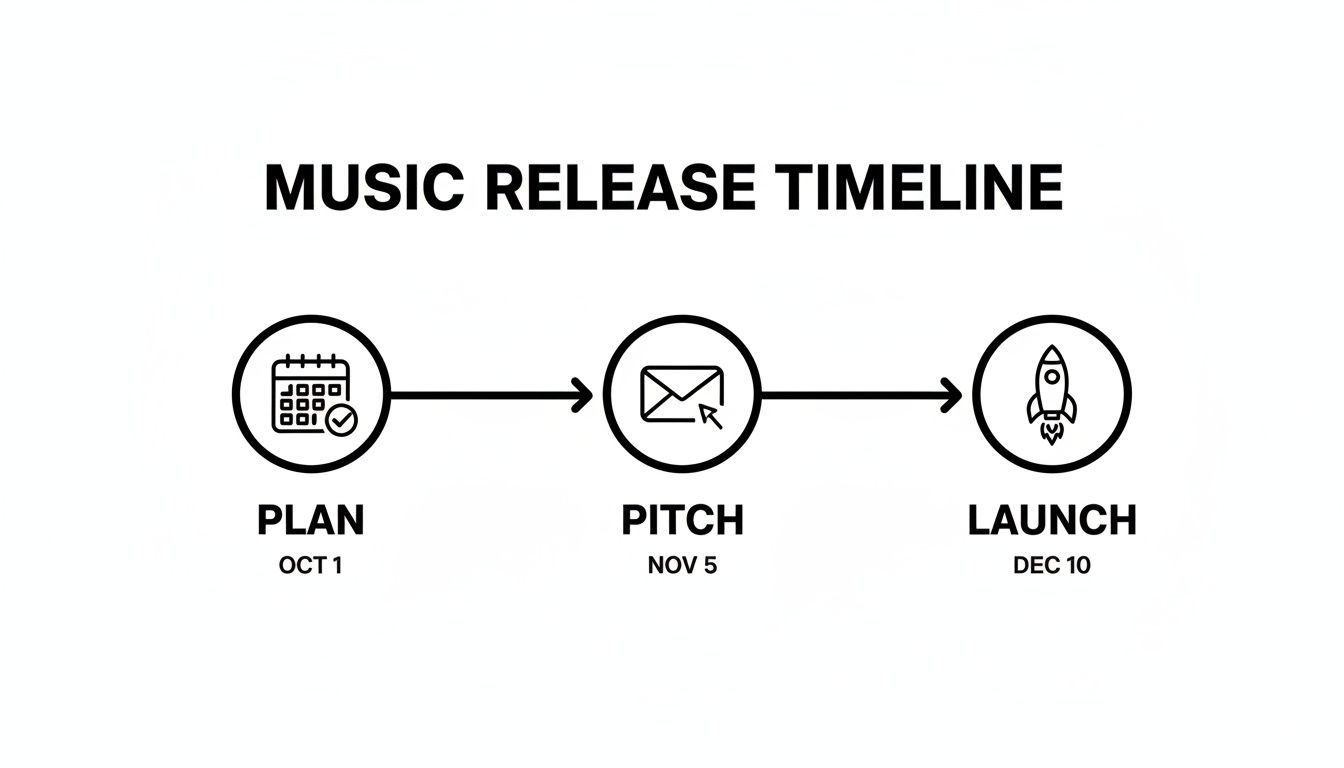
This visual shows why giving yourself enough lead time is so important. The work you put in weeks ahead of time is what makes your launch day actually pop.
The 8-Week Countdown: Planning and Creation
This is where you get your house in order. About two months out from release day, your entire focus is on locking in the final music and getting all your promotional assets ready to go. You’re building your toolkit so you're not scrambling for a press photo or the right audio file later.
The main goal is simple: have the final, mastered track in hand. But just as important is creating the visual world your song will live in.
- Finalize Your Master: Get the final mixed and mastered audio files (both .WAV and .MP3) from your engineer. No "almost done" versions.
- Create Visual Assets: This is the time to nail down your single artwork, shoot new press photos, and design social media banners that all feel connected to the music.
- Update Your EPK: Dust off that Electronic Press Kit. Add your new bio, the fresh photos, and all the key details about your upcoming release.
The 4-Week Push: Pitching and Priming
With a month to go, you switch gears from creation to outreach. Now it’s all about building buzz and getting your music in front of the right people—the curators, bloggers, and tastemakers who can give you a signal boost. Your absolute top priority here is submitting your track for playlist consideration, because platforms like Spotify need several weeks of lead time.
At the same time, you start dropping breadcrumbs for your audience. The idea is to make them lean in and wonder what's coming, without giving the whole game away.
"A great release isn't just about the song; it's about the story you tell around it. The four weeks before launch are your chance to invite your audience into that story, making them feel like part of the journey."
Here's how to start building that momentum:
- Submit to Playlists: Use your distributor's tools, like Spotify for Artists, to pitch your track to their editorial teams. This is non-negotiable for discovery.
- Begin Press Outreach: Start emailing your EPK and a private streaming link to a targeted list of music blogs and publications that actually cover your genre.
- Start Social Media Teasers: Post behind-the-scenes clips, short visual loops (without the full song!), and countdown graphics to get your followers excited.
Release Week: Maximizing Impact
This is it. Go time. The week of your release is an all-out blitz. Your goal is to cram as much activity as possible into a few days to make the biggest splash you can. You're trying to trip the algorithms and get everyone talking at once.
Make sure to coordinate with anyone involved in the track—collaborators, featured artists, producers—so you’re all pushing hard on the same day. The more people sharing, the wider your net.
- Go Live on Social Media: Host a listening party on Instagram Live or a Q&A on release day to connect with fans in the moment.
- Update All Profiles: Your "link in bio" on every single platform should point directly to the new release.
- Engage Your Email List: Your email list is gold. Send them a personal note with direct links to stream or buy the track. They’re your most dedicated fans, so treat them like it.
Post-Release: Sustaining Momentum
The launch is just the beginning. The work isn't over when the song is out in the wild. The first few weeks after release are crucial for fanning the flames and keeping the conversation going. Your mission now is to keep the song popping up in people's feeds and on their minds.
It's all about taking that initial buzz and turning it into something with staying power.
- Share Fan Content: Did someone add your song to their Instagram Story or post a video? Reshare it! This makes your community feel seen and encourages others to post, too.
- Release Bonus Content: A week or two after the release, drop a lyric video, an acoustic version, or a blog post detailing how the song was made. Give people a new reason to listen.
- Analyze Your Data: This is where the real learning happens. Dive into your OohYeah analytics. See which posts drove the most clicks and which playlists brought in the most streams. Use those insights to get even smarter for your next release.
Turning Promotion Into Sustainable Income
Building an audience is an incredible achievement, but it’s really only half the job. The ultimate goal is to turn that hard-won attention into a career you can actually live on. Let's be honest: the old model of relying on fractional pennies from streaming just isn't going to get you there.
The future for independent artists is all about building a direct financial connection with your fans. This simple shift flips the entire script. Instead of chasing millions of passive listeners on algorithms, you can focus on creating real, tangible value for your core community—the people who are genuinely invested in your art and want to see you succeed.
This is where direct-to-fan sales become your most powerful tool. You get to call the shots on pricing and keep the lion's share of the revenue.
Beyond Streaming Pennies
Relying on streaming revenue alone is like trying to fill a swimming pool with a dripping faucet. Yes, platforms like Spotify are essential for getting discovered, but their payout models were never built to sustain an indie artist's career. Real financial stability comes from diversifying your income and giving your fans different ways to support you directly.
Think of your music less as a single product and more as the heart of a multi-faceted business. Every fan is different. Some will stream your songs for free, and that's great for exposure. Others are ready and waiting to buy that deluxe vinyl package or join your fan club. Your job is to create compelling offers for every single level of support.
The core of modern music monetization is creating a value ladder. A fan might discover you through a free stream, then buy a digital track for a few bucks, then grab a t-shirt at a show, and eventually become a monthly subscriber. Each step deepens their connection to you and strengthens your financial foundation.
This model respects everyone, from the casual listener to your most dedicated supporter, making sure you capture value from your entire audience.
Creating a Multi-Tiered Release Strategy
So, how does this work in the real world? Imagine you’re about to launch a new five-song EP. Instead of just throwing it up on streaming services and crossing your fingers, you can build a strategic, layered campaign that maximizes both your reach and your revenue.
This is exactly where a platform like OohYeah becomes your mission control. It gives you one place to manage every part of your release, from free promotional tracks to exclusive, paid content.
Here’s what that strategy might look like in action:
The Free Teaser (Broad Reach): First, you release one or two singles from the EP across all the major streaming platforms. This is your top-of-funnel marketing—it’s all about getting new ears on your music and generating buzz.
The Digital Download (Direct Sale): On release day, make the full EP available for purchase directly on your OohYeah profile. You set the price—let's say $5—and fans get high-quality audio files while you pocket the vast majority of the sale.
The Subscriber Exclusive (Recurring Revenue): For your most dedicated fans, you can offer exclusive content through an OohYeah subscription. Maybe it's a commentary track for the EP, behind-the-scenes videos from the studio, or early access to the music video, all for a small monthly fee.
The Physical Merchandise (High-Margin Product): Finally, launch a limited run of EP-themed merch. This could be anything from a $25 signed vinyl record to a $30 t-shirt, all sold straight from your OohYeah storefront.
This tiered approach turns a single release into four distinct income streams. It lets you build a career on your terms by forging a direct line between your music and the fans who value it most. And remember, beyond these direct-to-fan methods, it's also smart to monetize your SoundCloud channel to build an even stronger financial base.
When you combine these strategies, you stop just promoting music and start building a real, sustainable business.
Using Data to Guide Your Next Move
Guesswork is the enemy of good music promotion. After pouring your heart and soul into creating, planning, and launching your music, the last thing you want to do is fly blind. The final step is always about learning from what happened. Becoming a data-informed artist isn't about getting lost in spreadsheets—it's about listening to what your audience is telling you with their actions.
Think of it like a post-game analysis. Athletes review the tape to see which plays worked and which didn't, helping them build a stronger game plan for the next match. Your data does the exact same thing, showing you which promotional efforts connected with people and which fell flat.
Decoding Your Key Performance Indicators
The term "Key Performance Indicators" (KPIs) might sound a bit corporate, but it’s really just a straightforward way of measuring what actually matters. You don't need to track dozens of different metrics. Instead, just focus on a few key numbers that give you a clear, honest picture of how your campaign is doing.
Here are the essential KPIs every independent artist should be watching:
- Social Media Click-Through Rate (CTR): Forget likes and followers for a second. CTR measures the percentage of people who saw your post and were compelled enough to actually click the link to your music or merch store. A high CTR tells you your message and visuals are hitting the mark.
- Email Open and Click Rates: Your open rate is a great sign that your subject lines are grabbing attention. But the click rate is even more important—it reveals if the content inside your email is actually driving action, like getting people to stream your new song or buy a ticket.
- Direct Sales Conversions: This is the bottom line. Of all the people who visited your OohYeah merch page, how many actually bought something? Tracking this helps you figure out which products truly resonate with your fans.
These are the numbers that cut through the noise. They move you past vanity metrics and show you what's actually driving your career forward.
Data isn't just about numbers; it's about the stories they tell. A sudden spike in streams from a specific city might be telling you where to book your next show. A high click-through rate on a behind-the-scenes video tells you exactly what kind of content your fans are craving.
Turning Insights Into Action
Once you start tracking these KPIs, you can begin to connect the dots. The real magic happens when you interpret this information to make smarter, more strategic decisions for your next project. It’s the difference between guessing what your fans want and knowing.
Your OohYeah dashboard is your command center for all of this. The built-in analytics give you a clear, easy-to-read overview of your performance, taking the headache out of data analysis.
Here’s how to apply what you learn:
- Identify Your Hits: Which song is racking up the most streams and downloads? That's the track you should think about making a music video for or pushing to new playlists.
- Pinpoint Your Audience: Where in the world are your listeners? OohYeah's geographical data can show you clusters of fans in cities you never expected, giving you a data-driven roadmap for a future tour.
- Refine Your Content Strategy: Did that raw, acoustic performance video get way more engagement than a polished promo graphic? That’s your audience telling you exactly what they want to see from you. Double down on what works.
- Optimize Your Merch: If one t-shirt design sold out instantly while another sat on the shelf, you have incredibly valuable information for your next merch drop.
By embracing this data-informed approach, you complete the promotional cycle. You shift from simply releasing music to building an intelligent, responsive, and sustainable career that grows stronger with every single release.
Ready to take control of your music career with powerful, easy-to-use tools? OohYeah gives you everything you need to sell, market, and analyze your music in one place. Start building your direct-to-fan business today.