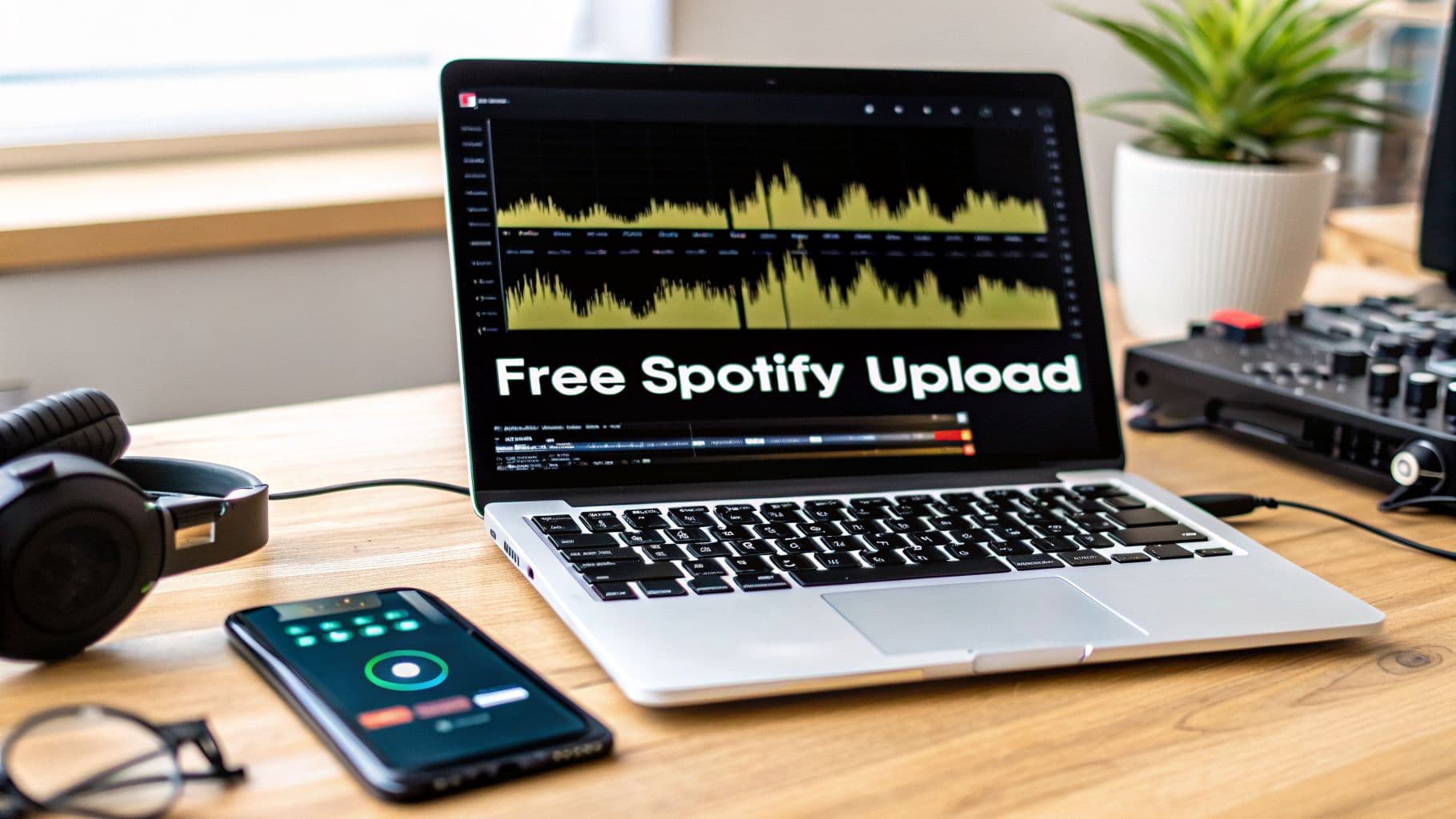
How to Upload Music to Spotify for Free A Guide for Artists
Learn how to upload music to Spotify for free with this practical guide. Discover the best distribution methods for independent artists to get on Spotify.
February 25, 2026
Music Marketplace Advisor
Buying & SellingSo, you want to get your music on Spotify without paying a dime upfront? It's a common goal for independent artists, but there's a crucial detail many miss: you can't just upload your songs directly to Spotify yourself.
Instead, you’ll need to partner with a digital music distributor. Think of them as the essential link between your finished tracks and major streaming platforms like Spotify, Apple Music, and others.
The Real Path to Getting Your Music on Spotify

A digital distributor handles the technical side of things, making sure your audio files and metadata meet Spotify's strict requirements and get delivered correctly. For an independent artist, working with a distributor isn't just an option—it's the only way onto the platform.
The "free" part of this process usually involves a trade-off. While you get to skip the annual fees that many distributors charge, the free services typically take a commission from your royalties. This is how they sustain their business. You can expect them to keep somewhere between 10% and 15% of what your music earns. It’s a solid model for artists who are just getting started and want to test the waters without any initial financial commitment.
Understanding the Competitive Landscape
Getting your music on Spotify is just the first step. Getting it heard is a whole different ballgame. The platform is incredibly crowded. We're talking about over 100,000 new songs hitting Spotify every single day. That breaks down to a new track being uploaded to major streaming services every 0.8 seconds.
This flood of new music means that just having your songs live isn't enough to build a following. You can dive deeper into what these numbers mean for artists by checking out recent 2026 reports on Spotify's growth.
The key takeaway is this: A "free" distributor is a tool, not a magic ticket. Your success depends on the quality of your music and your promotional efforts after the upload is complete.
While this guide will walk you through using these free distribution tools, it's good to know that other models exist. For example, some platforms are taking a different route. Services like OohYeah! let artists sell music directly to their fans, allowing them to keep 100% of the revenue. This bypasses the traditional commission model and can give you a much more direct connection with your audience.
Get Your Release Ready for a Professional Launch

Before you even start thinking about distributors, your release needs to be polished and ready for a global stage. This is your pre-flight checklist. Skipping these steps is a surefire way to get your music rejected or, worse, have it sound amateurish next to everything else on Spotify.
The first thing to get right is your audio quality. Spotify and its partners have strict technical requirements for a reason—they need to maintain a consistent, high-quality experience for listeners. Submitting a low-quality MP3 is a classic rookie mistake that immediately signals you're not taking this seriously.
Nail Your Audio and Artwork Specs
Your master audio files are the entire point of the release, so they must be perfect. Always, and I mean always, export your final, mastered tracks in a lossless format. This means you should steer clear of compressed files like MP3s or M4As, which literally throw away audio data to shrink the file size.
For your audio, stick to these professional standards:
- Format: WAV or FLAC. These formats keep every single detail from your studio session intact.
- Bit Depth: 16-bit or 24-bit. While 16-bit is the absolute minimum (think CD quality), 24-bit is the modern standard and gives you much more dynamic range.
- Sample Rate: 44.1 kHz. This is the universal standard for digital music and guarantees your track plays correctly everywhere.
Just as crucial is your album art. That cover image is often the first impression a potential fan gets. It has to look sharp and professional on a tiny phone screen and a giant desktop monitor, which means it must be high-resolution and perfectly square. The specs here are just as rigid:
- Dimensions: 3000 x 3000 pixels. Anything less might look blurry.
- Format: JPG or PNG.
- Color Space: Stick to RGB, the standard for all digital screens.
Think of your audio and artwork as your digital handshake. A crisp, high-quality presentation instantly tells everyone you're a serious artist. I've seen countless releases get held up because the artist failed to meet these basic specs—it’s the number one reason distributors reject music before it even gets near Spotify.
Gather Your Essential Release Data
Beyond the music and art, you need to collect all the crucial information that goes with it. This is your metadata, and it’s what allows Spotify to properly index your music, credit the right people, and, most importantly, track your streams so you get paid. For a deep dive, check out our guide on how to optimize your music metadata for streaming.
Get all of this information organized and ready to go before you start uploading:
- Track Titles: Exactly as you want them to appear.
- Artist Name(s): This includes any and all featured artists.
- Songwriter & Producer Credits: Proper attribution is not just professional courtesy; it's essential for royalties.
- UPC and ISRC Codes: These are the digital "barcodes" for your music.
A UPC (Universal Product Code) identifies your entire release (like an album or EP), while an ISRC (International Standard Recording Code) is assigned to each individual track. You absolutely need these, but don't worry about buying them. Almost every distributor, including the free ones we'll discuss, will generate these for you at no cost when you upload. Having this data ready makes the submission process quick and painless.
Choosing Your Free Music Distributor
This is probably the single most important decision you'll make in the process of getting your music on Spotify. Think of it less like picking a service and more like choosing a business partner—one that needs to align with where you want your career to go. The "free" part isn't magic; it's a trade. You're giving up a percentage of your future royalties in exchange for not having to pay anything today.
Distributors like Amuse, SoundOn, and the free tier from RouteNote all work on this commission model. They'll take a cut, usually somewhere between 10% and 15%, from the money your music earns. Understanding this trade-off is the first real step to picking the right partner for you.
Royalty Commissions vs. Release Speed
When you're looking at free distributors, your choice often boils down to one simple question: What matters more to you right now? Keeping as much of your money as possible, or getting your music onto Spotify as fast as you can? In the free distribution world, you usually can't have both.
A service that lets you keep 90% of your royalties might have a slower review process because they have a smaller team or a bigger backlog. On the flip side, a distributor that gets your tracks live in a few days might take a slightly larger commission to pay for the people and systems that make that speed possible. There’s no single "best" answer, only what's best for your current situation.
For example, if you're planning a big album launch with a three-month marketing runway, a slower release time in exchange for keeping more of your royalties is a smart move. But if you just created a track that's perfect for a trending sound and you need it live now, speed is everything. A slightly smaller royalty check is a price worth paying.
If you want to dig even deeper into this, our guide on how to choose the right music distribution service breaks down everything to consider for a long-term partnership.
A Closer Look at the Top Free Distributors
Let's get into the specifics of the most popular free options out there in 2026. This isn't just a list of features; it's about the philosophy behind each one and the type of artist they're built for.
Amuse: These guys are known for their slick, mobile-first app. Amuse has a fantastic free tier where you keep 100% of your royalties, which is hard to beat. The catch is that their review and release process can be on the slow side, often taking about four weeks. If you need things like a custom release date or faster support, you'll have to upgrade to a paid plan. It's a killer option for patient artists who want to maximize their earnings from day one.
SoundOn: Backed by TikTok itself, SoundOn is all about virality. You get to keep 100% of your royalties for the first year on TikTok and its sister platforms, which then drops to a 90/10 split in your favor. Its biggest selling point is the direct line to the TikTok ecosystem, including promotional tools you just can't get anywhere else. If your music and marketing live on social media, this is a no-brainer.
RouteNote (Free Tier): RouteNote has been in the game for a long time, and their free model is simple and reliable. You keep 85% of your royalties, and they get your music out to a massive network of stores, not just the big ones. Release times are pretty reasonable, usually somewhere between one and three weeks. It’s a solid, dependable, all-around choice that works well for artists who just want a no-fuss service.
To make this even clearer, here’s a side-by-side look at how these services stack up.
Free Music Distributor Comparison 2026
This table breaks down the essential differences between the top free distributors to help you see at a glance which one fits your needs. Pay close attention to the royalty splits and key features, as this is where the real value lies.
| Distributor | Royalty Cut (Artist Keeps) | Upfront Fee | Release Speed | Key Features |
|---|---|---|---|---|
| Amuse | 100% | $0 | ~4 Weeks | Mobile-first app, keep all royalties, upgrade for fast lane |
| SoundOn | 100% (Year 1), then 90% | $0 | ~1-5 Days | TikTok integration, promotional tools, fast distribution |
| RouteNote | 85% | $0 | ~1-3 Weeks | Wide store network, reliable service, simple terms |
Ultimately, the best choice aligns with your personal goals. An artist focused on building a catalog for long-term, sustainable income might lean toward Amuse to keep every cent. But a creator trying to ride the wave of a viral sound would be smart to go with SoundOn for its unique promotional power. When you match a distributor's strengths to your own strategy, you're not just uploading music—you're building a career.
Getting Your Music Uploaded and Ready to Go
You’ve picked your distributor and have all your files lined up. Now for the exciting part—actually uploading your music. This is where all that prep work really starts to pay off. The process itself is surprisingly similar across most free distributors, so once you've done it once, you'll know the drill.
It all starts in your distributor's dashboard, where you'll kick off a new release. You'll then be walked through a step-by-step process: first uploading your high-res album art and those final, mastered audio files (usually WAV or FLAC). After that, it’s all about the metadata. This is where you'll carefully input everything from your spreadsheet: song title, artist names, songwriter credits, and your ISRC/UPC codes. If you don't have codes, don't worry—your distributor will assign them for you right then and there.
How to Dodge Common Upload Mistakes
This is a stage where simple, avoidable errors can cause major headaches. I’ve seen it happen time and time again. For instance, pay very close attention to how you capitalize your titles. Every platform requires standard title case (e.g., "This Is My Song Title"), not all lowercase or all caps.
Another common pitfall is messing up artist mapping. When you add a featured artist to a track, you absolutely have to make sure you're linking to their correct, existing Spotify profile. Guessing or getting it wrong can send your release into a rejection spiral.
I’ve personally seen releases get kicked back for something as tiny as a typo in a songwriter's name. Always, always double-check every single field before you hit that final submit button. Taking five extra minutes to proofread can save you weeks of frustrating delays and support tickets.
The flowchart below recaps the key decisions you made when picking a distributor, which all come into play during this upload process.

From the royalty split to how fast they operate, each of these factors shapes your journey to getting your tracks live.
Why You Must Schedule Your Release in Advance
If you take only one piece of advice from this guide, let it be this: schedule your release at least three to four weeks before your target date. This isn't just a friendly suggestion; it's a non-negotiable strategy for any artist who wants to make an impact. This lead time is your secret weapon.
Here’s why that buffer is so important:
- It creates a safety net. Free distributors can have longer review times than paid services. By scheduling weeks ahead, you give your music plenty of time to get through the quality control queue without jeopardizing your release day.
- It enables playlist pitching. This is the big one. You can't pitch your track to Spotify's official editorial playlists until your distributor has approved it and delivered it to Spotify's system. To do this properly, you need a minimum of one week between when your song is in Spotify's backend and your release date.
With over 100,000 new songs flooding Spotify every single day, editorial playlists are a massive discovery engine. They still drive a huge number of streams, even as 45% of listening now comes from algorithmic sources like Discover Weekly and Radio. Dig into more Spotify statistics and you'll see just how competitive it is. That four-week window isn't just about avoiding problems—it's about creating an opportunity for your music to be heard.
Mastering Your Spotify for Artists Profile

After your distributor gives you the confirmation that your music has been delivered, it’s time to take control of your most powerful asset on the platform: your Spotify for Artists profile. This isn't just some optional extra; think of it as your mission control for everything you do on Spotify. Getting access is your immediate next step.
Don't wait. As soon as you have your music in Spotify's system, head straight to the Spotify for Artists site and claim your profile. The verification process is straightforward and gives you that coveted blue checkmark, but more importantly, it hands you the keys to your artist page. This is where you transform your page from a generic placeholder into a genuine hub for your music and your brand.
Crafting a Compelling Presence
Your artist profile is the first real impression you make on a potential fan. A blank or half-finished profile just doesn't cut it—it signals that you're not fully invested, so why should they be? A polished page, on the other hand, gives listeners a reason to connect with you beyond just the music.
Here are the absolute essentials you need to dial in:
- Artist Bio: This is your chance to tell your story. Go beyond the basics. What drives you to create? What’s the story behind your sound? Keep it fresh and update it as your journey unfolds.
- Artist Pick: Use this prime real estate at the top of your profile to direct attention. Pin your new single, a curated playlist of your influences, or an album you're proud of. It’s your spotlight.
- Canvas Videos: Add a short, looping video to each of your tracks. A visually interesting Canvas can seriously boost shares and keep listeners engaged for longer.
Maintaining a dynamic profile can feel like a job in itself. Beyond the initial setup, you might explore artist management apps to help keep your content fresh and organized. Of course, a great profile is only half the battle; you also need to learn how to attract fans to your music profiles to start building real momentum.
Pitching to Spotify's Editorial Playlists
Now for the game-changer. The single most important feature inside Spotify for Artists is the ability to pitch your unreleased music directly to Spotify's editorial team. This is your best shot at landing on massive playlists like New Music Friday or influential genre-specific lists that can rack up thousands, if not millions, of streams.
The rules are simple: the song must be unreleased, and you must submit your pitch at least seven days before its official release date. Think of your pitch as a sales letter to an editor. You need to explain the story behind the song, tag its specific moods, and select up to three genres that genuinely fit.
Pro Tip: Your pitch description is where you can truly stand out. Avoid generic phrases like "it's an upbeat pop song." Get personal and be specific. Try something like, "I wrote this after a road trip down the coast, trying to capture that feeling of summer freedom with a driving bassline and retro synths." Tell a story that makes an editor curious enough to press play.
Getting playlisted is never guaranteed, but a well-crafted pitch drastically improves your odds. It's a reminder of why independent platforms like OohYeah! are so valuable—they offer truly free uploads, commission-free downloads, and direct fan monetization, so you aren't just relying on Spotify's algorithm. With OohYeah!, artists keep full control over pricing and get analytics to connect directly with fans, bypassing the playlist lottery where 45% of 3.2 trillion projected streams in 2026 will come from discovery algorithms. You can dive deeper into these powerful Spotify statistics on Soundcamps.com.
Got Questions About Free Spotify Uploads? Let's Clear Things Up
Getting your music out there can feel like navigating a maze. When you're trying to release music on Spotify for free, a lot of questions pop up. I've been there. Let's tackle some of the most common points of confusion so you can move forward confidently.
Is It Actually Possible to Upload to Spotify for Free?
Yes, it is, but there's always a "catch." You can get your music on Spotify without paying a dime upfront by using a distributor that operates on a commission model. These companies need to make money, after all.
Instead of a yearly subscription, they take a cut of your streaming royalties. This is usually somewhere between 10% and 15%. So while it's "free" to get your songs online, you're trading a piece of your future earnings for that convenience.
It's a classic trade-off: save money now, but give up a percentage of your revenue later. For artists looking to avoid that commission entirely, platforms like OohYeah offer a way to bypass that model by selling directly to your audience, letting you keep 100% of your sales revenue.
How Long Will It Take for My Music to Appear on Spotify?
This is where planning becomes your best friend. Free distributors handle a massive volume of music, which means their review process is often slower than paid services. Don't expect your track to be live tomorrow.
Realistically, you should plan for it to take anywhere from one to four weeks for your music to show up on Spotify. Premium distributors can often get it done in a few business days, but with free services, you need to build in a buffer.
This is exactly why the industry standard is to submit your music at least four weeks before your release date. It’s not just about making sure it goes live on time; this window is critical for pitching your track to Spotify's editorial playlists.
What if I Want to Change Distributors Down the Road?
You're not locked in forever. Switching distributors is totally doable, but you have to be strategic about it to protect your stream counts and playlist spots. You can't just take the old version down and re-upload it—that’s a recipe for losing all your hard-earned progress.
Here’s the right way to make the switch:
- Start by re-uploading your music through your new distributor.
- This part is crucial: make sure every single piece of metadata is identical. I'm talking about the track title, artwork, and especially the original ISRC codes. They must match perfectly.
- Be patient and wait until you see the new version is live on Spotify and has linked with the original (you'll know because your stream counts will carry over).
- Only after you've confirmed everything has merged correctly should you go back to your old distributor and request a takedown.
Following this process ensures there’s no gap where your music disappears, keeping your momentum going without any awkward interruptions for your listeners.
Do I Really Need UPC and ISRC Codes?
Yes, 100%. Think of them as the digital barcodes for your music. They are absolutely mandatory for any official release on Spotify, Apple Music, or any other major platform.
- A UPC (Universal Product Code) is for your entire release—the album, EP, or single.
- An ISRC (International Standard Recording Code) is for each individual song.
These codes are how the global music industry tracks every single stream and makes sure royalties find their way to the right people. The great news? You don't have to worry about buying them. Nearly every distributor, including all the free ones, will generate these codes for you automatically during the upload process. It’s one less technical headache to deal with.
Ready to take full control of your music career? With OohYeah, you can sell your music, merchandise, and subscriptions directly to your fans and keep 100% of the revenue. Stop giving away your earnings and start building a sustainable future by visiting oohyeah.app today.