How to Publish Songs From Studio to Streaming
Learn how to publish songs with this guide for independent artists. Master the process from rights management and distribution to promotion and monetization.
January 4, 2026
Music Marketplace Advisor
Buying & SellingPublishing a song really comes down to three things: preparing your audio and metadata, protecting your rights so you get paid, and promoting your music so people actually hear it. When you get these three phases right, what seems like a complicated mess becomes a clear, manageable plan to get your music out there and build a real career.
Your Blueprint for a Successful Song Release
Putting your music out into the world can feel overwhelming, like trying to find your way through a maze blindfolded. But trust me, once you understand the core pieces of the puzzle, the path forward becomes surprisingly clear.
The whole journey of publishing a song successfully is built on a solid foundation of great preparation, smart legal moves, and strategic promotion. Think of it as your launch checklist, making sure you’ve covered every base from the final master track to seeing that first royalty payment land in your account.
Following these steps ensures your music not only sounds pro but is also properly set up to earn you money. If you skip any of these pillars, you risk leaving cash on the table, missing out on big opportunities, or just having your release fall flat.
The Three Pillars of Publishing
From a bird's-eye view, the process is pretty straightforward. First, you get all your assets ready—the final mastered audio file, your cover art, and all the crucial metadata. Next, you protect what you've created by registering your copyrights and signing up with the organizations that will collect your royalties. Finally, you get out there and promote your music to connect with listeners and build some real momentum.
This simple flow shows how everything fits together into one cohesive release strategy.
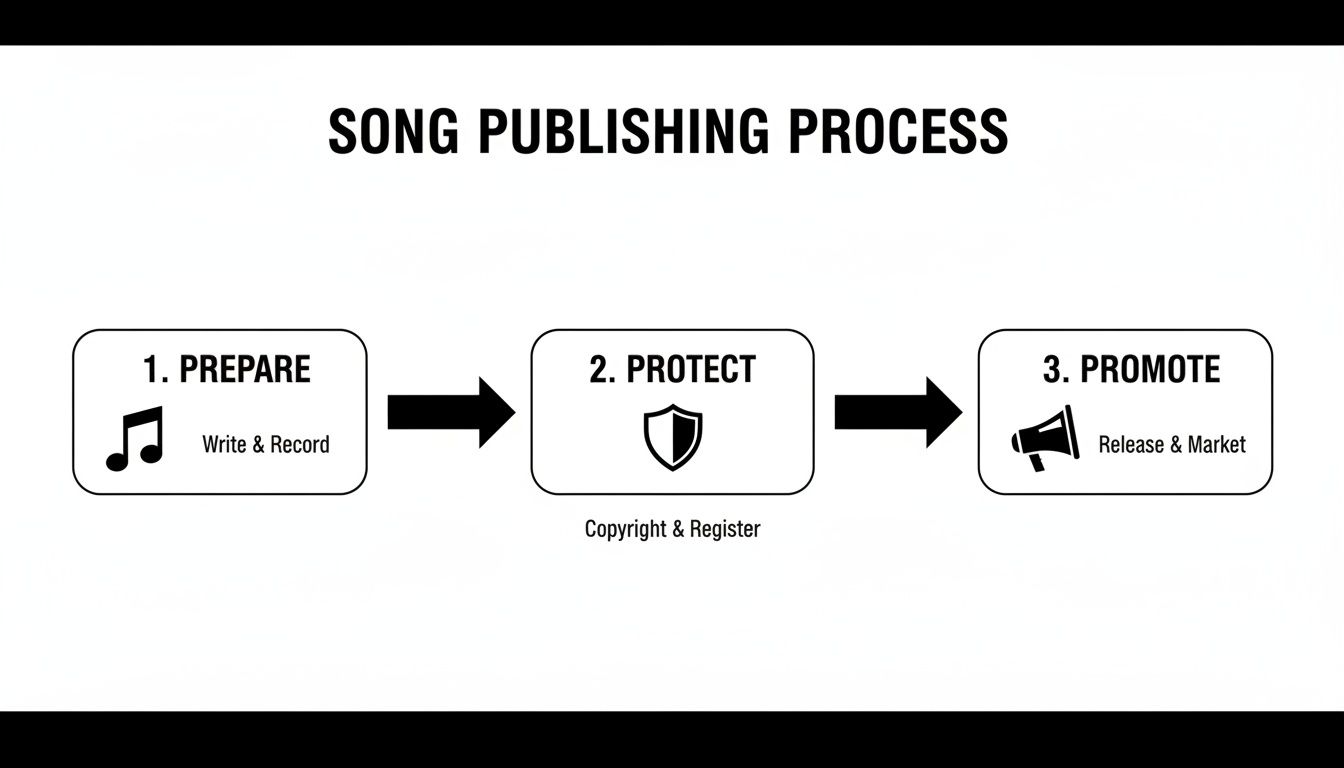
As you can see, each step builds on the last one, creating a solid launchpad for your music.
To give you a clearer picture of the road ahead, let's break down the entire process. Here’s a quick overview of the key stages, the tasks you’ll need to tackle, and the tools you’ll need in your corner.
Think of your song release as a business launch. Approaching it with a structured plan and knowing exactly what to do at each step is what separates artists who just upload a song from those who are building a sustainable career.
The Song Publishing Roadmap at a Glance
This table maps out the journey from start to finish. Use it as a high-level guide to visualize the entire process before we get into the nitty-gritty of each step.
| Stage | Key Tasks | Essential Tools/Services |
|---|---|---|
| Preparation | Finalize mix and master, create artwork, compile metadata (credits, lyrics) | Professional mastering engineer, graphic designer, a reliable organizational system |
| Protection | Register copyrights, obtain ISRC/UPC codes, affiliate with a PRO | U.S. Copyright Office, your distributor, a PRO (e.g., ASCAP, BMI), publishing administrator |
| Distribution | Choose a distribution partner, upload assets, schedule release date | Digital distributor (e.g., DistroKid) and/or a direct-to-fan platform like OohYeah |
| Promotion | Develop marketing plan, run pre-save campaigns, pitch to playlists and press | Social media platforms, email marketing service, PR outreach tools |
This roadmap gives you the "what" and the "how" in one place. Now, let's dive into what each of these stages actually looks like in practice.
Getting Your Music Ready for a Professional Release
Before your music even has a chance to connect with an audience, it has to pass a critical quality check. This isn't the glamorous part of being an artist, but getting these technical and administrative details right from the start is what separates the pros from the hobbyists. Think of it as building the foundation for your release—a little extra effort here prevents a world of headaches later.
The most important asset you have is your master audio file. This is no place to cut corners. Your final track needs to be a high-resolution, uncompressed WAV file, ideally at 44.1 kHz and 16-bit or 24-bit. Sure, an MP3 is fine for emailing a demo to a friend, but distributors and streaming platforms need the highest quality file to make sure your music sounds incredible everywhere.
When you're bouncing that final master, understanding the nuances between file types is key. Taking a moment to choose the right audio format for a professional release is a small step that ensures all your hard work in the studio translates perfectly to every listener's headphones.
The Critical Role of Mastering and Metadata
Mastering is that final coat of polish that helps your song stand up against major label releases in a playlist. A good mastering engineer will balance the EQ, bring out the dynamics, and optimize the overall loudness for streaming platforms. If you skip this, your track might sound quiet, muddy, or just plain amateurish—a red flag for both listeners and playlist curators.
Once the audio is sounding perfect, you need to embed its digital DNA: the metadata. This is simply all the text-based info that tells platforms who you are, what the song is called, and, most importantly, who gets paid.
I can't stress this enough: incorrect or incomplete metadata is one of the biggest reasons independent artists miss out on royalties. Taking 30 minutes to get these details right can save you from months of chasing lost revenue.
For anyone serious about learning how to publish songs the right way, accurate metadata is non-negotiable. It covers everything from the primary artist name and any featured artists to the songwriters, producers, and the release date. This information is what ensures the money and credit flow directly to you and your collaborators.
Essential Codes: ISRC and UPC
To track your music and sales across the globe, you'll need two essential codes: an ISRC and a UPC. Think of them as the social security number and the barcode for your music.
ISRC (International Standard Recording Code): This is a unique 12-character code assigned to one specific master recording. Every version of your song—the album version, a radio edit, the instrumental—needs its own unique ISRC. It’s how every single play is tracked for royalty payments.
UPC (Universal Product Code): This is a 12-digit barcode assigned to the entire product you're releasing, whether it's a single, an EP, or a full album. It’s how distributors and stores track sales of the whole package.
The good news? You usually don't have to go out and buy these yourself. Most digital distributors will assign them to your releases for free or for a small fee when you're uploading your music.
Finalizing Your Visuals and Credits
Your song's visual identity begins with its cover art. In a crowded digital space, this is your first and best chance to make an impression. It’s not just a pretty picture; it's a key piece of your branding that has to meet some strict technical specs to even be accepted by streaming services.
Artwork Requirements Checklist:
- Format: It must be a perfect square. No exceptions.
- Resolution: Aim for at least 3000x3000 pixels. This ensures it looks crisp on any screen.
- File Type: Stick to JPG or PNG formats.
- Content: Keep it clean. No URLs, social media handles, or pricing information allowed on the image itself.
Alongside your artwork, pull together all of your credits. Make a definitive list of every single person who contributed to the track—co-writers, producers, the mixing engineer, the mastering engineer. Having this information organized and ready to go will make the upload process a breeze and guarantees everyone involved gets the credit they deserve. This kind of attention to detail is what a professional release is all about.
Securing Your Rights and Future Royalties
Alright, you’ve got a killer track that’s mixed and mastered. Before you even think about uploading it, we need to talk about the single most important step for building a real career: owning your work. This is the part where you shift from being just a creator to being the business owner behind your music.
Think of it this way: skipping this step is like building a house on land you don't own. It might look great, but you have no legal claim to it or the money it could make. Let's make sure you get paid for your art.
Master vs. Composition: The Two Copyrights in Every Song
Here’s something many artists miss early on: every song you write and record actually contains two distinct copyrights. Getting this right is the key to collecting all the royalties you're owed.
The Master Recording: This is the copyright for the actual audio file—the finished WAV or MP3. It’s the specific performance you recorded. Typically, the artist or the label that funded the session owns this.
The Composition: This copyright protects the song itself—the lyrics, melody, and harmony. It's the intellectual property. As the songwriter, this belongs to you and your publisher (which, for now, is probably you).
Make It Official: Formally Registering Your Copyrights
Technically, your work is copyrighted the moment you create it. But "technically" doesn't hold up well in a legal dispute. Formally registering your music with the U.S. Copyright Office creates a public, undeniable record of your ownership.
This registration is your legal firepower. It's what gives you the right to sue for infringement if someone steals your music. It’s a pretty straightforward online process, and honestly, it’s one of the most powerful moves you can make to protect your future.
For a deeper dive into this, our guide on how to protect your music rights online has more specific strategies you can use.
Get Paid for Airplay: Joining a Performing Rights Organization (PRO)
To get paid when your music is played publicly, you absolutely have to join a Performing Rights Organization (PRO). These are the folks who track and collect royalties for you.
Every time your song plays on the radio, in a coffee shop, on a TV show, or gets streamed on a platform like Apple Music, it generates a performance royalty. PROs in the U.S. like ASCAP, BMI, and SESAC collect that money from the businesses and send it back to you. You can only be a member of one as a songwriter, so do a little homework to see which one feels like the right fit.
Affiliating with a PRO is non-negotiable for any serious artist. Without it, there is literally no system in place to track and pay you for most of the public uses of your music.
Don't Leave Money on the Table: Using a Publishing Administrator
PROs are essential, but they don't catch everything. They primarily handle performance royalties. What about the money made when your song is reproduced? That's where a publishing administrator comes into the picture.
They collect what are known as mechanical royalties, which are generated from streams, digital downloads, and physical sales (like vinyl or CDs).
Services like Songtrust or Sentric will act as your global publishing admin. They register your songs all over the world and chase down every last cent you're owed in exchange for a small commission. For an indie artist, this is a no-brainer. It's the only way to ensure you're collecting everything.
The world of independent publishing is exploding right now, opening up huge doors for artists who want to control their own destiny. For perspective, the independent music publishing sector was valued at just €1.15 billion globally in 2018. By 2023, it shot up to €2.57 billion—a massive 105.6% increase in just five years. This is a seismic shift, creating a new era for creators publishing without the old-school gatekeepers. You can read the full IMPF report on independent music publishing to see the numbers for yourself.
By taking these steps—understanding the two copyrights, registering your work, joining a PRO, and getting a pub admin—you're building the financial engine for your music career. You’re making sure that as your music finds its audience, the money finds its way back to you.
Picking Your Music Distribution Strategy
Alright, you’ve got a killer master and all your rights are in order. Now for the exciting part: getting your music out into the world. This is where distribution comes in—it’s the bridge connecting your studio to your listeners. The path you choose here will fundamentally shape your reach, your income, and the relationship you build with your fans.
You essentially have two main roads you can take: the traditional digital distributor or a direct-to-fan platform. They each serve a very different, yet equally important, purpose. The savviest artists I know don't just pick one; they actually use a combination of both to create a really solid release plan. Let's dig into what each option offers.
Traditional Digital Distributors: The Expressway to Global Reach
When you imagine your song popping up on Spotify, Apple Music, or even in a TikTok video, you're thinking about a digital distributor. Companies like DistroKid, TuneCore, and CDBaby are the logistical workhorses for independent artists. You upload your track and metadata, pay a fee, and they handle the nitty-gritty of pushing it out to hundreds of digital storefronts and streaming services across the globe.
The whole model is built for one thing: maximum reach. By getting your music onto 150+ platforms, you’re making it available pretty much anywhere someone could be listening. This is absolutely critical for discovery, landing on playlists, and just having a professional presence everywhere.
But that massive reach comes with a few strings attached.
- Fee Structures: You'll typically pay either an annual fee to keep your catalog live or a one-time fee for each release. Some also take a cut of your earnings.
- No Real Control: Once your music is out there, you have very little say in how it's presented on each service, and you get almost no meaningful data about who is actually listening.
- Slow Payouts: It can take months for royalties to wind their way through the system before they hit your bank account, and that's usually after the platforms and the distributor have taken their share.
Even with these downsides, using a distributor is basically non-negotiable in today's music world. It's the only way to tap into the massive audiences on the major streaming platforms.
Think of a digital distributor as the company that gets your product into every big-box store on the planet. It's essential for visibility and making sure people can find you, but it doesn't give you a direct line to the person actually buying your stuff.
Direct-to-Fan Platforms: The Path to Real Connection
The second road is all about selling your music directly to the people who care most—your audience. A platform like OohYeah is built for this. It completely flips the script on the artist-listener dynamic. Instead of being just another artist lost in a sea of millions, you're creating your own custom storefront where you call all the shots.
With a direct-to-fan model, everything changes. You can:
- Pocket 100% of the Revenue: When a fan buys your song, that money goes straight to you. No commissions, no hidden fees.
- Bundle Music with Anything: This is huge. You can sell your new single along with an exclusive t-shirt, a signed poster, or a behind-the-scenes video. This boosts the value of every single purchase.
- Build an Actual Fanbase: You get real data on who supports you. This allows you to talk to them directly, send updates, and turn casual listeners into a dedicated community.
This approach is about depth, not just breadth. While it won't land you on a thousand different streaming playlists, it gives you the power to build a truly sustainable career around your most passionate fans—the ones who genuinely want to support you directly.
Comparing Your Options Side-by-Side
To really see the difference, it helps to put them head-to-head. This table breaks down the core philosophies behind each distribution strategy.
A quick look at this table should make it clear that these aren't opposing forces. They're two different tools for two different jobs.
| Feature | Digital Distributor | OohYeah (Direct-to-Fan) |
|---|---|---|
| Primary Goal | Widespread reach on streaming platforms | Direct sales and fan community building |
| Revenue Share | You receive a percentage after platform and distributor cuts | You keep 100% of the revenue from sales |
| Fan Data | Minimal to no access to listener data | Full access to customer data for relationship building |
| Control | Limited control over pricing and presentation | Complete control over pricing, bundling, and content |
| Relationship | Indirect relationship with listeners | Direct communication and engagement with fans |
As you can see, these two approaches aren't competitors; they're complementary. Our guide on how to choose the right music distribution service dives deeper into this hybrid model and helps you figure out the best way to balance both worlds.
The global music publishing world is exploding, with revenues expected to hit a record $10 billion in 2025 and projected to climb past $14 billion by 2030. That growth is even outpacing the recorded music side of things, which signals a massive opportunity for indie artists who get serious about their publishing and distribution. You can discover more insights about these music industry forecasts and see exactly why a hybrid strategy is the way to go. Use distributors to get discovered, and use a platform like OohYeah to build your community and make real money.
Marketing Your Music and Building a Fanbase

Getting your song mixed, mastered, and delivered to streaming platforms is a huge milestone. But the work doesn't stop there. In fact, that’s where the real challenge begins. Your music won't find its audience by itself.
Think about it: over 100,000 new tracks hit services like Spotify every single day. Without a smart, proactive marketing plan, even a great song can get completely lost in the flood. The goal isn't just to get your song out—it's to make your release an event that cuts through the noise and connects with listeners.
Creating Your Release Timeline
A well-planned release timeline is the secret weapon of successful independent artists. It turns the chaos of a release into a manageable, step-by-step process that builds genuine anticipation. This timeline is your roadmap for all promotional activities before, during, and after your song drops.
First things first, set your release date at least four to six weeks out. This might feel like a long time, but that buffer is crucial. It gives your distributor plenty of time to get your track delivered everywhere without a panic, and more importantly, it gives you the window you need to pitch your song for editorial playlists on Spotify.
Your timeline should map out key moments like:
- The Big Reveal: Announce the single with its official cover art.
- Pre-Save Push: Launch a pre-save campaign to drive early engagement and signal to algorithms that something big is coming.
- The Story Behind the Song: Share behind-the-scenes content—studio clips, voice memos of the original idea, or videos explaining the lyrics.
Crafting a Simple and Effective Press Kit
Your Electronic Press Kit (EPK) is your digital handshake. When you're reaching out to bloggers, playlist curators, or podcasters, a polished and easy-to-use EPK shows you’re a professional who takes their career seriously.
It doesn’t need to be flashy, just functional. The best EPKs are a single, shareable link—like a page on your website or a Google Drive folder—that gives a journalist everything they need at a glance.
Your EPK is more than a folder of files; it’s your chance to tell your story your way. A great press kit makes it incredibly easy for someone to say "yes" to featuring your music.
Make sure to include these essentials:
- A short, compelling artist bio.
- High-resolution press photos and your single's artwork.
- A private streaming link to the new song (SoundCloud is great for this).
- Easy-to-find links to your website and all social media profiles.
Beyond Social Media Posts: Building a Real Community
Social media is a must, but a "like" isn't a fan. True, lasting success comes from building a genuine community around your music, and that requires more than just regular posts. It's about creating a direct connection with the people who believe in what you're doing.
This is where direct-to-fan platforms like OohYeah come in. They give you a way to offer exclusive content—early song access, private live streams, behind-the-scenes videos—directly to your most dedicated supporters. This kind of interaction builds a level of loyalty that social media algorithms simply can't compete with. You’re turning passive listeners into an active community. For more ideas on this, check out our guide on how to build a loyal fan base as an independent artist: https://oohyeah.app/posts/how-to-build-a-loyal-fan-base-as-an-independent-artist
To keep your promotion consistent without burning out, look into social media scheduling tools. They help you maintain a steady drumbeat of content, freeing you up to focus on the creative side. The opportunity has never been bigger—the independent music publishing world is on track to become a $14.04 billion industry by 2030. Artists who treat marketing with the same passion as their music are the ones who will claim their piece of it.
Common Questions About Publishing Music
Getting your music out into the world can feel like you're trying to read a map in a foreign language. It's totally normal to have a ton of questions as you get ready to release your new track. Let's clear up some of the most common hurdles I see independent artists run into, so you can move forward with confidence.
How Much Does It Cost to Publish a Song?
This is a big one, and the answer is: it varies. But it's almost certainly more affordable than you think. The main cost you'll encounter is your digital distributor's fee. This could be a one-time charge for a single release or an annual subscription that lets you upload as much music as you want.
Beyond that, here are a few other things to budget for:
- ISRC/UPC Codes: A lot of distributors throw these in for free. If not, they're usually a small, one-time fee.
- Copyright Registration: This is a must-do for legal protection. Filing with the U.S. Copyright Office will run you about $45 to $65 per work. Don't skip this.
- Professional Services: While optional, getting your track professionally mastered can make a world of difference. This can cost anywhere from $50 to over $200. You'll also want to set aside some cash for marketing.
Using a platform like OohYeah is a great way to recoup these expenses, since they let you keep 100% of the revenue from your direct-to-fan sales. That money goes right back into your pocket to fund the next project.
Do I Need a Publisher to Release My Music?
Absolutely not. Especially when you're just starting, you don't need to chase a traditional publishing deal. You can be your own publisher—and honestly, you probably should be.
The modern music industry empowers you to be your own CEO. By self-publishing, you maintain full creative control and keep a significantly larger share of your earnings—a game-changer for independent artists.
To do it right, you'll need to set up your own small publishing entity. This means affiliating with a Performing Rights Organization (PRO) like ASCAP or BMI twice: once as a songwriter and again as a publisher. From there, you can work with a publishing administrator who will chase down all the royalties you're owed from all over the world. It’s the perfect setup: you keep control while they handle the complex collections.
How Long Until My Song Appears on Streaming Services?
This isn't an instant process, so you'll need a little patience. Once you've uploaded your final master and all the metadata to your distributor, it can take anywhere from a few days to a couple of weeks for it to go live on all the big platforms like Spotify and Apple Music.
Because of this lag, a smart release timeline is your best friend. I always recommend submitting your music at least three to four weeks before your release date. This buffer is critical. It gives you time to fix any weird technical glitches that might pop up, and more importantly, it makes you eligible to pitch your track for editorial playlists, which almost always require a lead time of several weeks.
What Is the Difference Between Publishing and Distribution?
This trips up so many artists, but it's pretty simple when you break it down. Just think of your music like a book.
Publishing is all about the intellectual property—the story itself. In music, this is your song's composition (the lyrics and melody). Publishing handles the rights to that composition and makes sure you get paid royalties whenever it’s used, sold, or performed.
Distribution is the logistics. It's the process of getting the finished book into bookstores. For your music, it’s how your actual sound recording gets from your hard drive onto Spotify, Apple Music, and direct-to-fan sites where people can stream or buy it. You need both to have a successful release.
Ready to take full control of your music and connect directly with your fans? OohYeah provides the tools you need to sell your songs, merch, and more while keeping 100% of your revenue. Start building your artist-first business today at OohYeah.