How to Make Money as a Musician Online: A Practical Guide
Learn how to make money as a musician online with proven strategies to monetize your music, build your brand, and generate income. Read more!
August 24, 2025
Music Marketplace Advisor
Buying & SellingEarning a real living from your music online isn’t about chasing a one-off viral hit. It’s about methodically building a sustainable business with several different income streams. The smartest artists I know have diversified well beyond streaming by selling merch, offering exclusive content for their biggest fans, licensing their tracks, and even monetizing their skills as teachers or session players.
Your Blueprint for Online Music Income
Let's get straight to it. The old-school fantasy of getting "discovered" and living off record sales is pretty much dead. Today, making money as a musician means thinking like an entrepreneur. You're the CEO of your own career, and your success hinges on building a real business, not just waiting around for a lucky break. This is your roadmap—a practical plan for setting up the essential pillars of a modern, financially stable music career.
A powerful online presence always starts with a platform you own and control. This is your central hub where you shape the story and, most importantly, own the direct relationship with your fans. From there, you can funnel your audience to all your other ventures. This is exactly why it's so critical to learn how to build a professional website that perfectly captures your brand and sound.
Understanding the Modern Revenue Mix
While streaming gets all the headlines, it's rarely the biggest paycheck for independent artists. The real financial power comes from weaving together multiple income sources that support each other.
The core pillars of a solid online music income strategy include:
- Direct-to-Fan Sales: This is your bread and butter. Think digital downloads, vinyl, t-shirts, and exclusive content sold right from your own website or a platform like OohYeah.
- Fan Support & Subscriptions: Services like Patreon or a subscription feature on your own site let your most loyal fans support you directly with recurring payments in exchange for behind-the-scenes access and perks.
- Skill Monetization: Don't forget that your musical talent itself is an asset. You can generate steady income by offering online lessons, creating and selling sample packs, or booking remote session work.
- Licensing & Royalties: Getting your music placed in films, TV shows, commercials, or video games (known as sync licensing) can be a massive financial win.
The most successful online musicians never put all their eggs in one basket. They build an interconnected web of revenue streams. This way, if one area takes a dip, their entire career isn't on the line.
To give you a clearer picture, here’s a quick breakdown of the most common online revenue streams and what you can realistically expect from them.
Primary Online Revenue Streams for Musicians
| Revenue Stream | Earning Potential (Low to High) | Effort Level (Low to High) | Best For |
|---|---|---|---|
| Streaming Royalties | Low | Low | Audience building & discovery |
| Digital Downloads | Low to Medium | Low | Fans who want to own your music |
| Physical Merchandise | Medium to High | Medium | Artists with a strong brand identity |
| Fan Subscriptions | Medium to High | Medium | Musicians with a dedicated community |
| Sync Licensing | High | High | High-quality, professionally produced tracks |
| Online Lessons | Medium | Medium | Skilled players who enjoy teaching |
This table isn't exhaustive, but it shows how different strategies serve different purposes. The key is to find the right combination that fits your music, your brand, and your audience.
The Hard Reality of Streaming Payouts
It's absolutely essential to have a realistic view of streaming. Yes, platforms like Spotify and Apple Music are incredible for discovery and reaching a global audience, but the per-stream payouts are tiny.
Consider this: streaming now accounts for approximately 84% of recorded music revenue in the US, but you need massive volume to see a decent return. Spotify pays artists around $0.0039 per stream in the US, while Apple Music is a bit better at about $0.01 per stream.
This means you'd need hundreds of thousands, if not millions, of streams to generate significant income. It's a stark reminder that streaming should be just one piece of a much larger, more diverse financial strategy. You can dive deeper into these numbers by checking out the online music economy in 2025.
Building Income Streams Beyond Streaming
Let's be real: streaming is great for getting your music heard, but relying on it as your only paycheck is a recipe for disaster. To build a career that lasts, you have to start thinking like an entrepreneur. That means creating a whole portfolio of revenue streams that you control directly.
This isn't just about protecting yourself from the whims of algorithms; it's about putting the financial power back where it belongs—in your hands.
The best part? Your most dedicated fans are already looking for more ways to support you. They crave a real connection that goes beyond hitting the 'play' button. This is your chance to learn how to earn money with music by selling directly to the people who believe in your art.
Launch Your Own Online Store
Your website needs to be more than just a digital business card. It should be the command center for your entire operation, and a dedicated online store is its most critical component. When you sell directly to your audience, you keep a much bigger piece of the pie compared to what you’d make through third-party marketplaces.
Don't just stop at a standard-issue t-shirt. Your store is a blank canvas for your brand.
- Physical Merch: Think high-quality hoodies, signed posters, custom guitar picks, or even a limited-run vinyl pressing.
- Digital Goods: Offer high-resolution audio files (WAVs, FLACs), digital lyric books, exclusive behind-the-scenes videos, or the instrumental versions of your tracks.
- Unique Experiences: Get creative and offer things like handwritten lyric sheets, personalized video messages, or exclusive demo recordings that hardcore fans will love.
The goal is to offer something special that deepens that artist-fan connection—something they can't get anywhere else.
The Power of Physical and Digital Sales
If you think no one buys music anymore, the numbers tell a very different story. Diversifying your income is no longer a "nice-to-have"; it's an absolute must for long-term survival.
Fans are still spending big on music they can own. In 2023 alone, physical products like vinyl and CDs generated a massive $1.91 billion in revenue in the US. Digital downloads? They still pulled in $434 million. And that's before we even talk about merchandise. Artists using platforms like Bandzoogle earned nearly $9 million from merch sales last year. You can dig into the full breakdown of these music revenue insights on Ditto Music.
Ignoring these sales channels means you are actively leaving money on the table.
Your online store isn't just a shop; it's a direct line to your most supportive fans. Every sale is a vote of confidence in your art and a financial contribution that is far more impactful than thousands of streams.
Unlocking Sync Licensing Opportunities
Ever dreamed of hearing your song in a movie, a TV show, or a popular video game? That's the world of sync licensing, and it can be one of the most lucrative avenues for an independent artist. A single placement can mean a significant upfront fee, not to mention the performance royalties that can keep paying out for years.
But breaking into sync requires a professional game plan.
- Polish Your Sound: First and foremost, your tracks have to be professionally recorded, mixed, and mastered. Music supervisors won't give amateur-sounding tracks a second listen.
- Instrumentals Are Essential: Always, always have high-quality instrumental versions of your songs ready to go. Very often, a scene needs music underneath dialogue.
- Tag Your Files (Metadata): Make sure your audio files are properly tagged with your name, the song title, genre, mood, and—most importantly—your contact info. This makes it easy for supervisors to find you when they're searching their libraries.
- Start Networking: Connect with music supervisors on LinkedIn, attend industry panels, or consider working with a sync agent who can pitch your music on your behalf.
If you’re looking to get creative and discover various side income ideas, sync licensing is a fantastic place to start.
Selling Your Skills and Knowledge
Your musical talent itself is a sellable asset. Are you a killer producer? You could be creating and selling sample packs, preset bundles for synths and effects, or even project templates that other musicians can use to learn. These kinds of digital products are great because they have high-profit margins and can become a source of passive income.
Take a minute to think about the skills you've spent years developing. Maybe you're a shredding guitarist, a wizard at mixing, or a natural-born songwriter. Each of these skills can be packaged and sold as a product or service. This not only creates another income stream but also builds your reputation as an expert in your niche, opening up even more opportunities down the road.
Turning Your Fans Into Loyal Supporters
Let's be real: having 1,000 passive listeners on some algorithm-generated playlist doesn't pay the bills. What you really need are 100 true fans—people who are genuinely invested in your journey and eager to support you directly. Your community is your single greatest asset, and learning how to transform casual listeners into active patrons is the secret to a sustainable music career.
This isn't about panhandling. It's about creating a genuine value exchange. Modern platforms like Patreon, Ko-fi, and even the fan club features built into tools like OohYeah let you build a private world for your most dedicated supporters. This is your chance to offer them something special they can't get anywhere else, creating a powerful bond and, just as importantly, a stable, recurring source of income.
Crafting Your Membership Tiers
Okay, so where do you start? The first move is structuring your membership program. Think of it like a "choose your own adventure" for your fans, with different levels of support that offer escalating rewards. This makes it easy for people to jump in at a price point that works for them.
Before you set any prices, take a minute to brainstorm what you can realistically offer on a consistent schedule. The goal is to deliver, not to burn out.
What does your audience actually care about? Are they gearheads who want to see your pedalboard? Aspiring songwriters who would love to see your process? Or fans who just want to feel like they're part of your inner circle? Let those answers guide your offerings.
Here’s a simple framework to get the ideas flowing:
- Tier 1 ($3-5/month): This is your welcome mat. Offer access to a private community hub (like a Discord server), an exclusive newsletter, and a first look at new music or videos before anyone else.
- Tier 2 ($10-15/month): Here, you'll want to add more direct value. Think monthly Q&A livestreams, high-quality downloads of your full discography, or behind-the-scenes content like studio vlogs and raw song demos.
- Tier 3 ($25+/month): This tier is for your superfans. The rewards need to feel personal and unique. You could offer handwritten lyric sheets, a special "thank you" credit on your next album, or even personalized video messages.
The best membership programs aren't just about content; they're built on a sense of exclusivity and genuine connection. Your fans are investing in you. Make them feel like they're an essential part of your story.
The Power of Exclusive Content
Exclusive content is the fuel that keeps your fan club running. It’s what makes that monthly subscription feel like a no-brainer and keeps your supporters coming back. Your goal should be a mix of content—some things that are easy for you to create on the fly, and others that are higher-value perks.
The easiest way to keep things fresh is to simply document what you're already doing. In the studio for the day? Pull out your phone and shoot a quick video of your recording setup for a new track. That's gold-tier content right there. To expand your reach and draw more potential members in, mastering YouTube Shorts is also a fantastic way to engage a wider audience and funnel them toward your subscription page.
Building this community is a marathon, not a sprint. But it's one of the most reliable income streams you can create. If you want to dive deeper, our guide on how to build a loyal fan base as an independent artist has even more strategies for forging these critical connections.
Real-World Examples in Action
Let's see how this works for different artists.
Imagine you're an electronic music producer. Your exclusive content could be a game-changer for other aspiring producers. Think about offering:
- Custom sample packs
- Project file breakdowns from your tracks
- Tutorials on your signature sound design techniques
Now, picture a folk singer-songwriter. Your perks would probably be more intimate and personal. You could offer things like:
- "Work-in-Progress Wednesdays" where you share rough song ideas.
- A "song diary" where you explain the stories behind your lyrics.
- Exclusive virtual "house concerts" just for members.
The secret is to align your offerings with who you are as an artist and what your specific audience craves. This approach doesn't just create financial stability; it deepens the bond you have with the very people who make your career possible.
Turn Your Musical Skills and Knowledge into Cash
All those years you spent practicing, performing, and tweaking mixes have given you a set of incredibly valuable skills. Don't underestimate them. There are countless aspiring musicians out there right now, actively looking for the exact knowledge you have.
Sharing that expertise is a brilliant way to build a steady income stream. It’s not just about a side hustle; it’s about establishing yourself as an authority in your scene and rounding out your entire artistic brand. This creates a financial cushion that doesn't rise and fall with album sales or tour dates, giving you more creative breathing room.
Offer One-on-One Lessons Online
Teaching is probably the most direct route to turning your skills into money. The market for virtual music lessons has exploded, meaning you can connect with students across the globe without ever needing to rent a studio space.
Getting started is surprisingly straightforward. A decent webcam, a quality microphone, and a stable internet connection are really all you need. Platforms like Zoom or Skype work perfectly for live, face-to-face sessions.
The trick is to find your niche. Instead of just offering "guitar lessons," get specific. Think "fingerstyle folk guitar for beginners" or "advanced music theory for Ableton producers." This kind of focused approach attracts students who are genuinely looking for what you, and only you, can offer.
Create and Sell Your Own Pre-Recorded Courses
While private lessons are great, your income is always capped by the number of hours in a day. Pre-recorded courses are the answer to that problem. They are a genuinely scalable way to generate passive income long after you’ve put in the initial work.
You can package your know-how into a full-blown curriculum and host it on a platform designed for it, like Teachable or Kajabi. These services take care of the techy stuff—payment processing, video hosting, student accounts—so you can just focus on creating amazing content.
A well-made online course is a true digital asset. You build it once, and it can sell to hundreds, even thousands, of students. It multiplies your earning potential without demanding more of your time.
Think about the biggest hurdles for musicians in your genre. What did you struggle with? That’s where you’ll find your golden course idea.
- A "Songwriting from Scratch" course could walk people through melody, harmony, and lyric writing.
- A "Home Studio Mixing Essentials" program could demystify EQ, compression, and reverb.
- An "Instrument-Specific Masterclass" could be a deep dive into the advanced techniques on your main axe.
Your goal is to solve a real problem for a specific group of people. Do that, and your course will not only sell, but it will get your students actual results—leading to great testimonials and word-of-mouth marketing.
Get Paid for Remote Session Work
Are you a killer vocalist, a rock-solid drummer, or a versatile guitarist? You’d be amazed at how many artists and producers need your specific talent for their tracks but can't find the right person locally. Offering your skills as a remote session musician is a fantastic way to make money online and collaborate with creators from all over the world.
To pull this off, you'll need a professional recording setup. That means having a good microphone, an audio interface, and your preferred Digital Audio Workstation (DAW) dialed in to capture high-quality audio.
Once your rig is ready, you can start marketing your services on dedicated platforms like SoundBetter or Fiverr. Your profile is your storefront, so make it count. Include top-notch audio clips showing your range, a clear menu of your services, and your rates. A pro headshot and a well-written bio go a long way in building trust with potential clients.
This isn't just about the money, either. Every session you complete is a chance to expand your professional network, which can lead to more gigs or even collaborations on original music down the line.
Connecting Live Performance with Digital Revenue
The stage has always been the heart of a musician's world, but your reach no longer ends where the venue doors close. The real secret to building a sustainable music career today is learning how to blur the lines between your live shows and your digital presence.
Think of it as a feedback loop. Your online marketing fills seats at your gigs, and the energy from those live shows drives fans right back to your online world for merch, exclusive content, and memberships. It's a powerful cycle that strengthens every part of your career.
Bridge the Gap with Ticketed Livestreams
Nothing will ever truly replace the feeling of an in-person gig, but ticketed livestreams have become an incredible tool for reaching your global fanbase and generating direct income. They open the door for fans who can't make it to a physical show because of location, cost, or other life stuff. This isn't just a leftover trend from 2020; it’s a permanent and powerful revenue stream.
Platforms built with musicians in mind are your best bet.
- StageIt: This one is fantastic for intimate, "pay-what-you-can" style shows. Think acoustic sets, Q&As, and direct fan interaction.
- Mandolin: A more robust platform designed for high-quality, professional virtual concerts with sophisticated ticketing options.
- YouTube and Twitch: The big players have great built-in tools like Super Chat, Super Stickers, and channel memberships, letting fans tip you directly during a free stream.
The best part about livestreaming is that it's accessible. You don't need a Hollywood-level budget. Just focus on what matters most: your audio. Investing in a decent audio interface and a quality microphone is non-negotiable. For visuals, a modern smartphone camera paired with some creative lighting can look surprisingly slick.
Before you go live, it's worth weighing your options. Different platforms offer very different experiences for both you and your audience.
Livestreaming Platform Feature Comparison
Here's a quick look at how some of the most popular platforms stack up for musicians.
| Platform | Monetization Method | Audience Interaction Tools | Technical Requirements |
|---|---|---|---|
| OohYeah | Ticketed events, virtual tip jar, integrated merch sales, fan club subscriptions | Live chat, real-time Q&A, fan shout-outs, direct messaging | Stable internet, webcam, external microphone/interface recommended |
| StageIt | "Pay-what-you-can" tipping model, top supporter rewards | Live chat, virtual "hollers" (tips) | Basic webcam and microphone, stable internet connection |
| YouTube Live | Super Chat/Stickers (tipping), channel memberships, ad revenue | Live chat, polls, member-only chat | Stable internet, encoding software (like OBS), webcam/mic |
| Twitch | Subscriptions (Bits/Cheers), channel subscriptions, ad revenue | Live chat, custom emotes, channel points, raids | Encoding software required, stable high-speed internet, gaming-level PC often preferred |
| Mandolin | Advanced ticketing (tiered pricing, VIP bundles), integrated merch, tip jar | Live chat, fan-to-fan chat, virtual meet-and-greets | High-quality A/V setup recommended, stable internet, works with pro production teams |
Choosing the right platform really depends on your goals—whether you're aiming for an intimate acoustic session or a full-blown virtual concert.
Promote Your Virtual Event Like a Headliner
A livestream needs the same promotional hustle as a real-world tour. You can't just hit the "Go Live" button and expect a crowd to show up. A smart promo strategy is what sells virtual tickets and gets eyeballs on your show.
Start pushing your event at least two weeks in advance across every channel you use. Create a killer visual identity for the show—your virtual tour poster—and plaster it everywhere. You can build serious anticipation with behind-the-scenes rehearsal clips or sneak peeks of the setlist. A countdown timer on your site and social profiles is a simple trick that creates a real sense of urgency.
A livestream is more than a broadcast; it's a shared experience. Get in the chat, respond to comments by name, and take a few song requests. That direct engagement is what makes fans feel truly connected and eager to support you financially.
Getting a handle on the unique advantages of virtual gigs is a game-changer. For a deeper dive, check out our guide on the benefits of live streaming performances for music sales.
Turn Live Energy into Digital Dollars
Your performance is the main event, but every show—whether it's virtual or in-person—is also a prime marketing opportunity. You have the undivided attention of your biggest supporters, so use that moment to point them toward your other income streams.
A few ideas to try:
- Exclusive Merch Drop: Announce a limited-edition t-shirt or poster that's only available to buy during the livestream or at the venue that night.
- QR Code Integration: Put a QR code on the screen or at your merch table that links directly to your OohYeah page, fan club, or a digital tip jar. Make it easy for them.
- Fan Club Shout-Outs: Give a special thank-you to your top-tier members during the show. It makes them feel valued and shows everyone else the perks of joining your inner circle.
This same principle of scaling your efforts applies to other areas, too, like teaching music online.
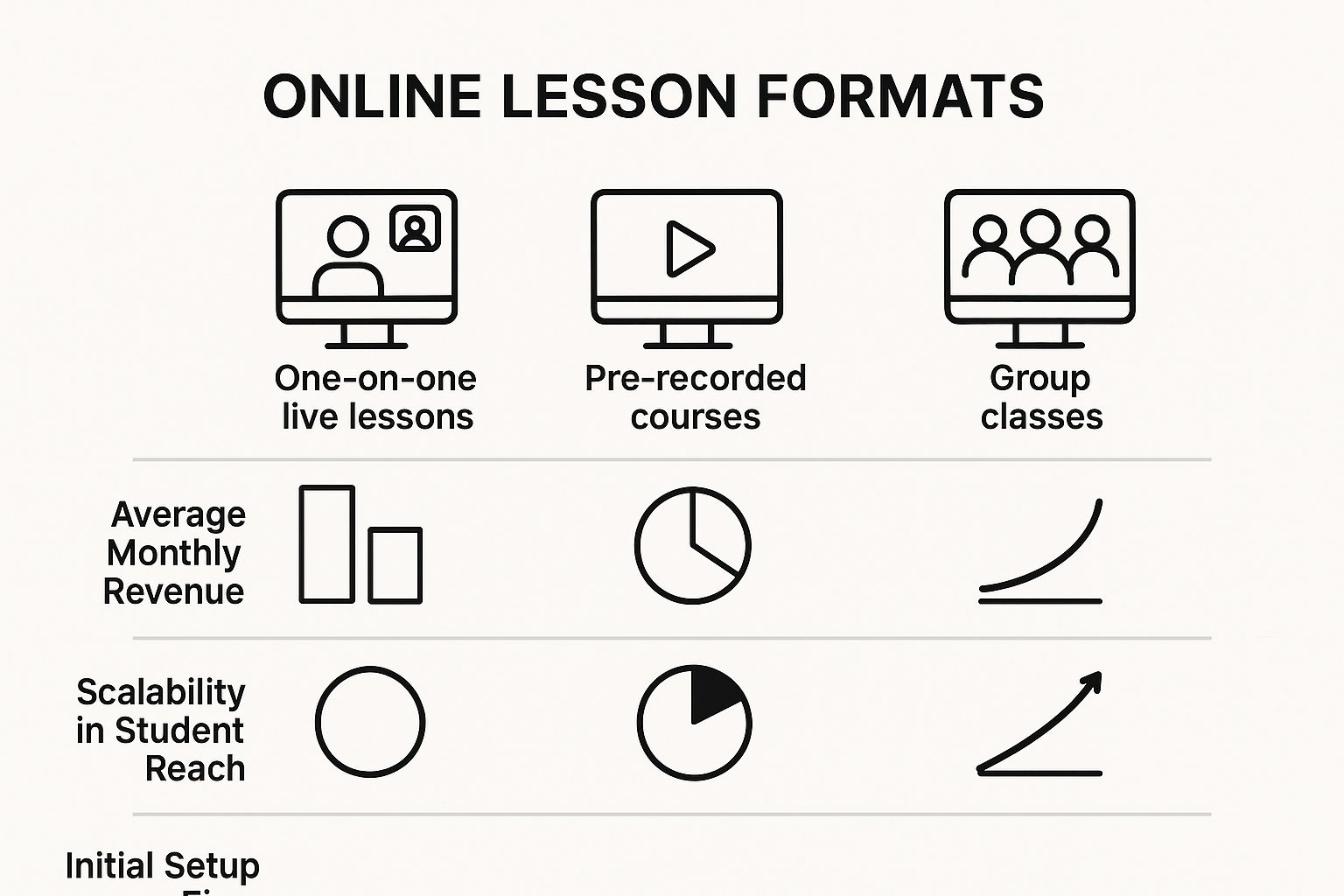
As you can see, while one-on-one lessons provide a steady income, it's the pre-recorded courses and group workshops that offer true scalability and the potential for passive revenue down the line.
When you start integrating these strategies, your live performances become the engine that powers your entire online business. Every chord you play and every note you sing starts contributing to a more stable and sustainable career in music.
Common Questions About Making Money as a Musician
Figuring out how to earn a real income from your music online can feel like trying to mix a track in a new studio—a little overwhelming at first. It's totally normal to have questions as you start pulling the different pieces together. Let's tackle some of the most common ones to give you a clearer path forward.
We'll cut through the noise and get straight to the practical concerns that every artist runs into when they start focusing on digital revenue.
How Much Can a Musician Realistically Make Online?
This is always the first question, and the honest truth is, it's a massive "it depends." Your income potential is a direct reflection of your audience size, how engaged they are, and how many different income streams you can get up and running.
For example, a new artist just starting out might pull in a few hundred dollars a month. That could be from a mix of streaming royalties, a handful of supporters in a fan club, and maybe a few virtual guitar lessons. It all adds up.
On the other hand, an established indie artist with a loyal fanbase could be bringing in thousands monthly. Their income might be powered by a slick merch operation, a couple of great sync placements in TV shows, and a thriving membership community. The trick is to stop thinking of it as a lottery and start treating it like a business you're building, one fan at a time.
The most important thing to remember is this: a small, deeply engaged audience is infinitely more valuable than a huge, passive one. Focus on building real connections with the fans you have right now—that's the fastest route to a stable income.
Do I Need a Huge Following to Start Earning?
Not at all. This is probably the biggest myth holding artists back. You don't need a million followers to make a living. The "1,000 True Fans" theory is more real today than ever before. All you need is a core community of dedicated supporters who believe in what you're doing.
Think of it this way: a few dozen loyal patrons on a platform like OohYeah, each chipping in a few bucks a month, can provide more financial stability than millions of passive, one-cent streams. Start with the audience you have, no matter how small, and give them your best. Quality engagement will always beat follower quantity when it comes to making money.
What Are the Most Essential Tools for an Online Musician?
It's easy to get buried under an avalanche of apps and software, but you only need a few core tools to build a solid foundation for your online music business. Getting these right makes everything else fall into place.
Here’s a look at your essential toolkit:
- A Digital Audio Workstation (DAW): This is your command center for creating. It’s where you record, produce, and mix all your music.
- A Music Distributor: You need a service like DistroKid or TuneCore to get your music onto the big streaming platforms like Spotify and Apple Music. It’s a non-negotiable step.
- Your Own Website: This is your digital home base. Using a musician-focused builder like Bandzoogle or a powerful e-commerce platform like Shopify gives you total control over your brand and lets you sell directly to your fans.
- An Email Marketing Service: A tool like ConvertKit or Mailchimp is crucial. It gives you a direct line to your audience—a line that you own, no matter what happens with social media algorithms.
These four elements are the framework for nearly every strategy we've talked about. They give you the power to create your art, get it out into the world, and build a direct, profitable relationship with the people who listen.
Ready to take control of your music career and build a direct connection with your fans? OohYeah provides the all-in-one platform you need to sell music, merchandise, and subscriptions commission-free. Start building your sustainable income stream today at https://oohyeah.app.