How to Get in Music Industry: A Modern Blueprint
Discover how to get in music industry with a modern blueprint. Build your brand, network, and monetize your music on your terms.
January 11, 2026
Music Marketplace Advisor
Buying & SellingForget the old fantasy of being discovered in some smoky club. The real path into the music industry today isn't about getting lucky—it's about building your own business, with your music as the core product. You're the one in the driver's seat.
The New Rules for Breaking Into the Music Industry
The days of handing a demo tape to a slick record executive are long gone. Today's industry doesn't discover raw talent; it recognizes artists who have already built momentum on their own. This requires a massive mental shift. You have to stop thinking like just an artist and start acting like an entrepreneur. You're not just a creator—you're the CEO of your own music brand.
This new mindset means you take control of everything. It's about making your own opportunities happen instead of waiting by the phone. This is exactly why platforms like OohYeah exist—they put the power back in your hands, giving you the tools to manage your own distribution, build real relationships with your audience, and earn money from your work without a middleman taking a huge cut.
Embracing the Streaming-First World
The money in music has completely changed. In the decade from 2014 to 2024, the entire industry flipped to a streaming-first model. In 2024, global recorded music revenues soared to US$29.6 billion, and a staggering 69% of that came directly from streaming. This isn't just a trend; it's the new reality. Your digital presence is no longer just for promotion—it’s your main storefront.
For a deeper dive into the numbers, the IFPI Global Music Report 2025 is essential reading to understand these global music industry trends.
Of course, this shift brings both challenges and incredible opportunities. Sure, the per-stream payouts can feel small, but your potential to reach a global audience has never been bigger. It's a game-changer, leveling the playing field so an artist in a small town can find fans on the other side of the world.
The question has changed. It's no longer "How do I get signed?" It’s now "How do I build a self-sufficient business that a label would be desperate to partner with?"
To build that business, you need to focus your energy on a few key areas that truly matter. Think of them as the foundation for everything you'll build.
The Four Pillars of a Modern Music Career
Building a sustainable career in today's music world requires a multi-faceted approach. These four pillars are the essential components that work together to create a stable and growing business around your art.
| Pillar | Core Action | Why It Matters Now |
|---|---|---|
| Distinct Artistic Identity | Define your unique story, sound, and visual brand. | In a crowded market, a clear identity is what makes you memorable and helps you connect with a specific tribe of fans. |
| High-Quality Digital Portfolio | Create professional music, visuals, and a cohesive online presence. | Your digital footprint is your resume. Industry pros and potential fans will judge you on the quality of your online package. |
| Direct-to-Fan Community | Build and nurture genuine relationships with your audience. | An engaged fanbase is your most valuable asset. They're your first customers, your biggest promoters, and your support system. |
| Diverse Monetization Strategy | Combine streaming, merch, direct sales, and other income streams. | Relying only on streaming is a recipe for struggle. Multiple revenue streams create financial stability and give you more control. |
Mastering these four areas is the difference between being a hobbyist and a professional. They provide the structure you need to not just survive, but to actually thrive in the modern music industry.
Building Your Professional Brand and Portfolio

Before you even think about pitching your music, you need to get your professional toolkit in order. Let’s be blunt: your music might be incredible, but if the packaging is amateur, it's likely to get ignored. A polished, professional presentation isn't just a nice-to-have; it's the signal to the industry that you’re serious and ready for business.
This is a classic stumbling block for so many talented artists. They pour everything into the music but forget about how it’s presented. A manager, A&R rep, or blogger is incredibly busy. They don't have time to piece your story together for you—you have to hand it to them on a silver platter. Your job is to make their job easy.
Crafting Your Essential Electronic Press Kit
Think of your Electronic Press Kit (EPK) as your digital handshake. It’s a single, shareable destination—a slick PDF or a dedicated webpage—that holds everything a professional needs to know about you. This isn’t just a random assortment of links; it’s a carefully curated snapshot of your entire artistic identity.
An effective EPK is all about impact and brevity. You have seconds, not minutes, to grab someone's attention.
Here are the absolute must-haves for an EPK that works:
- Your Artist Bio: This is your elevator pitch, not your life story. Keep it tight—around 150-250 words—and make it compelling. Who are you? What does your music sound like? What makes you different?
- High-Quality Press Photos: You need a collection of professional, high-resolution shots. Offer a mix of poses, backgrounds, and orientations (both landscape and portrait) so they have options for any layout.
- Your Best Music: Don't send your entire discography. Pick three of your absolute strongest tracks that best represent your sound and potential. Make them easy to stream via a private link on SoundCloud, Dropbox, or a platform like OohYeah.
- Key Career Highlights: Got some great press? Played a notable show? Hit some impressive streaming numbers? List them out in bullet points for quick scanning.
- Contact Information: Make it painfully obvious how to get in touch with you or your manager. Don't make them hunt for it.
Your EPK is the first impression. It needs to immediately answer two questions: "Who is this artist?" and "Why should I care?" A clean, organized kit shows you respect their time, and that goes a long way.
Defining Your Brand Identity
Your brand is the soul of your project. It's the story, the feeling, and the visual world you build around the music. It’s what makes you stick in someone's mind long after the song ends. A strong brand feels authentic because it is authentic. Audiences can smell a forced or inconsistent image from a mile away.
Look at the artists you admire. They have a consistent visual style, a clear tone of voice on social media, and an aesthetic that connects everything they do. That consistency is what builds a tribe. It’s a deep-dive topic, and you can learn more by exploring why artists should focus on branding and image.
Building a professional image that truly resonates is critical. For a more structured approach, there are some great resources out there on how to build a personal brand that not only aligns with your art but also unlocks doors in the industry.
Curating a Portfolio That Gets You Heard
While your EPK is the highlight reel, your portfolio is the full collection of evidence that proves you can deliver. This is where you can showcase your range and depth. It could be your official website, a meticulously organized SoundCloud profile, or a dedicated page on a platform like OohYeah.
Let me paint a picture for you. A music supervisor for a new TV series needs an indie-folk song with an uplifting feel. She gets two emails. The first contains a link to a Spotify profile with 50 tracks in no particular order. The second email links to a curated portfolio where the artist's songs are tagged by mood: "Uplifting," "Melancholy," "Energetic."
Which one do you think she’s going to click first? By organizing your work, you’ve done the heavy lifting for her and shown you understand how the industry works. Your portfolio should be a tool that actively helps people see exactly where your music fits.
Making Connections That Actually Matter
Your music is ready, your brand is dialed in, and your portfolio looks sharp. So, what’s next? Getting all that hard work in front of the right people. In an industry that runs on relationships, knowing how to get in music industry conversations is just as important as your talent. Forget about mass-emailing a list of contacts you bought online; that’s a one-way ticket to being ignored.
The real goal isn't just to rack up contacts, but to build a genuine network of supporters, collaborators, and mentors. This is all about quality over quantity. Trust me, one solid connection with a music supervisor who genuinely vibes with your sound is worth more than a thousand unanswered emails to A&R reps.
The Mindset of Smart Networking
Before you even think about hitting "send," you need to adjust your entire approach. Stop thinking, "What can this person do for me?" and start asking, "What can I offer them?" It might feel backward when you're the one looking for a break, but this single shift is what unlocks doors.
Industry pros are drowning in requests. A message that leads with value—or at the very least, shows you've done your homework—will always cut through the noise.
Here’s what this looks like in the real world:
- Instead of begging for a record deal, try offering a unique collaboration idea to an artist on their roster.
- Instead of asking a manager to listen to your demo, start by congratulating them on a recent win for one of their clients.
- Instead of asking a blogger for a review, share one of their articles and point out something specific you learned from it.
This approach immediately establishes you as a peer, not just another artist with their hand out. It proves you understand the world you’re trying to become a part of.
The most effective networking is relational, not transactional. People want to work with those they know, like, and trust. Your first job is to get known and liked. The trust will follow.
Digital Handshakes: How to Approach People Online
Your online profiles are your modern-day business cards and your primary networking tools. The real industry conversations are happening every day on platforms like LinkedIn, Instagram, and even X. Each one requires a slightly different game plan.
LinkedIn: This is your professional headquarters. Use it to find agents, publishers, sync licensing reps, and label staff. Make sure your profile is polished and up to date. When you send a connection request, always add a personalized note. A generic request is a wasted opportunity.
Try something like this: "Hi [Name], I was really impressed by the sync placement you secured for [Artist] in [Show]. I'm a composer working in a similar space and would love to connect and follow your work." It's specific, respectful, and shows you're paying attention.
Instagram: This is a more visual and informal space. Follow A&R reps, managers, and artists you look up to. The key here is genuine engagement—don't just spam fire emojis. Leave thoughtful comments on their posts. When you're ready to slide into the DMs, keep it short and to the point. For a deeper dive, you can read our guide on why networking is important in the music industry.
Mastering the Art of the Follow-Up
That first message is just the beginning. The real work often happens in the follow-up. A busy person's inbox is a chaotic place, and your email can easily get buried. A polite, well-timed follow-up demonstrates professionalism and shows you’re serious.
Didn't hear back after a week? Send a brief, friendly nudge. Avoid any hint of accusation or passive aggression.
A simple note works wonders: "Hi [Name], just wanted to gently bump this in your inbox. Hope you're having a great week!"
If you’ve sent two follow-ups with no reply, it's probably time to move on. Constantly bugging someone will only damage your reputation. It’s a fine line between persistent and pest, but learning to walk it is critical. Building a network is a marathon, not a sprint, and every thoughtful interaction gets you one step closer to the finish line.
Turning Your Music Into a Sustainable Business
You’ve poured everything into your music and built a solid brand. That’s the hard part, right? Well, now comes the real test: turning your art into a career that actually pays the bills. If you’re serious about learning how to get in music industry, you have to think like an entrepreneur, not just an artist. Relying on those tiny fractions of a cent from streaming just isn't a viable strategy for long-term success. You need a business model with multiple income streams you control.
The financial toolkit for a modern artist is so much more than streaming royalties. It’s about creating a diverse financial ecosystem where your most loyal fans can support you directly. This is the pivot from being a musician to becoming a business owner who truly understands their market.
Moving Beyond Streaming Royalties
Let's be real: streaming platforms are amazing for discovery, but they're notoriously unpredictable for an emerging artist's bank account. The smart move is to treat streaming as a marketing tool at the top of your funnel—it's how new listeners find you. The real income comes from converting those casual listeners into dedicated supporters.
This shift in mindset means focusing on direct-to-fan sales, where you pocket a much larger slice of the pie. Platforms like OohYeah are designed for this, giving you the power to sell downloads, merch, and exclusive content straight to your audience. No middleman taking a massive cut. You set your own prices, and more importantly, you own the relationship with your fans. That data is priceless.
Think strategically about who you need in your corner to open these doors. A manager is often the key that unlocks introductions to agents and publishers, who in turn can secure bigger opportunities.
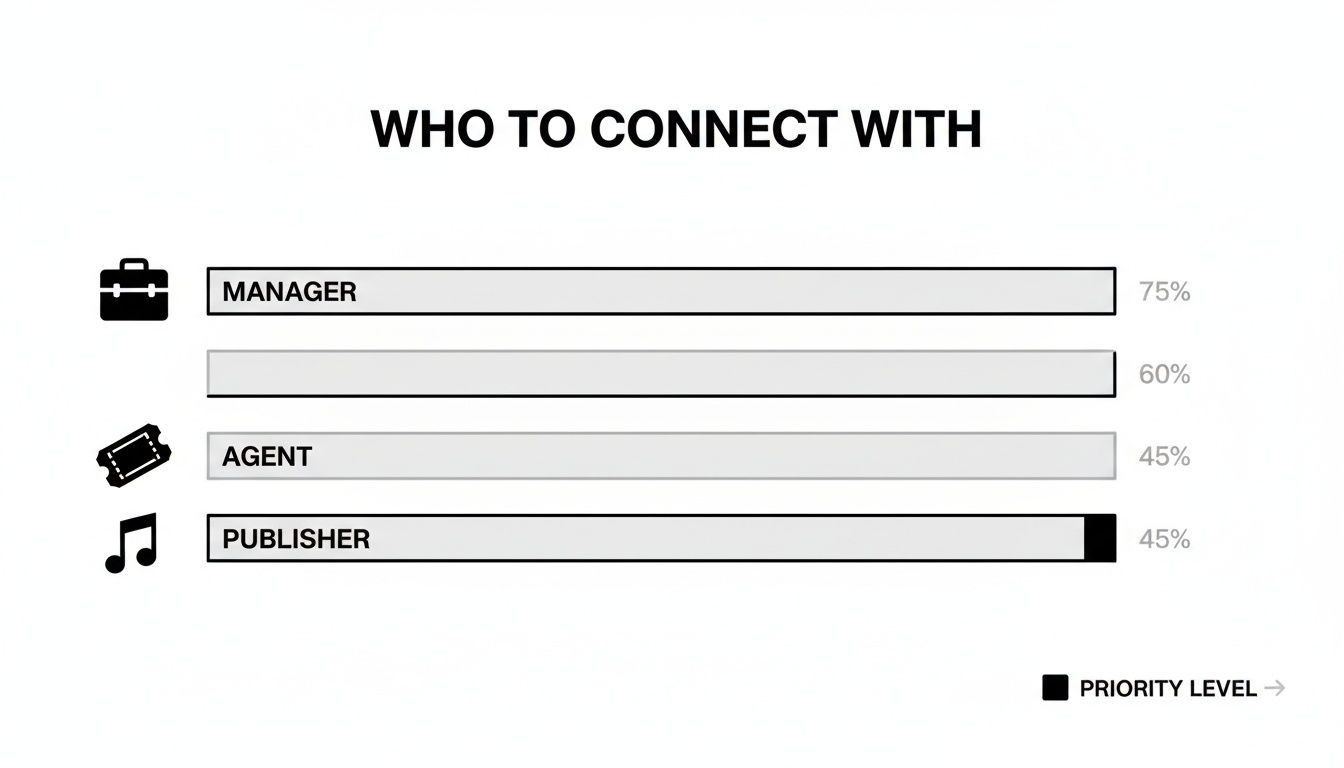
This chart shows a typical path: a great manager can be your gateway to the rest of the industry team that helps you grow and diversify your income.
Creating a Diversified Income Model
A truly resilient financial plan for an independent artist is built on several pillars. Each one caters to a different level of fan engagement, creating a much more stable foundation than a single, unreliable source.
Here are the essential streams you should be building:
- Direct-to-Fan Sales: Sell high-quality digital downloads, WAV files, or special editions of your music. This gives your biggest fans a way to own something tangible while putting money directly in your pocket.
- Merchandise: A great t-shirt or poster isn't just promo—it's a significant profit center. Merch allows fans to wear their support on their sleeve (literally) and feel like part of your tribe.
- Fan Subscriptions: Think Patreon or channel memberships. Offer exclusive access to behind-the-scenes content, early song previews, or monthly Q&A sessions for a recurring fee. This creates predictable, monthly revenue you can count on.
- Sync Licensing: Getting your music placed in a film, TV show, commercial, or video game can be a game-changer. Sync fees can range from $500 for a small indie placement to over $20,000 for a national ad campaign.
The goal is to create a value ladder. A casual fan streams for free. A dedicated listener buys a track. A superfan buys the vinyl, the t-shirt, and subscribes to your exclusive community.
The table below breaks down some of these key revenue streams, showing you what to expect and what it takes to get there.
Revenue Stream Comparison for Independent Artists
| Revenue Stream | Typical Artist Share | Platform / Effort Required | Best For |
|---|---|---|---|
| Streaming | $0.003 - $0.005 /stream | Digital distributors (DistroKid, TuneCore), consistent releases, playlist pitching | Building initial audience, discovery, top-of-funnel marketing |
| Digital Sales | 70% - 90% | Bandcamp, OohYeah, your own website; requires direct promotion to your fanbase | Monetizing dedicated fans who want to own your music |
| Physical Sales | 50% - 75% | Direct sales at shows, online store; requires manufacturing, inventory, and shipping | Superfans, collectors, creating high-value items (e.g., vinyl) |
| Merchandise | 40% - 60% | Print-on-demand services (Printful), direct sales; requires design and promotion | Brand building, significant profit margin, fan expression |
| Sync Licensing | 50% (publisher's share) | Sync agents, music libraries, direct networking with music supervisors | High-impact, lump-sum income; requires professional, "sync-ready" tracks |
| Fan Subscriptions | 85% - 95% | Patreon, OohYeah, Ko-fi; requires creating consistent, exclusive content for supporters | Building a loyal community, creating predictable recurring revenue |
| Live Shows | Varies Greatly | Booking gigs, promoting shows; door splits for new artists, guarantees for established acts | Direct fan engagement, primary income source for many, merch sales |
This comparison makes it clear: relying on streaming alone leaves a huge amount of money on the table. A diversified approach is not just an option; it's a necessity.
Understanding Performance Rights and Physical Sales
As your career gains momentum, more traditional revenue streams start to play a bigger role. To truly grasp how to get into the music industry today, you have to follow the money. In 2024, global revenue for performance rights—money paid when your recordings are played on the radio, TV, or in public venues—hit an estimated US$2.9 billion.
And don't write off physical sales. While overall physical music revenue dipped by 3.1%, vinyl sales jumped by 4.6%, proving a powerful and growing market for collectors and your most dedicated fans. If you want to dive deeper into these numbers, you can find more insights about current music industry revenue trends.
By centralizing these income streams on a platform like OohYeah, you can manage your music, merch, and fan interactions from a single dashboard. This integrated approach lets you see what’s selling, understand your audience on a deeper level, and make smarter business decisions without a huge team.
When you diversify your income and take ownership of your sales channels, you're not just making music—you're building a resilient business that can survive the industry's inevitable shifts, giving you the freedom to create for years to come.
Growing a Loyal Fan Community From Scratch
If you're wondering how to get in music industry, forget the old playbook. Today, the answer isn't a record deal—it's an audience. The most valuable asset you can build, the one that can actually sustain a career, is a community of fans who are genuinely invested in your music.
Let’s move past vanity metrics. A high follower count looks nice, but real, lasting connections are what pay the bills. This requires a shift in mindset: stop seeing your listeners as consumers and start treating them like partners on your journey. When you do, they become your advocates, your street team, and the first people to buy your next release.
Creating a Home Base for Your Fans
Think of social media as a rented apartment. It's fantastic for getting discovered, but you're always at the mercy of the landlord—the algorithm. They control who sees your content and can change the rules overnight. The real goal is to get your most dedicated fans to move from that rented space into a home you own.
This is where direct-to-fan platforms like OohYeah come in. They act as your digital headquarters, a place where you control the conversation. Here, you can share exclusives, talk to your community without an algorithm interfering, and build a true sense of belonging. It’s the incubator where you turn casual listeners into genuine superfans. We get into the weeds of this strategy in our guide on how to build a loyal fan base as an independent artist.
The foundation of any strong community is a value exchange. You give fans exclusive access and a deeper connection; they give you the support you need to keep creating.
And don't just take my word for it. The numbers prove that a dedicated fanbase is a powerful economic engine. The live music scene is on fire, with Pollstar reporting that the top 100 global tours raked in about US$9.5 billion in 2024. At the same time, niche genres are showing their strength. In the first half of 2025, Latin music revenues in the US grew over six times faster than the overall market, with an estimated 98% of that income coming from streaming.
Engaging Your Audience with Purpose
Building a community isn't about posting randomly and hoping for the best. It requires a strategy. Every piece of content you create should have a clear purpose: to entertain, to educate, or to connect. To really make your efforts count, it's worth understanding the fundamentals found in a complete guide to social media optimisation.
Here are a few practical ideas for content that actually works:
- Behind-the-Scenes Access: Show people your process. A quick video of you working out a new chord progression, a tour of your chaotic home studio, or the real story that inspired a lyric—this stuff makes your art feel human and brings fans into your world.
- Exclusive Content Drops: Use a platform like OohYeah to give your core community something special. Think early access to a new single, a B-side that won't be on the album, or a raw, acoustic version of a fan favorite.
- Interactive Experiences: Get your fans involved. Host a live Q&A, run a poll to let them pick the design for your next t-shirt, or create a collaborative playlist. These small actions create a powerful sense of shared ownership.
This kind of consistent, purposeful engagement is what turns a passive follower into an active supporter.
Using Simple Analytics to Understand Your Fans
You don't need a degree in data science to figure out who's listening. Most platforms offer simple analytics that are incredibly powerful. They tell you who your fans are, where they are, and what they actually care about.
Keep an eye on these three simple metrics:
- Demographics: Knowing the general age, gender, and location of your audience is gold. It helps you tailor your message and even helps you map out a tour route that makes sense.
- Engagement Rate: Look past the likes. Comments, shares, and saves are what really matter—they show that people are connecting, not just scrolling. High engagement means you're on the right track.
- Top Performing Content: Find out which songs and posts are getting the most attention. This is your audience giving you direct feedback. Double down on what's working.
Checking these insights regularly helps you stop guessing and start making informed decisions. It allows you to refine your strategy, create more of what your fans love, and build the loyal community that will become the true foundation of your career.
Answering Your Biggest Questions About Building a Music Career
Getting started in the music world brings up a ton of questions—the kind that can keep you up at night. Let's tackle some of the most common hurdles you'll face with some straight-up advice from the trenches.
Do I Really Need a Manager Right Away?
This is probably the biggest misconception I see. Many artists think a manager is the first puzzle piece, but it’s actually one of the last. A great manager isn’t looking to build an artist from zero; they're looking for a project with real momentum.
Think about it: they need something to manage. Before you even think about bringing someone else in, you need to become your own best manager. That means learning how to book your own shows, run your own social media, and understand your finances. You have to prove the concept first.
A manager's job is to amplify success, not create it from scratch. When you’ve built something that’s growing—a fanbase, a clear brand, consistent income—and the business side is eating up all your creative time, that’s when you start the conversation.
How Should I Handle Rejection?
Let's get one thing straight: rejection is not just a possibility in this industry, it's a guarantee. You'll get ignored by blogs, passed over for that perfect playlist, and turned down for gigs you really wanted. It’s part of the job description.
The trick is to reframe what a "no" actually means. It's not a final judgment on your talent. It's just a data point.
Maybe your pitch wasn't quite right for that specific blog, or your timing was off. Each rejection is a chance to get smarter. Was your EPK clean and professional? Did you target the right person? Was your music genuinely a good fit for their audience? Don't let it stall you. Focus on what you can control: your work ethic and your craft. Professional persistence is what separates the people who make it from those who don't.
What’s the Best Way to Protect My Music Legally?
The legal side of music can feel overwhelming, but ignoring it is a recipe for disaster. Getting a handle on your rights is non-negotiable if you want a sustainable career. Here are the absolute must-dos:
- Copyright Your Work: The moment you record a song or write down lyrics, you technically own the copyright. But to truly protect yourself, you need to register that work with the U.S. Copyright Office. This gives you the legal firepower you need if someone ever tries to steal your work.
- Join a PRO: You need to sign up with a Performance Rights Organization like ASCAP, BMI, or SESAC. These organizations track down and collect the royalties you're owed whenever your music is played in public—on the radio, in a bar, on TV, or streamed online. It's money you've earned.
- Get Your Splits in Writing: If you write with anyone else, you absolutely must agree on the ownership percentages (the "splits") from day one. Use a simple split sheet to document who owns what portion of the song. This one simple step can save you from massive headaches and broken friendships down the road.
Is It Still Possible to Get My Music in TV and Film?
Absolutely. Sync licensing—placing your music in TV shows, films, commercials, or video games—is still one of the best ways for an independent artist to get a huge boost in exposure and income. A single placement can be a game-changer. We're talking anywhere from $500 for a small TV spot to over $20,000 for a major ad campaign.
The game has changed, though. Music supervisors are swamped and rarely take music directly from artists anymore because of the legal hoops they have to jump through.
Your best shot is to get your music to a sync agent or a reputable music library. These are the gatekeepers. They have the relationships and trust of music supervisors because they deliver high-quality, pre-cleared music that’s ready to go. So, focus your energy on creating killer, "sync-ready" tracks and then build relationships with the agents who can get them heard by the right people.
Ready to take control of your music business? With OohYeah, you can distribute your music, sell merch, and build a loyal fan community all from one place, keeping more of your revenue. Start building your career on your own terms today at https://oohyeah.app.