How to Get Followers on Spotify Today
Learn how to get followers on Spotify with proven strategies for artist profiles, playlisting, promotion, and data analysis to build a loyal fanbase.
November 1, 2025
Music Marketplace Advisor
Buying & SellingGaining followers on Spotify really boils down to two things: making your artist profile a place where listeners want to stick around, and actively getting your music in front of new people. Your Spotify for Artists profile is your digital home base, while smart playlisting, regular releases, and promotion outside of Spotify are what bring people to your door. Nail both, and you’ll build a real engine for growth.
Turn Your Artist Profile Into a Follower Magnet
Think of your Spotify for Artists profile as more than just a page with your songs on it. It’s your digital handshake—the first impression that can turn a casual listener into a dedicated fan. Claiming your profile is just the first step. To really figure out how to get followers on Spotify, you need to build an experience that tells your story and gives people a compelling reason to hit that 'Follow' button.

It all starts with what people see. Your profile picture and header image are your album cover, your poster, your brand—all in one. Make sure they’re high-resolution and feel professional. A blurry phone picture just won’t cut it. Invest in a proper photoshoot or some quality design work that captures the vibe of your music. Is your sound dark and moody? Bright and poppy? Your visuals should scream that from the get-go.
Tell a Story, Not Just a Résumé
Your artist bio is your chance to connect with listeners on a human level. Don't just list off your achievements or past releases. Tell your story. Where are you from? What pushed you to make this kind of music? What's the idea behind your latest album? A good bio provides context, making your art—and you—far more relatable.
Keep it punchy and easy to read, especially on a phone. Short paragraphs are your friend. A well-crafted bio can genuinely be the thing that convinces someone who's on the fence to follow you. For a deeper dive on this, check out our guide on how to attract fans to your music profiles. https://oohyeah.app/posts/how-to-attract-fans-to-your-music-profiles
Use Every Tool in the Box
Spotify gives you a handful of great features inside the artist dashboard. Using them shows fans (and the algorithm) that you’re active and serious about your music.
- Artist Pick: This is prime real estate at the top of your profile. Pin your new single, an album, or a playlist you're proud of. You can even feature a playlist of songs that influenced you. Switch it up every couple of weeks to keep things fresh.
- Merch Integration: If you have a Merchbar or Shopify store, connect it. Selling merch directly on Spotify is not only a great way to make some extra money but also deepens the connection with your fans.
- Concert Listings: If you play live shows, this is a no-brainer. Sync your dates through Songkick or Ticketmaster so fans in any given city know when you’re coming to town. It's a simple way to drive ticket sales right from the app.
Your profile isn't a static page; it's a living, breathing reflection of your career. An active, updated profile shows you’re invested, making it an easy choice for a new listener to click 'Follow'.
Spotify's reach is truly global, and the numbers are staggering. Indian singer Arijit Singh, for example, is the most-followed artist on the entire platform with over 159 million followers. Meanwhile, Taylor Swift has 143 million followers and racked up an insane 26.1 billion streams in 2024 alone. These figures show the direct line between a strong following, massive stream counts, and smart marketing.
For more insights into the strategies that drive this kind of growth, the RebelGrowth blog is a fantastic resource to keep up with the latest trends. By focusing on these foundational profile tactics, you can transform your Spotify page from a simple music player into a true hub for your fans.
Unlock Growth with Strategic Playlist Pitching
Getting your track onto a popular playlist is one of the fastest ways to get your music in front of thousands of potential new fans. Think of playlists as the new radio; one solid placement can put your sound directly into the ears of a hyper-engaged audience, which is a game-changer for growing your Spotify followers.
The whole game boils down to two main paths: pitching to Spotify's official editors and connecting with independent curators. You need a smart, persistent strategy for both.
This isn't about getting lucky—it's about preparation and treating it like a professional pursuit. When you succeed, you’re tapping into a massive, global listener base. As of early 2025, Spotify had a staggering 696 million monthly active users, with 276 million of them being premium subscribers. This huge and growing pool of listeners, especially in markets like Latin America and Europe, is where your future fans are.
Of course, it also means the competition is intense. Getting your music into the right playlists is how you cut through all that noise and find your people. If you're curious, you can read more about Spotify's user growth and what it means for artists trying to make their mark.
Mastering the Official Spotify Editorial Pitch
Your direct line to Spotify's own curation team is the Spotify for Artists dashboard. This is the one and only official channel for submitting unreleased music for consideration on editorial playlists. You should be doing this for every single song you release.
To give your pitch a real shot, you have to submit your track at least a week before its release date. But honestly, aiming for three to four weeks in advance is the pro move. This gives the editors enough time to actually listen and consider your track among the thousands they get every day. A rushed pitch is a wasted opportunity.
When you're filling out the submission form, the details matter. Be specific and professional.
- Genre and Mood Tags: Don't just select the obvious, broad categories. Go deeper. Choose the tags that truly capture your song’s vibe. Think "rainy day indie folk," not just "folk."
- Instruments: Make sure to list the key instruments in the track. An editor might be hunting for a specific texture for a niche playlist, and this is how they’ll find you.
- The Pitch Description: This is where you make your case. You have 500 characters to tell the story behind the song. What was the inspiration? Is there a unique angle? Ditch generic lines like "this is my best song yet." Instead, give them a compelling narrative that provides context and makes them care.
A great pitch isn't just about the music; it's about the story. Editors are looking for songs with a clear identity and a narrative they can share with their listeners. Give them something to connect with beyond just the sound.
Connecting with Independent Playlist Curators
Beyond Spotify's official channels, there's a massive, sprawling universe of user-curated playlists. These are run by passionate music fans, bloggers, and influencers who have built dedicated followings around very specific tastes. A placement here can be just as powerful as an editorial one. The approach is all about solid research and building real relationships.
First, you have to find the right playlists. Start by searching Spotify for keywords related to your genre, mood, or artists you sound like. For instance, if you make ambient electronic music, you might search for "chill study beats," "ambient focus," or "electronic soundscapes."
Once you've found a playlist that feels like a perfect home for your sound, your next job is to find the curator's contact info. Often, it's right there in the playlist description, maybe as a link to their social media or a submission form. If not, you might need to do a little digging—try searching the playlist name or the curator's username on Instagram or Twitter.
When you reach out, personalization is everything. Cold, generic emails get deleted instantly.
- Use the curator's name. A generic "Hey" or "To Whom It May Concern" is a non-starter.
- Name the specific playlist you're pitching. This shows you've actually listened and done your homework.
- Briefly explain why your song is a good fit. Mention a track or two already on their list to show you genuinely understand their curation style.
- Keep it short. No one wants to read a novel. Include a direct link to your song on Spotify and get to the point. Never attach audio files or send a long, rambling bio.
Building these connections takes time and patience. Follow the curators you respect on social media, interact with their posts, and become a genuine member of their community. This long-game approach will pay off far more than blasting out hundreds of spammy emails. It’s about creating a network of people who believe in your music and will help you consistently grow your following on Spotify.
Create a Release Strategy That Builds Momentum
If you're just dropping new music whenever it's ready, you're missing one of the biggest opportunities to grow your audience. Sporadic releases are one of the fastest ways to lose a listener's attention. To really move the needle and gain Spotify followers, you need to treat every single track like a full-blown campaign.
Think about it: dropping a song without a plan is like shouting into the wind. A well-designed release strategy, on the other hand, builds genuine anticipation. It drives that all-important initial stream velocity and sends all the right signals to Spotify's algorithm from day one. That initial momentum is what turns a casual listener into a dedicated follower who can't wait to hear what you do next.
Choose Your Release Model
What works for a superstar on a major label probably isn't the right move for an independent artist. Your strategy needs to align with your resources, your brand, and your long-term goals.
- The Waterfall Single Strategy: This has become the go-to model for many independent artists, and for good reason. Instead of saving up for a massive album, you release a new single every 4-8 weeks. This approach keeps you constantly on people’s radar, gives you fresh material for playlist pitching, and creates a steady drumbeat of promotion around your profile.
- The EP Campaign: Got a few songs that tell a cohesive story? An EP is a great way to make a more significant artistic statement. You can build a campaign around it by releasing one or two lead singles to build hype before the full 3-5 song project drops.
- The Surprise Drop: This can be incredibly exciting, but it’s a high-risk move that really only works for artists with a massive, highly engaged fanbase. If you don't have an audience ready to create immediate buzz, a surprise release can unfortunately end up being a quiet one.
Your release frequency is directly tied to your visibility. Every new track is a fresh chance to pitch to Spotify's editorial playlists, a new opportunity to land on algorithmic playlists like Discover Weekly, and another reason for your existing fans to share your music.
Master the Pre-Save Campaign
The pre-save is easily your most powerful tool for building hype before release day. It’s a simple concept: when a fan pre-saves your track, it automatically shows up in their library the moment it goes live. For Spotify's algorithm, this is a massive green flag that your song is something special.
A strong pre-save campaign can seriously boost your odds of getting noticed by both algorithmic and human-curated playlists. It guarantees a surge of streams and saves in those critical first 24 hours, which can trigger even more promotion from the platform itself.
To run a pre-save that actually works:
- Start Early: Get your pre-save link out there 2-4 weeks before the release date. This gives you a solid runway to build real momentum.
- Give Them a Reason: Don't just ask people to pre-save; give them an incentive. Offer exclusive behind-the-scenes content, a sneak peek of the song, or entry into a giveaway for some cool merch.
- Promote It Everywhere: Share that link across all your socials, in your email newsletter, and right in your bio. Create some engaging content—short video clips, countdown graphics—to keep the energy up.
Build a Full Release Cycle Blueprint
A successful release isn't a one-day event; it's a journey. I always tell artists to think of it in three distinct phases to maximize their impact and consistently pull in new followers.
| Phase | Timeline | Key Actions |
|---|---|---|
| Pre-Release | 2-4 Weeks Out | Announce the song and date. Launch the pre-save campaign. Submit the track to Spotify's editors via your distributor. |
| Release Week | Release Day | Go hard on all social channels. Update your Spotify Artist Pick. Personally thank fans who share and stream your music. |
| Post-Release | 1-4 Weeks After | Keep promoting the track. Share every playlist placement. Dive into your Spotify for Artists data to see where your listeners are. |
This kind of structured approach ensures you’re not just releasing music but actively marketing it. Each step builds on the last, creating a wave of activity that’s hard to ignore. For a deeper dive into the nuts and bolts of a great launch, our guide on the best practices for releasing new music online breaks it down even further.
By turning every release into a strategic event, you create a powerful, repeatable engine for growth.
Drive Traffic To Spotify From Other Platforms
Your Spotify profile can't just be an island. To really get things moving, you need to think of yourself as a traffic controller, building highways from all corners of the internet that lead straight to your music. It's about creating a constant flow of potential fans from where they already hang out—social media, blogs, their email inboxes—directly to that all-important 'Follow' button.
This isn't about just dropping a link here and there and hoping for the best. It’s about building a cohesive promotional machine where your social channels act as powerful discovery funnels, feeding your Spotify growth day in and day out.
Tap Into Short-Form Video
Let's be clear: platforms like TikTok and Instagram Reels aren't optional anymore. They are where music discovery is happening right now. The magic here is that a 15-second clip of your track, paired with the right visual, can explode and reach millions of people who have never heard of you.
Forget just posting a static image of your album art. Dive in and create content that features your sound.
- Start a Trend: Think of a simple dance, a funny skit, or a unique visual that’s easy for other people to copy using your track.
- Pull Back the Curtain: Show your process. Film a quick clip from the studio, talk about how you wrote a specific lyric, or deconstruct a beat. This stuff builds a real connection.
- Jump on Duets and Stitches: Use the built-in features on TikTok to interact with other creators. It’s a brilliant way to put your personality and your music in front of entirely new audiences.
The goal is to make your track the official "sound" for your videos. This creates a clickable, direct link back to your song, making it dead simple for anyone who's intrigued to find you on Spotify.
Run Targeted Ad Campaigns
Organic reach is great, but don't sleep on paid ads. Running targeted campaigns on platforms like Instagram and Facebook lets you zero in on your ideal listener with almost scary precision. It's one of the most effective ways to drive high-quality traffic straight to your Spotify profile.
Instead of a generic "Listen to my new song!" message, get specific. Promote a single track to an audience that already loves similar artists. If you make indie folk, for instance, you can serve your ad directly to users who follow artists like Bon Iver or The Lumineers.
Your ad's purpose isn't just about racking up streams; it's about finding the people who are most likely to become genuine, long-term followers. Spending a little to gain 100 new, dedicated followers is infinitely more valuable than spending a lot to get thousands of passive, one-time plays.
Master Your Link In Bio
That "link in bio" on your social profiles is some of the most valuable real estate you have online. Don't waste it on a single, lonely Spotify link. Use a smart-linking tool like Linktree or ToneDen to build a simple landing page that gives visitors options.
This little hub should have big, obvious buttons for your Spotify profile and your latest release. It’s a tiny change that removes friction, making it ridiculously easy for a casual browser on Instagram to become your next Spotify follower. Many of the core ideas from general social media marketing for brands apply here, focusing on making the user journey as smooth as possible.
The infographic below maps out a simple but powerful promotional timeline, showing how all these pieces fit together to drive traffic right when it counts.
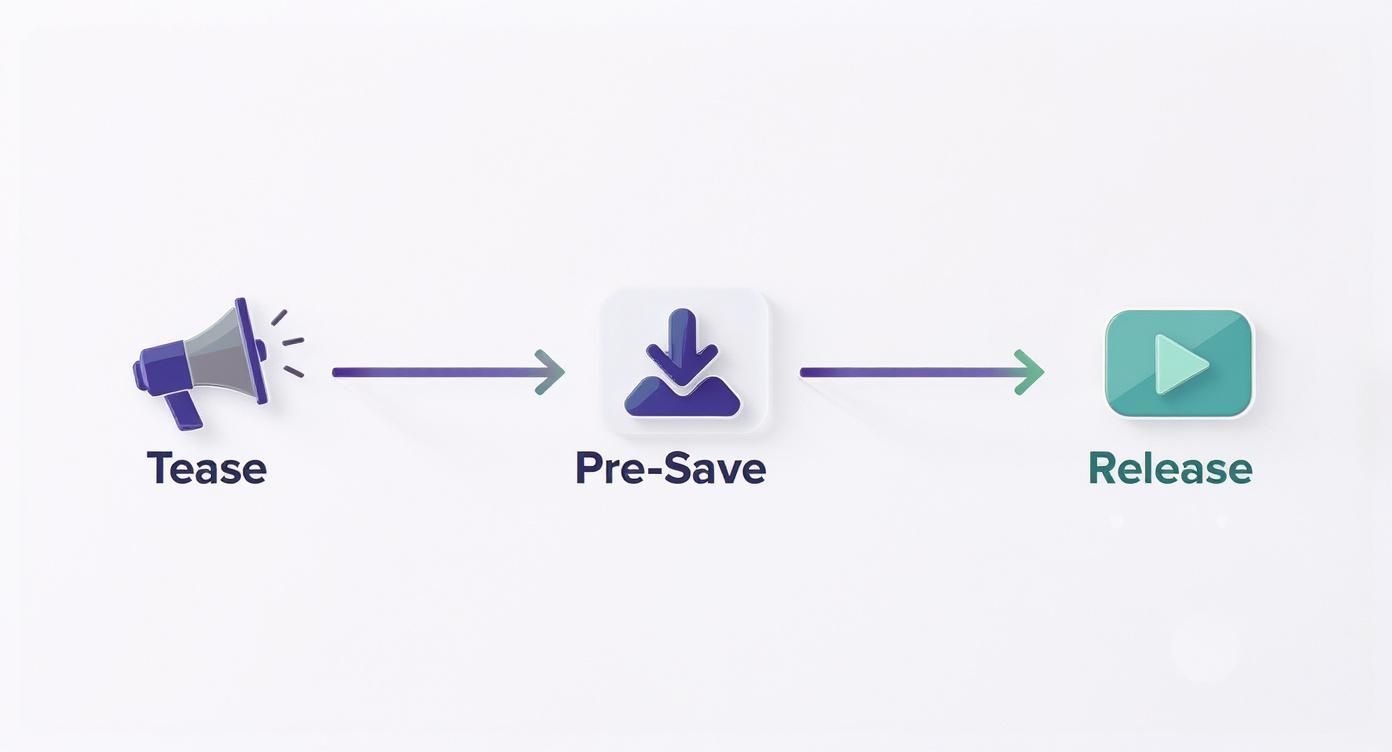
As you can see, the work starts long before release day. Building hype with teasers and pre-save campaigns is what creates the wave of traffic you need when the track finally drops.
Build Your Email List For Direct Access
Social media algorithms are fickle friends, changing their minds without warning. An email list, on the other hand, is an asset you own and control completely. It's your direct, unfiltered line of communication to your most loyal fans.
Get people to sign up by offering something valuable in return—a free download, an exclusive demo, or a pre-sale code for tickets. When you have a new song ready, your email list is the first group you should tell. A personal note encouraging them to listen and follow on Spotify will drive engagement from the people who are already invested in your success.
Bringing fans in from other platforms is a multi-channel effort. The key is to identify where your potential listeners spend their time and meet them there with a clear call to action.
Effective Off-Platform Promotion Channels
Here's a quick look at some of the best channels to focus on and how to use them effectively.
| Channel | Primary Audience | Best For | Key Tactic Example |
|---|---|---|---|
| TikTok/Instagram Reels | Gen Z & Millennials | Viral discovery, trend-setting | Creating a unique video trend using your song as the official "sound." |
| Facebook/Instagram Ads | Highly specific demographics | Targeted follower acquisition | Running an ad for your new single aimed at fans of 3-5 similar artists. |
| Email Marketing | Your most dedicated fans | Driving day-one streams | Sending a "new music" email with a direct Spotify link to your mailing list. |
| Music Blogs/PR | Niche music communities | Building credibility and authority | Securing a premiere or review on a blog that covers your specific genre. |
| Collaborator's Socials | Another artist's fanbase | Cross-promotion, audience sharing | Co-announcing a new track on Instagram Live with your featured artist. |
Ultimately, a strong off-platform strategy ensures you're not just waiting for listeners to find you on Spotify. You're actively going out and bringing them home.
Use Your Data to Make Smarter Growth Decisions
Your Spotify for Artists dashboard is so much more than a place to check your stream count. Think of it as the command center for your entire growth strategy. The artists I see consistently gaining followers are the ones who stop guessing and start listening to what their data is telling them.
When you really dig into your analytics, you move beyond how many people are listening and start to understand who they are, where they live, and how they found you. This is the kind of insight that turns a shot-in-the-dark promo effort into a targeted, effective campaign.
Focus on the Metrics That Actually Build a Fanbase
It's easy to get lost in all the numbers, so you need to know which ones really move the needle for follower growth. A high stream count is nice, but it doesn't always mean you're building a loyal audience. You have to look deeper.
A great place to start is the Sources of streams tab. I’d argue this is the most important section for understanding how people discover you. It shows you exactly where your plays are coming from, revealing which playlists, algorithms, or direct profile visits are doing the heavy lifting.
Here’s a quick breakdown of what to look for:
- Your profile and catalog: Streams from here are gold. They come from highly engaged listeners who are actively seeking you out—a strong sign of a healthy, growing follower base.
- Listeners' own playlists and library: When someone saves your music, they're planning to listen again. This is a powerful precursor to a follow.
- Spotify editorial playlists: These can give you massive exposure, but you need to check if those streams are actually converting to saves and follows.
- Spotify algorithmic playlists: Getting on playlists like Discover Weekly or Radio is fantastic for reaching new audiences who are primed to like your sound.
The real trick is learning to spot the difference between passive and active listening. A stream from a lean-back playlist is good, but a stream from someone’s personal library or your artist profile? That’s the signal of a potential superfan.
Turn Geographic Data Into Real-World Opportunities
Don’t sleep on the Audience tab, especially the location data. Knowing where your listeners are concentrated opens up a ton of smart promotional opportunities. See a sudden spike in listeners in Berlin or São Paulo? You can act on that immediately.
For instance, you could run a targeted social media ad campaign for users in that specific city, pushing your latest single. If you're a touring artist, this data is invaluable for planning shows where you know you already have a built-in audience, which helps ensure a better turnout.
This is especially critical when you consider Spotify's global reach. With huge market share in Europe (over 40%) and Brazil (55%), knowing your regional listener data helps you put your energy where it will have the biggest impact.
This view provides a quick summary of your streams, listeners, and followers, helping you track your growth over different time periods.
Figure Out Which Playlists Deliver True Fans
Let's be real: not all playlist placements are created equal. Getting on a huge playlist might give you a temporary surge in streams but result in very few new followers. Your job is to find the playlists that deliver not just plays, but actual fans.
The next time you land on a playlist, keep a close eye on your follower count for a few days. See a noticeable jump? Now, cross-reference that with your Playlists tab in Spotify for Artists to see how many streams that specific playlist is generating.
This simple process helps you identify which curators and playlist styles connect your music with the right people. If a smaller, niche playlist is driving more follows than a massive, generic one, that’s crucial intel for your future pitching strategy. For more on this, check out our guide on tips for increasing your music streams and earnings.
Spotify's premium subscriber base is projected to hit 276 million by mid-2025. This growing audience of highly engaged, paying listeners is exactly who you want to attract—they’re far more likely to explore artists deeply, save tracks, and ultimately follow.
Your Top Questions About Growing a Spotify Following, Answered
When you're grinding to grow your presence on Spotify, the same questions tend to pop up again and again. It's easy to get stuck on certain details, even when you have a solid plan. Let’s clear up some of the most common hurdles so you can move forward with confidence.
Is a Stream Always a Stream? Do More Streams Equal More Followers?
Not exactly, and this is a really important distinction. You might see a massive spike in streams after landing on a huge, mood-based playlist, but your follower count barely budges. What gives?
Listeners on those big "lean-back" playlists are often passive. The music is just background noise while they work or study, so they aren't actively engaging with who they're hearing. A stream is a stream, but the source is what matters.
Streams from a listener's personal library, their Discover Weekly playlist, or a direct visit to your artist profile are gold. These are signs of active interest. Someone who goes out of their way to find your profile or save your track is just a click away from hitting 'Follow'. The real goal isn't just getting streams; it's getting the right kind of streams that create actual fans.
Are Third-Party Promotion Services a Good Idea?
Tread very, very carefully here. The internet is flooded with services promising thousands of followers or guaranteed playlist spots for a fee. The hard truth is that the vast majority are just bot farms or use shady tactics that can get your music pulled from Spotify—or worse, your account banned entirely.
If a service guarantees a specific number of streams or followers, it’s a massive red flag. Real promotion is about pitching your music to real people, and no legitimate service can ever guarantee results.
That’s not to say all promotion companies are scams. Legitimate PR firms and playlisters do exist, but their work is based on genuine outreach and relationship-building, not on delivering vanity numbers. Always vet a service thoroughly, ask for case studies and references, and run from anything that sounds too good to be true. Building your audience the old-fashioned way is always the safer, more sustainable bet.
Seriously, How Long Does It Take to See Real Growth?
I get it, you want to see that follower count climb. But building a following on Spotify is a marathon, not a sprint. There's no set timeline, because it all hinges on how often you release music, your genre, and how hard you push each release. An artist dropping a new single every six weeks with a smart promo plan will naturally see faster growth than someone who releases an album once a year and hopes for the best.
Instead of getting impatient, focus on steady, consistent effort.
- Be Consistent: A regular release schedule keeps you fresh in the minds of fans and on the good side of the algorithm.
- Be Your Own Promoter: You have to be the one driving traffic to your Spotify profile from social media, your newsletter, and everywhere else.
- Be Patient: Every release is a building block. The momentum from one track carries over to the next, creating a compounding effect over time.
Think of each new song as another hook in the water. Some will catch a few new listeners, but one might just land you a huge catch. You just have to keep casting.
Does Interacting with Fans on Spotify Actually Do Anything?
Spotify wasn't built as a social network, but that's definitely changing. With features like Blends and collaborative playlists, the platform is encouraging more social sharing. They're even experimenting with new direct messaging tools, which tells you they're serious about building more in-app community features.
For now, the best strategy is to engage with fans wherever you find them. If someone comments on a playlist that added your song, reply to them! When fans feel like they have a real connection with you, they transform from passive listeners into true supporters who will actively share your music and stick with you for the long haul.
Ready to take full control of your music career? OohYeah provides the tools you need to sell music, merch, and subscriptions directly to your fans, all in one place. Start building your independent music business today at https://oohyeah.app.