How to Distribute Music to a Global Audience
Learn how to distribute music to Spotify, Apple Music, and beyond. This guide gives independent artists the real-world strategies to get heard.
August 22, 2025
Music Marketplace Advisor
Buying & SellingGetting your music out into the world starts with one key relationship: your digital music distributor. Think of them as the critical link connecting your finished tracks to a global audience on platforms like Spotify, Apple Music, and Amazon Music.
These services are your partners in the digital supply chain. They take your mastered audio and stunning artwork, package it all up with the right metadata, and ensure you get paid for your work. It all boils down to preparing your assets, picking the right distributor, and building a smart release strategy.
Understanding the Modern Music Distribution Landscape
Forget the old days of pressing CDs and hoping they'd land in a record store. Today, music is a global, on-demand experience. Digital storefronts have replaced physical shelves, and getting on the right playlist is the new radio play. For any independent artist trying to build a career, really grasping this new reality is non-negotiable.
The Shift to a Streaming-First World
Streaming is king. It's how most people discover new artists and listen to their favorites. Platforms like Spotify and TIDAL are where your audience lives, which is both a huge opportunity and a massive challenge. You can instantly reach fans in countries you’ve never even been to, but you’re also competing with millions of other tracks uploaded every month.
This is where a solid distribution strategy comes in. It’s not enough to just be available—you need to be discoverable. A good distributor is the partner that gets you on the digital shelves, making sure your music is properly formatted, tagged, and set up to earn you money.
The numbers don't lie. Streaming has completely changed the economics of music. By 2025, global streaming revenue is expected to blow past $28.4 billion, and a single platform like Spotify is projected to pay out over $9 billion to creators and rights holders. If you want a deeper dive, check out these recent music streaming statistics and insights.
Key Distribution Channels at a Glance
Navigating your distribution options can feel overwhelming at first. To help clear things up, here's a quick comparison of the main paths an artist can take.
| Distribution Channel | Best For | Key Advantage | Consideration |
|---|---|---|---|
| Digital Distributors | Independent artists & labels | Wide reach to all major streaming platforms | Fees can vary (annual, per-release, or commission-based) |
| Direct to Platforms | Artists with an established following | 100% control and direct fan connection | Limited reach; only available on select platforms like Bandcamp |
| Label Services | Established artists needing support | Access to marketing, promotion, and funding | Higher cost and usually involves a revenue-sharing agreement |
Each path has its place, but for most independent artists starting out, a digital distributor offers the most effective way to achieve global reach without giving up creative control or a huge chunk of your earnings.
Why Your Distributor Is Your Most Important Partner
Your distributor is your logistics hub, your administrative team, and your financial partner all rolled into one. They deal with the technical specs for every single store, deliver your pristine audio files, and chase down the royalties you've earned from every last stream. For an indie artist, there's really no other way to get your music onto the major platforms.
Your choice of distributor directly impacts your potential reach, your revenue, and your ability to market your music effectively. They are more than a simple upload service; they are a gateway to a global audience.
When you're shopping around, look past the initial price tag. What's their full network of stores? How quickly do they pay out royalties? What kind of promotional tools and support do they offer? Getting this foundational piece right is absolutely critical for everything that comes next, from your launch day push to building an audience that sticks around for the long haul.
Preparing Your Release for Professional Distribution
Before your music ever hits a listener's playlist on Spotify or Apple Music, it has to be packaged perfectly. Submitting a new release isn't as simple as uploading an MP3 and calling it a day. The entire package—your audio, your artwork, and all the data attached to it—needs to meet strict industry standards.
Getting these details right from the very beginning is the secret to a smooth launch. It’s what separates a professional release from one that gets stuck in limbo with frustrating rejections and delays. Let’s walk through what you need.
The Foundation: Your Mastered Audio
First things first: your audio files. This is the heart of your release, and quality is non-negotiable. Streaming platforms are built to deliver a high-fidelity listening experience, and that starts with the source file you provide.
Forget about MP3s. They are compressed, "lossy" files that shed audio data to save space, and distributors will reject them immediately. Your fans deserve to hear your music exactly as you intended in the studio.
The universal standard here is a lossless WAV file. Specifically, you'll almost always need to provide 16-bit, 44.1 kHz stereo WAV files for each track. While some distributors might accept other lossless formats like FLAC, sticking to the WAV standard is the safest bet.
Your Visual Handshake: The Cover Art
Your album art is often the first impression a potential fan will have. It's the visual hook that needs to look just as good on a tiny phone screen as it does on a massive desktop monitor. A blurry, poorly formatted image can instantly make an otherwise incredible release feel amateur.
For your cover art to pass inspection and look sharp everywhere, aim for these specs:
- A perfect square, at least 3000x3000 pixels.
- A high resolution of 300 DPI (dots per inch).
Beyond the technical specs, there are a few firm rules that can get your art rejected if you ignore them. Your artwork must not contain any URLs, social media handles, or other promotional text. The artist name and release title on the art must exactly match the metadata you submit. And of course, the image itself must be high-quality—no pixelated, stretched, or blurry visuals.
The Invisible Engine: Metadata
This is the part that trips up so many artists, yet it's absolutely critical. Metadata is all the information tied to your music that you don't see upfront—songwriting credits, publisher information, producer names, and so on. It's the digital DNA of your release.
Why is it so important? Metadata is the engine that powers everything from your music's discoverability in a search to ensuring everyone involved gets paid correctly. Inaccurate or incomplete metadata is one of the most common reasons for a release to be delayed or rejected.
Take the time to gather all the information for every single collaborator. This isn't just an administrative chore; it’s about making sure the money flows to the right people when your song starts generating royalties.
Key Takeaway: Getting your metadata right from the start is the mechanism that ensures proper crediting, accurate royalty payments, and search visibility. Don't treat it as an afterthought.
Your Digital Fingerprints: UPCs and ISRCs
Finally, every track and every release needs a unique identifier to be tracked and sold globally. Think of these as digital barcodes for your music.
- UPC (Universal Product Code): This is the code for the entire product—your single, EP, or album. It identifies the release as a whole for sales tracking.
- ISRC (International Standard Recording Code): This is a unique code assigned to each individual track. It acts as a digital fingerprint for a specific recording, allowing platforms to track every single play and allocate royalties accurately.
This might sound complicated, but there's good news. Most modern distributors, including services that work with platforms like OohYeah, will generate these codes for you during the upload process. This simplifies one of the more technical hurdles of music distribution. By carefully preparing your audio, artwork, and data, you’re paving the way for a successful release.
Choosing the Right Music Distribution Partner
Picking your music distributor is one of the most important decisions you'll make for your music. It's not just about getting your tracks onto Spotify. The partner you choose has a direct line to your reach, your revenue, and the promotional doors that open for you. So, let’s move past a simple list of services and build a real framework for finding a partner that actually fits what you’re trying to accomplish.
The first big question you need to answer revolves around the business model. Distributors typically fall into one of two camps, and the best fit for you depends entirely on where you are in your career.
Annual Fees vs. Commission Models
Some services charge a flat annual fee to keep your music live on all the platforms. This can be a brilliant move for artists who are already pulling in a high volume of streams. If you know your music performs well, paying a predictable fee once a year means you keep 100% of your royalties. Over time, that can make a huge financial difference.
On the flip side, plenty of distributors work on a commission model. They don't charge anything upfront but instead take a small cut of your royalties, usually around 15%. This is a great entry point for new artists or anyone with a smaller catalog. It gets your music out to the world without you having to spend a dime before you've earned one.
Think of it this way: a producer dropping instrumental beat tapes every month might lean toward a commission model to avoid stacking up costs. Meanwhile, an established band with a loyal following launching a big album will likely make more money with a flat annual fee, since they get to keep all the royalties from their expected high stream count.
Really understanding your potential streaming numbers and your own budget is the key here. For a deeper dive, we've put together a full guide on how to choose the right music distribution service.
Looking Beyond the Price Tag
Once you have a business model in mind, it's time to pop the hood and see what else they offer. A great distribution partner does more than just send your files to Apple Music; they give you tools and support that genuinely help you grow.
Here are a few non-negotiables to look for:
- Fast Royalty Payouts: How quickly do you get your money? Look for clear payment schedules and low payout thresholds. You earned it, you should be able to access it.
- Real Artist Support: Things can go wrong. When they do, you want to talk to a knowledgeable human who can actually solve your problem, not a chatbot.
- Meaningful Promo Tools: Do they offer things like playlist pitching, pre-save campaign builders, or deep analytics? These are the tools that help you turn a release into an event.
This decision tree gives you a solid visual of the pre-release checklist. It’s all about getting your ducks in a row before you even think about distribution.
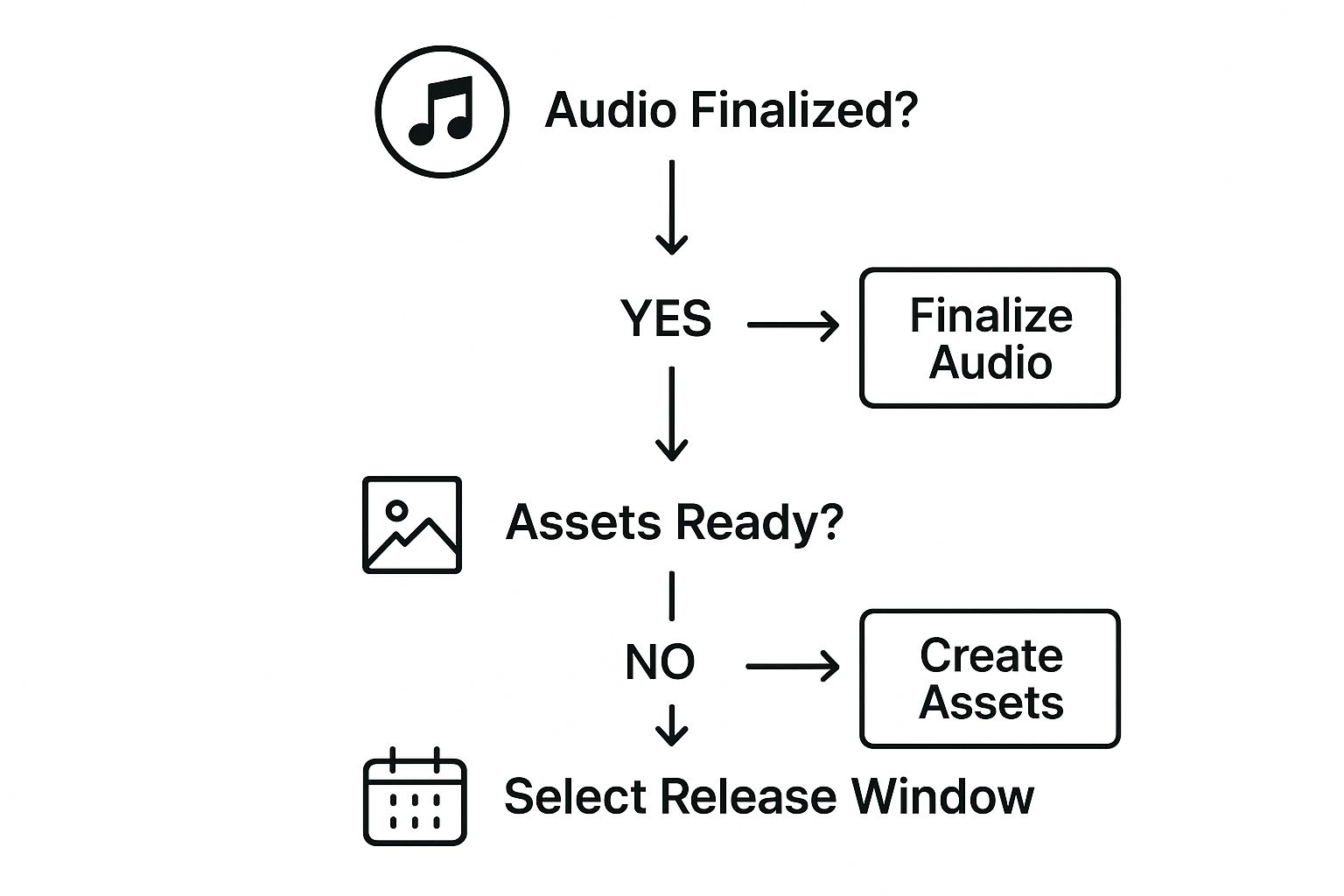
As the graphic shows, getting your final audio masters and artwork ready isn't just a small task—it's the foundation. You can't build a solid release strategy without it.
Don't Forget Physical Merchandise
Your strategy shouldn't end with digital streams. If you plan on selling vinyl, t-shirts, or any other physical merch directly to your fans, finding a solid logistics partner is just as critical as your digital distributor. It's worth checking out guides like the 12 Best Ecommerce Fulfillment Services for DTC Brands to see what a professional setup looks like.
A truly modern music business connects the digital and physical worlds. The best partners get this. Platforms like OohYeah are built to let you manage everything in one place—your streams, downloads, and physical merch sales. This creates a single, simple hub for your fans and, just as importantly, for you. An integrated approach like this makes sure you're capturing every bit of revenue from all your hard work.
Getting Your Music Uploaded and Ready for Release
You’ve got your polished tracks, your killer artwork, and you've picked a distributor. Now comes the nitty-gritty: uploading everything and turning a folder of files into a global release. This is your last chance to check every detail before your music hits the digital shelves.
Every distribution service, including OohYeah, has a dashboard designed to walk you through this process. You’ll be uploading your master WAV files, your high-res cover art, and plugging in all the metadata. Think of this stage as less about art and more about accuracy. Getting a collaborator's name spelled right is just as crucial as the final master.
Don't Rush the Release Date
One of the biggest levers you can pull is the release date itself. Just because you can upload your music today doesn't mean it should go live tomorrow. In fact, that's a classic rookie mistake.
For a release to have any real impact, you need to set your release date at least four to six weeks out. I can't stress this enough. That buffer isn't just for show; it's essential for a few key reasons:
- Playlist Pitching: To even be considered for major editorial playlists on platforms like Spotify, you need to submit your track weeks ahead of time. A last-minute release means you miss out on this huge discovery tool.
- Marketing Runway: A solid promotional campaign needs time to breathe. This window lets you build hype, run a pre-save campaign, and get all your social media content lined up.
- A Safety Net: What if your artwork gets flagged for a technical issue? Or you find a typo in the track title? This buffer gives you time to fix problems without throwing your entire launch schedule into chaos.
A well-planned release schedule transforms your music drop from a simple upload into a coordinated event. The goal is to build momentum so that on day one, your audience is already waiting.
Use Pre-Saves to Drive Day-One Streams
So, how do you build that day-one momentum? A pre-save campaign. This is your secret weapon for making sure your release day starts with a bang.
When fans pre-save your song, it automatically appears in their library the second it goes live. This guarantees a surge of streams in the first 24 hours, which is a huge signal to the platform algorithms that your track is worth paying attention to. Many distributors like OohYeah have built-in tools that make setting up a pre-save link dead simple. It’s a low-effort, high-reward tactic.
Configure Your Global Rollout
During the upload process, you'll also make some important decisions about where and how your music appears. The default option is almost always "worldwide" and "all stores," but you can get more tactical if you need to.
For instance, if you collaborated with an artist from France, you might want to coordinate a special marketing push in that region. Some distributors even let you set different release dates for different territories, though this is a more advanced strategy.
This is also where you'll lock in your royalty splits. If you co-wrote a track with two other people and agreed on an even split, you'll enter those percentages right into the dashboard. Getting this right from the start ensures everyone gets paid correctly and automatically. It’s the final step to a professional release and saves you from a lot of headaches later.
Marketing Your Music After It Goes Live
https://www.youtube.com/embed/IgRoPNQMhhg
So, you’ve hit "publish." It’s a great feeling, but the real work starts now. Getting your music out there is one thing; making sure people actually hear it is a whole different ball game. That initial launch day buzz is great, but building real, lasting momentum is what separates a fleeting track from a career-building release.
Your first move? Go claim your digital real estate. Seriously, before you do anything else, get your profiles verified on Spotify for Artists and Apple Music for Artists. This isn’t just about putting up a nice photo. These platforms give you the keys to the kingdom.
Once you're in, you unlock a treasure trove of data. You can see who’s listening, where they are in the world, and how they found you. This is pure gold. Use it to customize your bio, add fresh photos, and link up your socials. You’re essentially creating a professional home base for fans, old and new.
Build Your Direct-to-Fan Connection
Streaming platforms are fantastic for discovery, but you don't own that relationship. The algorithm can change tomorrow. This is why building your own direct line to your fans is non-negotiable. I'm talking about an email list. It might sound old-school, but it’s still one of the most powerful tools in an artist's arsenal.
You own that list. No gatekeepers, no algorithms.
Use your social media to get people to sign up. Don't just ask—give them a reason. Offer an exclusive demo, a discount on your next merch drop, or a behind-the-scenes video. This direct channel is your secret weapon for new release announcements, ensuring you get that crucial day-one engagement. To dive deeper, check out our complete guide on how to market your music as an independent artist.
Pitching to Playlists and Thinking Globally
Playlist placements can be a game-changer, putting your sound in front of thousands of potential new fans. Everyone chases the big official editorial playlists, but the real magic often happens with independent curators. Find user-created playlists that fit your vibe and have a genuinely engaged audience. A short, personal, and polite pitch goes a long, long way.
And while you're pitching, don't just think about your own backyard. The music world is global. While US on-demand audio streaming grew by 4.6% in early 2025, the market outside the US exploded, growing by a massive 12.6% and reaching 1.8 trillion streams. This isn't just a number; it's a massive opportunity waiting for you.
Your release day is just the starting line. The artists who win are the ones with a proactive plan—claiming profiles, building direct fan connections, and pitching smart. That’s how you turn casual listeners into true fans.
To really tap into that global listenership, you need a solid game plan. Understanding various Top Content Distribution Platform Strategies can make all the difference, helping you create a buzz that lasts far beyond release week.
Tracking and Collecting Your Royalties
Getting your music uploaded is a massive win, but that's really just the beginning of the journey. The next critical piece of the puzzle is understanding how the money finds its way back to you. Royalties can seem intimidating at first, but once you get the hang of it, it's pretty straightforward. Think of your distributor as your financial partner, meticulously tracking every single stream and sale to make sure you get paid.
Each time someone streams your song on Spotify, buys it on iTunes, or uses it in an Instagram Reel, a tiny bit of money is generated. While they're just micropayments, they add up. A distributor like OohYeah pulls all these earnings together from hundreds of digital stores across the globe and funnels them right into your account. The real power comes from knowing how to read the story your analytics dashboard is telling you.
Decoding Your Royalty Statements
Your distributor’s analytics dashboard is your command center. It’s where you’ll see exactly which tracks are resonating, where in the world your fans are, and of course, how much you’ve earned.
When you first dive in, you’ll primarily encounter two types of royalties from digital distribution:
- Mechanical Royalties: Generated every time your music is reproduced. In the digital world, this means every stream and every download.
- Performance Royalties: Earned whenever your music is played in a public setting. This includes traditional radio, but also streams in businesses, live shows, and more.
Your distributor takes care of collecting the mechanicals from streams and downloads. However, to collect your performance royalties, you have to take an extra step: registering as a songwriter with a Performing Rights Organization (PRO) like ASCAP, BMI, or SESAC. If you skip this, you’re literally leaving money on the table.
Learning the ins and outs of royalties is like learning the language of your music business. Knowing the difference between a mechanical and a performance royalty is your first, most important step toward getting paid everything you're owed.
A Global View Beyond the Streams
Streaming gets all the attention, but it’s a mistake to ignore how diverse music revenue has become worldwide. In some places, physical formats are not only surviving but thriving.
Take South Korea, for example. In 2024, it became the largest physical music market on the planet, accounting for a staggering 45.1% of all global physical sales. This surge helped push the total recorded music industry's revenue to $29.6 billion globally, a detail highlighted in the latest IFPI report.
This is exactly why having a distribution partner who gets both the digital and physical worlds is so important. For a deeper dive into making streaming work for you, check out our guide on whether artists can make money from streaming services.
Ultimately, learning to read your data—from which countries love your music most to the demographics of your listeners—helps you make smarter career moves. You might discover a surprise fanbase in a city you never expected, giving you the perfect reason to plan a tour stop there, or you could use those insights to run a hyper-targeted ad campaign.
Ready to take control of your music and your money? With OohYeah, you can get your tracks out to the world, sell merch, and build a direct line to your fans—all from one place. Start building your career your way. Learn more and sign up today at https://oohyeah.app.