How to Become a Musical Artist Your Modern Career Guide
Learn how to become a musical artist with our guide. Discover practical steps for building your brand, releasing music, and creating a sustainable career.
November 30, 2025
Music Marketplace Advisor
Buying & SellingSo, you want to build a career as a musical artist? The journey is about much more than just making music; it’s about building a sustainable business around your art. Think of it in terms of five key pillars: developing your craft, building a standout brand, releasing music the right way, growing a real audience, and creating multiple income streams.
This guide is your roadmap, packed with the real-world strategies that independent artists are using right now to build careers they can count on.
Your Modern Blueprint for a Music Career
Let's get one thing straight: the old-school dream of waiting for a record label to discover you is dead. Today's path is all about being an entrepreneur. You’re in the driver's seat now.
Success isn't about getting a lucky break from some industry gatekeeper. It’s about your ability to strategically build every piece of your career from the ground up. This requires a huge mental shift—you're not just a musician anymore. You're the CEO of your own music business.
This guide mirrors that modern reality. We're going to break down the five foundational pillars that turn artistic passion into a real profession. You'll get practical, no-fluff advice and tangible actions you can take at every single stage.
The Five Pillars of the Modern Artist
Each section of this guide is a deep dive into one of these pillars, complete with checklists and action items to get you moving. As you map out your plan, remember that a strong foundation is everything. Many artists sharpen their skills and find their voice through structured learning, like the kind found in general music programs.
Here are the core components of your journey:
- Developing Your Craft: This is where it all starts. It's about honing your songwriting, mastering your performance, and understanding production to create music that truly connects.
- Building Your Brand: This is your story. It's about creating a distinct identity with a professional press kit, killer visuals, and a narrative that people can get behind.
- Releasing Your Music: You need a plan. This pillar covers navigating digital distribution, collecting all your royalties, and launching your music for maximum impact.
- Growing Your Audience: It's time to find your people. We'll cover smart marketing tactics and genuine engagement strategies to build a loyal community, not just a list of followers.
- Diversifying Your Income: Don't rely on streaming pennies. This is about building real revenue through merch, fan subscriptions, live gigs, and more.
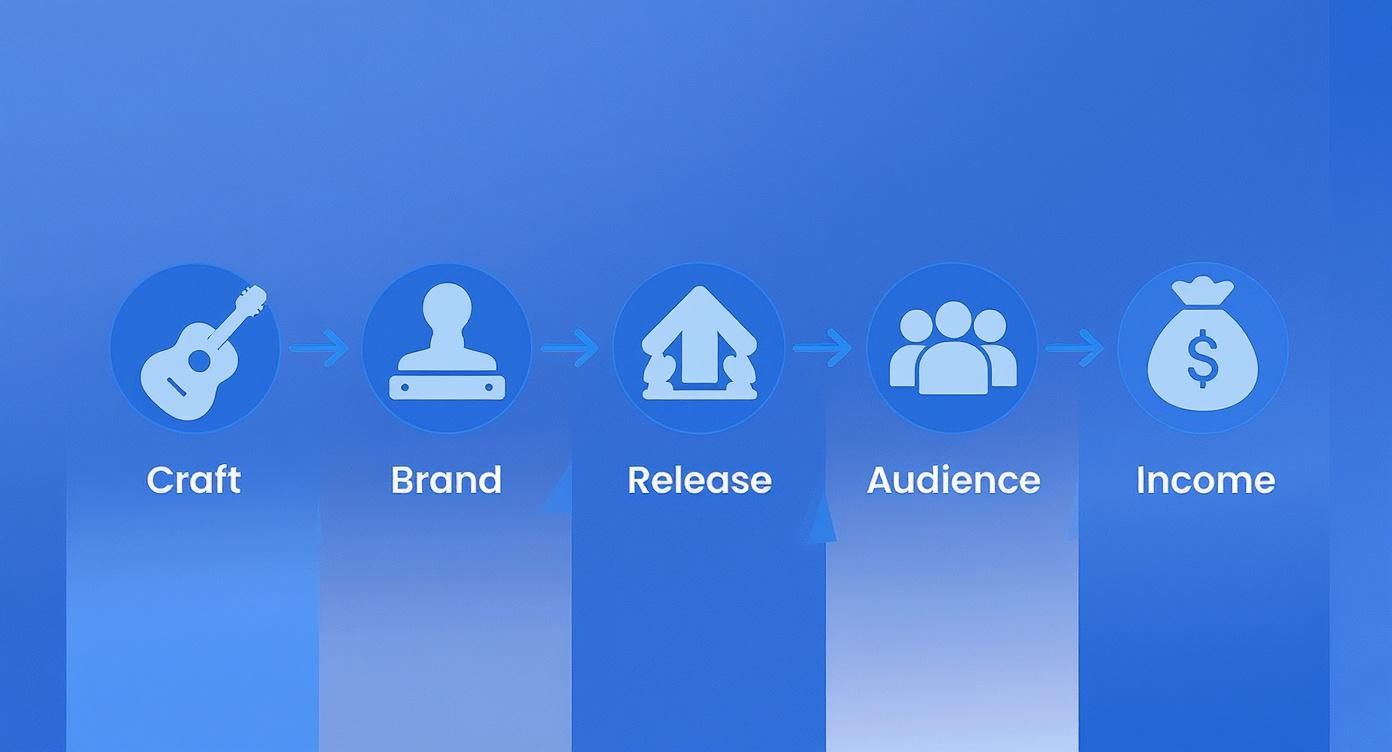
The image above really drives the point home: each pillar feeds into the next, creating a cycle where your growing audience and income fuel your ability to create even more great art.
To put it all together, here’s a quick overview of how these pillars function in today's music industry.
The Modern Artist Career Pillars
| Pillar | Core Focus | Key Action Items |
|---|---|---|
| Craft | Artistic & Technical Skill | Consistent songwriting, performance practice, production training. |
| Brand | Identity & Storytelling | Professional photos, cohesive visuals, a compelling bio/EPK. |
| Release | Strategy & Distribution | Choosing a distributor, setting release dates, a marketing plan. |
| Audience | Community & Connection | Social media engagement, email list building, fan interaction. |
| Income | Monetization & Sustainability | Selling merch, setting up subscriptions, booking shows, licensing. |
This table isn't just a list; it's a framework. Understanding how these pieces connect is the secret to building a career with real longevity.
The most crucial takeaway is this: you are no longer waiting to be discovered. You are the discoverer, the marketer, and the business owner. Mastering these five pillars is how you build a music career that lasts.
Let's dive in, starting with the foundation of it all: mastering your craft.
From the Practice Room to a Polished Sound
Before your music can connect with an audience, it has to be a solid, well-crafted piece of work. This is the real grunt work—the part that happens far from the spotlight. It's about turning that raw talent into something professional, built on discipline, honest feedback, and a relentless drive to get better at your craft.
The journey starts here, by deliberately refining your skills. It’s not just about having a gift; it's about building the habits that push your creative boundaries and help you carve out a sound that's truly yours.
Sharpening Your Songwriting Skills
In the music business, a great song is everything. It's the hook, the story, the thing that will make people stop and listen. And just like playing an instrument, songwriting is a craft you can get better at with focused, consistent effort.
Don't just sit around waiting for inspiration to hit. You have to build a routine around creating.
- Set aside dedicated writing time. Treat it like a job. Block out time in your calendar each week just for writing, even if all you do is chip away at a single lyric or chord progression.
- Take apart the songs you love. Really study the artists you admire. How did they structure that verse? What makes that melody so memorable? Ask yourself why certain parts work and see if you can apply those ideas to your own music.
- Try co-writing. Getting in a room with other musicians is one of the best ways to break out of a creative rut. A collaborator brings a whole new set of perspectives and skills to the table, and you'll often end up with something far better than what you could have made alone.
Elevating Your Performance and Musicianship
A perfectly written song can still fall flat if the performance isn't there to back it up. Whether you're a singer, a guitarist, or a producer behind a laptop, your technical skill and stage presence are what bring the music to life. This means practicing with purpose—not just noodling around.
Instead of vague goals like "practice guitar," get specific. Try something like, "Nail the chorus solo at 120 BPM without any mistakes," or "Sing the bridge in tune five times in a row." This kind of targeted practice gets you better, faster.
"The most reliable way to do this is with music. When two people share the joy of a song, the roles they carry—doctor vs. patient, healthy vs. sick, knowledgeable vs. vulnerable—melt away, revealing a shared humanity that can serve as the foundation for a genuine relationship and the start of true healing."
This idea, though from a medical context, gets to the heart of what performance is all about: creating a human connection. Your technical skill is just the tool you use to make that happen.
Grasping the Fundamentals of Production
These days, you can't afford to be clueless about basic production. You don't need to become a world-class audio engineer overnight, but knowing your way around a Digital Audio Workstation (DAW) and understanding the basics of recording and mixing is non-negotiable. It’s how you’ll create quality demos and clearly communicate your vision to others.
You can start by putting together a simple, functional home studio. It's amazing what you can achieve with a fairly modest budget.
Your Essential Home Studio Starter Kit:
| Component | Purpose | Budget-Friendly Option |
|---|---|---|
| DAW Software | For recording, editing, and mixing audio. | Reaper, GarageBand (free) |
| Audio Interface | Connects your mic/instrument to the computer. | Focusrite Scarlett 2i2 |
| Microphone | Captures your vocals and instruments. | Audio-Technica AT2020 |
| Headphones | For monitoring your sound accurately. | Sony MDR-7506 |
Once you have the gear, it's time to invest in your ears. There are a ton of online resources out there to help you with ear training and production skills.
Platforms like SoundGym use gamified exercises to help you sharpen your listening—a cornerstone of good production.
This is what it looks like—an interactive tool designed to improve your critical listening. By turning what can be a tedious process into a game, tools like this make learning frequencies, compression, and other audio nuances genuinely engaging. This is how you build the technical foundation to get the ideas out of your head and into a polished, professional-sounding track.
Crafting Your Brand and Professional Press Kit
Great music is the essential first step, but a powerful brand is what makes you unforgettable. This is where your art meets business—the point where you transform your sound into a cohesive identity that grabs listeners and doesn't let go. Your brand isn't just a slick logo; it's the story you tell, the visuals you create, and the professional way you show up.
Think about the artists you love. They don't just have songs; they have a whole world built around their music. Everything from their album art to their social media posts feels connected and intentional. That's a strong brand identity at work, and it's one of the most critical tools you have.
Defining Your Unique Artist Identity
Before you can build anything, you need a blueprint. That means digging deep to understand what you and your music truly stand for. Who are you trying to reach? What do you want people to feel when they hear your songs? Getting clear on these answers is what solidifies your artistic vision.
This identity becomes the core of every decision you make. It touches everything:
- Your Story: What's the real narrative behind your music? A compelling bio isn’t just a resume of your accomplishments; it tells a story that helps fans, journalists, and promoters connect with you as a person.
- Your Visual Style: This is everything from press photos and album covers to the specific fonts and color palettes you use online. When it’s consistent, people will recognize your work instantly.
- Your Voice: How do you talk to your audience? Are you sarcastic and funny, or more thoughtful and mysterious? Whatever it is, that tone needs to carry through your website, social media, and even interviews.
A well-defined brand is your North Star. It ensures that every single thing you put out into the world reinforces who you are as an artist. If you really want to get this right, you can explore our full guide on why artists should focus on branding and image.
Assembling a Professional Electronic Press Kit
Once you know who you are, you need a way to package it all for the industry. That's your Electronic Press Kit (EPK). An EPK is basically your professional music resume—a clean, one-stop shop that gives journalists, bloggers, booking agents, and venue managers everything they need at a glance.
A sloppy, incomplete EPK screams amateur. A polished, comprehensive one shows you’re a serious artist who means business.
Your EPK is often the very first impression you make on the gatekeepers of the music industry. Make sure it's a great one by providing high-quality, easy-to-access assets that prove you’re a pro from the jump.
The Essential Components of a Killer EPK
Your EPK should live on a single page on your website, making it incredibly simple to share with just one link. Never make people hunt for information. Here’s a checklist of the absolute must-haves that will get you noticed.
EPK Must-Haves Checklist
| Component | Description | Pro Tip |
|---|---|---|
| Artist Bio | Your story, written in a compelling third-person narrative. | Have short (100 words) and long (300 words) versions ready to go. |
| High-Resolution Photos | A mix of professional headshots and live performance shots. | Offer both landscape and portrait orientations for versatility. |
| Your Best Music | Embed 2-3 of your strongest tracks directly on the page. | Use a clean player like SoundCloud or Bandcamp for easy listening. |
| Music and Performance Videos | High-quality official music videos or live performance clips. | A well-shot live video proves you can deliver a great show. |
| Press and Testimonials | Quotes from positive reviews, blog features, or fan testimonials. | Even a short quote from a local blog adds instant credibility. |
| Contact Information | Clear contact details for you or your manager/agent. | Include direct links to your social media profiles and website. |
Treat your EPK like an investment. Professional photos and a well-written bio can open doors to interviews, gigs, and collaborations you never thought possible. It's the ultimate tool for proving you’re not just a hobbyist, but a professional musician ready for the next level.
Getting Your Music Recorded and Out to the World
Alright, your songs are written and you've got a handle on your brand. Now comes the exciting part: turning those ideas into actual tracks and getting them into people's ears. This is where your music goes from a concept to a finished product, ready for an audience.
The path from a rough demo to a polished track on streaming platforms can feel a bit daunting, but it’s more accessible now than ever. Whether you're bootstrapping it on a shoestring budget or you've got the funds to work with pros, the mission is the same—capture the best possible version of your sound and deliver it to your listeners.
The Recording and Production Phase
This is where your musical concepts become real, tangible audio files. The quality of your recording is the bedrock of your final track, so it pays to get this part right. Your main options are setting up your own space or booking time in a professional studio.
A home studio gives you ultimate freedom and can be set up for less than you might think. Before you can even think about releasing music, you need a decent space to create it. It’s worth checking out a complete guide to setting up your recording studio to make sure you’ve got the essentials covered. The beauty of this approach is having unlimited time to experiment and nail your takes without the pressure of a studio clock.
On the flip side, working with a seasoned engineer in a professional studio brings years of expertise and high-end gear to the table. A good producer can do more than just hit "record"; they can offer game-changing creative input, helping you shape arrangements and find a sound you didn't even know was possible. Never underestimate the power of a fresh set of ears.
The Fine Art of Mixing and Mastering
Once your tracks are recorded, they need to be mixed and mastered. These are two distinct, critical steps for making your music sound professional and ready to stand up against everything else out there.
- Mixing is all about balancing the individual elements. A mix engineer adjusts the levels, panning, EQ, and effects for every vocal and instrument track, making sure each piece has its own space while contributing to a cohesive whole. It’s about creating an emotionally impactful listening experience.
- Mastering is the final polish. The mastering engineer takes the final stereo mix and applies subtle tweaks to optimize it for playback on everything from tiny earbuds to massive club systems. This ensures your music has competitive loudness, clarity, and consistency across an entire album or EP.
Here’s a good way to think about it: Mixing is like a chef perfectly balancing every ingredient in a complex dish. Mastering is the final presentation—the plating that makes it look and feel like a meal from a five-star restaurant. You wouldn't serve a gourmet meal on a paper plate, and you shouldn't skip these steps.
Choosing Your Path to Digital Distribution
With your mastered track in hand, it’s time to get it onto Spotify, Apple Music, and all the other global streaming services. This is where digital distribution companies come into play. Services like DistroKid, TuneCore, and CD Baby are the essential middlemen that connect your music to the world's biggest platforms.
Typically, for a small annual or one-time fee, these distributors will:
- Upload your music to hundreds of digital stores and streaming services globally.
- Collect all the royalties generated from your streams and downloads.
- Provide you with analytics so you can see where and how people are listening.
Picking the right distributor is a big decision. Do a little homework on their fee structures and features to find the one that aligns with your budget and how often you plan to release music. This one move can make your music available to millions of potential fans.
Don't Forget the Royalties: Signing Up with a PRO
The last piece of the administrative puzzle is registering your songs with a Performing Rights Organization (PRO). In the U.S., the big ones are ASCAP, BMI, and SESAC. These organizations are your advocates, responsible for tracking down and collecting performance royalties owed to you.
Every single time your song is streamed, played on the radio, performed live, or used in a TV show, it generates a performance royalty. If you aren't registered with a PRO, you're literally leaving money on the table. It's an absolutely essential step for any serious musician. This ensures that as your career grows, you get paid for every public performance of your work, building a crucial long-term revenue stream.
Making Money in Music: A Reality Check
Alright, let's get real about what it takes to build a long-term career in music. The single most important shift you can make is to start thinking like a business owner, not just an artist. Why? Because the old dream of getting rich from streaming alone is, for most of us, a myth. It's a dangerous one that can stop a promising career dead in its tracks.
Getting your music on Spotify and Apple Music is non-negotiable—it's how new listeners find you. But treating it as your primary paycheck is a recipe for disappointment. The per-stream payouts are microscopic. We're talking millions of streams just to see a few thousand dollars, and that’s before it gets split with your co-writers, producer, and distributor.
The key is a mental flip. Stop seeing streaming as your income. Start seeing it as your most powerful marketing tool. It’s the top of your funnel, a massive engine for discovery that brings people into your world, where you can connect with them through channels that are actually profitable.
Beyond the Pennies-Per-Stream Mindset
Relying on streaming for your income is like building a house on quicksand. The numbers don't lie. The global recorded music industry's growth has slowed down, adding only $1.4 billion in revenue in a recent year—its slowest growth rate since 2015. The U.S. market, which makes up 40.3% of the whole pie, grew by a tiny 0.9% in the first half of that year.
What does this mean for you? You’re fighting for a slice of a pie that isn't growing as fast as it used to. This makes it absolutely critical to build your own, diversified income streams. Check out these insights on the music industry's growth on vinylculture.substack.com for a closer look at the data.
This reality is exactly why you need a financial strategy that you control. A sustainable career is built on multiple revenue streams that you own, creating a foundation that can weather any industry storm. If you want to go deeper, we break it all down in our guide on whether artists can truly make money from streaming services.
The independent artists who are crushing it right now aren’t just great musicians—they’re smart entrepreneurs. Let’s look at the real-world income streams you can start building today.
Your Direct-to-Fan Empire
The most dependable way to earn a living from your music is to sell directly to the people who believe in you the most: your fans. This model puts you in the driver's seat, cutting out the industry middlemen who always take their cut.
- Merchandise: For many artists, this is the #1 income source. T-shirts, vinyl, hats, posters—it’s more than just money. It turns your listeners into walking billboards for your music. You don't need a massive warehouse to start; a simple t-shirt design can be your first step.
- Exclusive Fan Subscriptions: This is where platforms like OohYeah become your secret weapon. You can offer a premium experience to your core fans for a monthly fee. Think early access to songs, behind-the-scenes content, exclusive merch, or even private Q&As. It creates a predictable, recurring income stream you can count on.
- Direct Music Sales: Streaming is for discovery, but selling your music directly is for support. Using a platform like Bandcamp or your own OohYeah store to sell high-quality downloads lets fans give you their money directly. You keep a much bigger slice of the pie, and they get to truly own your art.
Key Takeaway: Your direct-to-fan business is the financial engine of your music career. Every stream should be seen as an opportunity to guide a listener toward your own ecosystem where you control the products, pricing, and profits.
Unlocking Higher-Value Opportunities
Once your direct-to-fan engine is running, you can branch out into other areas that can bring in serious money. These often take a bit more hustle and networking, but the payoff can be huge.
- Live Performances: Playing shows is still a cornerstone of being a musician. From the cash you make on ticket sales and merch at your own gigs to the fees you get for opening for another band or playing a festival, performing live is how you connect with fans in the real world and get paid well for your talent.
- Sync Licensing: Ever heard a cool indie song in a TV show, a movie, or an ad? That’s sync licensing. Getting your music placed in media can be a game-changer. A single sync deal can not only come with a hefty paycheck but can also introduce your music to a massive, untapped audience overnight.
- Brand Partnerships: As your audience grows and your brand becomes more defined, companies will want to tap into your community. They might pay you to promote their products to your followers. The key here is authenticity—the partnership has to feel right—but it can become a very substantial source of income.
By weaving all of these streams together, you build a financial safety net. When one area is slow (maybe you're off-cycle and not touring), the others, like your fan subscriptions and merch sales, keep the lights on and your career moving forward. This is how you don't just survive as a musical artist—you thrive.
Getting Your Music Heard & Building a Real Fanbase
So, you’ve poured your heart and soul into your music. It's mixed, mastered, and ready for the world. But here's the hard truth I've learned over the years: making great music is only half the job. Now comes the real work—getting people to actually listen and building a genuine connection that turns casual listeners into dedicated fans.
This isn't about chasing cheap viral moments or spamming your links into oblivion. It’s about methodically building a community from the ground up, one person at a time. A smart marketing plan is what transforms your art into a sustainable career, creating a loyal base that buys your merch, shows up to your gigs, and tells their friends about you.
Nailing Your Digital Presence
Think of your online presence as your home base—it's your digital merch table, your stage, and your fan club rolled into one. Your goal is to create a seamless world where fans can easily find you, hear your story, and connect with your music. This starts with a clear idea of what you want to share, going beyond just "hey, stream my new song!"
Platforms like TikTok and Instagram are your visual storytelling tools. Use them to show the messy, human process behind the art. Share a raw voice memo of a new song idea, a behind-the-scenes look at your recording setup, or just the weird stuff that makes you you. People connect with other people first, and the music second.
The secret to modern music marketing is just being a real person. Fans don't just want a product; they want to know the artist behind the songs. Your entire digital strategy should be built around fostering real relationships, not just racking up follower counts.
Your Email List: The Most Important Thing You'll Build
Social media is great for getting discovered, but algorithms change and platforms fade. Your email list, on the other hand, is yours forever. It's a direct, unfiltered line to your most dedicated supporters—no algorithm can get in the way of that.
- Give them a good reason to sign up. Offer an immediate reward, like a free download of an unreleased track, access to exclusive behind-the-scenes videos, or a first crack at tickets.
- Be a welcome presence in their inbox. Send regular updates, but make them count. Share personal stories from the road, ask for their opinion on a new demo, or give them a special discount on merch.
- Get organized as you grow. You can eventually segment your list for superfans, people in a specific city, or fans who bought a particular piece of merch. This helps you send messages that feel personal and relevant, not like a marketing blast.
Your email list is your direct-to-fan lifeline. It's how you'll announce your new OohYeah subscription, drop that limited-run vinyl, and sell out your next tour. For a deeper dive, check out our guide on how to market your music as an independent artist for more advanced strategies.
Getting in Front of New Ears: Playlists and Press
Landing your music on the right playlists and getting a mention on a respected music blog can be a game-changer for discovery. The music streaming world is massive—it now accounts for 84% of all music revenue and has reached over 752 million subscribers globally. That's a ton of opportunity, but it also means the competition is insane. You have to be strategic to be heard. Discover more insights about music streaming statistics on explodingtopics.com.
Start by digging in and finding playlists and blogs that actually feature artists in your niche. Forget the massive, corporate-owned lists for now and focus on independent curators who are genuinely passionate about finding new sounds.
A Quick-and-Dirty Outreach Checklist
- Do Your Homework: Don't pitch your folk song to a death metal blog. Make sure it's a real fit.
- Find a Name: Hunt for a person's name instead of sending your email to a generic "info@" address. It shows you tried.
- Keep it Simple: A short, punchy email is best. Introduce yourself, say why you think your track is a fit for them, and drop your EPK link.
- Make Listening Easy: Send a direct streaming link (like SoundCloud) so they can listen with one click. Don't make them download anything.
- Follow Up (Once): If a week goes by with no response, one polite follow-up is totally fine. Then, move on.
Ultimately, all of this is about building a career that lasts. By creating a strong digital identity, nurturing a direct connection with your fans, and getting your music in front of the right curators, you're building a powerful engine that will drive your music forward for years to come.
Your Questions Answered About a Music Career
Trying to make a go of it in music is a journey filled with questions and, let's be honest, a lot of conflicting advice. I want to cut through some of that noise and give you straight answers to the things I see artists wrestling with the most.

Do I Need a Record Deal to Succeed?
The short answer? Absolutely not. A record deal is no longer the golden ticket it once was. The entire game has changed, and it's changed in favor of the independent artist.
Today, you have the power to build a real, sustainable career entirely on your own terms. With direct-to-fan platforms, you can release music globally, manage your own marketing, and keep way more of the money you earn. A label might offer a big check upfront, but many artists find that building a loyal fanbase and diverse income streams on their own is far more rewarding—and stable—in the long run. You get to keep 100% of your creative control.
How Much Can I Realistically Make from Streaming?
I'm going to be blunt: you can't build a career on streaming royalties alone, especially when you're starting out. The payouts are incredibly small, often just fractions of a penny per stream.
To give you a dose of reality, a million streams might only bring in a few thousand dollars. And that's before you split it with your co-writers, producer, and distributor. It's much healthier to think of streaming as a discovery tool, not a bank account. It’s your top-of-funnel marketing—use it to find the people who love your music, then connect with them through channels you actually control, like merch, gigs, and direct fan support.
How Often Should I Release New Music?
In the current music world, consistency is key. A lot of artists are finding success by dropping a new single every 6-8 weeks. This strategy keeps you on your fans' radar and plays well with the algorithms on streaming platforms, building a steady drumbeat of excitement that can lead up to a bigger EP or album release.
Treating each single as its own mini-event lets you maximize your marketing efforts. But here's the most important part: never let the schedule compromise the quality. One incredible song that you promote well is always going to have a bigger impact than a handful of rushed, mediocre tracks.
Find a release cadence that you can actually maintain without burning out. The goal is to build momentum, not to sacrifice your art for the sake of a deadline.
What Are the Most Important Non-Musical Skills?
This is what separates the hobbyists from the pros. Beyond your ability to write and perform, you absolutely must develop skills in business management, digital marketing, and networking.
Think of yourself as an entrepreneur, because that’s what you are. You need to understand your finances, learn how to create social media content that connects, and look at the data to see what’s working. Building real, genuine relationships with other artists, producers, and industry folks is just as crucial. These connections lead to collaborations and open doors you couldn't open alone.
Ready to take control of your music career? OohYeah provides all the tools you need to sell your music, merch, and subscriptions directly to your fans, commission-free. Build your community and grow your income at https://oohyeah.app.