How to Become a Music Artist: Your Ultimate Guide
Learn how to become a music artist with proven tips on developing your sound and launching a successful music career. Start today!
September 22, 2025
Music Marketplace Advisor
Buying & SellingSo, you want to build a career in music. It's about more than just writing great songs; you have to find your sound, produce high-quality tracks, and build a brand that connects with people. Think of it as a journey that blends your raw creative talent with smart, strategic marketing. This guide will walk you through that exact path.
Your Music Career Launchpad: A Quick Overview
Breaking into the music industry isn't about one lucky break. It's a series of deliberate, carefully planned phases. Each step you take builds on the last, slowly turning your passion for music into a real, sustainable profession.
These days, you need to be more than just an artist—you need a solid grasp of creativity, tech, and business. For independent artists, it’s helpful to think of yourself as a startup. Building an essential marketing strategy for startups isn't just a good idea; it's critical for getting off the ground and keeping the momentum going.
The Foundational Steps to an Artist Career
Everything starts with discovery and creation. Before you even think about an audience, you need to figure out who you are as an artist. What’s your message? What does your music sound like? This is the time for experimentation and honing your craft behind the scenes. Your goal here is to emerge with a solid catalog of music and a crystal-clear artistic identity.
This process is really about finding your unique musical fingerprint.
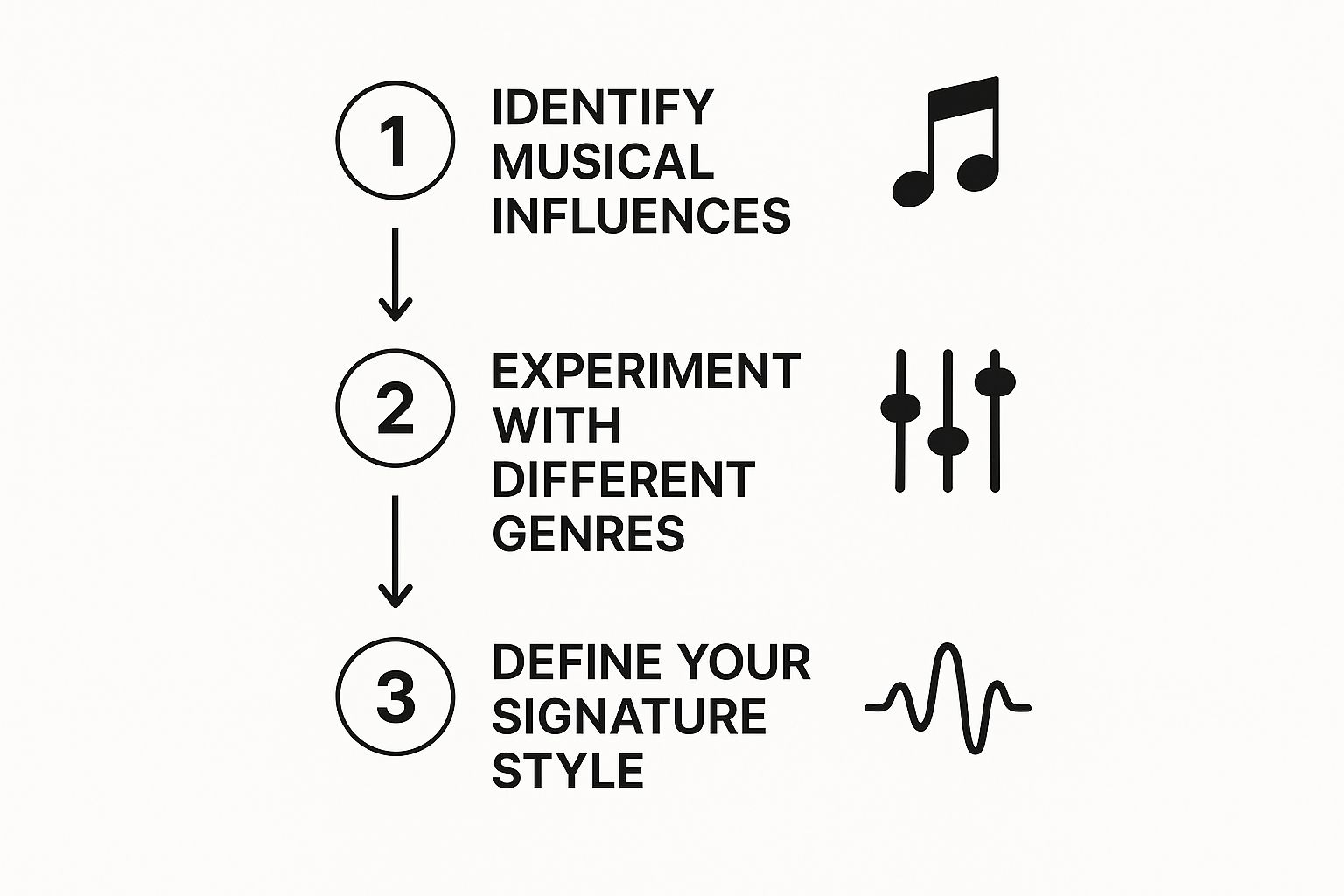
As you can see, it's a clear progression from raw inspiration to a defined artistic style. That style becomes the bedrock of your brand, and once it's solid, you can start thinking about the more public-facing parts of your career.
To give you a bird's-eye view, let's break down the journey into its core phases.
Key Phases in Building Your Music Career
| Phase | Core Action | Primary Goal |
|---|---|---|
| Discovery & Creation | Define your unique sound and artistic identity. | Build a strong foundation of quality music. |
| Production & Polishing | Record, mix, and master your tracks to a professional standard. | Create a market-ready product. |
| Branding & Marketing | Develop your brand and promote your music. | Build an engaged and loyal fanbase. |
| Distribution & Monetization | Get your music on streaming platforms and find revenue streams. | Generate income and achieve sustainability. |
Each of these phases is a critical building block. Skipping one or rushing through it will only create problems down the line. Take the time to build your career the right way, one solid step at a time.
Discovering Your Signature Sound and Vision
Before you can build an audience, you have to know who you are as an artist. This isn’t about just picking a genre. It's about a deep, honest look at what makes your music yours. Your signature sound is that unique cocktail of your influences, your skills, and your story.
Think of this as setting your artistic compass. The "why" you establish here will guide everything that comes next, from the songs you write to the brand you build. It’s about creating an authentic core that connects with people and makes you stand out.
Deconstructing Your Influences
Every musician stands on the shoulders of giants. Your job isn't to copy your heroes, but to figure out what exactly you love about their work. This means listening with intent.
Start by creating what I call a "musical DNA" playlist. But don't just throw on your favorite tracks. Get specific.
- Lyrical Inspiration: Whose storytelling grabs you? Break down their rhyme schemes or the way they structure a narrative. Maybe it’s the raw honesty of one writer or the clever metaphors of another.
- Melodic Hooks: Which melodies are stuck in your head for days? Try to understand the rhythm and intervals they use. What makes them so infectious?
- Production Textures: Do you gravitate toward the polished sheen of a pop hit or the raw grit of an indie garage band? Pinpoint the specific layers and effects that create that vibe.
Once you’ve got this collection, start smashing these elements together. What happens when you blend the intricate guitar riffs of one artist with the sparse, atmospheric vocals of another? This is where your own unique sound begins to take shape.
Your signature sound isn't something you find; it's something you build. It’s born from the clash between your influences, your own abilities, and the story that only you can tell. In a crowded industry, that authenticity is everything.
The Power of Prolific Creation
All the analysis in the world can't replace the simple act of creating. You have to write. A lot. Even when you know it's not your best work. This isn't about chasing perfection—it's about building momentum and embracing experimentation.
Treat it like a workout for your songwriting muscle. A great exercise is to challenge yourself to write and record a rough demo every day for a month. Sure, most of it might end up in the trash, but somewhere in that volume, you'll stumble upon moments of unexpected magic and stylistic breakthroughs.
Experimenting with Your Artistic Vision
Your vision is bigger than just your sound. It’s your entire creative identity—the visual aesthetic, the themes you explore, the message you want to send. All these pieces should feel connected, creating a cohesive world for your listeners.
Try a few practical experiments to push your boundaries:
- Genre Blending: Take a finished song and completely rearrange it in three different genres. Turn that folk ballad into a driving electronic track or a stripped-down punk anthem. See what new life it takes on.
- Lyrical Perspectives: Try writing the same story from three different points of view. This is a powerful way to find the narrative voice that feels most genuinely you.
- Visual Mood Boards: Jump on Pinterest or just start a folder on your desktop. Collect images, color palettes, and fonts that feel like your music sounds. This will become an invaluable guide for album art, videos, and social media down the line.
This kind of deliberate experimentation is what separates the hobbyists from the pros. In a global music industry projected to grow from $105 billion in 2024 to nearly $200 billion by 2035, a clear, compelling vision is non-negotiable. If you want to claim your piece of that pie, you need an identity that cuts through the noise. You can dig deeper into these industry trends over at goldmansachs.com.
Seeking and Filtering Feedback
Once you've got a few tracks you feel good about, it's time to bring in some outside ears. But be careful—not all feedback is helpful. Forget asking your mom or your best friend. Share your demos with a small, trusted circle of people whose opinions you actually respect, like other musicians or a mentor.
Be specific with your questions. "Do you like it?" is useless. Instead, ask things like, "What part of the song stuck with you the most?" or "What images came to mind when you heard the lyrics?" This kind of targeted feedback gives you concrete insights you can actually use to make your work better.
Bringing Your Music to Life: Production and Recording
An initial melody or lyric sketch is just the start. The real work unfolds when you turn that seed of an idea into a full-fledged track ready for listeners. This phase—production and recording—is where your creative spark meets hands-on execution.
Whether you’re crafting tunes in a cozy home setup or booking time in a professional studio, mastering the art of capturing clean audio and communicating your vision is non-negotiable for serious artists.
Choosing Your Production Path
Deciding where and how to record shapes everything—from your creative freedom to the final cost. Your budget, technical skills, and sonic goals will guide this choice.
| Path | Pros | Cons |
|---|---|---|
| Home Studio | Unlimited experimentation, lower cost | Room acoustics can be challenging |
| Producer Collaboration | Fresh perspective, technical know-how | Higher fees, tight scheduling |
Home Studio
- Essential Gear: A reliable microphone, a solid audio interface, a computer with a DAW like Logic Pro or Ableton Live, and quality headphones.
- Acoustic Treatment: Even modest investments—acoustic panels, bass traps or thick blankets—can turn a reflective room into a recording-ready space.
Collaborating With a Producer
- Brings an objective ear and technical finesse.
- Helps shape arrangements and performance dynamics.
- Ensures consistency, so your track stands alongside commercial releases.
The Three Pillars Of Production
The path from rough tracks to a polished song hinges on three stages: Recording, Mixing, and Mastering.
The goal isn’t just to record a song; it’s to create an experience. Each layer of production sharpens your emotional intent for the listener.
Recording: Capturing The Performance
Here you’re focused on securing the cleanest possible tracks. A stellar performance can’t thrive if your signal is noisy or distorted.
- Prioritize microphone choice: a condenser mic often excels on vocals and acoustic guitars.
- Minimize background noise by isolating your recording space and checking levels before you hit record.
Mixing: Blending The Elements
Once every track is in the can, mixing weaves them into a cohesive whole. This stage is where artistic vision meets technical precision.
- EQ (Equalization): Carves out space for each instrument. For example, roll off low frequencies on guitars to let the bass shine.
- Compression: Balances dynamics—taming peaks and lifting softer passages for a punchier feel.
- Reverb & Delay: Build depth, placing elements in a virtual room so nothing sounds flat or crowded.
A thoughtful mix brings clarity and emotion, guiding the listener’s focus from verse to chorus.
Mastering: The Final Polish
Mastering is quality control at its finest. Your mastering engineer will adjust overall loudness, widen the stereo image, and fine-tune tonal balance.
This last step ensures your song translates well everywhere—from earbuds and car speakers to high-end sound systems. When done right, mastering gives your track that professional edge, ready for streaming platforms or radio airplay.
Building Your Brand as an Independent Artist
Your music is the heart of what you do, but your brand is the story that pulls people in. Think of it as the visual aesthetic, the tone you use online, and the values you stand for. In a world overflowing with new tracks daily, a strong, genuine brand is what turns a casual listener into a true fan—someone who feels connected to your journey.
This isn't about creating a fake persona. It's about figuring out what makes you you and then amplifying it consistently across every single touchpoint. From your album art to your Instagram stories, a cohesive brand makes you memorable and helps your music find its people.
Crafting Your Artist Narrative
Every artist has a story. What's yours? Your artist narrative is more than just a list of accomplishments on a bio page. It needs to capture your unique perspective, your influences, and the real reason you make music in the first place. This is your chance to tell the world who you are and what you're about.
When you sit down to write your story, ask yourself a few things:
- What was the moment that made you start creating music? Origin stories resonate with people.
- What are the core themes or messages that pop up in your songs again and again? This is your artistic purpose.
- What makes your sound or viewpoint different from everyone else in your genre? Pinpoint what sets you apart.
Remember, your narrative needs to be flexible. You'll want a longer version for your press kit or website, a tighter paragraph for streaming profiles like Spotify, and a punchy one-liner for your social media bios. Each one should tell the same core story, just in a different way.
Developing a Consistent Visual Identity
Long before someone presses play, they see your brand. Your visual identity—your logo, color choices, fonts, and photography style—creates an immediate vibe. Consistency is everything here; it’s how you build recognition.
Think about one of your favorite artists. I bet you can instantly picture their album art, the look of their music videos, maybe even the font they always use. That’s the power of a strong visual brand at work.
A brand is the set of expectations, memories, stories and relationships that, taken together, account for a consumer’s decision to choose one product or service over another. Your brand as a music artist is the emotional shorthand for your entire creative world.
A great way to start is by creating a simple mood board. Pull together images, colors, and textures that feel like your music sounds. Is your vibe dark and moody, or is it bright and full of energy? Let that feeling guide your choices for everything from your logo design to the filters you use on your photos. This kind of visual consistency makes your content instantly recognizable in a crowded social feed.
Engaging Authentically on Social Media
Social media is your direct line to your audience. It's the place where you share your story, build a community, and give fans a reason to care about you as a person, not just as a musician. The secret ingredient? Authenticity. People can sniff out a purely promotional account from a mile away.
Treat your social platforms like a window into your creative life. Don't just post, "My new song is out now!" Share the behind-the-scenes stuff: the frustration of a tricky recording session, the high of finally nailing a lyric, or a quick video of you nerding out over a new synth. Those are the moments that make your journey feel real and relatable.
Ultimately, turning listeners into loyal supporters comes down to building actual relationships. If you want to dive deeper into this, our guide on how to build a loyal fan base as an independent artist is packed with more strategies. This isn't just about a single release cycle; it's about learning how to be an artist who thrives for the long haul. When you're genuine and consistent, you create a brand that people don't just recognize—they feel like they're a part of it.
Getting Your Music Heard: Distribution and Marketing
You’ve poured everything into creating a killer track. That’s a huge win, but honestly, it’s just the beginning. If you’re serious about becoming an artist who connects with an audience, the next phase is all about getting your music out into the world. Your finished song needs a pathway to listeners, and that path is built with smart distribution and relentless marketing.
This isn’t about just tossing a file online and crossing your fingers. It's a deliberate process. You have to place your music where people can actually find it and then actively lead them there. From the big streaming players to a well-timed social media push, this is how you transform your hard work into a release that makes an impact.
Choosing Your Music Distributor
First things first, you need a way to get your songs onto platforms like Spotify, Apple Music, and Amazon Music. For that, you’ll need a digital music distributor. Think of them as the essential bridge connecting you to the countless streaming services and online stores across the globe. They handle all the technical heavy lifting and, just as importantly, collect royalties for you.
You've got a lot of options, and they all work a bit differently. Here are a few of the most common choices I see artists making:
- TuneCore: You pay an annual fee for each single or album, but the trade-off is that you keep 100% of your royalties.
- DistroKid: This one’s a favorite for artists who release a lot of music. You pay a single annual subscription for unlimited uploads.
- CD Baby: Instead of a recurring fee, you pay a one-time setup cost for each release, and they take a small commission from your earnings.
The right choice really depends on your release strategy. If you’re dropping a new single every month, a subscription model like DistroKid is a no-brainer. But if you’re more of an album-every-few-years kind of artist, CD Baby’s one-time fee might be the more economical route.
The Art of Pitching to Playlists
With your release scheduled, it’s time to focus on the holy grail: playlists. A spot on a popular playlist can change everything overnight, putting your music in front of thousands of potential new fans. It's not an exaggeration to say that for many indie artists, a staggering 96% of their monthly plays can come directly from Spotify playlists.
Getting your music on algorithmic playlists like Discover Weekly often starts with getting on human-curated playlists first. Each placement acts like a vote of confidence, telling the platform's algorithm that your song is worth sharing.
Your distributor will give you access to pitch your unreleased track directly to Spotify's editorial team through your Spotify for Artists account. Don't skip this step. It’s your single best opportunity to land on one of their official, high-traffic playlists.
When you write your pitch, get specific. "Vibe-y" isn't going to cut it. Talk about the mood, the specific instruments, the genre, and even sub-genre. Name-drop a few artists you sound like. You need to give the editors all the context they need to see exactly where your track belongs.
Marketing Your Release With Purpose
Your marketing shouldn’t start on release day—it needs to begin weeks earlier. The goal is to build anticipation and create a sense of an event. This means mapping out a content plan that tells the story behind your new music.
A great release campaign is a series of coordinated moves, not just a single "out now" post. To keep everything organized and consistent, I highly recommend using a social media calendar template. It helps you schedule everything from short teaser clips to the final release announcement, ensuring your message builds momentum.
Effective marketing goes way beyond just posting on your socials. For a much deeper dive, our guide on how to market your music as an independent artist breaks down how to build a campaign that actually connects.
Don't forget to branch out beyond social media. Here are a few other channels to work into your plan:
- Your Email List: This is your direct line to your most loyal supporters. Always give them the news first. It makes them feel like insiders and strengthens that connection.
- Music Blogs: Do some research and find smaller, genre-specific blogs that cover emerging artists like you. A personal, thoughtful email will always beat a generic mass message.
- Visual Content: In 2024, audio needs a visual partner. Create a music video, a lyric video, or even just some simple, eye-catching visualizers for platforms like YouTube and Instagram Reels. Video gives your track a much longer shelf life.
Monetizing Your Music and Building a Career
Passion is what gets you started, but revenue is what keeps you going. You've poured your heart into creating incredible music, and that's a huge win. The next step—and it's a critical one—is learning how to turn that art into a career that actually lasts. It's time to start thinking like a creative entrepreneur.

This means looking beyond the fractions of a penny you earn from individual streams. While getting on playlists is great for discovery, trying to live off streaming royalties alone is a tough, slow climb. The artists I see succeeding long-term are the ones who diversify, building multiple income streams that work together.
Think Beyond Streaming Royalties
Streaming platforms are powerful for getting your music heard, but they're just one piece of the financial puzzle. To give you some perspective, an indie artist earning $800 per month from streaming might need over 170,000 monthly plays to hit that number. To build a more stable foundation, you have to expand your financial toolkit.
Let’s get into the most effective ways artists are actually making a living today.
- Live Performances: This is still a cornerstone. From gigs at your local pub to ticketed online concerts, playing live is a primary source of income. It's not just about the ticket sales, either—it's your best chance to connect with fans face-to-face and sell some merch.
- Merchandise Sales: Your brand has real value. T-shirts, vinyl, posters, and other unique items give your fans a tangible way to support you. Finding a platform that lets you sell directly to your audience without taking a massive cut is a game-changer here.
- Music Licensing (Sync): Landing your song in a TV show, a movie, or even a commercial can mean a significant payday. Building relationships with music supervisors and using sync licensing platforms can unlock this world, and it's often more accessible than you'd think.
Own Your Financial Future
It's absolutely essential to start thinking like a business owner. This means knowing exactly where your money is coming from, managing it wisely, and making strategic moves that protect your creative freedom. You're not just the talent; you're the CEO of your own music enterprise.
Don’t just be the artist; be the boss. When you understand the business side of your music, you can negotiate better deals, invest in your own growth, and build a career that doesn’t depend on anyone else’s approval.
This mindset shift is what separates artists who thrive from those who just get by. It’s about taking real, active control of your financial destiny.
One of the most powerful ways to take control is by selling directly to the people who love your music. This approach cuts out the industry middlemen who traditionally take a huge percentage of sales. To get started, you can explore platforms that make it easy to sell your music and merchandise commission-free. This ensures that more of the money you earn goes directly into your pocket.
Building Multiple Streams of Income
Diversification is your best defense against the music industry's unpredictability. When you have several different revenue streams, a slow month in one area—say, fewer gigs in the winter—won't derail your entire career.
Here’s a look at what a balanced revenue mix might look like for an independent artist:
| Income Source | Potential Monthly Contribution | Key Action |
|---|---|---|
| Streaming Royalties | 10-20% | Consistently release new music and pitch to playlists. |
| Live Shows | 30-40% | Book regular gigs and build a solid local following. |
| Merchandise | 20-30% | Design cool products and promote them at shows and online. |
| Fan Subscriptions | 10-15% | Offer exclusive content for your most dedicated supporters. |
| Sync Licensing | 5-10% (Variable) | Actively pitch your catalog for placements in film and TV. |
This isn't a rigid formula, of course, but it shows how different income sources can create a stable whole. An artist might have a huge month from a sync placement that makes up for a lighter touring schedule. It’s this blend that creates financial security and lets you focus on making the music you love.
Ready to take full control and build a sustainable income from your music? OohYeah provides the tools you need to sell your music, merchandise, and subscriptions directly to your fans, all in one place. Sign up and start monetizing your passion today at https://oohyeah.app.