How to Analyze Competitors as an Independent Music Creator
Learn how to analyze competitors in the music industry with a step-by-step framework for independent artists. Gather data, spot gaps, and build a winning action
August 24, 2026
Music City Media
You release a polished EP, line up the artwork, schedule the posts, and watch the first wave arrive. Then the streams flatten, the comments slow down, and you're left asking whether the music missed the audience or whether the release entered a crowded conversation without a clear reason for anyone to listen.
That question is where how to analyze competitors becomes useful for an independent artist. Competitor analysis isn't about copying another artist's sound, captions, or rollout. It's about understanding who is competing for the same listener, how those artists turn attention into streams or sales, and which opportunities they've left open. The wider practice has become a continuous business function. One report cited by Small Business Computing said 94% of businesses have at least some employees working on competitive intelligence, while the average number of competitors tracked rose from 25 in 2019 to 29 in 2020.
For a creator, the payoff is practical. A good analysis can influence your release timing, content calendar, merch offer, fan funnel, and platform mix without taking creative control away from you.
Why Most Independent Artists Skip Competitor Analysis
An artist usually skips competitor analysis for understandable reasons. It sounds corporate. It feels uncomfortable to compare your work with people you admire. Some creators also worry that studying other artists will dilute their originality.
The larger problem is that avoiding comparison doesn't remove competition. It only hides it.
A strong song still needs a route to discovery. Listeners choose between new releases, familiar artists, podcasts, gaming streams, short-form videos, live events, and countless other uses of their limited attention. If your EP enters that environment without a distinct position, the audience has to work out why it matters. Most listeners won't do that work for you.
Practical rule: Don't ask whether another artist is “better.” Ask what makes their offer easier to notice, understand, share, or buy.
The cost of creating in a vacuum
Suppose an independent electronic artist releases an atmospheric EP after months of production. Their closest peers have been releasing singles steadily, posting short studio performances, and collecting email addresses from fans who want unreleased edits. The EP may be musically strong, but its rollout gives listeners no clear entry point and no reason to return after the first play.
A competitor review would reveal those differences before release day. It might show that the audience responds to process content rather than polished announcements, or that similar artists use a free download to move casual listeners into a direct fan channel. That insight doesn't tell the artist what music to make. It tells them how the surrounding audience behaves.
The romantic idea that “if the music is good, it will find its audience” leaves out positioning, timing, discovery mechanics, and retention. Quality matters, but quality alone doesn't explain why one release earns repeated attention while another disappears in the same listening environment.
Reconnaissance, not imitation
Start with a manageable set of artists and platforms. Your research should answer questions such as:
- Who shares my listener pool? Include artists in the same genre, career tier, geography, and release rhythm.
- What does their audience respond to? Look beyond views. Read comments, inspect saves where available, and note repeated questions.
- How do they monetize attention? Review merch, memberships, ticket offers, paid communities, and direct sales.
- What do they ignore? An absent email list, weak product pages, or limited fan interaction can point to an opening.
Your artist profile and direct-to-fan options also matter. OohYeah's artist resources are relevant when you're comparing how creators can present music, products, and fan relationships in one environment.
The point isn't to become a market analyst instead of a musician. It's to stop making strategic decisions from instinct alone. Analysis gives your next release a context, and context makes creative choices more deliberate.
Defining Your Competitive Field Beyond Direct Rivals

An independent artist can lose listener attention to a nearby genre, a creator with stronger fan access, or a platform that changes how discovery works. A useful competitor map therefore asks more than, “Which artists sound like me?” Porter's framework examines direct rivalry alongside new entrants, substitutes, buyer power, and supplier power, a structure summarized in this overview of Porter's Five Forces. It remains useful because it connects competitor behavior with the forces affecting access, revenue, and negotiating power.
Adapt those forces to attention and monetization rather than treating them as a corporate checklist.
Map the five forces around your artist brand
Direct rivals share a similar genre, career tier, audience profile, and release rhythm. They may pursue the same playlists, opening slots, local venues, press coverage, and fan spending. Review their release timing, positioning, content formats, and path from discovery to a stream, ticket, product, or membership.
Adjacent competitors make different music or offer a different experience while drawing from the same audience pool. A bedroom-pop artist may compete with an R&B singer, remix channel, DJ, or short-form creator whose followers discover music through the same feeds. These comparisons expose changes in taste and attention that a genre-only list can miss.
Substitutes compete for leisure time. Podcasts, gaming streams, creator videos, and live broadcasts can occupy the moment when someone might have played your track. Study what keeps that audience returning, then decide whether your artist brand can participate through a natural format, collaboration, or community touchpoint.
Potential new entrants include emerging artists, producers, collectives, and creators who have not yet become obvious rivals. Watch accounts gaining attention through a distinctive visual identity, community format, collaboration pattern, or live concept. Early observation can reveal a changing audience before it affects your release plans.
Supplier power sits with platforms, playlist ecosystems, distributors, venues, collaborators, and other gatekeepers. An algorithm change, editorial preference, policy update, or venue decision can alter access quickly. Keep building channels you control, such as an email list, direct sales page, or owned fan community.
Buyer power belongs to fans. They decide what to save, share, replay, attend, and purchase. Their actions carry more weight than compliments, so compare which calls to action create movement and which produce only passive approval.
Build a four-tier competitor list
Create a spreadsheet with four groups and place five names in each:
- Direct: Similar genre, audience, career stage, and release behavior.
- Adjacent: Different format or genre, but overlapping listener attention.
- Substitute: Non-music entertainment competing for the same time.
- Aspirational: Artists whose systems, brand, or monetization model you may study later.
Each tier calls for a different response. Direct rivals establish a realistic benchmark. Adjacent artists reveal opportunities in audience, format, and fan relationships. Substitutes clarify attention habits. Aspirational artists offer strategic principles, although their resources and recognition can make direct comparisons misleading.
Include merch stores, fan memberships, social platforms, commission services, and direct-to-fan marketplaces in monetization research. The OohYeah marketplace can be compared with those systems by reviewing how creators present products and turn audience interest into a purchase.
Gathering Quantitative and Qualitative Data on Competitors
An artist can appear to be growing quickly because one clip performs well, while ticket sales, direct purchases, or fan retention remain flat. Reliable competitor research therefore combines quantitative signals, which show what happened, with qualitative observations, which help explain how attention became listening, attendance, or revenue.
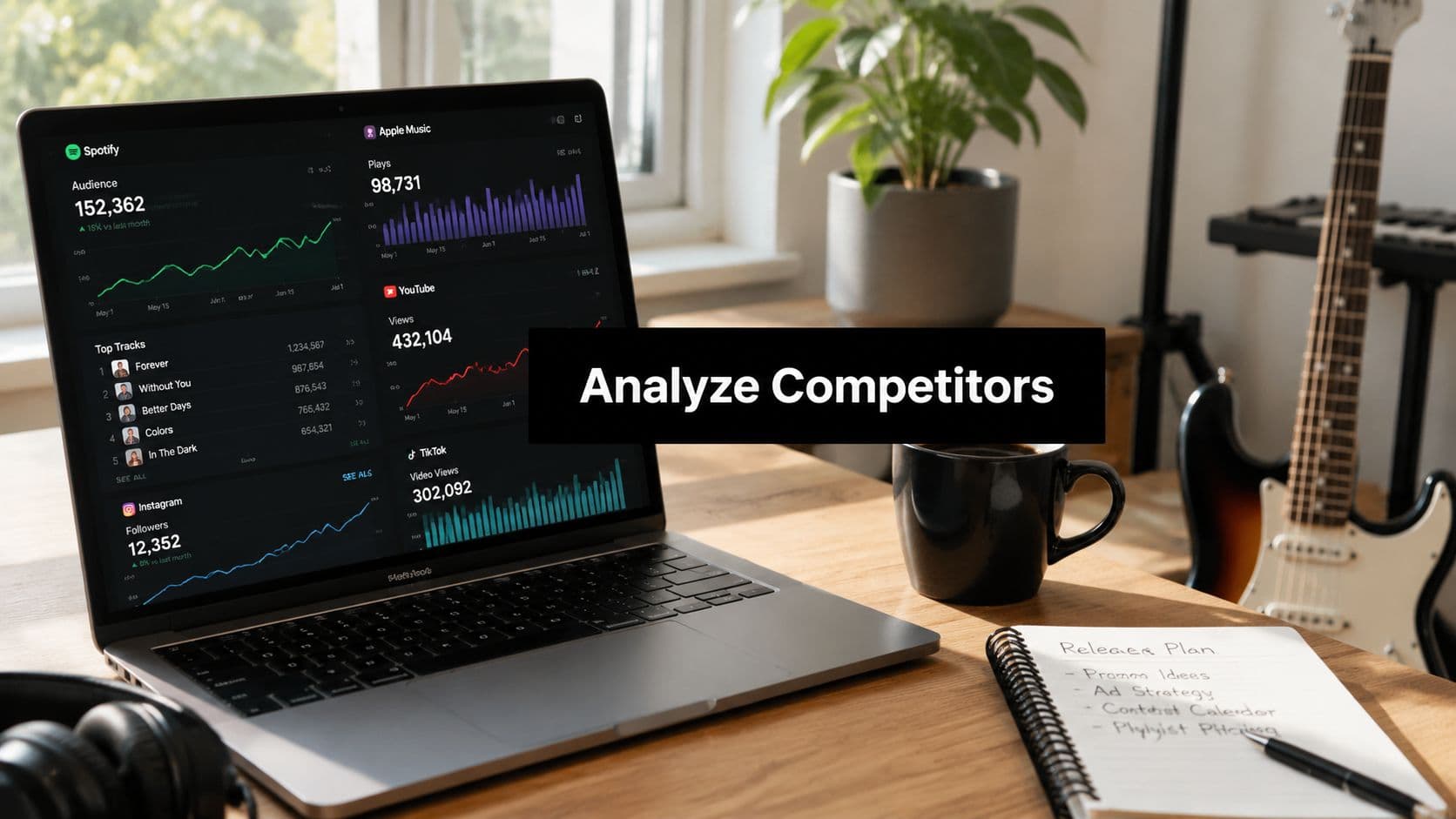
Start with public and permission-based sources. Spotify for Artists gives you benchmarks for your own audience. Chartmetric and Viberate can support comparisons when their available data uses consistent definitions. Social Blade helps track public channel movement, while Similarweb offers directional website-traffic context. Treat estimates as signals, not ground truth, and record the source and date beside every observation.
What to record
Use the same fields for every artist. Track monthly-listener direction, playlist appearances, social-audience movement, visible engagement, YouTube view velocity, release response, merch pricing tiers, memberships, and direct purchase options. Compare like with like. A public estimate for one artist should not be placed beside a private first-party figure for another, because the difference may reflect measurement rather than performance.
Qualitative research supplies the context behind those numbers:
- Release cadence: Record whether the artist favors singles, EPs, albums, remixes, or long gaps.
- Visual system: Review cover art, thumbnails, colors, typography, stage design, and recurring symbols.
- Community tone: Read comments, public Discord discussions, and fan replies. Note whether the relationship feels intimate, humorous, educational, or transactional.
- Live strategy: Record show frequency, venue type, ticket packaging, meet-and-greets, and other paid experiences.
- Collaboration network: Map producers, artists, creators, brands, playlist communities, and event partners.
- Content behavior: Identify formats that invite saves, shares, replies, or repeat viewing, rather than measuring reach alone.
- Monetization path: Follow the route from post to profile, mailing list, membership, merch page, or purchase. Friction at any step matters.
For tool ideas and workflow organization, the Samuel Woods competitive toolkit provides a useful reference. Software can sort observations, but it cannot decide whether a creator's strategy fits your audience, budget, or release schedule.
Use a small, repeatable spreadsheet
A simple sheet beats a dashboard you never revisit. Record the observation date, source, metric definition, interpretation, and confidence level. Separate weekly signals from monthly patterns, so one successful post does not become a false conclusion.
| Data Category | Specific Metrics | Recommended Tools | Tracking Frequency |
|---|---|---|---|
| Streaming | Listener direction, playlist appearances, release response | Spotify for Artists, Chartmetric, Viberate | Weekly for releases, monthly for broader movement |
| Social | Follower movement, visible engagement, recurring formats | Instagram, TikTok, Social Blade | Weekly |
| Video | View velocity, upload rhythm, recurring subjects | YouTube, Social Blade | Weekly |
| Website | Key pages, referral context, product presentation | Similarweb, manual review | Monthly |
| Monetization | Merch tiers, bundles, memberships, paid offers | Storefronts, Patreon, manual audit | Monthly |
| Community | Comment themes, fan questions, interaction style | Social comments, Discord spaces | Weekly |
| Brand | Artwork, copy, tone, visual consistency | Manual audit | Monthly |
The OohYeah music-commerce magazine is one possible reference for platform and creator-commerce comparisons. Verify each observation against the artist's public pages, then record what the evidence suggests and what remains uncertain. The goal is a repeatable view of how independent artists turn attention into durable fan relationships and income.
Identifying Patterns and Gaps in Competitor Strategies
Collection is the easy part. The difficult work starts when several observations point in different directions.
A rival may have strong short-form output but little visible direct-fan infrastructure. Another may sell merch consistently but rarely explain the story behind each product. A third may generate attention through live studio sessions instead of conventional release announcements. None of these observations matters alone. Together, they can reveal how different strategies convert attention into a relationship.
Turn observations into a SWOT view
Use a SWOT-style review for each important competitor, but keep it tied to decisions. The Statista competitor-analysis guidance supports identifying relevant competitors, prioritizing meaningful market participants, and evaluating their strengths and weaknesses against strategic goals.
| Category | Questions to Ask | Data Sources | Example Finding |
|---|---|---|---|
| Strengths | What do fans consistently recognize or reward? | Comments, releases, live listings, social posts | A clear visual identity makes each release immediately recognizable |
| Weaknesses | Where does the artist lose momentum or leave fans unsupported? | Release history, product pages, community replies | Strong reach, but no obvious next step for a new listener |
| Opportunities | Which audience need or format receives limited attention? | Cross-competitor comparison, fan questions | Fans ask for intimate process content that few peers provide |
| Threats | Which move could compress attention or pricing power? | Release calendars, collaborations, platform activity | Several artists are entering the same niche with similar messaging |
Cross-reference instead of copying
Look for repeated relationships between variables. If an artist posts heavily around a release but the conversation disappears afterward, the gap may be retention rather than awareness. If another artist's streams rise around live-streamed sessions, the relevant lesson may be access to process, not the exact livestream format.
Compare:
- Release date against content timing.
- Content format against comments, saves, or shares.
- Product launch against the artist's story and fan participation.
- Collaboration announcement against subsequent audience movement.
- Platform activity against direct-fan calls to action.
Then write a hypothesis in plain language. For example: “This audience responds to unfinished creative access more than polished promotion.” That hypothesis can guide your next content experiment without requiring you to imitate the competitor's identity.
The useful gap is rarely “they don't do this.” It's “their audience appears to want this, and their current system doesn't deliver it clearly.”
Your own assets determine whether a gap is worth pursuing. A vocalist with strong live chemistry should not chase a video-heavy strategy because another artist receives attention there. Choose whitespace that fits your voice, skills, collaborators, and available time.
Building an Action Plan From Your Competitive Intelligence
Research earns its place when it changes what you schedule, publish, sell, or test. The Pulse AI Research guide to competitive benchmarking mistakes warns that analysis without a decision attached can misdirect a business, especially when one metric or a carefully selected comparison carries too much weight.
Convert each useful observation into a small operating decision:
- Write the insight. Record what you observed, where it appeared, and which audience behavior supports it.
- State the hypothesis. Explain what the pattern might mean for your own listeners, customers, or members.
- Choose one action. Attach it to a release, content cycle, show, merch offer, or membership test.
- Set a deadline. Put the action on the same calendar as the campaign.
- Define the signal. Decide which behavior would support or weaken the hypothesis.
- Review the result. Keep, adjust, or abandon the move based on what happened.

Plan across three horizons
Immediate tactics apply to the next release window. Change the order of teaser posts, test a different call to action, or avoid a crowded date after reviewing nearby releases. These choices should be easy to reverse if the response is weak.
Medium-term positioning develops across several campaign cycles. Build a recurring studio format, introduce a fan membership, or create a merch bundle that answers a specific audience need. Track whether the offer creates repeat participation, direct replies, or completed purchases, rather than judging it by reach alone.
Long-term differentiation defines what listeners associate with your project. You might own intimate songwriting education, a distinctive live concept, a visual world, or direct access to the creative process.
Use a working template like this:
| Insight Source | Proposed Action | Priority Score | Deadline | Success Metric |
|---|---|---|---|---|
| Peer release audit | Add a process-led content sequence | High, if production is manageable | Before next single | Meaningful saves, shares, replies, or fan sign-ups |
| Merch comparison | Test a story-led bundle | Medium | Next product window | Product visits and completed purchases |
| Community review | Create a recurring direct interaction | High | During the next campaign | Repeat participation and direct responses |
Rank ideas by relevance, effort, fit with your identity, and how quickly the test can produce useful learning. Do not give every idea high priority. Set monitoring triggers for meaningful competitor moves, such as a major collaboration, a new membership offer, a recurring content shift, or a change in platform access.
Keep the review active as your audience and offers change. Research works better as a recurring operating habit than as a document filed after one campaign. Revisit the plan when a new release, merch drop, membership offer, or platform shift changes the choices available to you.
Common Mistakes That Make Competitor Analysis Useless
The first mistake is choosing artists you can't reasonably compare with. A global star's reach, team, catalog, and budget create conditions that an independent artist may not share. Study one tier above your current position for useful strategic ideas, and use larger artists for broad brand principles rather than performance benchmarks.

Five traps to avoid
- Benchmarking wrong artists: Comparing career stages produces distorted targets. Match genre, audience, geography, release behavior, and business model before you compare performance.
- Chasing vanity metrics: Follower counts and raw views can look impressive without showing listener depth. Examine repeat interaction, direct responses, product movement, and the path from discovery to ownership.
- Ignoring non-music factors: An artist may appear to be winning through songs when the advantage comes from community, visual identity, touring, collaborations, or consistent publishing.
- Analyzing without a goal: Research becomes procrastination when you haven't attached it to a release, offer, audience problem, or positioning decision. Write the decision you need to make before collecting data.
- Only looking at peers: Direct rivals show the current contest, but substitutes and adjacent ecosystems reveal where attention is moving. Include social platforms, membership tools, merch stores, and other entertainment formats in the market.
Copying surface tactics creates another common failure. A format that works for one artist may depend on their personality, audience history, production capacity, or relationship with fans. Adapt the principle instead. If their audience responds to behind-the-scenes access, find the version of access that feels natural for your own creative practice.
Your own assets belong in every comparison. A competitor's weakness isn't automatically your opportunity if you lack the time, skills, or audience trust to serve that need. Research should narrow your choices, not pressure you into becoming a different artist.
Turning Competitive Intelligence Into Ongoing Creative Advantage
Competitor analysis works best as a living creative practice. Artists who review their ecosystem regularly can notice new formats, offers, collaborations, and audience expectations without surrendering their identity to whatever appears popular that week.
Set a modest monthly rhythm. Spend 30 minutes scanning competitor releases, social shifts, product launches, and fan conversations, then use 15 minutes to write what changed, what seems durable, and what opportunity fits your next campaign. These time allocations are a practical workflow recommendation, not an industry statistic.

Keep a competitive inspiration journal with four columns: the observed move, the likely reason it works, the part that feels authentic to your brand, and the experiment you could run. This prevents passive scrolling from masquerading as research. It also gives you a record of ideas that can develop across several release cycles.
The wider competitive-intelligence field is moving toward real-time monitoring, AI-assisted workflows, and predictive analysis. One industry source claims 54% of firms believe real-time data improves competitive-intelligence decision-making, as reported by SuperAGI. For an artist, that doesn't mean watching every rival constantly. It means building a lightweight system that catches meaningful changes early and leaves enough time for creative work.
Your aim isn't to copy the loudest artist in your scene. It's to understand the ecosystem thoroughly enough to choose a lane with intention, protect your voice, and make each release teach you something useful.
OohYeah gives independent artists a place to compare and develop direct monetization options across music, merchandise, and fan subscriptions. Visit OohYeah to explore how its artist-first platform can support the competitor insights you turn into your next release and fan-building plan.