Explore: how much does spotify pay and why it matters
Curious how much does spotify pay per stream? This guide breaks down royalties, payout factors, and practical tips to maximize earnings.
January 14, 2026
Music Marketplace Advisor
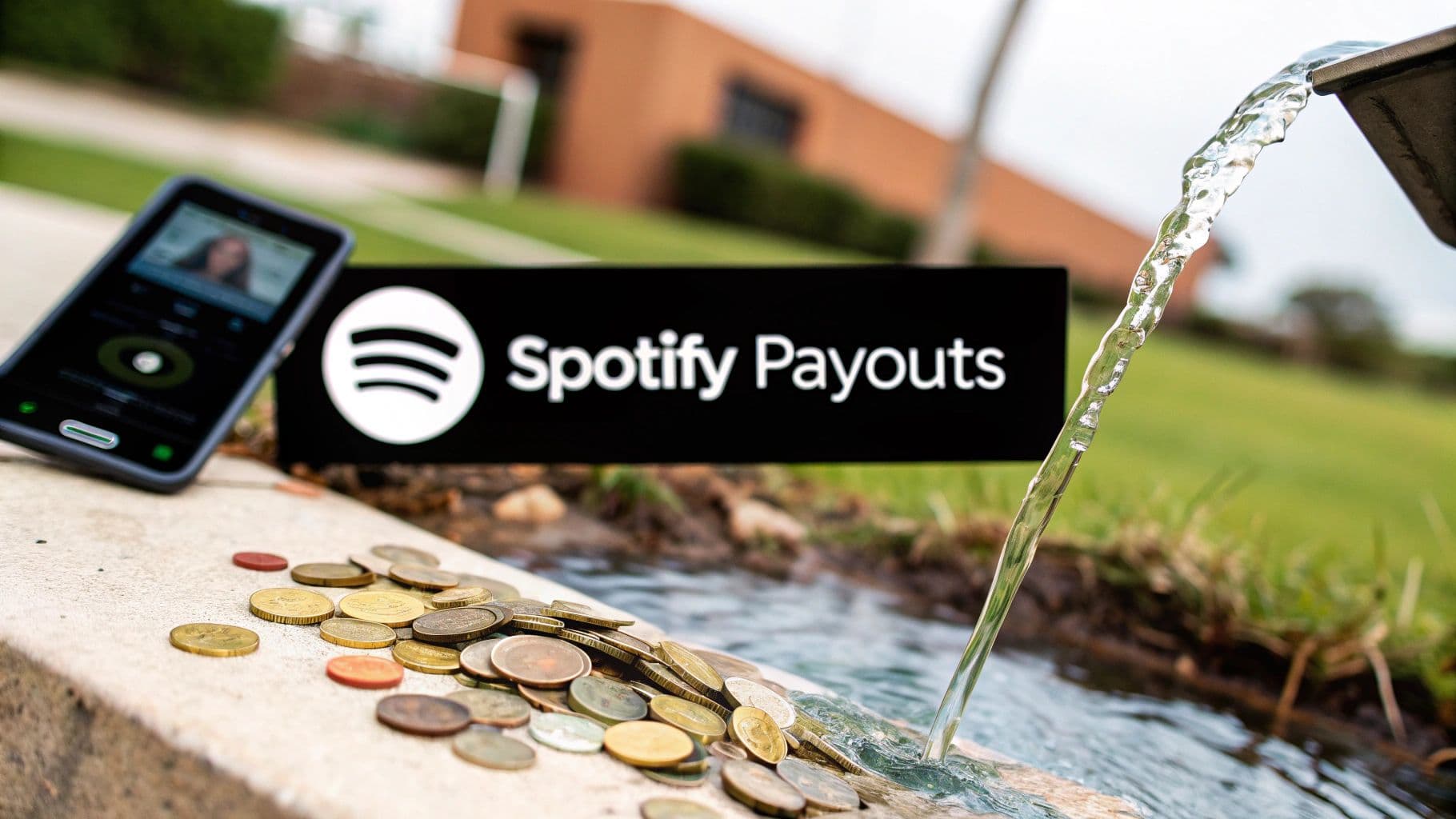
Buying & SellingAlright, let's get right to the question every artist asks: how much does Spotify actually pay per stream? The hard truth is there's no magic number. You’re typically looking at a range between $0.003 and $0.005 per stream.
That might not sound like a lot, and it isn't. To put it in perspective, hitting one million streams will likely only generate a few thousand dollars before anyone else takes their cut.
The Real Answer to How Much Spotify Pays Per Stream
Spotify doesn't operate like a vending machine where one play equals a fixed payout. Instead, everything runs on a "pro-rata" system, which they sometimes call "streamshare."
Think of it this way: imagine all the money Spotify makes in a month from both Premium subscriptions and ads gets thrown into one giant pool. Your earnings are simply your slice of that pool, and the size of your slice is determined by how many streams your music got compared to every other song on the platform that month.
This model is precisely why the per-stream rate is always shifting. It’s a moving target. If the total number of streams on the platform skyrockets but the revenue in the pool stays flat, the value of each individual stream drops for everyone.
Understanding the Variables
So, what determines the actual value of your streams? A few key things can make that per-stream rate swing one way or another, which is why forecasting your earnings is so tricky.
- Listener's Subscription Type: A stream from a Spotify Premium subscriber is worth a whole lot more than one from a free, ad-supported user. This is just simple math—Premium users contribute more cash to that monthly revenue pool.
- Listener's Geographic Location: Where your listeners are in the world matters. A stream from the United States or the UK, where subscription fees and ad rates are higher, will pay more than a stream from a region with a lower-cost market.
- Your Distribution Agreement: This is a big one. The deal you signed with your distributor or record label dictates the percentage of the final payout that actually lands in your pocket. These splits vary wildly from one deal to the next.
A 2025 analysis confirms that Spotify's average payout remains notoriously low, with an independent artist needing roughly 1 million streams to earn between $3,000 and $5,000 before any cuts are taken by distributors or labels. You can discover more insights about payout specifics on RevisionsMusic.com.
To give you a clearer picture of what this looks like in practice, here are some ballpark estimates.
Spotify Payout Estimates at Different Stream Counts
This table provides estimated gross earnings on Spotify before any distributor or label cuts, based on the average per-stream payout range.
| Total Streams | Estimated Payout (at $0.003/stream) | Estimated Payout (at $0.005/stream) |
|---|---|---|
| 10,000 | $30 | $50 |
| 100,000 | $300 | $500 |
| 1,000,000 | $3,000 | $5,000 |
Remember, these are just estimates. They represent the total amount paid to the rights holders (which includes you, your label, your publisher, etc.) before anyone else takes their share.
Deconstructing the Spotify Royalty Pool
To get a real handle on Spotify payouts, you have to start with where the money actually comes from. It all hinges on a concept called the royalty pool—basically, a massive pot of cash that gets collected and divvied up every single month.
Think of it this way: all the money from Premium subscriptions and every ad played on the platform gets poured into one giant financial reservoir. That's Spotify's total net revenue for the month. But before any artist gets paid, Spotify takes its share, which is roughly 30%.
The other 70% is what's left for everyone else. This is the official royalty pool, the money set aside to pay all the rights holders—artists, record labels, publishers, and songwriters. What you earn is a direct slice of this shared pie, based on how your music performed.
This chart helps visualize how the money travels from a listener's pocket to an artist's payout.
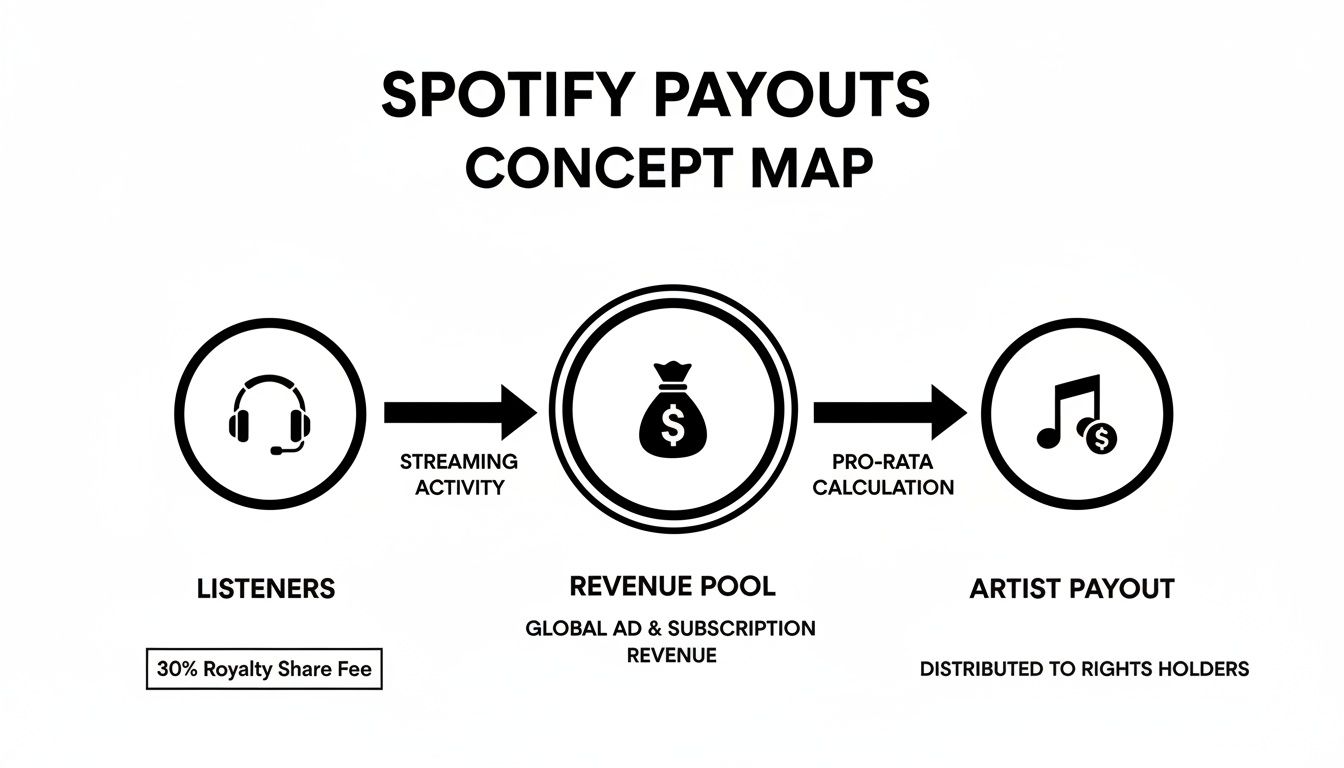
As you can see, all the money is pooled together first. This is the single biggest reason why there's no such thing as a fixed "per-stream" rate.
The Streamshare Formula Explained
So, how does Spotify figure out your exact cut of that enormous pie? It all comes down to a model they call "pro-rata," or streamshare. The idea is pretty straightforward: your earnings are directly proportional to your share of the total streams on the platform for that month.
Here's a simple way to think about the formula:
(Your Total Streams ÷ Total Streams on Spotify That Month) × Total Royalty Pool = Your Gross Payout
This calculation is precisely why the per-stream value is always shifting. If the total number of streams on Spotify skyrockets one month, but the revenue in the royalty pool doesn't grow as fast, the value of each individual stream actually drops for everyone.
Putting the Formula into Practice
Let's walk through a quick example to make this concrete. Imagine you're an independent artist who racked up 100,000 streams in a month. Let's say Spotify's royalty pool for that month was $1 billion, and the total number of streams across the entire platform was 300 billion.
Here’s how the math would work:
- Find Your Streamshare: 100,000 (your streams) ÷ 300,000,000,000 (total streams) = 0.000000333
- Calculate Your Gross Payout: 0.000000333 (your streamshare) × $1,000,000,000 (royalty pool) = $333
In this scenario, your 100,000 streams earned a gross revenue of $333, which works out to a per-stream rate of $0.0033.
Now, that $333 is paid to the rights holders. Your final take-home pay depends on the deal you have with your distributor or label. Getting your head around these core mechanics is the first step in figuring out how independent artists make money from music in a world dominated by streaming. But this pro-rata system is just the foundation—several other factors can change your final payout quite a bit.
Key Factors That Change Your Spotify Payout Rate
Getting your head around the "big pool" of money is one thing, but the real mystery behind Spotify payouts lies in a few key variables. These are the things that make your per-stream rate jump up one month and dip the next.
Put simply, not all streams are created equal. The value of a single play isn't some fixed number—it's a dynamic figure that shifts based on who is listening, where they are, and the fine print in your contracts. Understanding these moving parts is the only way to truly make sense of your royalty statements.
Listener Type and Territory
First and foremost, the value of a stream comes down to the listener. Think of it this way: a stream’s worth is directly tied to the cash it adds to that month's royalty pool.
- Premium vs. Free Listeners: A play from a Spotify Premium subscriber is always worth more than a play from someone on the free, ad-supported tier. Why? Because that Premium user is kicking in a subscription fee every month, making their listening habits far more valuable.
- Geographic Location: Where in the world your fans are streaming from matters—a lot. A stream from a listener in the United States or the UK, where subscription costs and ad revenues are high, will pay out more than one from a developing market with lower price points.
This is why 1,000 streams from Premium subscribers in New York will always earn you more than 1,000 streams from free users in a region with less ad spend. It's one of the biggest reasons you'll see your average per-stream rate fluctuate so much.
A stream’s value is a direct reflection of the revenue it generates. High-revenue sources, like Premium subscriptions in established markets, naturally lead to higher payouts for the artists those users listen to.
Your Distribution and Label Agreements
Even after Spotify calculates what your music has earned, that money doesn't just magically appear in your bank account. It first has to pass through your distributor or label, and they always get their piece of the pie.
Whether you're using a DIY service like DistroKid or you're signed to a record label, they will take a percentage or a fee before you see a dime. And those deals can be wildly different. An independent artist on a flat-fee distribution plan might keep nearly 100% of their royalties, while someone with a traditional label deal might only see a small fraction of the total.
Let’s say Spotify pays out $1,000 for your streams this month. Here's how quickly that can shrink:
- Distribution Fee: Your distributor takes its cut. This might be a percentage (15-30%) or a simple annual fee.
- Label Split: If you have a record deal, the label takes its share, which could easily be 50% or more.
- Other Deductions: Don't forget other team members. Managers, co-writers, and producers might also have a contractual claim to a slice of that revenue.
Suddenly, that initial $1,000 payout might only be a few hundred dollars by the time it hits your account. This is a critical detail people often miss when they ask, "How much does Spotify pay?"
Master vs. Publishing Royalties
Finally, it's essential to know that every song actually generates two different kinds of royalties. If you write and record your own music, you're owed both, but they get paid out through completely different channels.
- Master Recording Royalties: This is the money paid for the specific sound recording—the actual finished track you upload. These royalties are paid to the owner of that recording, which is usually the artist or their record label. Your distributor (like DistroKid or TuneCore) is the one who collects this for you from Spotify.
- Publishing Royalties: This is the money paid for the underlying song itself—the melody and lyrics. These royalties are owed to the songwriter and their publisher.
For an independent artist, this is a crucial distinction. Your distributor handles the master royalties, but the publishing royalties are managed separately by a Performing Rights Organization (PRO) like ASCAP or BMI and a publishing administrator. If you haven't registered your songs with a PRO, you're almost certainly leaving money on the table.
Spotify Payouts in Perspective: A Tale of Two Tiers
When you ask, "how much does Spotify pay per stream?" the real answer is… it depends entirely on who you are. The gap between what a global superstar takes home and what a brand-new artist makes can feel like two different universes. At one end, you have the astronomical figures that make headlines, painting a picture of streaming as a modern gold rush. On the other, you have millions of artists grinding it out, hoping to make the numbers add up.
This isn't a small gap, either. It’s a staggering disparity. The biggest names in music aren't just earning a living—they're building empires off billions of streams. Understanding this top tier is crucial for putting the entire ecosystem into perspective.
The Superstar Stratosphere
The numbers at the very top are almost difficult to process. These artists are operating at a scale where their total streams dwarf the populations of entire continents, and that translates into some truly jaw-dropping revenue. It's a world fueled by global fanbases and massive marketing machines.
Just look at the top earners. Recent estimates put Taylor Swift at the front of the pack with a mind-boggling $426.4 million from 106.6 billion streams. Right behind her are artists like Bad Bunny, pulling in an estimated $369.6 million from 92.4 billion streams, and The Weeknd with $359 million from 89.8 billion. Because of the pro-rata system, their colossal stream counts capture a massive slice of the total royalty pie. You can dive deeper into the highest-earning artists over on Routenote.
These numbers represent the absolute peak of the payout mountain. While they’re certainly inspiring, they’re a reality for only a tiny fraction of a percent of all artists. For everyone else, success on Spotify looks quite a bit different.
The Rise of the Artist Middle Class
It’s easy to get discouraged looking at those superstar figures. But focusing only on the top misses a much more optimistic and important part of the story: the growth of a sustainable "artist middle class." These are the musicians who aren't selling out stadiums but are absolutely building real careers from their streaming income.
While becoming a streaming millionaire remains a long shot, earning a meaningful, sustainable income is more achievable than ever. Success on Spotify is a spectrum, not an all-or-nothing game.
This growing group is made up of artists with niche but incredibly dedicated followings. They might not be household names, but their music consistently brings in enough streams to pay the bills, fund new recordings, and keep their careers moving forward. In fact, Spotify’s own data shows the number of artists earning over $10,000, $50,000, or even $100,000 a year from the platform is growing steadily.
This tier of success is built on smart growth, consistent output, and cultivating a loyal fanbase—not on chasing a viral lottery ticket. It completely reframes what "making it" means in the streaming age. The key takeaway here is that you don't need billions of streams to build a viable career. For most artists, the goal isn't to compete with Drake; it's to forge a direct, profitable connection with their own audience. Understanding this is essential when asking if artists can make money from streaming services in a realistic way. It shifts the focus from chasing impossible numbers to building something tangible and lasting.
How to Actually Make Money From Your Music in 2024
Let's be real: trying to build a career on Spotify streams alone is an uphill battle. While the platform is an incredible tool for discovery, the artists who are truly making it have learned to think bigger. They use Spotify to find their audience, then build more meaningful—and profitable—relationships with those fans somewhere else.
Think of Spotify as the front door, not the whole house. It's a fantastic way to get your music heard by millions of people who might love what you do. The real trick, however, is to invite those listeners inside, into your own world where you call the shots. Spotify isn't your primary paycheck; it's your most powerful marketing tool.
Making Spotify Work for You
To get the most out of the platform, you need to focus on actions that get you noticed and help you learn who's listening. The more you understand about your audience, the smarter you can be about building your career off-platform.
- Go After Editorial Playlists: Landing on a big playlist like New Music Friday or a popular genre-specific list can change everything overnight. It puts your music in front of thousands of new ears instantly. Make sure you’re submitting unreleased tracks through your Spotify for Artists dashboard at least a week ahead of time.
- Dig Into Your Audience Data: Your Spotify for Artists account is a treasure trove. Dive into the analytics to see who is listening, where they live, and how they found you. This info is gold for planning tours, running targeted ads, and understanding what other artists your fans enjoy.
- Push for Follows and Pre-Saves: These actions don't pay you directly, but they send strong signals to Spotify’s algorithm that people are excited about your music. This can help you land on algorithmic playlists like Discover Weekly and kick off a snowball effect of new listeners. For more on this, check out these tips for increasing music streams and earnings.
In 2024, Spotify paid out a record-breaking $10 billion in royalties, with lifetime payouts nearing $60 billion. This massive growth shows the platform's financial power, but strategic artists know to use that exposure to fuel more direct revenue streams.
Building a Business Beyond the Stream
Once you have someone’s attention on Spotify, the real work begins. Your goal is to turn that casual listener into a true supporter. This is how you create a stable income that isn't at the mercy of fluctuating per-stream payouts.
The key is to move the relationship off-platform. Use your Spotify bio, your song "Canvas" videos, and your social media to point people toward your mailing list or website. Having a solid modern content distribution strategy is just as important as understanding how payouts work because it guides fans toward interactions that actually support you.
From there, you can offer things Spotify can't. Create exclusive content for your die-hard fans—give them first dibs on tickets, sell limited-edition merch, or share behind-the-scenes stories in a newsletter. This direct line of communication builds a loyal community that wants to support you, turning passive listeners into the people who will actually fund your career.
Answering Your Top Questions About Spotify Payouts
Even with a grasp of the basics, a lot of practical questions pop up when artists try to make sense of their Spotify statements. Let’s tackle some of the most common ones I hear from musicians trying to connect the dots.
How Often Will I Actually Get Paid?
Spotify pays out royalties every month, but there's a catch: they don't pay you directly. The money first goes to your distributor—think DistroKid, TuneCore, or CD Baby—or your record label.
From there, your distributor has to process Spotify's report and payment before it lands in your bank account. This can add a bit of a delay. It's perfectly normal to get paid for January's streams in March or even April. The final timing all comes down to your distributor's specific schedule.
The key takeaway? While Spotify sends money monthly, your distributor determines your "payday." Always check their payout schedule to know what to expect.
Is There a Minimum Number of Streams Before I See Any Money?
Yes, but it's not based on stream count—it's based on earnings. Spotify generally won't send a payment to your distributor until your accumulated earnings hit a certain minimum, which is often around $10.
If you make less than that in a month, don't worry. The money doesn't disappear. It simply rolls over and keeps adding up until you cross that threshold. It's a practical step to keep small transaction fees from eating into tiny payments for everyone involved.
Do Pre-Saves and Playlist Adds Pay Me Anything?
Not directly, no. You only get paid when someone actually listens to your track for at least 30 seconds. A pre-save or a user adding your song to their personal playlist doesn't count as a monetized stream.
But that doesn't mean they aren't incredibly important. Think of these actions as votes of confidence. They signal to Spotify's algorithm that people are excited about your music. This can be a huge factor in getting your track placed on powerful algorithmic playlists like Discover Weekly and Release Radar, which is where you'll find the massive stream counts that do translate into real earnings.
Can I Figure Out My Exact Earnings Beforehand?
I wish! But unfortunately, it’s impossible to calculate your exact Spotify earnings in advance. The "pro-rata" system we talked about means the value of a single stream is always changing. It depends on that month's total revenue pool and the total number of streams across the entire platform.
Online calculators are great for getting a ballpark estimate, but they can never give you a precise figure ahead of time. The final number will always be a bit of a surprise.
Maximizing your revenue means looking beyond just streams. With OohYeah, you can sell music, merchandise, and subscriptions directly to your fans, commission-free. Take control of your career and keep 100% of what you earn by signing up at https://oohyeah.app.