A Modern Guide: how do you get into the music industry
Wondering how do you get into the music industry? Discover practical steps to build your craft, audience, and sustainable success.
November 25, 2025
Music Marketplace Advisor
Buying & SellingLet's be real: getting into the music industry in 2024 isn't about waiting for a lucky break anymore. It's about methodically building a small business from scratch. Success today is a potent mix of artistic skill, sharp marketing instincts, and sheer entrepreneurial grit. You have to create a solid catalog of music, get it out there strategically, and build a real, engaged fanbase online.
Breaking Into Today's Music Industry
The classic dream of being discovered playing a smoky club has been almost entirely replaced by a more complex—and frankly, more empowering—reality. Now, the path to a music career is paved with digital tools, direct connections with your listeners, and a proactive, roll-up-your-sleeves mindset.
Sure, the old gatekeepers still exist, but their walls have never been lower. This allows independent artists to build serious momentum entirely on their own terms, creating a vibrant, dynamic, and multi-layered industry.
Just look at the numbers. The U.S. alone was home to 236,269 music-related businesses in 2023. That figure screams expansion and diversification. It means more niches, more specialized roles, and more opportunities for anyone willing to learn the new rules of the game. For a deeper dive, you can explore the full report on the industry's economic impact.
The Modern Artist as an Entrepreneur
You have to start thinking like a startup founder. Your music is the product, your brand is the company, and your fans are your customers. Internalizing this from day one gives you a strategic lens for every single decision, from which social media platform deserves your time to how you price your merch.
This guide is your roadmap. We're cutting through the noise to give you clear, actionable advice on the pillars that hold up a modern music career.
The table below breaks down the essential components you need to focus on. Think of it as your blueprint for building something that lasts.
The Modern Music Career Blueprint
A quick look at the essential pillars for building a sustainable career in music today.
| Pillar | Core Action | Why It's Non-Negotiable |
|---|---|---|
| Artistic Brand & Identity | Define your unique story, sound, and visual aesthetic. | This is what makes you memorable in a crowded market. It's your "why." |
| Digital Presence & Distribution | Master platforms like TikTok, YouTube, and OohYeah to release music and engage fans. | This is your modern-day stage, radio, and fan club all rolled into one. |
| Business & Legal Acumen | Understand the basics of royalties, copyright, and revenue streams. | You can't protect your art or your income if you don't know how the money works. |
| Strategic Networking | Build genuine relationships with collaborators, promoters, and industry pros. | Your network is your support system and your source of future opportunities. |
Seeing these pillars laid out makes it clear that building a career is an active, not a passive, process.
The question isn't just "how do you get into the music industry," but rather, "how do you build a sustainable business within it?" The answer lies in treating your art with the same strategic focus as any successful enterprise.
By concentrating on these core areas, you shift from hoping for a break to actively engineering your own success. To really get a handle on this ecosystem, it helps to first understand how the music industry works from the inside out.
Build a Body of Work That Demands Attention

Let's be blunt: your music is the only currency that truly matters. It’s your resume, your business card, and your product, all rolled into one. If you’re serious about breaking into the music industry, a couple of great songs won't cut it. You need a compelling, high-quality body of work that tells a clear story about who you are.
A deep catalog proves you’re not a one-hit wonder. It signals to fans, playlist curators, and A&R reps that you have a vision and the work ethic to see it through. One viral hit might get you a meeting, but a solid collection of tracks is what builds a career.
Defining Your Unique Artistic Identity
Before you even think about hitting record, you need to get real about your artistic identity. This goes way beyond genre. It's about the unique perspective, sound, and message that only you can bring to the table. What makes your music yours?
Think of it like this: when someone hears one of your tracks for the first time, what feeling or story should they instantly connect with you? This sonic signature is your most potent branding tool. It's the common thread that ties your entire catalog together, making it feel cohesive and intentional, not like a random collection of songs.
To start carving this out, ask yourself some honest questions:
- What are my real influences? Go deeper than just listing artists. Pinpoint the specific elements you love—a certain snare sound, a lyrical turn of phrase, a type of chord progression.
- What story am I trying to tell? Your music needs a point of view. It can be deeply personal, a sharp observation about the world, or pure fiction.
- What emotions do I want people to feel? Joy, melancholy, defiance, peace—your musical choices, from the tempo to the reverb, should serve the emotional core of your work.
Answering these helps you build a creative filter. It gives you a north star for every decision, from instrumentation to vocal delivery, ensuring your body of work is unified and powerful.
The Home Studio vs. Professional Studio Debate
Once you know the sound you're chasing, you need to figure out where to capture it. The choice between a home setup and a pro studio often feels like it's about money, but the strategic reasons run much deeper.
A home studio gives you total freedom. It's your personal lab where you can experiment for hours on end without the pressure of a ticking clock. For genres like electronic, hip-hop, or intimate singer-songwriter material, a well-treated room and the right gear can absolutely produce release-ready, professional tracks.
On the other hand, a professional studio offers things you just can't replicate at home: high-end gear, acoustically perfect rooms, and—most importantly—the expertise of an experienced engineer. If you're a full band trying to capture live energy or a vocalist who needs that pristine, radio-ready vocal chain, the investment can be a total game-changer. A great engineer isn't just a tech; they're a collaborator who can help you achieve a polish you'd struggle to get on your own.
This isn't about which option is "better." It's about what best serves the song. Many successful artists use a hybrid approach—they track demos and flesh out ideas at home, then book pro studio time for the crucial parts like live drums and final vocals.
Leveraging Collaboration to Elevate Your Music
Trying to make it in this industry alone is an uphill battle. Collaboration is one of the fastest ways to grow, pushing you out of your creative comfort zone and expanding your skillset. Bringing in other songwriters, producers, or musicians introduces fresh perspectives that can take a good idea and make it truly great.
Start local or look in online communities. Platforms like OohYeah are built specifically to connect creators, making it easier than ever to find partners whose skills complement your own. Maybe you're a lyrical genius who needs a producer with the technical chops to bring your vision to life. Or perhaps you're a melody machine who gets stuck on the words.
For any collaboration to work, it has to be built on clear communication and mutual respect. Before you even start a project:
- Discuss creative goals to make sure you're all on the same page.
- Clarify roles and responsibilities so everyone knows what they're bringing to the table.
- Agree on songwriting splits and ownership upfront. This is non-negotiable and prevents massive headaches later.
Building a catalog is a marathon, not a sprint. Every song, every session, and every collaboration is another brick in the foundation of your career. By focusing on a unique identity and consistently creating high-quality work, you build a musical resume that doesn't just ask for attention—it commands it. This body of work is the launchpad for everything that comes next.
Launch Your Music with a Strategic Digital Plan
So, you’ve finished the track. The mix is perfect, the master is polished, and you’re proud of what you’ve created. But here's the hard truth: finishing the song is just the starting line. The real work begins now.
Getting your music heard in a crowded world isn’t about luck; it’s about a smart, deliberate digital launch. Just tossing your song online and hoping for the best is a one-way ticket to obscurity. To build real momentum, you need a game plan. This is how you turn a single track into a career-defining moment.
Choosing Your Digital Distributor
First things first, you need to get your music onto platforms like Spotify and Apple Music. That’s where a digital distributor comes in. They’re the bridge between your finished file and the hundreds of streaming services and online stores around the globe.
Think of them as a key business partner. While they all do the same basic job, each has a different model and vibe.
- DistroKid is a favorite for prolific creators who are constantly putting out new music. You pay one flat annual fee for unlimited uploads, which is perfect if you’re dropping singles every month or experimenting with different projects.
- TuneCore works on a pay-per-release basis. If you’re only planning to release a single or an EP this year, this can be the more budget-friendly route. They also offer robust publishing admin services, which is something you’ll definitely want to look into as your career starts to take off.
- CD Baby charges a one-time fee to distribute a single or album, and it stays up forever without any recurring costs. This is a great "set it and forget it" option if you want to ensure your music is always available without worrying about annual fees.
There’s no single "best" choice here. Look at your release schedule, your budget, and what you want to achieve long-term. Pick the partner that fits your plan right now.
Building Momentum Before the Release
A successful launch starts weeks—sometimes months—before anyone hears a single note. This pre-release window is your golden opportunity to build hype and give people a reason to care when your track finally drops. The cornerstone of this strategy? A well-timed pre-save campaign.
When a fan pre-saves your song, they’re giving Spotify or Apple Music permission to automatically add it to their library on release day. This is huge for two reasons: it guarantees you a burst of streams right out of the gate, and it sends a massive signal to the platform's algorithms that people are already excited about your music.
The music industry has seen a seismic shift, opening up new pathways for independent artists. The number of artists earning between $1,000 and $10 million annually has tripled since 2017. What's even more telling is that nearly a quarter of the 12,500 artists earning over $100,000 today hadn't even started releasing music professionally five years ago. This shows just how quickly new talent can break through with the right strategy.
This data isn't just a bunch of numbers; it's proof that a smart digital launch can lead to a real, sustainable career.
Your Release Week Checklist
When the big week finally arrives, it’s all about execution and engagement. This is where all that prep work pays off.
- Pitch to Playlists: At least a week before your release, jump into your Spotify for Artists and Apple Music for Artists dashboards. This is your chance to pitch your song directly to their editorial curators. Keep your pitch short, sweet, and compelling—tell them the genre, the mood, and the story behind the song.
- Rally Your Network: Now's the time to call in favors. Reach out to other artists, bloggers, or any influencers you’ve built a relationship with. Send them an early link and ask if they’d be willing to share it on release day. A coordinated push from your network can make a huge difference.
- Go All-In on Social Media: Don't just post a link and walk away. Share behind-the-scenes clips, go live to talk about the song's meaning, and reply to every single comment and share. Your excitement is infectious, so show it.
Keeping the Fire Burning Post-Launch
Too many artists treat release day as the finish line. In reality, it’s the starting gun. The first week is important, but the weeks that follow are what determine a track's real lifespan.
Keep the conversation going by creating more content around the single. Drop a lyric video, an acoustic version, or a tutorial showing how you made the beat. If video is part of your strategy, you need to be thinking about how people will find it. Diving into the latest YouTube SEO best practices can make sure your visuals don’t just get lost in the noise.
This sustained effort tells the algorithms that your track has staying power, increasing its chances of being recommended to new listeners for months to come.
Cultivate a Fanbase That Believes in Your Music
Let’s be honest: your music catalog is the engine, but a dedicated fanbase is the fuel that actually makes a career go. Forget chasing vanity metrics. A real, sustainable path in this industry is built on a foundation of people who actively support your journey—the ones who buy your merch and show up to your gigs.
You’re not just building an audience; you’re building a community.
When you get this right, your art transforms from a simple product into something much bigger—a movement. The entire process becomes a cycle where each part feeds the next.
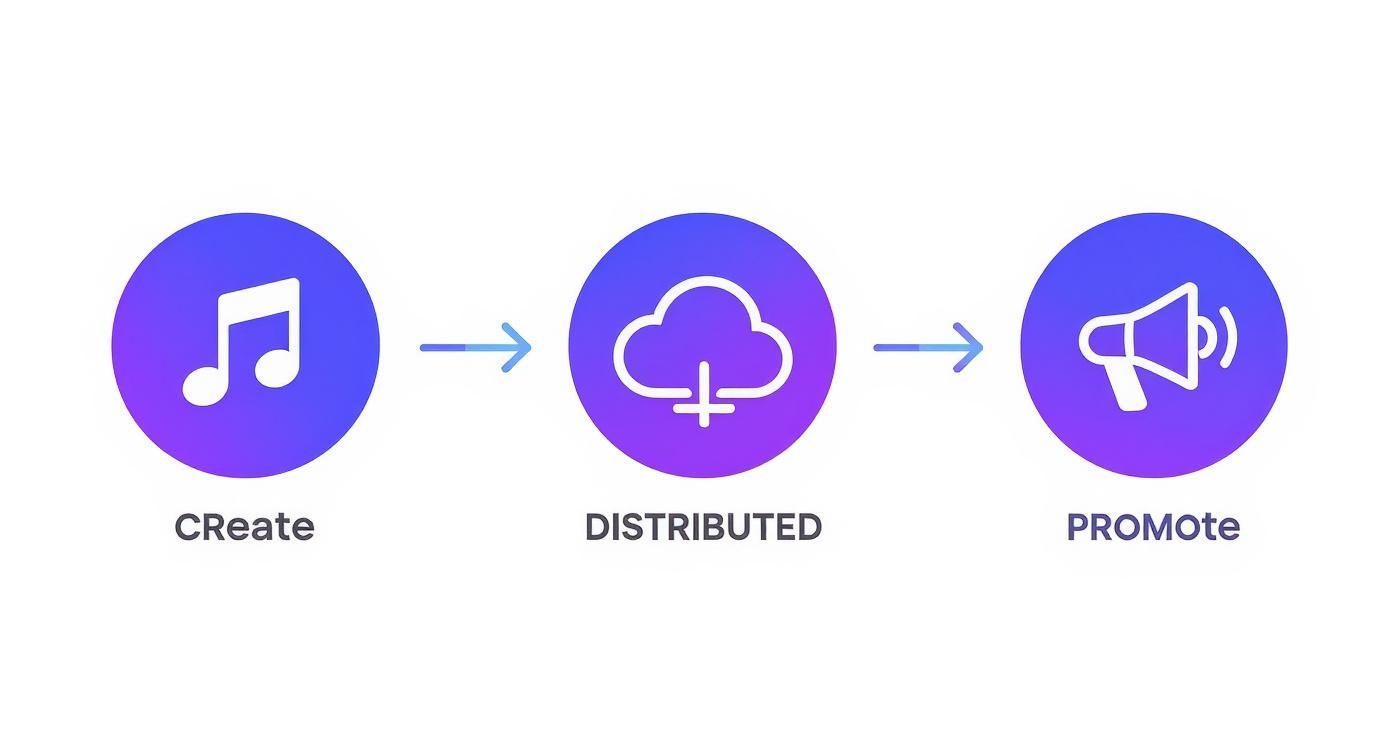
As you can see, promotion isn't some final step you take after the music is done. It’s a continuous effort that connects you with your listeners and inspires the new music you'll create for them.
Connect Authentically on Social Platforms
Think of platforms like TikTok, Instagram, and YouTube as your modern-day stages. The secret isn't being everywhere at once; it's being authentic wherever you choose to be. Your content has to do more than just announce a new song. It needs to tell your story.
Share the behind-the-scenes chaos of a song coming to life. Talk about the one lyric that means the most to you. You could even post a video about a creative experiment that totally failed. It’s that kind of vulnerability that builds a real connection. When people feel like they know the person behind the music, they're far more likely to become true supporters.
Of course, a huge part of this is figuring out platforms like YouTube. To do it right, you need more than just good content—you need a smart approach. Take some time to explore effective strategies to grow your YouTube subscribers who will actually connect with your music and your message.
Build Your Inner Circle with Direct Communication
Social media algorithms are notoriously fickle. One day you're getting reach, the next you're invisible. But a direct line to your fans? That's priceless. This is where an email list and direct-to-fan platforms like OohYeah become your most powerful assets. Someone's inbox is a personal, distraction-free space where you can share exclusive news, early access links, and personal stories.
Owning your audience connection is non-negotiable. An email list or a direct messaging channel on a fan platform gives you a reliable way to reach your most dedicated supporters without being at the mercy of a changing algorithm.
This direct access is everything. It's the difference between renting an audience on social media and actually owning a direct relationship with your community. Digging into why building a fanbase is essential for selling music will completely reframe how you approach every fan interaction.
The Undeniable Power of Live Performance
Even in our digital-first world, nothing beats the raw energy of a live performance for forging lasting connections. Whether it’s an open mic night, a local club gig, or a small ticketed show, playing live is how you turn online followers into real-life fans. It’s where they can feel the passion in your performance and connect with other people who love your music.
Live shows are still a critical pathway for artists. A huge chunk of the music industry's revenue comes directly from ticket sales, which just goes to show how important it is for an artist's career.
Make the most of every show with these tips:
- Engage the Crowd: Don't just stand there and play your songs. Talk to the audience. Share the stories behind the music. Make eye contact. Make them feel like they're part of the experience.
- Have Merch Ready: A performance is a prime opportunity to sell merchandise. A t-shirt or a vinyl record is a physical reminder of the connection you just made.
- Capture Email Addresses: Have a simple sign-up sheet at your merch table. Offering a free sticker or a digital download in exchange for an email is a classic, effective way to grow your direct list.
Building this community takes time and consistent effort. It's all about showing up, sharing your authentic self, and giving people a reason to believe not just in your music, but in you.
6. Navigate the Industry and Build Your Team
You’ve got the music and you’re starting to see a real fanbase take shape. That's a huge win. But trying to be the artist, manager, booking agent, and publicist all at once is a fast track to burning out.
If you want to take things to the next level, you need a network. And eventually, a team. The old saying, "it's who you know," still holds water, but how you get to know them has completely changed.
Forge Connections with Purpose
Forget about just swapping business cards at stuffy industry events. Real networking today is about building genuine connections and offering value before you ever think about asking for something.
The goal isn't just to meet a ton of people; it's to connect with the right people. Do your homework. Before you slide into a producer's DMs or email a manager, get to know their work. Who have they worked with? What's their vibe?
Follow them on social media and actually engage with their posts. When a producer you admire posts about a synth you love, that's your in. Start a real conversation, don't just send a cold pitch with a link to your demo.
Building a professional network isn't about collecting contacts; it's about cultivating relationships. Offer support, share their work, and demonstrate your value as a peer. This approach transforms a cold outreach into a warm introduction.
When you find yourself at a conference or a local music meetup, try listening more than you talk. Ask people about what they're working on. Genuine curiosity is probably the most effective networking tool you have.
Assembling Your Professional Circle
As things start picking up, you'll hit a point where you need to bring in pros to handle the business side of things. This is a good thing—it frees you up to do what you do best: make music. Knowing who does what is the first step to building a team that actually helps you grow.
Here’s a look at the key players who might join your corner as your career progresses.
Who's Who on an Artist's Team
Understanding the key players who can help elevate your music career and when to seek them out.
| Professional Role | What They Really Do | When You Might Need Them |
|---|---|---|
| Manager | The CEO of your music career. They guide your overall strategy, handle major business decisions, and open doors to their network. | When your career has real momentum and the business side of things is becoming too much to manage alone. |
| Booking Agent | Your live show guru. They find and negotiate performance opportunities, from local club gigs to full-blown tours. | Once you have a polished live set and proof that you can draw a crowd and sell some tickets. |
| Music Publisher | Manages the rights to your compositions (the lyrics and melody). Their job is to get your songs placed in TV, film, and ads (sync licensing) and collect your songwriting royalties. | As soon as you've written and released original music. It's never too early to protect your compositions and explore new revenue streams. |
| Publicist (PR) | Your storyteller. They craft your public narrative and get you press coverage in blogs, podcasts, and magazines to build buzz. | When you’re dropping a major project like an album or heading out on a tour and need to make a lot of noise. |
Bringing someone onto your team is a massive commitment, so don't rush into it. The right partner can launch your career into the stratosphere, but the wrong one can bring it to a grinding halt.
Look for people with a solid track record, sure, but more importantly, find someone who truly gets your vision and is a passionate believer in your music. This is your inner circle—choose wisely.
Turn Your Music Into a Sustainable Business
Let's be real: to make it in the long run, you have to think like more than just an artist. You have to become an artist-entrepreneur. Treating your music as a business isn't selling out—it's what gives you the power to build a real career, protect your creative work, and actually get paid for it.
This means you need to know exactly where the money comes from and have the legal pieces in place to collect it. Relying on streaming royalties alone is a recipe for a very, very slow climb. A modern music business is built on a smart mix of different income sources.
Diversify Your Income Streams
The most successful independent artists I know have built multiple channels for making money. Each one taps into a different part of their brand and connects with their fanbase in a unique way.
- Streaming Royalties: Okay, the per-stream payout is tiny. We all know that. But with a solid catalog and a growing audience, it becomes a steady, passive foundation.
- Sync Licensing: This is where things get interesting. Getting your music into TV shows, movies, ads, or video games can be a game-changer. A single sync deal can easily bring in more than millions of streams, with fees for indie artists ranging from $500 for a small TV spot to over $50,000 for a major ad campaign.
- Live Performances: Nothing beats playing live. Ticket sales are direct, immediate income, and the connection you make with fans at a show is something they can't get anywhere else.
- Merchandise Sales: T-shirts, vinyl, and posters aren't just cool swag. They are a massive profit center, especially when you're selling them directly to fans at shows or from your own website.
The artists who are truly financially secure are the ones who've built a multi-faceted business around their music. They aren’t just sitting around waiting for a royalty check; they're actively creating products, experiences, and opportunities.
Secure Your Legal and Financial Foundations
Understanding the business side is how you not only get into the music industry but stay in it. Before you can collect a dime, you have to get your legal house in order. These steps are absolutely non-negotiable.
First things first: copyright your work. Register your songs with the U.S. Copyright Office. This is your legal proof of ownership, your shield against anyone using your music without permission. Think of it as the deed to your house.
Next, you need to join a Performance Rights Organization (PRO). We’re talking about organizations like ASCAP, BMI, or SESAC. These are the folks who track and collect your performance royalties whenever your music is played publicly—on the radio, in a bar, on TV, or streamed online. If you're not with a PRO, you're literally just leaving money on the table.
Finally, for every single song you co-write, get your songwriting splits in writing. A simple split sheet that spells out who owns what percentage of the song is essential. It prevents ugly disputes later and is exactly what publishers and PROs need to pay everyone correctly. For a deeper dive into all of this, check out our guide on how to make money as a songwriter.
Got Questions About Breaking Into the Music Industry?
If you're an artist trying to find your footing, you're probably wrestling with the same big questions as everyone else. It's a crowded space, and figuring out what actually moves the needle can feel overwhelming. Let's cut through the noise and tackle the questions I hear most often.
Is a Record Label Still a Must-Have for Success?
The short answer? Not at all. Gone are the days when a label deal was the only path to a career. Today, you have the tools to build a sustainable, profitable career entirely on your own terms.
A label can bring a big budget and a team to the table, but building your own success first gives you all the power. If and when you do sit down with a label, you'll be negotiating a partnership, not begging for a shot.
Think of yourself as the CEO of your own startup. Your ability to market yourself, build a genuine brand, and connect with people is just as important as your ability to write a killer song.
Realistically, How Do New Artists Make Money?
Forget about getting rich off streaming royalties at the start. It’s just not going to happen. Your first few years are about building multiple, diverse income streams. You have to think bigger than the play count right from the get-go.
Focus on these three areas to generate real cash flow early on:
- Live Shows: Getting paid for gigs, even small local ones, is your most immediate source of income. Ticket sales and a cut of the bar add up.
- Merchandise: Your fans want to support you. Selling t-shirts, vinyl, and other creative items at shows and online is a proven moneymaker with great profit margins.
- Direct Fan Support: Platforms like Patreon or Bandcamp are brilliant for this. They let your most dedicated fans support you directly, creating a reliable, recurring revenue stream.
Ready to take control of your music business? OohYeah provides the tools you need to sell your music, merch, and subscriptions directly to your fans—all in one place. Start building your career on your own terms today at https://oohyeah.app.