How Do I Get Into the Music Industry? Your Modern Guide
Wondering how do I get into the music industry? Discover actionable steps to develop your sound, build your brand, and succeed in the modern music scene.
October 20, 2025
Music Marketplace Advisor
Buying & SellingLet's get one thing straight: the old idea of a single "big break" is dead. If you're wondering how to get into the music industry today, it's not about being discovered out of thin air. It’s about methodically building a career through your skill, strategy, and genuine connection with others. This guide is your no-nonsense roadmap to do just that.
Your Modern Roadmap for a Music Career
 Not too long ago, the path to a music career felt like a lottery, with a few gatekeepers at major labels holding all the winning tickets. Today, the game has completely changed. It’s still incredibly competitive, don’t get me wrong, but the tools you need to build a career from the ground up are now at your fingertips. This isn't about waiting for a label to find you; it's about becoming the CEO of your own music business.
Think of this guide as your playbook. We're going to move past vague advice and give you a clear framework you can start using right away.
A New Era for Artists
The shift in power over the last two decades has been seismic. Back in the early 2000s, major labels had an iron grip on about 80% of music distribution, making it a near-impossible climb for independent artists.
Now, fast forward to 2023. Independent artists represent over 35% of the global streaming market. That’s a massive jump from just 2% in 2010. You can dig into the full data on this industry shift to see just how much the landscape has opened up.
This isn't just a trend; it's proof that a real, sustainable career outside the traditional system is not only possible but is quickly becoming the new standard. Your success now depends on your ability to connect directly with your audience and build a business around your art.
The question has shifted from "How do I get signed?" to "How do I build a self-sustaining music enterprise?" This guide is here to answer that second question, focusing on practical strategies for today's independent creator.
What This Guide Will Cover
We’re going to walk through the core components you need to build momentum and turn your passion into a profession. Consider this your personal roadmap, covering the entire journey from honing your craft to actually earning a living from your music.
Here’s a look at what we’ll tackle:
- Defining Your Artistic Identity: It all starts with the music. We'll talk about honing your craft and creating a sound that is authentically you.
- Building a Compelling Brand: This is about crafting a story and a look that turns casual listeners into true fans.
- Strategic Networking: Making real connections that lead to collaborations, opportunities, and genuine growth.
- Mastering Distribution: The nuts and bolts of getting your music on platforms like Spotify and Apple Music and into the ears of a global audience.
- Monetization Pathways: We'll explore the different ways you can make money, far beyond just streaming royalties.
Modern Pathways into the Music Industry
To get a clearer picture of how artists are breaking in today, let's look at the main strategies that are working right now. These are the modern-day "front doors" to the industry.
| Pathway | Key Actions | Primary Tools |
|---|---|---|
| The DIY Influencer | Build a large, engaged following on social media by consistently posting high-quality content (covers, originals, behind-the-scenes). | TikTok, Instagram Reels, YouTube Shorts |
| The Live Performer | Grind it out in local venues, building a fanbase through live shows, touring, and selling merchandise. | Local venues, booking agents, Bandcamp, social media event promotion |
| The Digital Networker | Focus on online collaboration, connecting with producers, songwriters, and other artists to cross-promote and create opportunities. | SoundCloud, Discord, email outreach, OohYeah community forums |
| The Sync Licensing Hustler | Create a portfolio of high-quality, licensable tracks and pitch them for use in TV, film, ads, and video games. | Music libraries (e.g., Artlist, Musicbed), sync agents, direct outreach to supervisors |
Each of these pathways requires a different blend of skills and effort, but they all share a common thread: proactive work. The days of passively waiting are over; today's industry rewards those who take initiative.
Mastering Your Craft and Defining Your Sound
Before you ever think about marketing, branding, or even playing your first show, the journey has to start with the one thing you can completely control: the music itself. In a world saturated with new tracks every single day, your musicianship and unique voice are the only things that truly matter. Getting this right isn't just a step; it's the foundation for everything else you hope to build.
It's easy to fall into the trap of thinking raw talent is enough. But the artists who have real staying power are the ones who treat their craft like a discipline. They show up day after day with focused, intentional effort. This is about moving past just playing and getting into the headspace of deliberate practice.
Go Beyond Basic Practice
Mastery never comes from just repeating what you already know. It’s born from pushing your own boundaries, pinpointing your weaknesses, and systematically turning them into strengths. A truly great song is so much more than a catchy melody; it's a carefully constructed blend of technical skill, emotional honesty, and thoughtful arrangement.
If you're serious about leveling up, try a few of these approaches:
- Deconstruct Your Influences: Don't just learn a cover—tear it apart. Why is that bassline so effective? How does that specific chord progression make you feel something? This kind of deep listening trains your ear and fills your creative toolbox with new ideas.
- Embrace Music Theory: You don't need a PhD in musicology, but understanding the fundamentals is like learning the grammar of your language. It gives you a framework for your ideas and opens up pathways for songwriting you might never find by just noodling around.
- Record Yourself. Constantly: Your phone is an incredibly powerful tool. Get in the habit of recording practice sessions, song ideas, and even live rehearsals. Listening back gives you an unfiltered look at what's really happening. You’ll hear timing issues, pitch problems, or clunky arrangements you'd otherwise miss in the moment.
The goal of practice isn't just perfection. It's to get so comfortable with your instrument that it becomes a seamless extension of your creative mind. When you stop having to think about the 'how,' you can finally focus on the 'what' and 'why' of your music.
Finding Your Unique Artistic Voice
Your unique sound lives at the intersection of your influences, your personal story, and your technical ability. It's that unexplainable quality that makes someone hear a track and know, without a doubt, that it’s yours. This isn’t something you discover overnight; it’s a process of constant experimentation, refinement, and sometimes, failure.
Start by asking yourself some hard questions. What do you actually want your music to say? What do you want your listeners to feel? The answers will become your North Star, guiding every creative choice you make, from the lyrics you write to the sonic textures you layer in your production.
The Power of Collaboration and Feedback
Trying to do it all in a vacuum is the fastest way to hit a creative wall. If you truly want to understand how to get into the music industry, you have to learn to work with others and, just as importantly, learn how to take constructive criticism.
Finding the right collaborator can completely change your trajectory. A producer with a fresh perspective might push your sound in an exciting new direction, or a co-writer could help you unlock a lyrical concept you’ve been stuck on for months. These partnerships are invaluable because they challenge your habits and force you to think differently.
It's also crucial to build a trusted circle—other musicians, producers, even a few hardcore fans—who will give you honest feedback. It can sting to hear that your chorus isn't landing or the mix is muddy, but that kind of input is gold.
- Ask for specifics. Instead of "Do you like it?" try "How does the second verse make you feel?" or "Is the transition into the bridge working for you?"
- Separate your art from your ego. Remember that feedback on your song isn't a personal attack. It's just data. Use it to make the final product better.
The digital era has thrown the doors wide open for independent artists. Streaming platforms give you a direct line to fans, meaning you no longer have to wait for a gatekeeper to give you a chance. Data from MIDiA Research shows that independent artists saw their revenue grow by a massive 18% in 2022, fueled almost entirely by direct digital distribution. You can read the full MIDiA Research report on independent artist growth to see just how much the ground has shifted.
But with this incredible opportunity comes a higher bar. The only way to cut through the noise is with a polished, unique, and undeniable sound.
Building Your Brand as an Artist
Okay, so you’ve spent countless hours honing your craft and your sound is finally where you want it to be. That’s a huge milestone. But now comes the next challenge: building a world around your music.
Your artist brand is what connects your music to an audience. It's the story, the look, and the vibe that turns a casual listener into a dedicated fan. In a world where music is everywhere, a strong brand is what makes you stick.
The sheer volume of new music is staggering. Back in 2021, Spotify was already getting over 40,000 new songs uploaded every single day—and that firehose of content has only gotten wider. With that kind of noise, your brand isn't just a "nice-to-have"; it's how you get heard in the first place.
Crafting Your Unique Story
Your brand story is the soul of your entire project. This isn't about inventing some fake persona. It's about finding the most authentic parts of yourself and your music and turning up the volume. What experiences led you to write these songs? What message are you trying to get across?
Think about your favorite artists. You can instantly picture their brand because it’s authentic and consistent. Whether it's the raw honesty of a folk singer or the chaotic energy of a punk band, their story is baked into everything they release. That narrative is the hook that pulls people in and makes them feel like they know you.
Your brand isn’t just a logo or a color scheme. It's the promise you make to your listeners—the consistent experience they can expect every time they engage with your art, your posts, or your shows.
This story has to feel real across every platform. From your social media bio to your answers in an interview, everything should line up. To keep it all straight, it’s a good idea to put together some simple social media brand guidelines so your online presence always feels intentional.
Developing a Cohesive Visual Identity
Let’s be real: people judge a book by its cover. Before anyone even hits play, they're forming an opinion based on what they see. Your visual identity is everything from your press shots and album art to the fonts you use on your Instagram stories.
- Professional Photography: Please, invest in good photos. High-quality press shots that capture your vibe are non-negotiable for your press kit, social profiles, and any media outreach.
- Consistent Aesthetic: Settle on a visual theme that actually matches your music. Are you minimalist and clean, or are you more gritty and vintage? Whatever you choose, run with it across your website, socials, and video thumbnails.
- Memorable Logo/Logotype: A simple, strong logo or even just a unique font for your name helps people remember you. This is a core asset you’ll use on everything from merch to posters.
A solid visual identity makes you look professional and helps your content pop in a crowded feed. It’s the visual shorthand for your entire brand. For a deeper dive, check out our guide on why artists should focus on branding and image.
Assembling Your Electronic Press Kit
Think of your Electronic Press Kit (EPK) as your professional music resume. It's the go-to link you send to journalists, bloggers, venue bookers, and A&R reps so they can get the full picture without having to dig around. A polished EPK tells them you’re serious.
This should be a clean, easy-to-navigate page on your website or a slick, well-organized PDF. Clutter is your enemy. The goal is to make it incredibly simple for a busy industry person to find exactly what they need in seconds.
Essential EPK Components
| Component | Description | Why It's Important |
|---|---|---|
| Artist Bio | A compelling summary of your story, sound, and recent accomplishments. | This is your elevator pitch. It needs to grab attention and tell a memorable story, fast. |
| High-Res Photos | A gallery of professional, downloadable press photos (both portrait and landscape). | Media outlets need good images for their articles. Making them easy to grab removes a major hurdle. |
| Music | Embeds of your key tracks, music videos, and links to your streaming profiles. | Give them instant access to your best work without making them search for it. |
| Press & Accolades | Links to any articles, blog features, or reviews you've received. | This is social proof. It shows that other people are already talking about you. |
| Contact Info | Clear contact information for you, your manager, or your publicist. | Makes it dead simple for interested people to reach out for bookings or interviews. |
Your EPK is the key that opens professional doors. Having a great one ready to go shows you understand the business side of things, a crucial part of figuring out how to get into the music industry.
Networking and Building Industry Connections
https://www.youtube.com/embed/uMycaWdznMY
You’ve probably heard the old saying, "It's not what you know, it's who you know." In music, that’s only half the story. The real truth is closer to this: it’s about who knows you and, more importantly, what they think of when they hear your name.
Networking isn't about schmoozing or collecting contacts. It's about building a real, supportive community around your art. A producer you vibe with might pull you into a session. A venue owner who likes your hustle might offer you a last-minute opening slot for a national act. These career-changing moments don't come from cold emails; they come from genuine relationships built on mutual respect.
Start Where You Are: Your Local Scene
Before you start DMing A&R reps in another city, look around. Your local music scene is your first and most important network. These are the people you'll come up with, and those early bonds are powerful.
Get out there. Go to shows, especially on nights you're not playing. Introduce yourself to the other bands. Buy a t-shirt. Chat with the sound tech and the person taking tickets. Be a genuine fan and supporter of your local scene, and you'll be amazed at how that energy comes back to you.
Digital Handshakes: How to Network Online
Your online presence is your modern-day business card. Platforms like Instagram, X (formerly Twitter), and even LinkedIn are incredible for making connections, but you have to play it smart.
Here’s how to do it right:
- Engage, Don't Just Follow: Don't be the person who follows and immediately slides into the DMs with a link. Leave thoughtful comments. If a producer you admire posts about a new piece of gear, ask a smart question. Show you're paying attention.
- Give Before You Get: This is the golden rule. Instead of asking for a feature, share their latest track on your story and tag them. Offer a genuine compliment on a specific lyric or production choice. Building goodwill always pays off.
- Keep it Pro: When you do finally reach out directly, be brief and professional. Say who you are, why you're a fan of their work, and have a clear, simple point. Often, the best first message has no "ask" at all—it's just an introduction.
The most powerful networking happens when your goal is just to connect and learn. People can spot desperation a mile away. Focus on building real relationships, and the opportunities will find you.
Talent alone rarely cuts through the noise anymore. The modern artist has to be a marketer, a brand builder, and a community manager. Data shows just how much this shift matters; independent artists are generating serious income by going direct to their audience. In fact, direct-to-artist revenue streams hit $1.7 billion in 2022, which is more than the entire global CD market. You can explore the data on direct-to-artist revenue streams to see how powerful this has become.
From Connection to Collaboration
Ultimately, the point of networking is to find your people—the ones you can create amazing things with. A single great collaboration can open more doors than a hundred polite emails ever will.
Think about it: working with a more established local artist exposes you to their entire fanbase overnight. Co-writing with someone whose lyrical skills complement your melodic instincts can lead to a song that neither of you could have written alone.
These partnerships are the bedrock of a sustainable career. For a deeper dive, check out our guide on why networking is important in the music industry. Every person you meet is a potential collaborator, mentor, or fan. Your reputation is built one conversation at a time—make each one count.
Get Your Music Out There and Find Your Audience
You’ve poured everything into your music. It's mixed, mastered, and your brand feels right. So, what's next? It's time to get your art into the hands—and ears—of the world. This is where modern music distribution comes in, acting as the essential bridge between you and listeners on Spotify, Apple Music, and all the other major platforms.
This isn’t just about uploading a file; it’s the official launch of your music into the marketplace. Your choice of distribution partner and release strategy can make or break your impact. While getting a label deal is still a path for some, today's music world rewards artists who are proactive. Persistence and smart self-promotion are the name of the game.
Finding the Right Digital Distributor
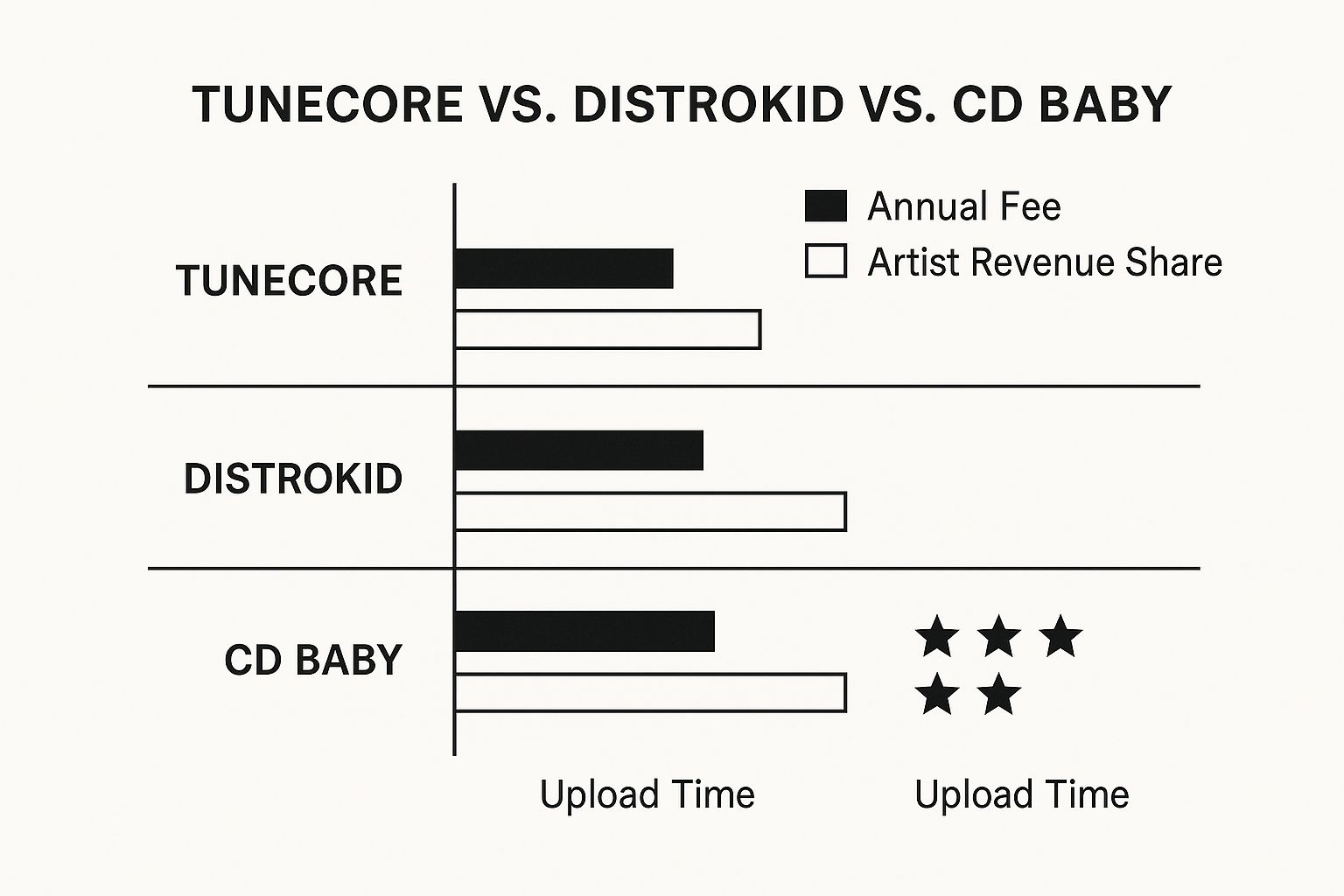
Think of a digital distributor as the logistics service for your music. They're the ones who take your tracks and all the associated info (like artwork and credits) and deliver them to hundreds of online stores and streaming services globally. For most independent artists, the big three are TuneCore, DistroKid, and CD Baby, and they each operate a little differently.
The best choice for you really boils down to your release plans and your budget. Are you a singles artist dropping a new track every month, or are you focused on releasing a full album once a year? Answering that question will get you much closer to figuring out which service makes the most financial sense.
To help you sort through the options, I've put together a quick comparison of the major players. This table breaks down what you can expect from each service, from how they charge to what cut you get to keep.
Digital Music Distributor Comparison
| Distributor | Pricing Model | Artist Keeps % of Royalties | Key Feature |
|---|---|---|---|
| TuneCore | Annual fee per release | 100% | Comprehensive publishing administration add-on |
| DistroKid | Annual fee for unlimited uploads | 100% | Fast uploads and unique promotional tools |
| CD Baby | One-time fee per release | 91% | Physical distribution (CD/vinyl) options |
Looking at this, you can see the trade-offs. An annual fee service like DistroKid is great for prolific artists, while a one-time fee from CD Baby might be perfect if you release music less frequently. For a deeper dive, our guide on how to choose the right music distribution service breaks it all down.
Building a Smart Release Campaign
Here’s a hard truth: just uploading your music and hoping people find it is a surefire way to get lost in the noise. A successful release is a carefully planned campaign, designed to build hype and get as many ears on your track as possible from day one.
You need to start planning at least four to six weeks before your release date. Seriously. This runway gives you enough time to get your music submitted, pitch to playlist editors, and get all your promotional content ready to go.
Here's what that timeline should look like:
- Get Your Assets Together: Finalize everything—the master audio file, high-res cover art, press photos, and a short bio.
- Upload to Your Distributor: Submit everything at least four weeks ahead of time. This is non-negotiable if you want to ensure your music goes live everywhere on the same day.
- Pitch to Playlists: As soon as your distributor delivers your track to Spotify, you can log into your Spotify for Artists account and pitch it directly to their editorial team. This is your shot at getting on massive playlists.
- Launch a Pre-Save: About two weeks out, start pushing a pre-save campaign. This gets fans to add your song to their library ahead of time, which signals to the algorithms that your track is worth paying attention to on release day.
A great release campaign tells a story. It’s not just about the song; it's about the entire experience you create for your audience leading up to the moment they can finally press play.
Registering Your Music to Get Paid
Getting paid in music is way more complicated than just cashing a check from Spotify. To collect every dollar you've earned, you have to register your songs with the right organizations. This is, without a doubt, one of the most common steps new artists miss.
Performance Rights Organizations (PROs) are the ones who track and collect performance royalties. These royalties are generated anytime your song is played in public—think radio, TV shows, bars, cafes, and, yes, online streams.
These are the organizations you absolutely need to know:
- ASCAP, BMI, or SESAC (US): As a songwriter, you need to join one of these PROs. They collect and pay out the songwriter's share of performance royalties.
- SoundExchange: This is a separate but equally important organization. SoundExchange collects digital performance royalties for the owner of the master recording (that's probably you) and for the featured artists on the track. This is completely different from the songwriting royalty collected by the PROs.
If you don't register with these groups, you are literally leaving your money on the table. It’s a bit of admin work, but it’s a critical part of treating your music like a business. It’s also a huge piece of the puzzle when you're trying to figure out how do I get into the music industry. And in today's world, don't forget to make your music easy for new fans to find. Using tools like QR codes for Spotify to promote audio content can be a simple but effective way to bridge the gap between the physical and digital worlds.
Music Industry FAQs: Your Biggest Questions, Answered
Let's be real—trying to make it in music brings up a ton of questions. The industry can feel like a maze, especially when you're just starting out and trying to figure out how to get into the music industry the right way.
We've all been there. So, let's break down a few of the most common questions that artists grapple with on their journey.
Do I Still Need a Record Label to Succeed?
This is the big one, isn't it? The simple answer is no. A traditional record deal isn't the only ticket to the show anymore, and countless independent artists are proving you can build a sustainable career entirely on your own terms.
But that doesn't mean labels are useless. A good label partner can bring serious firepower to the table—we're talking big marketing budgets, deep industry connections, and a full team to handle the business grind so you can focus on the music. The real question isn't "Do I need a label?" but rather, "What are my goals, and would a label help me get there faster?"
For many, staying independent means total creative freedom and keeping a much bigger slice of the pie. For others, the muscle and structure of a label are worth the trade-off.
The game today isn't about being signed vs. independent. It's about finding the right business model for your art, right now. That could be fully DIY, a label services deal, or a traditional contract down the road.
How Much Money Do Artists Actually Make from Streaming?
Ah, streaming royalties. It's a complicated and often frustrating topic. There's no magic number for what a stream is "worth" because the payout is a moving target.
Your actual earnings depend on a mix of things:
- Which Platform: Spotify, Apple Music, and TIDAL all pay out differently.
- Where the Listener Is: A stream from a paid subscriber in the U.S. will earn you more than one from a free user in another country.
- Your Distribution Deal: The cut your distributor takes directly impacts what lands in your pocket.
Here’s the honest truth: for most new artists, streaming is a marketing engine first and a direct paycheck second. Don't count on it to pay the rent right away. Think of it as the fuel that drives your real money-makers—live shows, merch sales, and licensing deals.
When Should I Look for a Manager?
Hiring a manager is a massive step, and jumping the gun is one of the most common mistakes artists make. A manager’s job is to scale a business that’s already working, not build one from the ground up for you.
So, when is the right time? You should start looking for a manager when you have so much momentum that you literally can't handle all the opportunities yourself.
That usually looks something like this:
- You have a consistent brand and a solid catalog of music.
- Your fanbase is growing organically and showing up for you online and at gigs.
- You're getting regular DMs and emails for bookings, collaborations, or press features.
Once you have that real, tangible traction, a great manager can step in to handle negotiations and long-term strategy, freeing you up to create. Until you hit that point, the best manager for your career is you.
Ready to stop guessing and start building? OohYeah gives you the tools to sell your music, merch, and fan subscriptions directly to the people who matter most. It’s time to build your own ecosystem. Get started at OohYeah.