How Do I Get Into the Music Business An Insider's Guide
Wondering how do I get into the music business? This guide gives you a real-world roadmap, from finding your role and building a brand to monetizing your work.
January 19, 2026
Music Marketplace Advisor
Buying & SellingBefore you can even think about breaking into the music business, you need to figure out where you fit. It’s not about waiting for a lucky break; it’s about making a deliberate choice. You have to align your own unique talents—whether they’re creative, organizational, or strategic—with a genuine need in the industry.
Finding Your Place in the Music Industry
When people hear "music business," their minds usually jump straight to sold-out stadiums and platinum albums. But that’s just the tip of the iceberg. The industry is a massive, sprawling ecosystem of highly specialized roles. The real first step is to ask yourself: am I a creator, a strategist, a connector, or a technician? Getting honest about your natural strengths is the only compass you need to guide your career.
Too many people get tunnel vision, focusing only on becoming the star artist. In doing so, they completely overlook dozens of critical roles that are often just as fulfilling and, frankly, more financially stable. The industry simply wouldn't run without the countless professionals working behind the scenes. Look past the spotlight, and you'll find a world of opportunity where all sorts of different skills can flourish.
Matching Your Skills to the Right Role
Success here isn't just about raw talent; it’s about knowing how to apply it. Someone with an incredible ear for sonic detail might make a phenomenal producer or audio engineer. On the other hand, a person who loves bringing order to chaos and helping artists thrive is probably a natural-born manager.
This isn't just theory. You can see how a central talent can branch out into very different, but equally impactful, career paths.
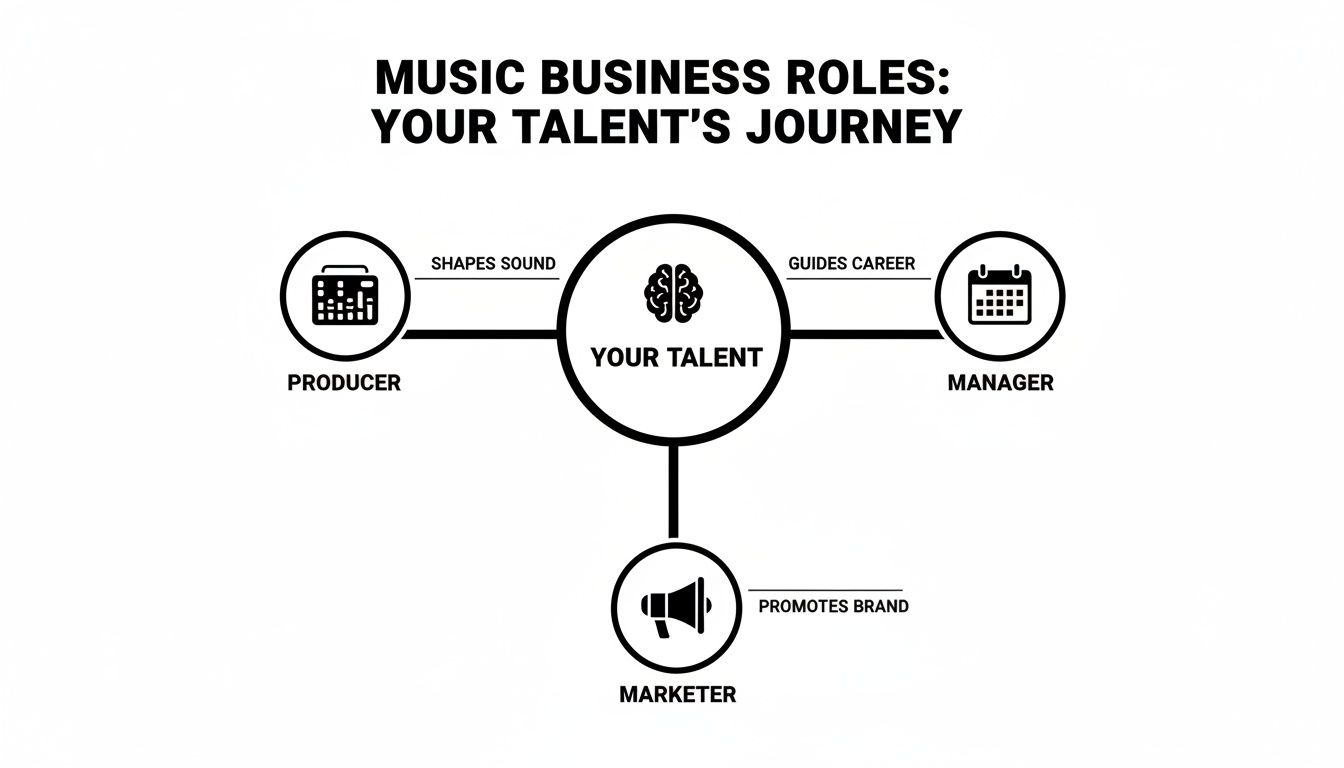
The map shows it clearly: whether your strength is in the creative, the strategic, or the communicative, there’s a specific job waiting for that skill.
My two cents: Stop trying to be everything to everyone. The single most effective way to break in is to get exceptionally good at one thing. Find your core competency and build your professional identity around it.
This focused approach makes you far more memorable and valuable. Instead of being a vague "musician who also manages and promotes," you become "the go-to producer for indie rock" or "the marketing strategist who actually gets the metal scene." Specialization is your superpower.
Music Industry Roles and Core Skills
To make this more concrete, let's look at a few of the most common career paths in music. This table breaks down what they do and what it takes, helping you see where your talents and ambitions align best.
| Role | Primary Responsibilities | Essential Skills |
|---|---|---|
| Producer | Oversees the recording process, shapes the sonic direction of a track or album, and guides the artist's creative vision. | Music theory, DAW proficiency (e.g., Pro Tools, Ableton), project management, communication. |
| Artist Manager | Acts as the CEO of the artist's career, handling business decisions, contract negotiations, and long-term strategic planning. | Negotiation, organization, strategic thinking, networking, financial literacy. |
| Promoter | Organizes and markets live shows, from booking venues and handling ticketing to promoting the event to drive attendance. | Marketing, event planning, sales, risk assessment, local market knowledge. |
| Marketer/Publicist | Creates and executes campaigns to build an artist's brand, secure media coverage, and grow their fanbase. | Storytelling, social media management, content creation, media relations, branding. |
| A&R Representative | "Artists and Repertoire." Scours for new talent, signs artists to a label, and helps guide their artistic development. | Talent scouting, trend analysis, industry knowledge, relationship-building. |
Each path demands a completely different mindset and skillset, yet they are all absolutely essential for helping an artist succeed. Picking your lane is the foundational decision that will shape every other choice you make, from the skills you develop to the people you meet.
Building Your Professional Toolkit and Brand
Once you’ve figured out where you fit, it’s time to build the assets that prove you belong there. Raw talent is great, but in this business, it's the professional presentation that gets you in the door. This is the moment you stop thinking like an aspiring creative and start acting like a business-minded pro who knows that packaging matters just as much as the product itself.
For artists and producers, that means your demo tape is dead. Its modern replacement is a polished Electronic Press Kit (EPK). This is your digital resume, and it's often the very first thing a booking agent, journalist, or A&R rep will see. It has to be sharp.

Crafting a Standout Electronic Press Kit
Think of your EPK as your professional handshake. It needs to give someone everything they need to know in one clean, easy-to-digest package. Don't make them dig for information, because they won't.
A truly effective EPK must include:
- A concise and engaging artist bio: This isn't your life story. It's a tight, well-written narrative that explains who you are, what your music sounds like, and why anyone should care.
- High-resolution photos: Seriously, invest in a real photographer for headshots and live performance pics. Grainy phone pictures immediately brand you as an amateur.
- Your best music: Embed 2-3 of your absolute strongest tracks. Make it effortless for them to hit play without leaving the page.
- Links to your work: Drop in links to your official website, social media profiles, and streaming platforms like OohYeah.
- Contact information: Have a dedicated, professional email address for bookings and inquiries.
[email protected]works just fine.
If you’re aiming to be a manager or marketer, your toolkit will look different. Instead of an EPK, you need a portfolio that proves you can get results. Start by helping a local artist build their social media or by promoting a small gig. Document everything—track the 25% bump in ticket sales or the 40% growth in Instagram followers—and turn it into a simple case study. These small wins are your proof of concept.
Defining Your Unique Brand Identity
Your brand is so much more than a logo. It's the story you tell. It's the gut feeling people have when they hear your name or see your art. In a ridiculously crowded field, a strong, consistent brand is what makes you stick.
Your brand is the reason someone chooses you over the next person. In an industry built on connection and emotion, a clear identity isn't just a marketing tactic—it's a necessity for anyone trying to get into the music business.
A solid social media strategy is non-negotiable for managing your presence and connecting with fans. Your brand’s voice and look must be consistent everywhere you show up. To keep your messaging on point, tools like an Instagram Caption Generator can be surprisingly helpful for crafting posts that align with your established tone.
Building an authentic brand takes work, and it's something we explore more deeply in our guide on why artists should focus on branding and image.
A cohesive brand all comes down to consistency across three key areas:
- Visuals: Your logo, color scheme, typography, and the overall vibe of your photos and videos. Think of Billie Eilish—her neon green and baggy clothes were an instantly recognizable part of her brand from day one.
- Messaging: This is your tone of voice on social media, in your bio, and in interviews. Are you funny and irreverent, or serious and introspective? It should feel connected to your music.
- Values: What do you actually stand for? When your brand is tied to something bigger than just your music, you forge a much deeper connection with fans who share those same values.
At the end of the day, whether you're creating an EPK or a portfolio of marketing wins, the goal is identical: assemble a professional package that proves you have both the creative talent and the business savvy to make it. This toolkit is your ticket in.
Getting Your Music Heard and Paid
Great music is the starting point, but getting that music in front of an audience—and actually getting paid for it—is what turns your passion into a real career. Not too long ago, artists were completely dependent on labels and industry gatekeepers. Today, you have a direct line to listeners all over the world. The trick is knowing how to navigate the current environment and using the right tools to build your own financial ecosystem.
The first thing to wrap your head around is the sheer scale of how people listen to music now. If you want to break into the music business, you have to understand that streaming is king. Global recorded music revenues recently soared to $29.6 billion, and a massive 69% of that came from streaming. With 106,000 new tracks hitting these platforms every single day, you can see why just uploading your music and hoping for the best is a recipe for getting lost in the noise.
Taking Control with Direct-to-Fan Platforms
Instead of chasing fractional pennies per stream on the major platforms, a direct-to-fan strategy puts you in control. This is exactly what platforms like OohYeah were built for. They let you create a central hub where fans can do more than just listen—they can directly buy your music and support you.
This approach is so effective because it flips the script from passive consumption to active support. When you use a platform where you can sell your music directly to fans, you cut out the middlemen and keep a much healthier chunk of the revenue. It puts you squarely in the driver's seat of your career.
The most successful independent artists today don't just release music; they build multi-faceted businesses around their art. Thinking like an entrepreneur from day one is the fastest way to turn your creative output into a reliable income.
This shift in mindset is about creating multiple avenues for your audience to support you. It's not just about one-off track sales; it's about building a complete commercial experience for the people who love what you do.
Building Diverse and Recurring Revenue Streams
Relying on a single income source is a fragile way to build a career. A truly resilient path in music is built on a diverse portfolio of revenue streams that cater to different levels of fan engagement. This is your chance to get creative and design a system that fits your unique brand.
Here are a few models you can put into action right away:
- Digital Sales: Let your biggest fans buy high-quality, commission-free downloads of your tracks and albums. This is for the people who want to own your music and support you in the most direct way.
- Exclusive Subscriptions: Set up tiered membership levels for your superfans. Think about offering access to unreleased demos, behind-the-scenes videos, monthly Q&A sessions, or early bird access to concert tickets and merch drops. This gives you a predictable, recurring monthly income stream.
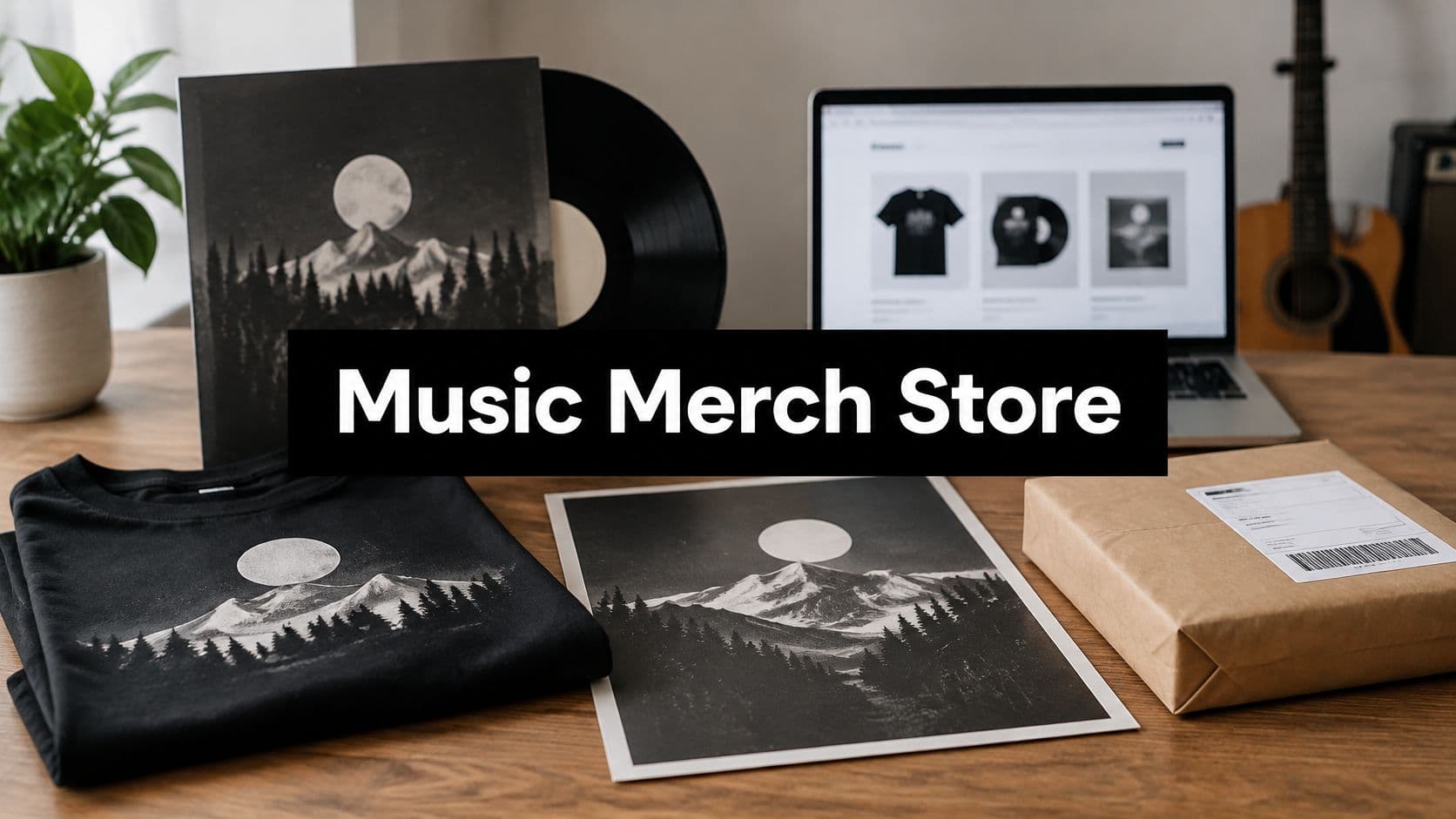
- Integrated Merchandise: Your music page shouldn't just be for music. Integrate a storefront to sell t-shirts, posters, vinyl, and other custom gear right alongside your tracks. This way, every visitor becomes a potential customer for more than just your songs.
When you combine these elements, you transform your artist page from a simple music player into a comprehensive online headquarters—a one-stop shop for your most dedicated followers.
Funding Your Next Big Project
Beyond direct sales, you can also rally your community to bring your next big idea to life. There are plenty of proven strategies for crowdfunding for musicians that can help you get started. This approach doesn't just raise the money for a new album or tour; it deepens the connection with your audience by making them a real part of your creative journey.
Ultimately, getting your music heard and paid for is about more than just distribution—it’s about ownership. When you control your music, your merchandise, and your fan relationships, you're no longer just a participant in the music business. You're building your own.
Winning Fans with Live Performances
While streaming gets your music out there, the stage is where you build your tribe. A killer live show forges a bond with an audience that a digital stream just can't match. This is where you turn casual listeners into die-hard fans—the people who buy your merch, drag their friends to your next gig, and stick with you for the long haul.
Don't start by plotting a national tour. The journey begins in your own backyard. Think of local open mics and small venue gigs as your training ground. They're low-stakes opportunities to test-drive new songs, get comfortable in front of a crowd, and start generating some local buzz. Treat every one of these shows like you're headlining a festival.
From Local Stages to Regional Tours
Once you've built a solid local following, it’s time to level up. The most logical next step is landing opening slots for more established, touring bands that roll through your town. This is a golden opportunity to perform for a built-in crowd that's already there to discover new music.
Getting these gigs requires a mix of professionalism and persistence.
- Build Your Network: Get to know the local promoters and venue bookers. Seriously. Go to their shows, introduce yourself, and show that you're an active part of the scene.
- Have a Killer EPK: Your Electronic Press Kit needs to be sharp and easy to digest. A promoter should be able to grasp your entire vibe and value in less than a minute.
- Prove You Can Draw a Crowd: You need to show them you can bring people through the door. Even if it's just 30-50 people at first, documented ticket sales or strong social media engagement for a show proves you have a real-world audience.
This is how you climb the ladder. A few successful opening gigs can lead to offers for small regional tours or a slot on a local festival bill, letting you expand your reach one city at a time.
The Business of Being on the Road
Touring might seem glamorous, but it's a business venture that demands serious planning and financial smarts. A poorly managed tour is a fast way to lose money and burn out completely. Think of your tour budget as your roadmap to staying on the road.
A live show is more than just a performance; it’s a direct touchpoint with your audience and a major revenue opportunity. Mastering the logistics behind touring and the art of the merch table is a critical step for anyone asking how do I get into the music business for the long haul.
Never underestimate the power of live music. Live Nation alone reported $23.1 billion in revenue from over 54,000 events, and top tours grossed $9.5 billion—a number that keeps growing. This shows how crucial live events are, complementing your streaming strategy and giving you a direct revenue stream. This is where a platform like OohYeah becomes so valuable, allowing you to promote tour dates and sell tickets right alongside your music and merch, connecting your online presence with your on-stage hustle. For a deeper dive into the numbers, check out these industry trends and the 2025 global report.
More Than Just Music: A Memorable Experience
At the end of the day, people come to a show for an experience. Your set is the main event, but the real magic happens when you create an entire atmosphere that sticks with them long after the last note.
Think about the whole journey from a fan's perspective:
- The Hype: Use your OohYeah community posts to get people excited before the show. Share behind-the-scenes rehearsal clips or drop a hint about the setlist.
- The Show: This is your moment. Pour everything you have into a high-energy, authentic performance that truly connects with the people in the room.
- The Merch Table: Don't just make it a place to sell t-shirts; make it a destination. Hang out after your set to talk to fans, sign stuff, and take photos. That personal connection is priceless.
For managers and promoters, these shows are where they scout new talent and see an artist’s true potential. By mastering the art of the live performance, you aren’t just winning over fans—you’re building a career that can actually last.
Building Your Network and Going Global
People always say, "it's not what you know, it's who you know." In the music business, that's less of a cliché and more of a fundamental truth. Nearly every big break—whether it's a game-changing gig, a sync placement, or a record deal—boils down to the relationships you've built. But networking isn't about collecting contacts or relentlessly pitching yourself. It's about building genuine professional connections that can open doors you didn't even know existed.
Your network always starts at home. Get out there. Go to local shows, introduce yourself to the other artists, and actually talk to the sound tech, the bartender, and the promoter. These are the people on the ground floor who can give you an opening slot or put your name forward for a festival bill. Think of every conversation as building a bridge, not just making a transaction. For a deeper dive, check out our article on why networking is so important in the music industry.
Making Meaningful Connections
Once you've got a local buzz, your sights will naturally turn toward bigger players: A&R reps, influential playlist curators, music journalists. The secret here is to do your research and lead with value. The generic "check out my music" email gets deleted instantly.
Instead, personalize your approach. If you're pitching a playlist curator, don't just send a link. Tell them you love a specific song on their playlist and explain exactly why your track would resonate with their audience. It immediately shows you’ve done your homework and you respect their craft.
Key Takeaway: The whole game changes when you shift your mindset from "What can you do for me?" to "Here's what I can bring to your world." A thoughtful, well-researched outreach will always cut through the noise.
You have to carry yourself like a professional peer looking to collaborate, not just another artist asking for a handout.
Tapping into Emerging Global Markets
While a strong local and national network is your foundation, some of the most exciting growth opportunities right now are happening overseas. The global music scene is exploding in markets you might not have on your radar, creating incredible entry points for savvy independent artists. Instead of clawing for attention in oversaturated markets like the US or UK, you can build a dedicated fanbase in regions hungry for new sounds.
This is where paying attention to the data gives you a massive edge. For the third year in a row, recorded music revenues have grown in every single region around the globe.
- The Middle East and North Africa (MENA) is on fire, growing by 22.8%.
- Sub-Saharan Africa isn't far behind with 22.6% growth.
- Latin America saw a huge 22.5% surge, with powerhouses like Brazil (21.7%) and Mexico (15.6%) now ranking among the top 10 global music markets.
These aren't just statistics; they're millions of potential new listeners. By using a platform with a global reach like OohYeah, you can connect directly with these audiences. You can read more about this explosive growth in the full report on H1 2025 global music revenues.
Platforms available on iOS, Android, and the web give you the power to run a hyper-local strategy on a global scale. With tools for commission-free downloads and merchandise sales, you can customize what you offer to different territories, all while keeping 100% control of your career and pricing. With over 253 million tracks fighting for space on streaming services, a targeted global strategy isn't just a good idea—it's how you truly break through.
Your First Year in Music: A Practical Plan
Big dreams are fantastic, but they don't mean much without a plan. The real secret to breaking into the music business isn't some magic connection; it's turning your ambition into a series of deliberate, focused actions. Let's break down your first year into a practical roadmap that builds momentum month by month.
Think of this as your personal game plan for a year of real, measurable growth.
The First 30 Days: Laying the Foundation
Your first month is all about getting your house in order. Forget about massive promotional campaigns for now. The goal here is preparation. You're building the essential assets that will fuel the next eleven months. Get this part right, and everything that follows becomes so much easier.
- Nail Down Your Brand: Get crystal clear on your visual identity, your artist bio, and what you're all about. Ask yourself: who am I, and what makes my sound unique?
- Build Your Digital Home: Get your OohYeah profile set up completely. This means uploading high-quality photos, linking all your socials, and really learning the platform's tools for selling your music, merch, and subscriptions.
- Get Your Content Ready: Put the final touches on your first single or EP. The master needs to be ready to go, the artwork has to be finalized, and your release description should be compelling and well-written.
The Next 90 Days: Building Real Momentum
Okay, foundation's set. Now what? The next three months are about action and connection. This is where you shift from planning to doing, establishing a steady rhythm of releasing content and reaching out to people. Your main objective is to prove you're not just a hobbyist—you're a pro.
The most valuable currency in your first year is consistency. Releasing one great track a month for three months straight is infinitely more powerful than dropping three songs on the same day and then going silent.
Your 365-Day Vision: Hitting Career Milestones
With that early momentum, your long-term plan can focus on bigger, more ambitious goals. This is where you start chasing the kind of achievements that truly move the needle on your career.
It's time to set specific, measurable targets. For example:
- Audience Growth: Make it a goal to get your first 1,000 true fans on OohYeah.
- Revenue Goals: Aim for your first $1,000 in direct sales from your music, subscriptions, or merchandise.
- Career Milestones: Start working towards booking a small, three-city tour, landing a collaboration with an artist you genuinely admire, or securing your first sync placement.
Common Questions About Starting in Music
Getting your start in the music business is exciting, but it's natural to have a ton of questions. Let's tackle some of the most common ones I hear from aspiring artists and pros so you can get past the uncertainty and focus on what matters.
Do I Need a Record Deal to Make Money?
That's probably the biggest myth still kicking around, and the answer is a firm no. The old-school mindset was that a label deal was the only way to a real career, but that world is long gone.
Today, you're in the driver's seat. Direct-to-fan platforms give you the tools to build a sustainable business on your own terms. By selling your music, merch, and fan club subscriptions directly, you not only keep more of the revenue but also build a much stronger connection with the people who support you. Frankly, the income from a loyal fanbase often eclipses what you’d make from streaming royalties alone.
How Do I Get My Music on TV Shows or in Films?
Getting your song placed in a show, movie, or commercial is called sync licensing, and it's an incredible way to get both exposure and a paycheck. But it's not as simple as emailing your track to a producer.
Music supervisors—the people who pick the songs—are swamped. They also have to navigate a legal minefield to clear the rights for every track. Because of this, they almost never take submissions directly from artists.
Your best bet is to find a sync agent. These are the gatekeepers who have built trust and relationships with music supervisors. They act as the bridge, pitching your music for the right opportunities in TV, film, and even video games.
Sync agents build catalogs of "one-stop" music, meaning all the rights are pre-cleared and ready to go. That’s exactly what a supervisor on a tight deadline needs.
Is It Necessary to Live in a Major Music City?
It used to be. Not anymore. While moving to a hub like Nashville, LA, or New York certainly puts you in the middle of the action, it's no longer a requirement for building a career.
Thanks to the internet, collaboration tools, and social media, the playing field has been completely leveled. What really matters now is your hustle—your ability to build a compelling online presence and make genuine connections digitally. You can truly build a global career from your hometown.
How Much Money Can I Realistically Make from a Sync Placement?
Sync fees are all over the map, but even a single placement can be a massive financial boost for an indie artist.
To give you a rough idea of the upfront fees you might see:
- TV Shows: $500 – $20,000+
- Films: $10,000 – $80,000+
- Commercials: $20,000 – $550,000+
And that's just the initial payment. You also earn performance royalties on the backend every time that show, film, or ad is broadcast. That's income that can keep flowing for years.
Ready to take full control of your music career? With OohYeah, you can sell your music, offer exclusive subscriptions, and manage your merchandise—all from one place with zero commission. Start building your independent business today at https://oohyeah.app.