How Do Artist Make Money on Spotify? Insider Tips & Strategies
Wondering how do artist make money on Spotify? Learn about streaming royalties, playlist growth, merch sales, and fan support to boost your earnings.
October 10, 2025
Music Marketplace Advisor
Buying & SellingThe most direct way artists earn from Spotify is through streaming royalties. Every time someone presses play on your track, a tiny payment is generated. But it's not a simple flat rate—it's calculated through a complex “pro-rata” system where your music earns a slice of a massive revenue pie based on your share of total streams.
The Reality of Spotify Streaming Royalties
For any artist, especially those going it alone, grasping how money actually moves from a fan's tap to your wallet is non-negotiable. Spotify doesn't just pay a fixed amount every time a song is played. Instead, it pools all the revenue from Premium subscriptions and ad placements into one giant pot.
From there, Spotify takes its cut, which is typically around 30%. The other 70% is paid out to rights holders—a group that includes record labels, publishers, distributors, and ultimately, you, the artist. How big your piece of that 70% is comes down to your "streamshare," which is your percentage of the total streams on the platform during a specific period.
This infographic gives a great visual breakdown of where the money goes and what a million streams might actually look like in your bank account.
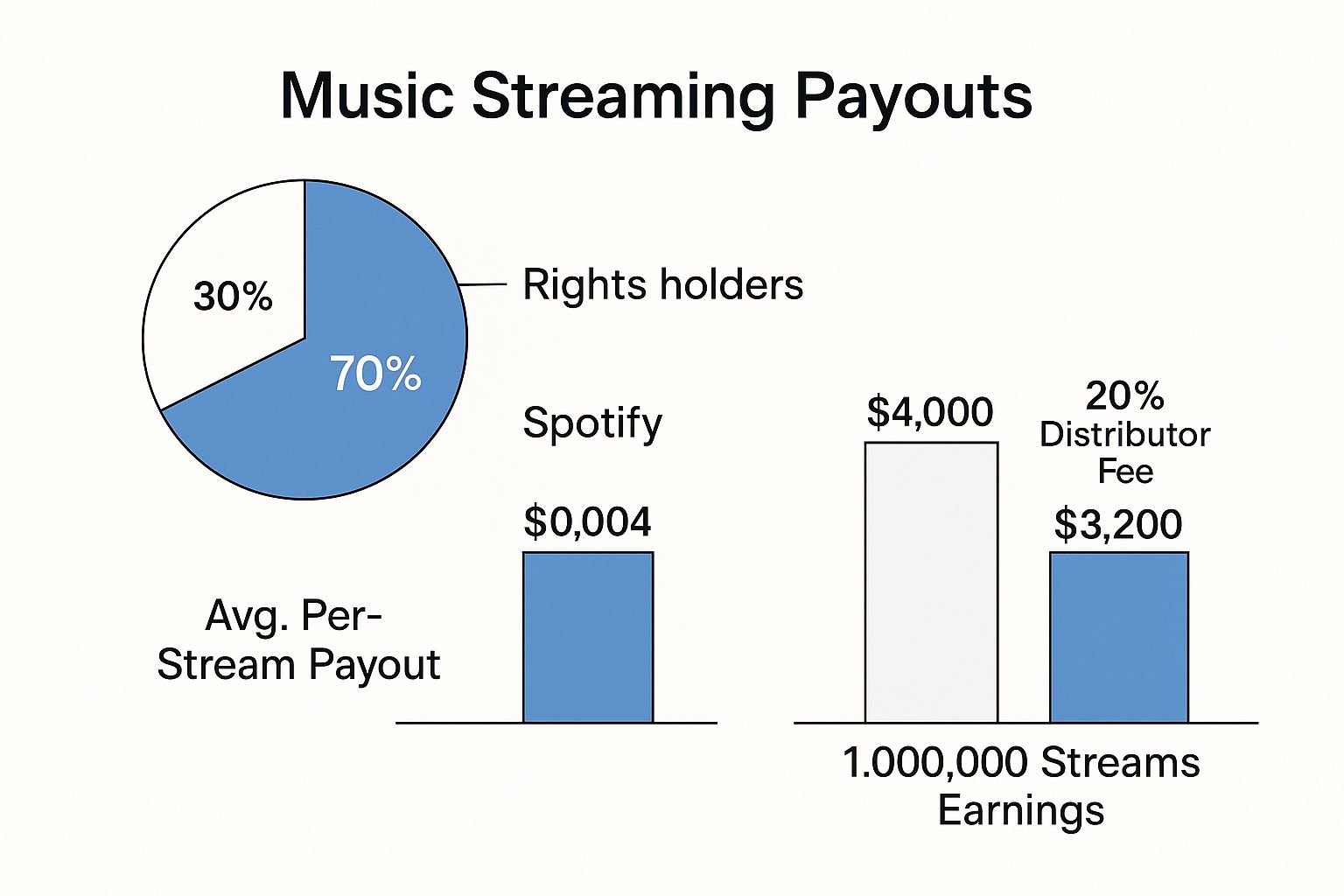
As you can see, the initial gross payout is just the beginning of the journey before various partners get their share.
Decoding the Per-Stream Payout
So, what does that all boil down to in actual dollars and cents? On average, Spotify’s per-stream payout lands somewhere between $0.003 and $0.005. That rate isn't set in stone; it fluctuates based on things like where the listener is located and if they're a free or Premium user.
Let's put that into perspective. At those rates, a million streams will generate roughly $3,000 to $5,000. But hold on—that’s the gross revenue. It’s the total amount before anyone else gets paid.
The table below breaks down what this looks like in a real-world scenario, showing how that initial gross revenue gets whittled down as it passes through the hands of distributors, labels, and managers.
Estimated Earnings from One Million Spotify Streams
| Revenue Stage | Estimated Amount (Low End) | Estimated Amount (High End) | Notes |
|---|---|---|---|
| Gross Revenue | $3,000 | $5,000 | Total generated from 1M streams before any deductions. |
| After Distributor Cut (15%) | $2,550 | $4,250 | A typical distributor fee for independent artists. |
| After Label Cut (50%) | $1,500 | $2,500 | A common split for artists signed to a label (varies widely). |
| After Manager Cut (20%) | $1,200 | $2,000 | The manager's commission, typically taken from the artist's share. |
| Artist's Final Take-Home | $1,200 | $2,000 | The estimated net earnings after all parties have been paid. |
As the numbers show, an artist's final take-home pay is significantly less than the initial payout from Spotify. These deductions are a standard part of the music business, but seeing them laid out highlights just how many streams are needed to generate meaningful income.
It's crucial to remember that these figures are the gross earnings. Your distributor will take a slice, and if you’re signed to a label, they're going to take a much, much larger one before that money ever hits your account.
A New Hurdle for Emerging Artists
Just when you thought it was complicated enough, Spotify threw a new rule into the mix in early 2024. Now, for a track to earn any royalties at all, it needs to hit at least 1,000 streams within a 12-month period.
While Spotify says this policy is meant to curb stream fraud, it also creates a significant barrier for up-and-coming artists and those in niche genres. It's no longer enough to just get your music online and hope for the best.
This reality check makes a solid release strategy more important than ever. You need a game plan to get those first 1,000 streams and get the ball rolling. It's no wonder that many artists are asking themselves if they can truly make money from streaming services in today's climate.
Getting Your Music on Spotify
Before you can even think about royalties, you have to get your music on the platform. This is a common stumbling block for new artists who assume they can just upload tracks directly to Spotify.
The reality is you need a go-between: a digital music distributor. These companies are the essential link that gets your finished songs from your studio computer into the ears of listeners worldwide. They handle the technical side, making sure your music is properly delivered and tracked not just on Spotify, but across all major streaming services. Picking the right distributor is one of the most important first steps you'll take.
Choosing Your Digital Distributor
Think of your distributor as a key business partner. Each one operates differently, so there’s no single "best" choice for everyone. Your decision should really come down to your personal release schedule, your budget, and what you want to achieve. Some of the biggest names you'll see are DistroKid, TuneCore, and CD Baby.
The main thing that sets them apart is how they charge for their services.
- Annual Subscription: Platforms like DistroKid use a flat-fee model. You pay one price per year for unlimited uploads, which is a great deal if you're constantly putting out new music. The biggest draw? You keep 100% of your royalties.
- Per-Release Fee: Services like TuneCore typically charge you for every single or album you release. This can work out cheaper if you only plan to release music once or twice a year.
- Commission-Based: Then you have distributors like CD Baby, which might charge a one-time setup fee for a release and then take a small percentage of the royalties it earns. This means less money upfront, but they’ll get a piece of that song’s earnings forever.
Your distributor does more than just upload your files. They're your financial pipeline—they collect the money you earn from Spotify and pass it on to you. So, when you're comparing them, look beyond the price tag. Dig into their payout schedules, the quality of their analytics, and how good their customer support is.
Preparing Your Music for Release
Once you've picked a partner, it's time to get your assets in order. This is about more than just having a finished song; it's about providing clean, professional files and information so you can get paid correctly.
First, let's talk tech specs. Your audio files need to be top-notch. Most distributors will ask for high-quality WAV files, specifically 16-bit, 44.1 kHz. For your artwork, you'll need a crisp, high-resolution square image, usually at least 3000x3000 pixels. One pro tip: keep it clean. Don't put your social media handles or website on the cover art, as Spotify will likely reject it.
Just as critical is your metadata. This is all the text-based info that travels with your song:
- Song Title
- Artist Name(s)
- Songwriter Credits
- Producer Credits
- Record Label (if you have one)
Don't rush through this part. Inaccurate or incomplete metadata is one of the top reasons artists miss out on royalties. Getting every detail right from the start ensures that when your music starts making money, that money actually finds its way back to your pocket.
Unlocking Your Spotify for Artists Profile
https://www.youtube.com/embed/4Q3s4ZyIKpM
So, your distributor has pushed your music live to Spotify. What’s next? Your very first move should be claiming your Spotify for Artists profile.
Don't treat this as just another box to check. This is your mission control. It’s where you take the reins of your brand, connect with your audience, and actually start making sense of your streaming data. Think of it as being handed the keys to your own digital storefront.
Claiming your profile is usually a breeze. Most distributors can fast-track your verification, or you can request access directly from Spotify. Once you're in, the first thing you'll want to do is customize your profile. Upload a professional artist photo, write a compelling bio, and link out to your socials. This is your chance to tell your story and make a killer first impression.
Your Dashboard for Growth
Once you start exploring, you'll see that Spotify for Artists is packed with insights that are absolutely essential for figuring out how to make money on the platform. You get a real-time look at who's listening, where they are, and what playlists are driving your streams.
This analytics dashboard is your window into your music's performance.
At a glance, you can spot trends. Is a new single taking off in Brazil? Are you getting a ton of adds to user-created workout playlists? This is the kind of information that helps you plan a tour, target a social media ad, or even decide what kind of song to write next.
But it’s not just about the numbers. The platform also gives you some powerful promotional tools.
- Artist Pick: This lets you pin a track, album, or even a playlist you love right to the top of your profile. It's the first thing people see, so use it to spotlight your new single or a tour announcement.
- Merch Integration: Got merch? You can connect your Shopify store and sell t-shirts, vinyl, and anything else directly to your fans on Spotify.
- Fan Support: You can add a link for direct fan funding through partners like Cash App or PayPal. It gives your most dedicated supporters a way to show some love beyond just streaming.
"I get why the growing irrelevance of albums bums some people out... But things change and that’s okay. Asking listeners to listen to a single song might just be a more realistic ask in our attention-starved world."
This really nails why features like Artist Pick are so valuable. In a world where individual tracks reign supreme, you need a way to direct listeners to the one song that matters most right now.
The Power of Playlist Pitching
Now for the real game-changer: the playlist pitching tool. This is your direct line to Spotify's official editorial team. It allows you to submit one unreleased song for consideration on playlists like New Music Friday, Lorem, or RapCaviar.
Landing one of these official playlists can be a massive catalyst for your career, sending your stream count—and your royalties—through the roof.
To give yourself the best shot, make sure you submit your track at least a week before its release date. When you fill out the submission form, be as specific as possible. Tag the genre, sub-genre, mood, and instrumentation. The more information you give the editors, the better they can understand where your music fits. This tool alone makes your Spotify for Artists profile one of the most vital assets you have for growing your income.
Strategies for Increasing Your Spotify Streams
Getting your music on Spotify is just the first step. The real work begins when you try to get people to actually listen. If you want to make money from your streams, you have to get inside the head of the Spotify algorithm. It’s not some unknowable force; it’s a machine that reacts to human behavior. Every time a listener saves your track, adds it to their personal playlist, or shares it, they’re sending a powerful signal to Spotify that your music has value.
This means your strategy has to start long before your song ever goes live. A smart pre-save campaign is one of the best ways to build momentum right out of the gate. When you get your fans to pre-save a track, you’re lining up a wave of streams and positive engagement signals for release day. This initial burst is exactly what can catch the algorithm's attention and land you on powerful playlists like Release Radar.
Mastering a Multi-Faceted Playlist Strategy
Playlists are the engine of discovery on Spotify. Sure, getting on a big official editorial playlist is the dream, but a truly sustainable growth strategy is much broader than that. Don't sleep on the smaller, user-curated playlists.
These lists, often run by passionate fans or indie curators, can become a source of steady, long-term streams. The key is building real relationships with these curators. Do your homework, listen to their playlists, and send a personalized message explaining exactly why your track is a perfect fit. A little genuine effort goes a long way.
Beyond your music, listeners connect with you. Developing a strong personal brand is what makes you memorable and keeps people coming back. Check out this guide to building your unique personal brand to figure out how to carve out your own space.
The secret to getting your music on algorithmic playlists like Discover Weekly is to get on human-curated playlists first. It’s similar to SEO: playlists are like backlinks. When a song is added to a playlist, it's a vote for the quality of the song.
Think of it this way: every playlist add builds your track's authority. As more real people add your song to their personal collections and more indie curators feature it, Spotify’s algorithmic heavy-hitters like Discover Weekly and Radio start to take notice. This kicks off a powerful cycle of discovery that can feel like it’s running on its own.
Driving Engagement Beyond Playlists
Playlists are huge, but they aren't everything. You have to be proactive about driving your own traffic and encouraging your listeners to engage more deeply.
- Social Media Momentum: Use platforms like TikTok, Instagram, and X to tell the story of your music. Share behind-the-scenes clips from the studio, break down the meaning of a lyric, or create a simple video trend with your song as the audio.
- Encourage Follows and Saves: It sounds simple, but you have to ask! Directly tell your listeners to follow you on Spotify and save your tracks to their libraries. These are two of the strongest signals you can send to the algorithm.
- Collaborate with Other Artists: Find another artist in your scene and team up. A collaboration is a fantastic way to introduce your music to a new, highly relevant audience and cross-pollinate your fanbases.
The opportunity for artists is bigger than ever. In 2024, Spotify paid out a record-breaking $10 billion to rights holders, fueled by its massive audience of 696 million monthly active users. Since 2017, the number of artists earning at every income level has at least tripled, proving that a career in music is more achievable than ever.
Building a consistent strategy around these engagement drivers is what separates the hobbyists from the pros. For more actionable advice, check out our guide on https://oohyeah.app/posts/tips-for-increasing-music-streams-and-earnings.
Earning Beyond Streams on Spotify
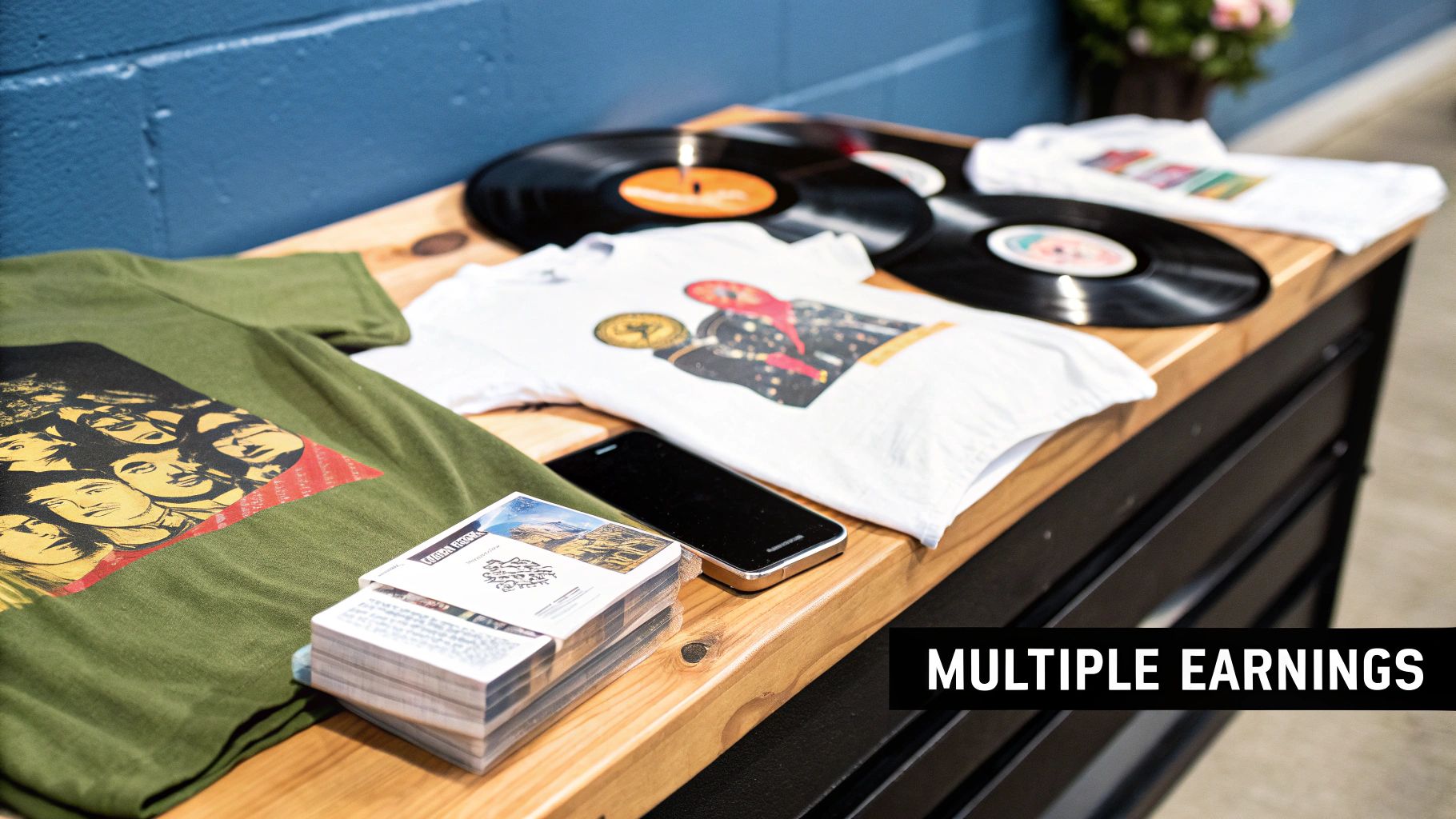
Smart artists know that streaming royalties are just one piece of the puzzle. Relying only on per-stream payouts is a long, slow grind. The real money on Spotify comes from using the platform as a launchpad to connect with your most dedicated listeners.
Think of your Spotify profile not just as a place for your music, but as a central hub for your entire brand. It's built to help you turn passive listeners into genuine fans who will buy your merch, fund your next project, and show up to your gigs. This shift in perspective is key to building a sustainable career.
Sell Your Merch Directly to Fans
Spotify’s integration with Shopify is a game-changer. It lets you link your online store directly to your artist profile, putting your merchandise front and center for anyone listening to your music.
Imagine this: a fan discovers your new single, loves it, and sees a t-shirt or vinyl record right there on your profile. They can browse and buy without ever leaving the app. This simple, direct connection captures that impulse excitement and turns it into a sale.
A fan who buys a t-shirt isn't just giving you money; they're becoming a walking billboard for your music. It's a powerful way to build a loyal community around your brand.
Getting it set up is easy. Just head to your Spotify for Artists dashboard, connect your Shopify account, and pick the products you want to feature. It's one of the most effective direct-to-fan sales channels you have.
Get Direct Support from Your Community
Spotify also has a Fan Support feature, which is basically a digital tip jar for your artist profile. This tool, once called the Artist Fundraising Pick, lets you add a link to a payment platform where fans can contribute directly to you.
You can link to several approved fundraising sites, including:
- Cash App
- PayPal.me
- GoFundMe
- Givealittle
It’s a straightforward way for listeners who truly value your work to show their appreciation. You can use it to crowdfund a new album, help cover tour costs, or just get a little extra support to keep the music going. If you're looking for more ways to create multiple income streams, our guide on how independent artists make money from music has some great ideas.
Turn Online Listeners Into Live Audiences
Don’t forget about the power of live shows. Your Spotify for Artists profile syncs up with major ticketing partners like Ticketmaster, Songkick, and Eventbrite to automatically pull in your tour dates.
This means anyone listening to your music on Spotify will see a list of your upcoming shows right on your profile. They can check if you're playing in their city and click through to buy tickets on the spot. It's an incredibly efficient way to sell tickets and make sure your local fans never miss a show.
Ultimately, all these tools work best when you have a direct connection with your audience. That’s why building a robust email list is so critical. An email list gives you a direct line to your most passionate fans, free from any platform's algorithm, so you can promote everything from new merch drops to upcoming tours.
Burning Questions: Your Spotify Earnings FAQ
Let's be real—the money side of Spotify can feel like a black box. You see the streams climb, but what does that actually mean for your bank account? Let's clear up some of the most common questions artists have about their earnings.
How Often Does Spotify Actually Pay Me?
Spotify cuts the checks monthly, but you won't get a direct deposit from them. Instead, the money flows through your distributor first.
Here’s the catch: there's a lag time. Most distributors work two to three months behind. That means the royalties you earned in January probably won’t hit your account until March or even April. It's a good idea to check your specific distributor's payout schedule so you know exactly what to expect.
Do Premium Streams Pay More Than Free Streams?
Yes, and it's not even close. You earn a whole lot more from Spotify Premium subscribers.
Think of it like this: Premium users pay a monthly fee, creating a big, reliable pot of money for royalties. The ad-supported tier relies on ad revenue, which is smaller and fluctuates.
A stream from a Premium user is simply worth more. The revenue generated per subscriber is higher than the revenue per ad-supported listener, and that directly inflates the value of each stream when royalties are calculated.
This is a huge reason to focus on turning casual listeners into dedicated fans—they're far more likely to be Premium subscribers.
Can I Really Make a Living Just from Spotify Streams?
For the vast majority of artists, the honest answer is no. Making a full-time living solely from Spotify streaming royalties is incredibly tough unless you're consistently pulling in millions upon millions of streams.
A much smarter approach is to see Spotify as one piece of a bigger puzzle. It's a phenomenal tool for getting discovered and building a fanbase. From there, you can monetize that audience in other, more lucrative ways we’ve covered:
- Selling merch through your Shopify integration.
- Booking shows and selling tickets.
- Connecting directly with fans for support through platforms like Patreon.
- Landing sync licensing deals for TV, movies, or commercials.
It helps to think of Spotify as the top of your funnel, not the end goal. It’s where people find you. The real money comes from turning those listeners into fans who want to support your entire creative world.
Ready to take full control of your music business? OohYeah provides a unified platform where you can stream your music, sell merchandise, and offer subscriptions with zero commission fees. Build a direct connection with your fans and keep more of the money you earn. Start building your career with OohYeah today.