Free Music Distribution for Independent Artists: 2026 Guide
Discover the best free music distribution for independent artists in 2026. Get your tracks on major platforms without upfront costs.

September 24, 2026
Music Marketplace Advisor
Buying & SellingMore than 100,000 new recordings reached digital service providers every day in 2025, and more than one-third of Spotify artists earning at least $10,000 in royalties were DIY artists or had started that way. Free music distribution for independent artists can get your work into the global streaming system, but it isn't automatically the cheapest route once commissions, delays, metadata errors, and lost control enter the calculation.
The important question isn't, “Which distributor lets me upload for nothing?” It's, “What am I giving up to avoid an upfront fee?” A free plan may take a share of royalties, restrict useful tools, slow your release schedule, or leave you managing publishing and rights administration alone. For a new artist with no budget and flexible timing, that trade can be sensible. For an artist building a serious catalog, it can become an expensive habit.
The Scale of Independent Music Distribution
More than 100,000 new recordings were delivered to digital service providers every day in 2025, up 7% from the prior year, with much of that growth coming from outside the major-label system (industry coverage of music distribution trends). The same coverage makes the business reality clear: delivery is widely available, while attention remains limited. Getting onto Spotify is only the first operational step.
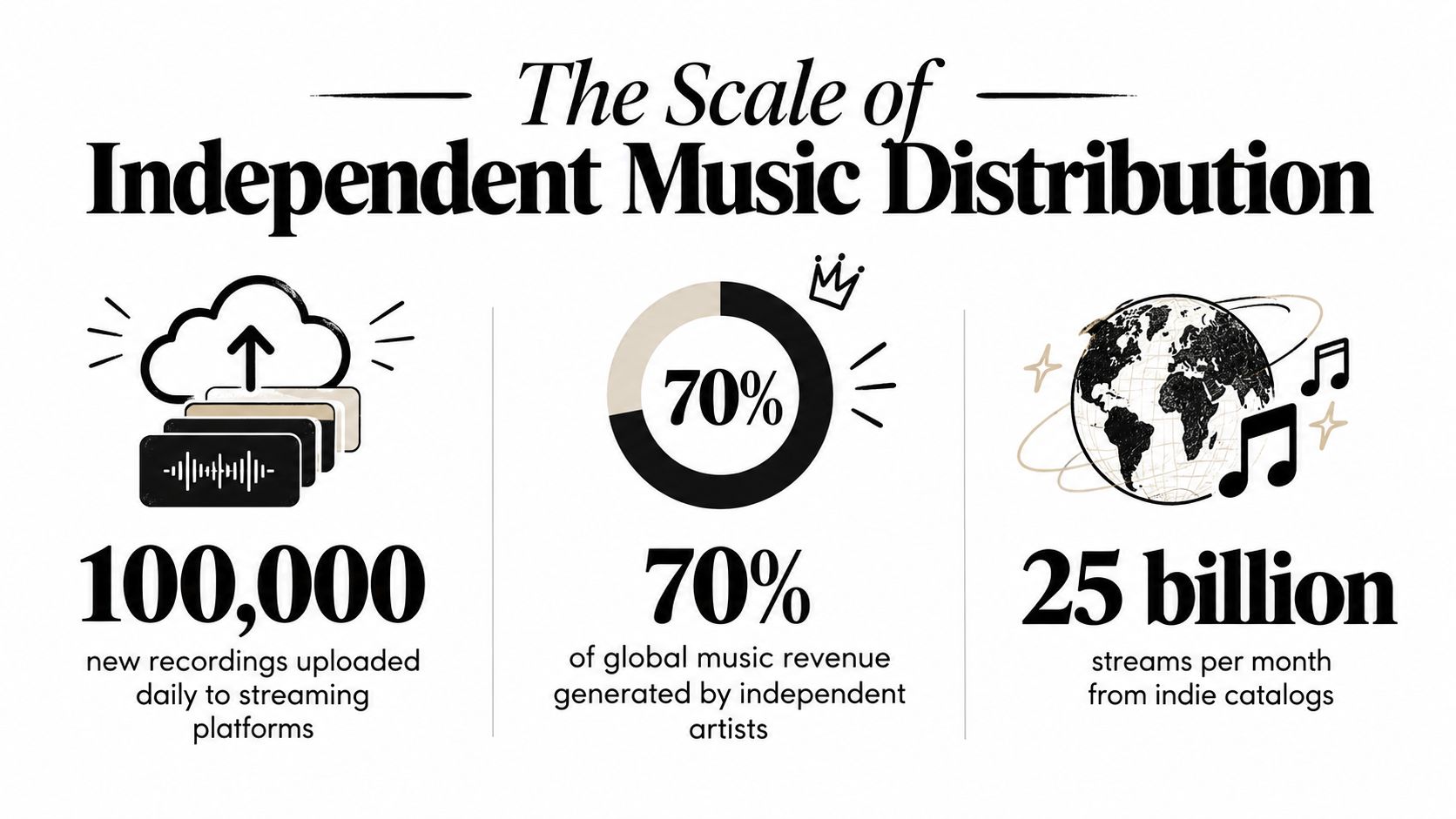
Spotify's royalty data shows why independent distribution deserves strategic attention. More than one-third of artists who earned at least $10,000 in Spotify royalties were DIY artists who self-released through independent distributors or began their careers that way. Roughly half of the royalties Spotify paid to the music industry went to independent artists and labels, according to the same industry coverage.
This does not make a free distributor a career plan. It does show that independent delivery has moved beyond being a fallback for artists without label offers. It is now a primary route into the market for artists who release consistently, maintain accurate rights information, and build demand beyond the DSP dashboard.
The long tail is where independence wins
Luminate's 2025 year-end data, summarized by Luminate data summarized by Mordor Intelligence, reported that independent distributors gained a 4.4% share of total distribution against the majors, leaving independents with 96.2% of total distribution volume. The same reporting counted more than 106,000 tracks uploaded to DSPs each day in 2025. That figure sits within the broader 100,000-plus daily recordings reported across the industry, rather than contradicting it.
The top tier follows a different pattern. Earlier Luminate analysis found that, through the first half of 2024, more than 29,000 artists in the U.S. on-demand audio stream tier between 1 million and 10 million streams included a majority with independent distribution. Among artists above 1 billion U.S. streams, only 43 of 46 artists had major distribution, based on the same summarized analysis.
The decision is practical. Free distribution can provide credible infrastructure for a developing catalog, but delivery alone will not distinguish your releases. Choose a setup that protects rights data, supports disciplined release planning, builds direct fan relationships, and leaves room for income beyond streaming. A zero-cost upload is useful only when its commission and operational limits still fit the catalog you are building.
How Free Distribution Models Work
“Free” usually describes the checkout screen, not the complete economic arrangement. A distributor may remove the upfront payment and recover operating costs through a commission on royalties, paid upgrades, promotional products, limited analytics, or slower service.
Commission-based distribution is the clearest model. You upload without paying, then the distributor keeps an agreed share of income from streams or downloads. That arrangement suits artists with little or unpredictable revenue because no cash leaves your account before the release earns. The trade-off grows more expensive as your catalog generates meaningful royalties. A percentage is taken repeatedly, while a paid plan charges according to its own terms.
Read the plan as a rights contract
Other services offer free delivery but restrict the workflow around it. Basic DSP delivery may be available while advanced reporting, faster review, playlist tools, collaborator controls, publishing administration, or responsive support require a paid plan. Your music reaches stores, but the tools needed to manage a growing catalog remain limited.
Some companies have moved away from free tiers. A 2026 review reports that Amuse no longer offers a free distribution tier and starts at $23.99 per year (review of free distribution models). The reason is straightforward. Moderation, rights review, customer support, and fraud prevention require staff and systems, regardless of who pays.
Practical rule: Treat every free plan as a commercial contract with a deferred price.
Before uploading, get clear answers in writing:
- Royalty share: What percentage applies to streams, downloads, Content ID, user-generated content, and other uses?
- Catalog continuity: What happens to your releases if you stop using the service or fail to renew?
- Timing: What processing window does the distributor publish, and does it support your release date?
- Feature access: Which analytics, splits, pitching, and support functions are excluded?
- Payout terms: Are there thresholds, delays, account conditions, or deductions that affect withdrawal?
Free distribution can also narrow your strategy if you treat delivery as the entire release plan. Build the weeks after launch around audience follow-up, content, and catalog sequencing. Use this resource on post-launch catalog growth advice to strengthen that second half of the release cycle.
My recommendation is direct. Use free distribution when preserving cash matters more than speed, service, and maximum royalty retention. Set a switching point before uploading. Move when the commission, delays, or weak support cost more than the paid alternative.
Evaluating the Hidden Costs and Limitations
The actual cost of free distribution appears after delivery. A wrong songwriter credit, unclear collaborator split, missed campaign date, or unmatched royalty can create problems long after upload.
Accurate metadata supports both discovery and payment. A professional release package should include an ISRC for every sound recording, a UPC or EAN for the release, correct artist and title details, version credits, territory settings, explicit-content flags, and platform-compliant artwork (metadata guidance for independent distribution). The distributor uses these fields to route and catalog your release. Inconsistent information can weaken search visibility and complicate royalty administration.
Audit the platform before the upload
A store list proves delivery, not quality. Test the controls that determine whether you can manage the catalog later.
Check identifier ownership. Confirm who supplies the ISRC and barcode, whether you can use your own identifiers, and what happens during migration. Your recording history should remain usable outside a dashboard you may eventually leave.
Inspect collaborator controls. Look for split-payment tools, written approval procedures, and a clear ownership record. If the free tier relies on email threads and spreadsheets, create signed documentation before release.
Read the payment terms. Verify the payout schedule, withdrawal conditions, deductions, currency rules, and account-suspension language. A royalty balance has little value if retrieving it is unpredictable.
Test support with a real question. Ask how the company handles duplicate releases, incorrect metadata, takedown disputes, and migration requests. The answer reveals more than a feature list.
Confirm release timing. Processing may take from about one day to four weeks, depending on platform review and whether editorial consideration is involved (DIY distribution guidance). Schedule around the slowest plausible step. A late release can cost more than a paid plan.
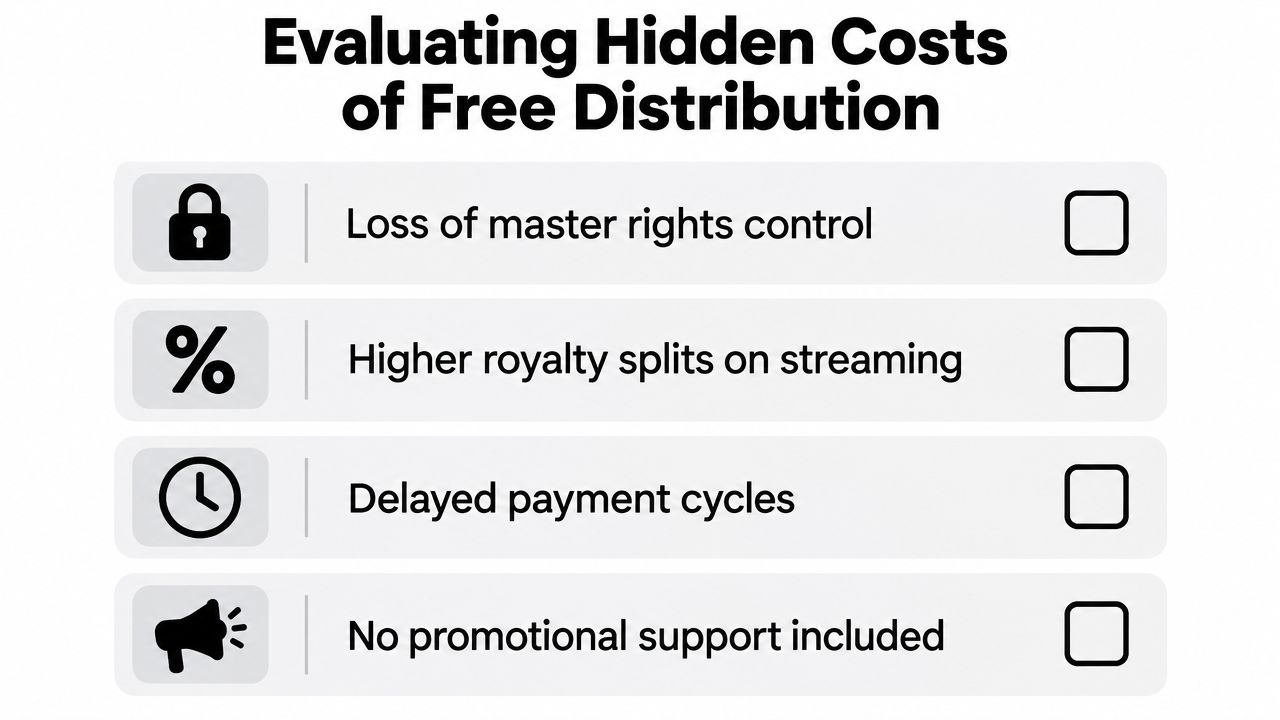
Publishing creates another cost boundary. A distributor may collect master income while leaving songwriting and performance income outside its service. Confirm exactly which rights the plan administers, which it does not, and whether commission cuts apply to any additional revenue stream.
Keep a local catalog file with masters, artwork, final metadata, ISRCs, release barcodes, ownership splits, publishing registrations, and payout dates. This record protects your exit if terms change or support becomes difficult to reach. Artists usually lose control through missing records, unclear permissions, and dependence on one login, not through a single dramatic event.
The free option makes sense when preserving cash matters more than speed, support, and maximum royalty retention. Set a switching point before uploading. Review the OohYeah FAQ for artist marketplace access and transactions before assuming that workflow matches a conventional DSP distributor. Move when commissions, delays, or weak support cost more than the paid alternative.
Master Royalties vs Publishing Income Streams
A released song creates income through separate rights, and free distribution usually manages only one layer. Master royalties belong to the finished sound recording. Publishing royalties belong to the underlying composition, including the songwriter's rights.
A distributor normally sends the master to streaming and download services and collects recording income. Publishing requires separate registration and administration through relevant performing rights organizations and, in the United States, the Mechanical Licensing Collective. Review the Mechanical Licensing Collective's guidance on mechanical royalties.
Delivery does not equal complete royalty collection. A track can be live and earning master revenue while composition income remains unregistered, misattributed, or unpaid. Treat those as separate workflows from the start.
Build one ledger for both layers
Use the ISRC as the recording-side anchor. Connect it to the release barcode, songwriter names, ownership percentages, publishing registrations, and payout dates. A spreadsheet is enough if every collaborator can review the entries and you retain the supporting agreements.
| Revenue layer | What it relates to | What you should verify |
|---|---|---|
| Master income | The finished sound recording | DSP delivery, ISRC, distributor statements, payout dates |
| Publishing income | The composition and songwriting | PRO registration, mechanical registration, writer splits |
| Collaborator accounting | Shared ownership of either layer | Written split agreement, approvals, payment records |
Flat-fee and commission-based distribution address different costs. A flat-fee service creates a predictable expense and usually makes royalty calculations easier to follow, but it does not automatically handle publishing. A commission-free ecosystem can improve direct-sale economics by letting you set prices and transact with fans. Rights records still remain your responsibility.
Use a direct comparison: net income, rights coverage, timing, and portability. If a free plan collects only master royalties, include your separate publishing-administration cost in the calculation. If a paid plan offers stronger reporting without publishing administration, do not mistake a cleaner dashboard for complete rights management.
Your distributor is a delivery partner, not your entire rights department.
Use free distribution for access, while keeping ownership evidence and registration records outside the platform. That structure protects your catalog if terms change, payments stall, or you move to another service. A low-cost release stays low-cost only when its rights data remains accurate and portable.
The Rise of Artist-First Ecosystems
A representative independent artist, Maya, releases a small catalog through a conventional free tier. She avoids an upfront fee, but accepts the platform's revenue share and relies on streaming services for discovery. Her release reaches DSPs, yet her fan relationship remains fragmented across social accounts, streaming profiles, and direct messages.
The arrangement works while the goal is availability. It becomes restrictive when Maya wants to sell a download, offer a subscription, promote merchandise, or keep a larger share of a purchase. She isn't only looking for another delivery pipe. She needs a place where the music, offer, audience, and transaction can sit together.

Delivery is only one part of the business
OohYeah! is a music-first ecosystem for streaming, selling, and marketing creative work. Its marketplace removes intermediary fees from creator transactions and lets artists retain control over pricing and distribution. That addresses a weakness in standard free distribution: the artist can reach listeners, but may have few ways to convert attention into a direct purchase or ongoing support.
For Maya, a unified environment could support a release page, direct digital sales, merchandise, subscriptions, and fan communication in the same operating space. The benefit isn't automatic success. She still needs strong music, clear offers, consistent promotion, and accurate rights data. The difference is that the business model isn't limited to waiting for a DSP statement.
This is also where artist ecosystems need scrutiny. Ask whether the platform lets you export your catalog and customer information, define your own prices, understand transaction terms, and communicate with fans without surrendering ownership. “Direct-to-fan” is useful only when direct control accompanies the direct relationship.
The artist tools available through OohYeah illustrate this broader approach, combining music availability with selling and marketing functions rather than treating distribution as the complete artist business.
Independent artists should compare these ecosystems with traditional distributors on the job they need completed. A DSP distributor is built for delivery, identifiers, platform ingestion, and master royalty reporting. A unified marketplace is built for direct commerce and fan engagement. Many artists will need both, because a direct storefront doesn't replace global DSP reach and DSP reach doesn't replace a storefront.
To see how a creator-focused workflow can support both listening and commercial activity, review the following overview before choosing a platform mix.
Strategic Considerations for the Future of Music
The global independent-artists market is estimated at $161 billion in 2025, covering streaming, live performance, merchandise, memberships, crowdfunding, licensing, and sync income (independent artists market coverage). That breadth changes the decision. Free distribution is only one route to market, and its real cost depends on the income streams, rights, and audience relationships an artist gives up or retains.
Streaming still belongs in an independent artist's plan, yet growth is slowing in major markets. Recent industry coverage describes global streaming growth falling from 10.2% in 2023 to low single digits in 2025. It also reports that streaming represented roughly 69.6% of $31.7 billion in global recorded-music revenue in 2025. Treat those figures as a planning signal: volume alone will not protect an artist's income. Each listener should support a broader system of revenue, data, and rights control.
Choose the model by career stage
Use the following framework:
- No budget and flexible timing: Start with a free distributor, but prepare metadata, ownership records, and split information before uploading. A commission or slower support process may be the actual price of entry.
- Growing catalog and reliable income: Compare the royalty share against a flat fee. Paid distribution makes sense when predictable delivery, reporting, and support save meaningful operating time.
- Active fan demand: Add direct sales, subscriptions, merchandise, or memberships. Convert attention into income with terms you can inspect and control.
- Multiple collaborators or projects: Require split accounting, catalog portability, and centralized rights records. A low headline price cannot compensate for confused ownership.
The platform should also support better decisions. Analytics earn their place when they determine which song to promote, which audience to target, or which offer to present beside a release. Messaging has value when it helps retain a fan relationship instead of forcing the artist to rent access through another platform.
Campaign assets deserve the same scrutiny. Artists assessing creative software can compare AI video models online, then judge each result against brand requirements, rights obligations, production time, and audience response. Novelty is not a marketing strategy.
A unified commerce platform brings streaming, sales, marketing, and fan interaction into a closer operating system. The OohYeah Magazine offers context for artists assessing that direct-to-fan approach. The practical choice may be a combination: broad DSP distribution for discovery, plus a controlled artist environment for pricing, customer relationships, and additional income.
Free distribution removes an immediate barrier. It also creates exposure to commission cuts, metadata bottlenecks, limited support, and platform incentives that may not match an artist's long-term interests. Choose the arrangement that protects the catalog, keeps rights records usable, and supports more than one path to revenue.
OohYeah offers artists a unified place to stream, sell, and market music, with direct pricing control and commission-free creator transactions. Artists seeking alternatives to DSP-only delivery can visit OohYeah.