Your Guide to Free Music Distribution
Unlock your music career with our guide to free music distribution. Learn how to get your tracks on Spotify and Apple Music without any upfront costs.
January 31, 2026
Music Marketplace Advisor
Buying & SellingThink of a free music distribution service as the global shipping network for your songs. You're the one in the studio creating the art, and the distributor is the logistics partner who gets it onto every digital shelf, from Spotify to Apple Music and beyond. It’s the essential bridge connecting your creative work to millions of potential fans, all without asking for a single dollar upfront.
How Free Music Distribution Works For Artists
At its heart, free music distribution is a model where you can get your music onto all the major streaming platforms and digital stores without paying subscription fees or per-release charges. This is a massive shift from the old days. Instead of having to build relationships with dozens of different services one by one, a distributor handles all the technical heavy lifting, metadata management, and even royalty collection for you.
The whole system works on a straightforward exchange: you bring the finished music and all its related info, and the distributor makes sure it lands on all the right digital storefronts, ready for listeners.
This approach lets artists do what they do best—create music—while the distributor navigates the complicated backend logistics. This map really helps visualize that journey from your studio to a listener's headphones anywhere in the world.
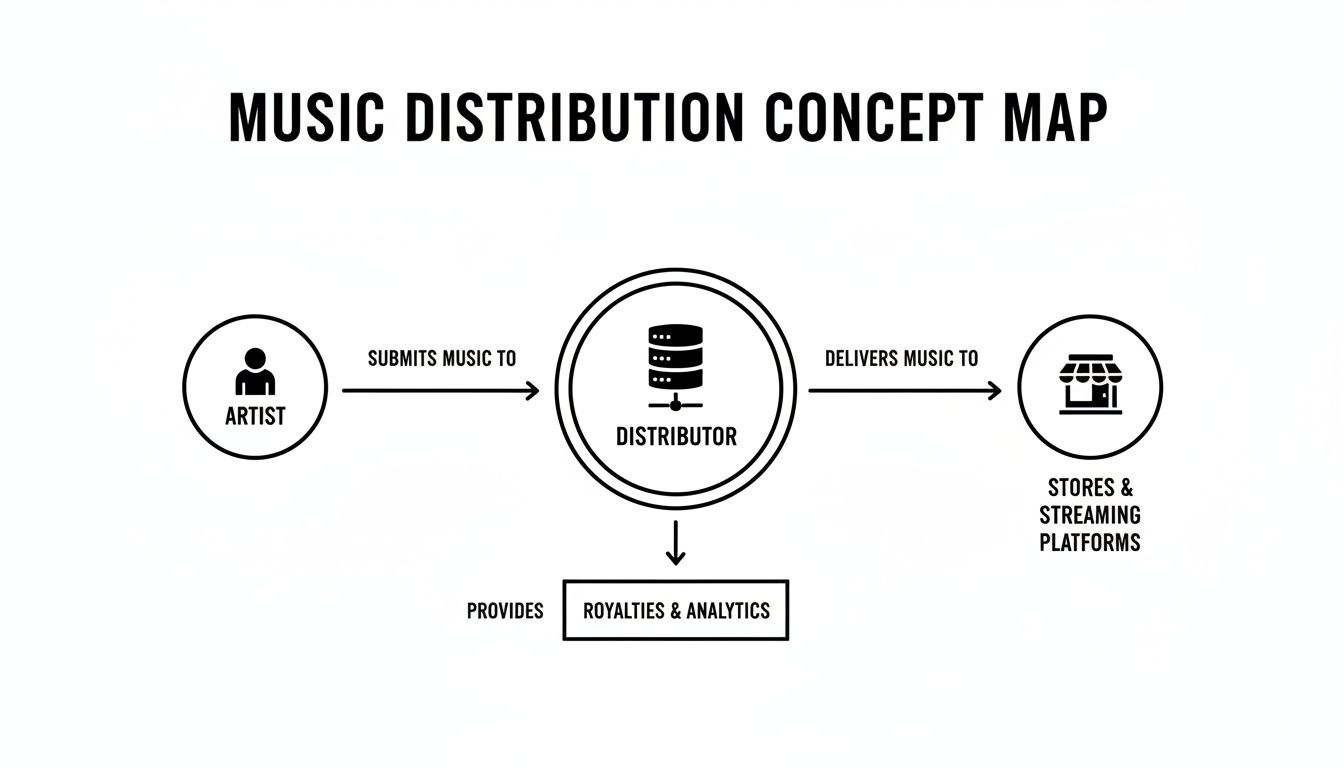
As you can see, the distributor is that critical hub connecting your art to its audience, breaking down barriers that once made the music industry feel impenetrable for independent artists.
What You Need To Provide
As the artist, your job is to get your release package ready. Think of it like packing a box to ship overseas—if you forget an item or mislabel the contents, it's not going to get where it needs to go. You'll need to supply high-quality audio files (usually WAV format is best) and your album art, which has to meet strict size and quality specs (typically 3000x3000 pixels).
Your metadata is the digital fingerprint of your song. It includes everything from the track title and artist name to songwriter credits and genre. Accurate metadata is non-negotiable—it’s how you get credited and, most importantly, paid correctly.
Getting all your ducks in a row before you upload is key. To help, here’s a quick rundown of what you'll need to have ready for your distributor.
Your Music Release Essentials
| Component | What It Is | Why It Matters |
|---|---|---|
| High-Quality Audio | The final, mastered track in a lossless format like WAV or FLAC. | This ensures your music sounds its best across all platforms, from premium headphones to car stereos. |
| Cover Artwork | A high-resolution image (3000x3000 pixels) that represents your release. | It's the first thing listeners see. Good artwork grabs attention and must meet strict platform guidelines. |
| Metadata | All the "data about your data"—song title, artist, writers, genre, release date, etc. | This is how stores categorize your music, how you get paid, and how fans find you. Accuracy is crucial. |
| Release Information | Details like the release date, UPC/EAN code, and ISRC codes for each track. | These are the unique identifiers that track sales and streams globally, ensuring royalties are attributed correctly. |
Having these components organized and ready to go will make the distribution process smooth and prevent any last-minute headaches.
What The Distributor Does
Once you've handed over your release assets, the distributor takes the wheel. Their systems are built to automatically format your files and metadata to meet the unique technical requirements of every single platform, from a niche electronic store like Beatport to a massive social platform like TikTok.
But they do more than just deliver the files. The distributor also handles the money side of things:
- Royalty Collection: They pull in all the revenue your music generates from streams and downloads across every platform, worldwide.
- Payment Processing: After collecting those earnings, they process them and pay them out to you. Most provide detailed analytics dashboards so you can see exactly where your streams and money are coming from.
This model is clearly working. The Music Distribution Services Market is on track to grow to USD 2,374.79 million by 2026, a huge jump driven almost entirely by the boom of independent artists. This surge proves just how essential accessible distribution has become for modern creators.
To get the most out of every release, check out our complete guide on the best strategies for independent music distribution.
Weighing the Pros and Cons of Free Distribution
Let’s be honest: when you see “free music distribution,” it sounds like the perfect deal. But as with most things in life, “free” rarely comes with no strings attached. Before you hand over your music, it’s critical to understand what you’re really getting—and what you might be giving up.
The right choice can be a launchpad for your career. The wrong one can become a frustrating roadblock.
The Upside: What You Gain
The biggest and most obvious win here is the zero upfront cost. For any artist just starting out or working with a tight budget, this is a game-changer. It completely removes the financial gatekeeping that once prevented countless musicians from getting their tracks on Spotify, Apple Music, and all the other major stores.
You can release a single, an EP, or a full album without dipping into your wallet for per-release fees or annual subscriptions.
Beyond the cost savings, most free distributors let you keep 100% of your ownership and rights. You're not signing away your master recordings, which is huge. That kind of creative control is essential for building a long-term career on your own terms.
The Downside: The Hidden Costs of "Free"
So, where’s the catch? If you’re not paying upfront, the distributor has to make money somewhere else, and that's usually from your earnings. Many services take a commission on your royalties, often a slice ranging from 15% to 30%.
That might not seem like much when you’re earning pennies, but as your streams climb into the thousands and millions, that percentage starts to represent a serious chunk of your income.
Another thing to watch for is the "à la carte" menu of hidden fees. Need to fix a typo in your track title? That could be a fee. Want to take a song down? Some platforms charge for that, too. These little charges can pile up fast. It’s a common model, and it's worth learning from similar scenarios in other industries, like understanding the high cost of "free" event software, where the initial appeal can mask long-term expenses.
The core trade-off in free music distribution often comes down to this: you either pay with money upfront (subscriptions) or you pay with a percentage of your future earnings (commissions). Understanding which model aligns with your career stage and goals is the key.
Making an Informed Decision
Ultimately, you want a partner whose business model is crystal clear and genuinely supports your growth. A commission-based service might be a great fit for an artist who’s just testing the waters and doesn't want any upfront risk. But if you’re focused on building a sustainable career, a truly commission-free platform like OohYeah could be a much better financial move in the long run.
The global music streaming market is absolutely booming—it’s projected to hit USD 49.09 billion this year and soar to USD 176.84 billion by 2033. This explosion means there's a massive opportunity for independent artists to find an audience. You can dive deeper into these powerful market trends to see just how big the pie is getting.
The goal is to find a distributor that helps you claim your slice, not one that takes a bigger piece for themselves as you succeed.
Your Step-by-Step Release Checklist
Getting a track out into the world can feel overwhelming, but a solid checklist makes it so much easier. Think of this as your game plan for a professional release. Following these steps helps ensure your music not only meets all the technical standards but actually goes live when you want it to, without any last-minute drama.
Honestly, every single one of these steps matters. If you skip one, you risk having your release kicked back by the stores, which throws your whole promo schedule into chaos. Let’s get everything lined up.
Step 1: Finalize Your Audio Master
First things first: your music has to sound absolutely killer. The file you hand over to your free music distribution service is the final, locked-in version. Once it's out there, you can't just swap it out for a new mix.
This means you need a professional master of your track.
- File Format: Always export your final track as a high-resolution, uncompressed audio file. The gold standard is a WAV file at 16-bit, 44.1 kHz. Don't even think about using an MP3—its compressed quality is a fast track to rejection from major platforms.
- Listen Closely: Before you hit upload, do one final listening check. Put it on your headphones, play it in your car, and run it through your studio monitors. Catching a mistake now saves a massive headache later.
Step 2: Prepare Your Cover Art
Your cover art is the first thing anyone sees. It's your visual handshake, and it has to both look good and meet some very strict technical rules set by platforms like Spotify and Apple Music.
Your artwork must be a perfect square and high-resolution—3000 x 3000 pixels is the standard. It should only feature your artist name and the release title. No social media handles, website URLs, or streaming logos allowed.
This isn't just about making it look clean; it's a hard requirement. In fact, incorrect artwork is one of the most common reasons a release gets delayed.
Step 3: Gather All Your Metadata
Think of metadata as your music's DNA. It’s all the crucial info that tells the stores who you are, what the song is called, and, most importantly, who needs to get paid. If your metadata is wrong, you're pretty much guaranteed to lose out on royalties.
Here’s the essential info you'll need:
- Song Title: The exact title, spelled correctly. No typos!
- Artist Name(s): List all primary artists and any featured artists.
- Songwriter Credits: You need the full legal names of everyone who wrote or composed the track.
- ISRC and UPC Codes: Don't worry, your distributor will usually assign these for free. The ISRC (International Standard Recording Code) is a unique fingerprint for your song, while the UPC (Universal Product Code) is for the entire release (yes, even a single needs one).
- Release Date: Be strategic here. You should plan to upload everything at least three to four weeks before you want the song to come out. This gives you enough time to pitch the track to editorial playlists, which can be a total game-changer for your visibility.
Getting these details right from the very beginning is the key to a smooth delivery and making sure your money finds its way to you. For a deeper dive into the submission process, check out our guide on how to upload music for a complete walkthrough.
How to Choose the Right Distribution Partner
Let's be real: not all services that shout "free music distribution" from the rooftops are created equal. Once you get past the flashy marketing, you’ll find huge differences in how they operate and what they actually cost you down the road.
Choosing the right partner isn't about finding the cheapest option—it's about finding one that genuinely lines up with your career goals. Think of a distributor as a business partner. Their success should fuel yours, not come at your expense.
Key Questions to Ask Any Distributor
Before you hand over your music, you need to do a little digging. Getting straight answers to these questions will tell you everything you need to know about a platform's true intentions.
- What's your royalty commission? This is the big one. Many "free" services will quietly take a 15% cut (or more) from your earnings. That might not sound like much at first, but as your streams climb, you're leaving serious money on the table.
- Are there any hidden fees? Get specific. Ask about charges for takedowns, faster customer support, updating a release after it's live, or adding new stores later on. These little "gotchas" add up quickly.
- Do you offer YouTube Content ID? This is a non-negotiable tool for making money whenever your music gets used in other people's YouTube videos. Some distributors charge extra to turn it on or take an even bigger slice of those specific earnings.
The answers to these questions will quickly separate the truly artist-friendly platforms from the ones just using "free" as bait.
The core difference isn't the price tag—it's the business model. Commission-based services only make money by taking a piece of yours. A truly free platform is built to give you a service without touching your art.
Comparing Free Distribution Models
To make the best call, you have to understand the real difference between the two main types of 'free' music distribution and see where the costs truly lie.
| Feature | Commission-Based Free Model | Truly Free Model (e.g., OohYeah) |
|---|---|---|
| Upfront Cost | $0 | $0 |
| Royalty Split | Artist keeps 70-85%; the platform takes the rest. | Artist keeps 100% of all royalties. |
| Hidden Fees | Common for takedowns, support, or release edits. | None; the model is built on transparency. |
| Artist Alignment | Platform profits by taking a share of your income. | Platform grows by providing genuine value to artists. |
At the end of the day, it's about control and your long-term financial health. A commission-based service might feel harmless when you're just starting out, but it puts a cap on your income as your career takes off.
A truly free, commission-free partner like OohYeah is built to grow with you, making sure you keep every single dollar you earn from your hard work. For a deeper dive, check out our guide on how to choose the right music distribution service.
Turning Your Release Into Real Momentum
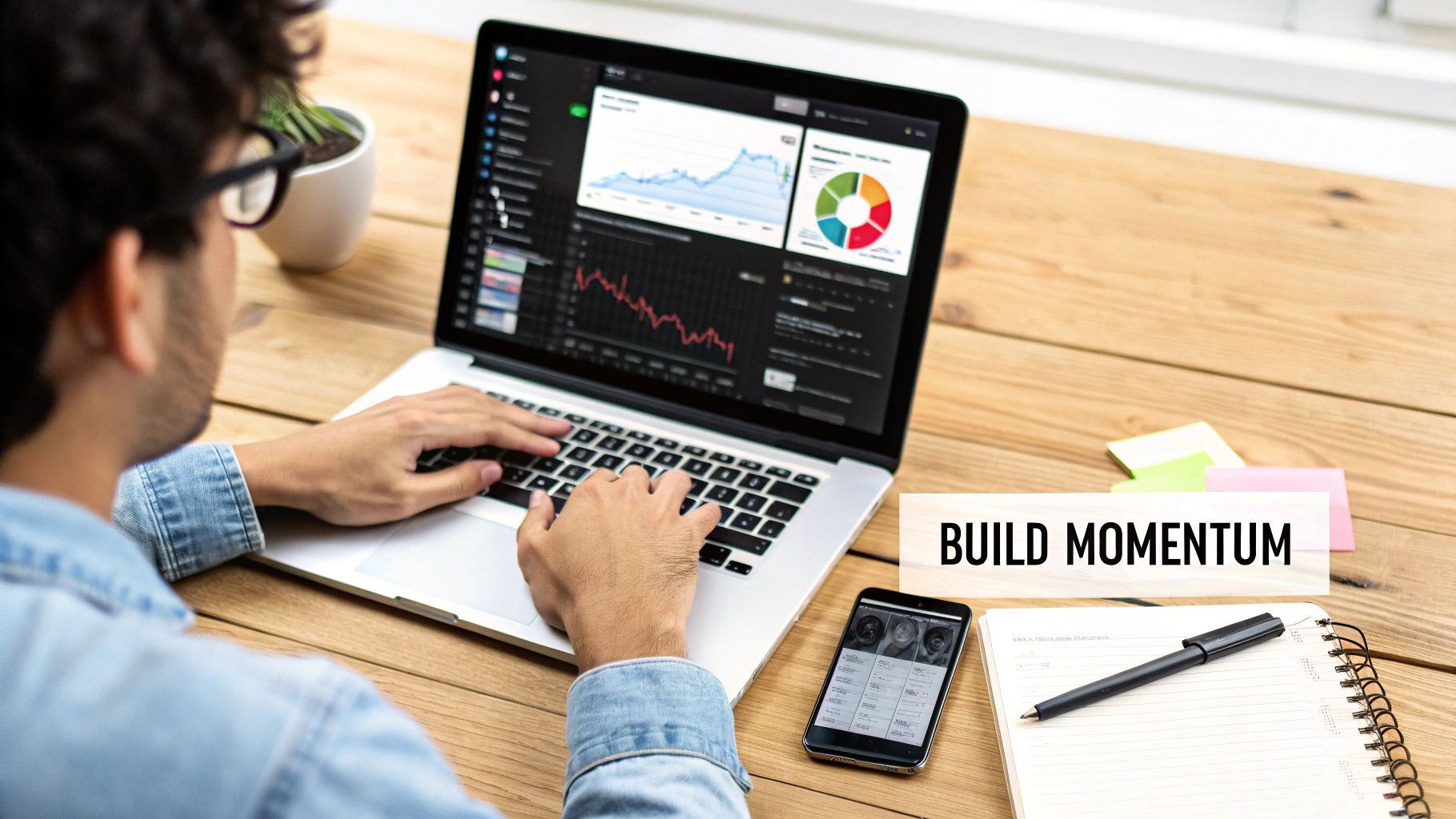
Getting your music uploaded is just the starting line, not the finish line. A truly successful release isn't just about showing up on Spotify; it's about turning that presence into real momentum that grows your audience and builds your career. The moment your track goes live, the real work begins.
Your first move? Take ownership of your artist identity on the major platforms. This means immediately claiming your profiles through services like Spotify for Artists and Apple Music for Artists. This step is non-negotiable. It unlocks a whole suite of essential tools, letting you customize your bio, update your photos, and, critically, pitch your music directly to the people who curate the big playlists.
Driving First-Week Streams
Those first seven days after your release are everything. The algorithms on streaming platforms are watching closely, tracking initial engagement metrics like streams, saves, and shares. A flurry of activity in that first week tells the system your track is connecting with people, which can massively boost its visibility across the entire platform.
You need a promotional game plan ready to execute on day one:
- Social Media Blitz: Get creative with your content. Think short video clips, behind-the-scenes footage, or sharp graphics all designed to funnel people to your new music. Your calls-to-action should be crystal clear, pointing followers straight to their favorite streaming service.
- Email List Engagement: Your email list is a direct line to your most loyal fans. Send a dedicated release announcement with direct links, making it easy for them to listen and share it the moment it drops.
- Playlist Pitching: This one requires planning ahead. Use your Spotify for Artists account to submit your track for editorial consideration at least a week before it goes live. Landing on a popular playlist can be a game-changer, putting your music in front of thousands of new listeners overnight.
Your release isn't just a song; it's a data-generating event. Every stream provides valuable insight into who your fans are and where they live, turning a simple track into a powerful career-building tool.
Understanding Your Streaming Data
Once the streams start coming in, you need to put on your analyst hat. Dive into the analytics provided by your distributor and your artist profiles on Spotify and Apple Music. Look for the patterns. Which cities are streaming your music the most? What are the demographics of your listeners? This data is pure gold.
It tells you where to book your next tour, who to target with social media ads, and what kind of content actually connects with your audience.
Ultimately, using free music distribution effectively is about treating it as a launchpad. It’s the tool that gets you in the game. It has opened doors for independent artists to get their music everywhere, a key strategy for maximizing reach in an industry where streaming now accounts for a staggering 84% of all revenue. To get a deeper understanding of the current streaming economy and how artist payouts work, you can discover more insights from Rebel Music.
Building Your Career Beyond Streaming Royalties
Getting your music onto Spotify and Apple Music is a huge milestone, but let's be real—it's just the first step. A sustainable career isn't built on fractions of a penny per stream. The real future for independent artists is about creating a world where free music distribution is just one tool in a much bigger toolbox.
The game is changing. It's less about chasing anonymous listeners and more about building a genuine community around your music.
This means shifting your focus to creating direct relationships with your fans and opening up multiple streams of income. Modern platforms designed for today's artists do more than just push your tracks to stores; they give you an integrated toolkit to turn your passion into a real, self-sufficient business. It's about taking back control of your financial destiny.
Owning Your Entire Music Business
Think about having a single home base for your entire operation. A place where you not only release your music but also sell merch, offer fan club subscriptions with exclusive content, and talk directly with the people who support you most. For any artist looking to diversify beyond streaming, learning about the best platforms to sell digital products is a great way to start exploring those direct-to-fan sales.
This all-in-one approach is exactly what platforms like OohYeah are built for, combining distribution with e-commerce and fan engagement tools in one spot. The kicker? A truly commission-free model means you keep 100% of your earnings, no matter where they come from—be it a t-shirt sale or a stream in Tokyo.
When you pair commission-free distribution with direct-to-fan sales, you stop being a passenger in the streaming economy and get behind the wheel of your own career. You're building a profitable business that you own, top to bottom.
Frequently Asked Questions About Free Distribution
Even after you've got a handle on the basics, there are always a few lingering questions that pop up when you're considering free music distribution. Getting straight answers to these common concerns is the best way to move forward confidently, making sure the path you choose actually lines up with your career goals and protects your money.
Let’s dive into the big ones.
Can I Really Keep 100% of My Royalties?
This is the million-dollar question, isn't it? The honest answer is: it completely depends on the service. A lot of distributors that market themselves as "free" actually work on a commission model. This means that while there's no fee to upload your music, they'll take a cut of your streaming royalties—often somewhere between 15% and 30%.
But not all "free" services are built the same.
Some platforms, like OohYeah, are structured on a genuinely commission-free model. This means you truly keep 100% of your earnings without any hidden percentages being skimmed off the top. Always, always read the fine print to see exactly how a distributor makes its money.
How Long Until My Music Is Live on Spotify?
This is where planning ahead really pays off. A good rule of thumb is to allow for a lead time of two to four weeks. Pretty much every distributor will tell you to submit your music well ahead of your planned release date.
Giving yourself this cushion is smart for a few key reasons:
- Internal Review: The distributor needs time to check your audio files, artwork, and all the metadata for any issues.
- Store Processing: Digital stores like Spotify and Apple Music need time to ingest your track and get it scheduled on their end.
- Playlist Pitching: This is the big one. If you want a shot at landing on major editorial playlists, submitting early isn't just a suggestion—it's a requirement.
What If I Want to Remove My Music From Stores?
Your control over your catalog shouldn't stop once your music is live. Most services let you request a "takedown," but this is another one of those areas where sneaky fees can hide. Some distributors will actually charge you for every single track or album you want to pull down.
A truly artist-friendly platform makes this process simple and, most importantly, free. This ensures you have total flexibility over where and when your music is available without being penalized for managing your own creative work.
Ready to take control of your music career with a platform that actually puts you first? With OohYeah, you get truly free distribution, keep 100% of your royalties, and access a full suite of tools to build your business. Get started today and release your music with OohYeah.