Your Guide to Finding Free Christian Music Downloads Legally
Discover the best legal sources for free Christian music downloads. Our guide covers where to find tracks, copyright basics, and tips for artists and listeners.
December 15, 2025
Music Marketplace Advisor
Buying & SellingIf you've been searching for high-quality, free Christian music downloads, you're in the right place. It's actually easier than you might think to find incredible music offered legally by the artists and ministries themselves. They often share their work for free as a way to spread their message and connect with new listeners. This guide will be your roadmap to finding those tracks ethically, so you can support the creators you love while building up your own worship library.
Why Free Christian Music Is More Accessible Than Ever
The surge in free Christian music isn't just a passing trend. It's part of a much bigger shift in how faith-based content is created and shared. As our communities and worship experiences move increasingly online, artists and ministries have found new ways to meet people right where they are.
The numbers back this up. Since 2019, Spotify streams for contemporary Christian music have jumped by a staggering 50%. During a similar timeframe, religion and spirituality apps saw a 79.5% increase in downloads. This tells us there's a real hunger for digital resources that support our faith.
In this new environment, a free download is more than just a promotional item; it’s a form of digital outreach, a tool for building community, and a way for artists to share their ministry beyond traditional channels.
This shift brings some amazing benefits for you, the listener:
- Discover New Artists: You get to explore a world of emerging and independent musicians who you might never hear on mainstream radio.
- Support Ministry Goals: When you download directly from an artist, you're often supporting their work more directly than a simple stream.
- Build a Personal Library: You can legally create a personal collection of worship and inspirational music for offline listening.
- Access Worship Resources: Many downloads come with bonus materials like chord charts or lyric sheets, perfect for your church or small group.
And this extends beyond just music. If you're building out your church's media library, you can also legally download free Christian visuals to complement your worship services.
In this guide, we'll focus specifically on the music, showing you exactly where to look so you can find and enjoy these free downloads with total confidence.
Understanding Copyright for Free Music
When you see the phrase "free Christian music downloads," the word "free" can be a little tricky. It almost always means free of cost, but it rarely means free of rules. Think of copyright as the artist's way of giving you a permission slip that spells out exactly how you can—and can't—use their work. Getting this right is the key to enjoying their music while respecting their craft.
Just because a song is offered as a free download doesn't mean you have a blank check to use it however you want. That promotional track you got for signing up to a newsletter? It's almost certainly for personal listening only. Using it in your church service, a podcast, or a YouTube video is a different story and usually requires a different kind of permission.
This is where music licensing comes in, and each type of license offers a unique set of permissions.
The Different Flavors of Free
Not all "free" music is created equal. The license attached to a song is your instruction manual, telling you precisely what you’re allowed to do. Once you get a handle on the main categories, you can navigate the world of free music downloads with confidence.
Here are the most common types you’ll run into:
- Public Domain: This is the good stuff. When a song's copyright expires, it enters the public domain, meaning it’s completely free for anyone to use, adapt, and share without asking. Many classic hymns live here. For a deeper look, check out our post on how long before a song is public domain.
- Royalty-Free: This one trips people up all the time. "Royalty-free" doesn't mean the music costs nothing. It means you typically pay a one-time fee to use the track multiple times without having to pay ongoing fees (royalties) to the creator.
- Creative Commons (CC): Think of this as a "choose your own adventure" for copyright. Artists use Creative Commons to grant specific permissions ahead of time. For example, they might allow you to share their song freely, but not for commercial use, or they might just require you to credit them as the original artist.
This image breaks down the different types of Creative Commons licenses you'll see.
Each little icon represents a different rule, like giving credit (Attribution) or not using the work to make money (NonCommercial).
Personal Use vs. Public Performance
If there's one thing to take away from this section, it's the massive difference between personal use and public performance. That free download from an artist’s website grants you a license for personal use—listening on your phone, your computer, or in your car.
Key Takeaway: A public performance is basically playing music anywhere a good number of people outside your immediate family and friends can hear it. This covers everything from church services and conferences to live streams and background music in your videos.
To legally play music in those public settings, you'll almost always need a specific public performance license, like the ones CCLI provides for churches. The bottom line? Always check the terms that come with a download. For a bit more technical insight, it’s useful to understand what is protected by DRM (Digital Rights Management). Knowing this stuff helps you honor the artists whose ministry you enjoy.
Finding Music Directly from Artists and Churches
While big streaming platforms have endless catalogs, sometimes the best way to find truly special free Christian music downloads is to go straight to the source. Connecting directly with the artists and churches who make the music creates a much richer experience, letting you support their ministry in a more personal way.
For many creators, offering a free track isn't just a promotion—it's an act of outreach.
Artist Websites and Bandcamp
Think of an artist's website as their digital home base. It’s where they can connect with their community without an algorithm getting in the way, and it’s often where they share exclusive content you won't find anywhere else.
A popular approach you’ll see is artists offering a free song—maybe a new single or a fan-favorite—when you sign up for their email newsletter. It’s a simple, honest exchange. You get a great new track, and they get a direct way to keep you in the loop on tour dates, new albums, and stories from the road.
Platforms like Bandcamp are also fantastic for this. Many artists use its "name your price" feature, which lets you enter $0 to download a track for free. Of course, it also gives you the option to pay what you feel is fair, empowering you to support the artists you love directly.
Church and Worship Collective Hubs
It’s not just solo artists sharing their work. Many of the world’s most influential worship collectives and churches are passionate about equipping the global Church by giving away their music.
By providing free access to their songs, these ministries are investing in local worship teams everywhere. They aren't just sharing music; they're sharing tools for worship, helping smaller congregations sing the same powerful songs of praise.
Organizations like Elevation Worship, Bethel Music, and Hillsong often provide entire resource packages on their websites. You’ll find far more than just an MP3 file; it’s a complete toolkit for your worship team.
- Free MP3s: High-quality audio to learn the song.
- Chord Charts: The official arrangements for your band to practice.
- Lyric Sheets: Printable lyrics for your vocalists and congregation.
- Tutorial Videos: Instrument-specific guides to help musicians nail their parts.
This direct-to-church model is a huge part of how modern worship music spreads so quickly. The whole industry has shifted toward digital access, with free downloads and streaming fueling incredible growth. In fact, streams of contemporary Christian music on Spotify jumped by 50% since 2019, and in 2022, the top 10 Christian songs alone pulled in over 1 billion streams. If you're interested in the numbers, you can learn more about the growth of Christian music streaming. It just goes to show how powerful these direct digital offerings have become.
As you explore these downloads, it helps to know a little about the permissions behind the music. This chart breaks down the common licensing terms you'll run into.
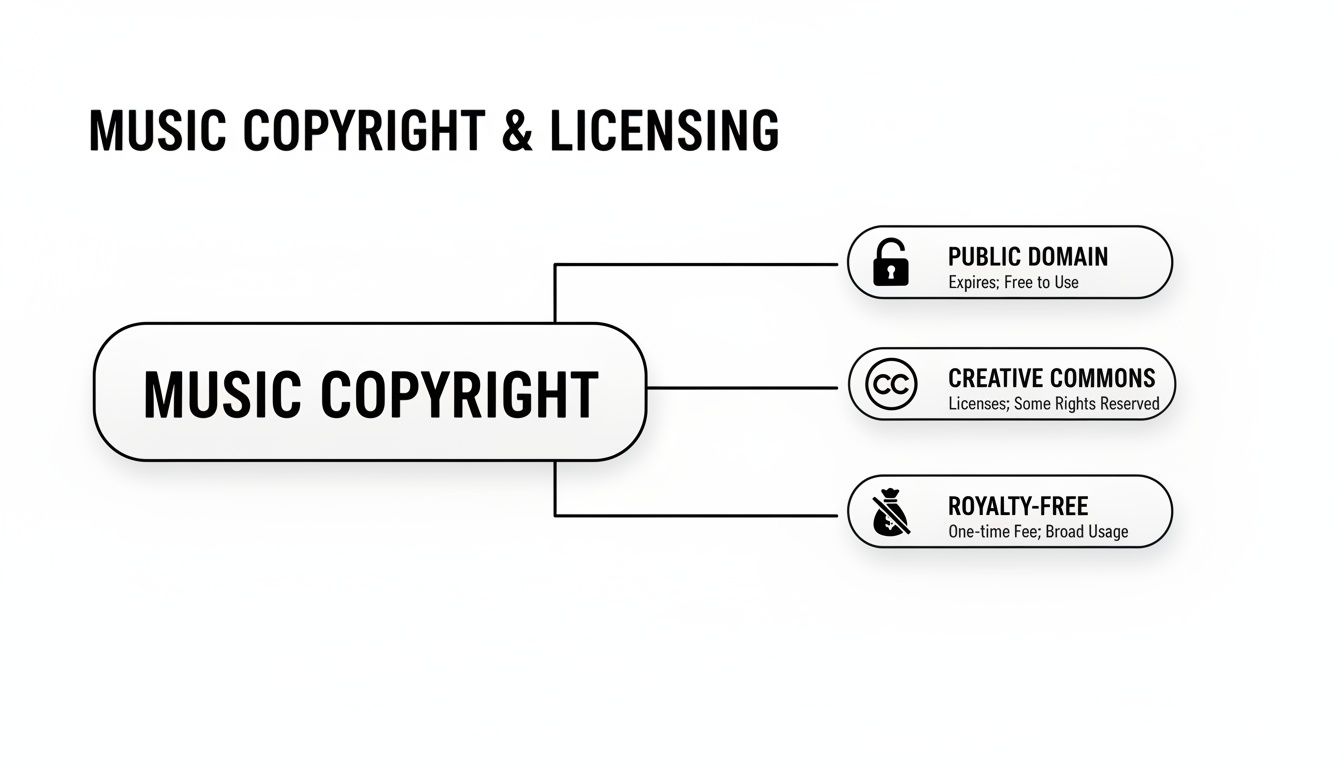
Understanding these basics will help you confidently and respectfully use the free music that artists and churches so generously provide.
Using Digital Platforms and Apps to Find Free Tracks
While reaching out to artists directly is a fantastic personal approach, there’s an entire ecosystem of digital platforms designed to help you discover new music. Think of these websites and apps as curated digital record stores, each one making it easier to find legal free Christian music downloads.
These platforms are built to bridge the gap between independent musicians and new listeners. They act as discovery engines where artists can upload their music and offer a free track, often in exchange for something simple like an email signup or a social media share. It’s a classic win-win: you get to explore incredible new music, and the artist gets to build a direct relationship with a fan.
Platforms Built for Music Discovery
Some services are designed from the ground up for this kind of ethical music exchange. They offer curated collections and feature artists from all walks of life, including a strong community of Christian and Gospel musicians.
Here are a few of the best places to start your search:
- Paste Music (formerly NoiseTrade): A true pioneer in this space, Paste Music built its model around offering free EPs and singles for an email address. It remains a treasure trove for finding high-quality projects from up-and-coming Christian artists.
- ReverbNation: While a broad platform for all genres, many Christian artists use ReverbNation to offer free MP3s. It's a smart promotional tool for them to climb the site's charts and catch the ear of new fans.
- SoundCloud: Keep an eye out for a "Download" button just below the track's waveform. Countless artists, both big and small, enable direct downloads on their SoundCloud uploads as a way to share their music freely.
These kinds of platforms are a huge reason for the genre's recent growth. With accessible streaming and downloads, Christian music has exploded, evidenced by the popularity of Spotify's Christian Hits playlist and a 60% surge in the genre's streaming numbers over just five years. You can see how Christian contemporary music is booming and dive into the data yourself.
Distinguishing Downloads from Offline Streaming
Now, this is an important distinction to make. A true music download is very different from the "offline listening" feature you see on apps like Spotify or Apple Music. They feel similar at first, but they work in completely different ways.
A free Christian music download gives you a permanent audio file (like an MP3 or WAV) that you own. You can move it to any device, play it with any app, and keep it forever—no subscription required. Offline streaming is more like renting. The app saves temporary, encrypted files that only work inside that app as long as you're a paying subscriber.
The moment your subscription ends, so does your access to all that "offline" music. If you want to build a lasting, personal library that isn’t tied to a monthly fee, you need actual downloads. For a deeper dive into this, our guide on how to legally stream music for free breaks it down even further. Using the right platforms ensures you're collecting music files you can truly call your own.
A Practical Guide for Artists Offering Free Music
As a Christian artist, your music is more than just art—it's a ministry. Offering free Christian music downloads can be one of the most powerful ways to get that ministry into more hearts and homes, connecting your message with new listeners and equipping the global Church.
It might feel backward to give away something you’ve poured your heart into. But think of it as an investment in your most important asset: your community. When you offer a free download, you’re doing more than sharing a song; you're inviting someone into your story. This simple act of generosity builds a loyal audience that will be far more likely to support you down the road by buying albums, picking up merch, and coming to your shows.
This isn't just about goodwill; it's a smart strategy with real, tangible benefits for your music ministry.
Why Giving Away Music Actually Works
The real goal behind offering a free track is to open a direct line of communication with the people who connect with your music. When a fan trades their email address for a song, they're giving you permission to reach out to them personally. That’s infinitely more valuable than a passive stream or a social media "like."
This strategy has a direct impact on your ability to build a sustainable career. Let's break down the advantages:
- Build Your Email List: Your email list is something you truly own. You aren't at the mercy of social media algorithms that can change overnight. It’s your most reliable channel for announcing new music, sharing tour dates, or just offering a word of encouragement.
- Equip Local Churches: Worship leaders are constantly on the lookout for fresh, anointed songs. By providing a free download—especially if you include chord charts—you can help your music find a home in church services all over the world. It’s an incredible way to let your ministry spread organically.
- Drive Traffic and Engagement: A free download is a fantastic reason for someone to visit your website. Once they're there, they can discover your other albums, read your bio, and find your social links. That first click often leads to much deeper engagement.
For a deeper dive, our guide explains why building a fanbase is essential for selling music and the critical role that free offerings play in that process.
How to Set Up Your Free Download
Getting your free download set up is actually pretty simple. Platforms like Bandcamp are built to make this process incredibly easy for independent artists.
The Bandcamp for Artists page shows how creators can set up their own storefront to sell music and merchandise directly.
Bandcamp lets you use a "name your price" model. This means fans can enter $0 to get the track for free, or they can choose to pay a little something to show their support.
Another great option is to integrate an email signup form from a service like Mailchimp directly onto your artist website. You can set it up to automatically send the free track as soon as someone subscribes. The key is to make it as simple and seamless as possible, turning a curious first-time listener into a genuine fan.
Got Questions About Free Christian Music Downloads?
Diving into the world of free Christian music can feel a little confusing at first. You want to support artists and do the right thing, but it's not always clear what's legal, what's safe, and what's actually helpful to the musicians you love. Let's clear up some of the most common questions.
Think of this as your guide to downloading with confidence. Knowing the difference between a legitimate offer from an artist and a sketchy website protects everyone involved.
Is It Legal to Download Christian Music from YouTube?
This is a big one. It's incredibly easy to find a website that will "rip" the audio from a YouTube video and turn it into an MP3. But just because you can doesn't mean you should. In almost every case, this violates YouTube's terms of service and infringes on the artist's copyright.
The best way to think about it is like photocopying a book you found at the library. You get the content, sure, but the author and publisher see none of the benefit, and it wasn't the intended way for you to receive it.
The only time it's okay is when the artist or their label explicitly provides an official download link right there in the video's description. That link will take you to a place they control—like their own website, a Bandcamp page, or another trusted platform where they've chosen to give the song away. Otherwise, stick to streaming the video or using the "offline" feature if you have a YouTube Premium subscription.
Can I Use a Free Download in My Church Service?
This is where good intentions can easily lead to a sticky situation. When an artist offers a free download, they are almost always granting you a license for personal listening only. It's a gift for you to enjoy on your phone, in your car, or on your computer.
Playing that same song during a church service, for a youth group, or in a livestream is considered a "public performance." That requires a completely different type of permission. It’s the difference between buying a movie ticket for yourself and buying the rights to screen that film for an entire audience.
For any kind of public use, including worship services, your church needs a public performance license. The most common one is the CCLI Church Copyright License. The only way around this is if the artist specifically states the track is cleared for church use or if it's released under a Creative Commons license that allows public performance. When in doubt, always assume you need a license.
How Can I Spot a Safe and Legal Download Website?
You can usually tell the good from the bad with a little bit of observation. Legitimate sources want you to feel secure. They're proud to be associated with the artist.
You're generally in a safe zone on official artist websites, established platforms like Bandcamp, and resource hubs from well-known ministries like Elevation Worship or Bethel Music. Sketchy sites, on the other hand, tend to give themselves away.
Here are a few red flags to watch out for:
- A storm of pop-up ads. If you have to fight your way through ads just to see the download button, it's a bad sign.
- Sloppy details. Illegal sites are notorious for misspelling artist names and song titles.
- Clunky, unprofessional design. Real platforms invest in making their sites look good and work well.
- Offers that are too good to be true. If a site claims to have a major artist's entire catalog for free, it's almost certainly illegal.
The easiest gut check is to ask: "Does this feel like the artist is actually here?" If the answer is no, it's best to back away.
What Is the Difference Between Streaming and Downloading?
While they both let you listen to music, streaming and downloading are fundamentally different.
Streaming is like turning on the radio. The music plays in real-time over the internet, but you never actually possess the song file. You're renting access to it.
Downloading is more like buying a CD. A legal free download gives you a permanent copy of the music file (usually an MP3) that lives on your device. You own that specific file and can listen to it whenever you want, even without an internet connection.
People often get this confused with the "offline mode" on apps like Spotify. That feature saves temporary, encrypted files that can only be played inside that app, and only as long as you have an active subscription. Cancel your subscription, and those offline tracks vanish. A true download is yours to keep.
At OohYeah, we're all about building a bridge between artists and their listeners. Our platform helps musicians offer commission-free downloads, sell merch, and share exclusive content, making sure they keep more of their hard-earned revenue. Discover a new way to support the artists you love on OohYeah today.