10 Event Promotion Strategies for Music Artists
Explore 10 event promotion strategies for music artists, from social campaigns and email to partnerships, local outreach, livestreams, and OohYeah! tools.

October 2, 2026
Music Marketplace Advisor
Buying & SellingOne viral post rarely fills a music event. Even when a clip reaches a large audience, attention doesn't automatically become ticket sales. Fans still need a clear reason to attend, a convenient way to buy, confidence that the event is worth their time, and a prompt to bring someone else.
The strongest event promotion strategies work as a coordinated funnel. Social content attracts the right listeners, owned channels deepen interest, local partners add credibility, paid campaigns close gaps, and referrals turn satisfied fans into a distribution channel. Email remains particularly important. One benchmark reports that targeted email campaigns generate 86.3% of event and webinar registrations (Remo's event industry statistics), while broader industry data shows organizers expanded their average marketing channel mix from 4.79 in 2022 to 6.5 in 2023 and 9.5 in 2024 (EventVesta's event industry statistics).
The following ten tactics are designed to work together across social media, email, communities, partnerships, advertising, local activation, media, livestreaming, and referral loops. OohYeah! can support that system with artist profiles, direct messaging, community posts, content, merchandise, analytics, and event-related promotion, so fans don't have to move between disconnected tools at every stage.
1. Social Media Campaigns and Influencer Partnerships
Social media should create a sequence of reasons to care, not a pile of repetitive ticket announcements. For a music event, start with the artist's strongest emotional asset, such as a live performance moment, an unreleased song preview, a venue detail, or a collaboration fans can't experience elsewhere. Then adapt that asset for short-form video, Stories, posts, and direct conversations instead of copying the same caption everywhere.
Influencer partnerships work best when the creator already has credibility with the relevant music audience. A local tastemaker, genre-focused reviewer, dance creator, or musician with an active community may drive more meaningful attendance than a larger account with weak audience fit. Give partners something specific to share, such as an exclusive preview, a rehearsal clip, or a personal explanation of why the event matters.
Practical rule: Pay for access when necessary, but choose partners for audience trust and relevance before follower count.
Build the campaign around a trackable event hashtag and unique links for each collaborator. Use artist accounts to cross-promote the event, invite participating artists into the same content calendar, and use OohYeah! direct messaging for private previews or early announcements. The artist profile can then act as the conversion destination for tickets, music, and merchandise. The OohYeah! artist platform gives the campaign a direct home instead of sending every interested fan to a different destination.
Short-form production doesn't need to become a bottleneck. A creator can use tools such as best faceless reels generators for supporting formats, while the artist's own face, voice, and performance remain central to the campaign.
2. Email Marketing and Newsletter Campaigns
Email gives an event campaign a direct route to people who have already shown interest. Social posts can create reach, but platform algorithms decide who sees them. A permission-based list gives the campaign a steadier owned channel for fans who attended a previous show, bought merchandise, followed an artist, or live near the venue.
Email should connect the funnel rather than operate as a separate announcement stream. Use the event page as the campaign destination, then build a short sequence around decisions fans need to make: why this show matters, what the ticket includes, how to reach the venue, and what changes as the date approaches. Earlier industry research also places email among the established tools used to promote events (Remo's event marketing benchmarks).
Segment before writing. Local subscribers need venue, transport, and timing information. Past attendees need a clear reason to return. Merchandise buyers may respond to a bundle or event-only item. Fans of a participating artist may care more about the set, collaboration, or early access. Sending one message to every subscriber saves setup time but usually makes the offer less relevant.
Open rates vary by event type. Benchmarks put them at 55% for internal events, 45% for free events, and 40% for paid events (Oniva's event marketing KPI benchmarks). Use those figures as planning context, not a promise. Test subject lines, send timing, and audience segments, then judge performance by ticket clicks and completed purchases.
Send the announcement when the event page is ready, followed by reminders that add useful information instead of repeating the subject line. Link directly to the OohYeah! event page, where subscribers can move from interest to tickets, merchandise, exclusive content, or artist interaction through the OohYeah! fan experience. Add tagged links or referral codes by segment to identify which emails produce attendance and sharing.
Check deliverability with this guide to checking whether emails are going to spam before a major send, particularly after changing email tools or domains.
3. Community Building and Direct Artist Engagement
A community converts promotion from an announcement into a relationship. Fans who regularly hear from an artist are more likely to understand the event's story, ask questions, notice early access, and share the invitation with friends. That doesn't require constant personal replies to every message. It does require consistent signs that the artist sees the community as more than a list of buyers.
Use community posts to reveal details that aren't available in the public campaign. An artist might explain why a particular city matters, share a stripped-back rehearsal moment, ask fans to choose between two encore songs, or show the visual concept for the stage. These posts give supporters material to discuss and share while preserving the event's sense of occasion.
OohYeah!'s direct messages, voice notes, and community posts fit naturally into this layer. An artist can send a short voice note to a group of local fans, answer questions about accessibility or set length, and invite the community to an early ticket window. A private Q&A can also expose objections before they become abandoned purchases.
Reward participation without making the community feel transactional
Early access, signed merchandise, acoustic recordings, and event-day meetups can reward active members. Keep the offer aligned with the artist's identity. A small club of engaged listeners is more valuable than a large group that only appears when a discount is available.
Fan content can extend the campaign. Feature artwork, cover versions, dance clips, or memories from previous shows in the artist's community and public channels, with permission. The strongest advocates won't sound like paid advertisers because they're sharing a real connection to the artist.
4. Content Marketing and Educational Storytelling
Ticket copy answers what, where, and when. Strong content answers why this event deserves attention. Artists can build that reason through rehearsal footage, production diaries, interviews, podcasts, artist stories, and explanations of the creative work behind the performance.
For example, an independent band preparing a hometown release show could publish a short video about how the new record was made, then follow it with a rehearsal excerpt and a conversation about the musicians joining the bill. A DJ could explain the sound system, visual setup, or musical concept behind a special set. The content doesn't need to reveal every surprise. It needs to make the experience feel distinctive.
Use long-form content as the source and short-form posts as distribution. The full story can live in the OohYeah! magazine, while clips, quotations, and stills lead fans back to it from social channels. This creates a useful destination for search traffic and gives partners something more substantial to share than a ticket graphic.
Content should sell the meaning of the event before it sells the ticket.
Avoid generic backstage posts with no narrative. “We're rehearsing” is weak. “We rebuilt this song for a room where the audience surrounds the stage” gives the fan a reason to pay attention. Explain the decision, introduce the people involved, and connect the creative process to what the audience will experience.
A music event can also become a source of evergreen content after the show. Record interviews, capture audience reactions, and edit selected performance moments for future promotion, while respecting performer rights and venue agreements.
5. Strategic Partnerships and Cross-Promotion Networks
Partnerships extend an event into audiences the artist couldn't reach efficiently alone. The most useful partners share either the same listeners or the same local context. That might include another artist on the bill, a venue, a record shop, a music school, a gear brand, a promoter, or a community organization.
Start by defining the exchange. A partner shouldn't receive a vague request to “post about the show.” Give them a clear role, ready-to-use assets, a unique link, and a reason their audience benefits. A venue can promote its room and hospitality. A supporting artist can introduce the headliner to a related fanbase. A music retailer can connect the event to an in-store performance or product bundle.
Multi-artist bills create natural cross-promotion, but they also create a coordination problem. Every artist may have a different visual identity, release schedule, and preferred platform. Set one shared event message, then allow each participant to express it in their own voice.
Make the partnership useful beyond visibility
A co-branded merchandise bundle, joint interview, shared playlist, or artist takeover can give the collaboration substance. OohYeah! can provide a single place for partner merchandise, event information, community announcements, and direct fan interaction. A manager or promoter can coordinate links and assets without asking each partner to build a separate sales path.
Track each partner with distinct links or codes. Compare not only ticket activity but also profile visits, sign-ups, merchandise interest, and community engagement. A partner that doesn't produce immediate sales may still introduce valuable local fans who join the artist's owned audience.
The trade-off is control. More partners mean more reach, but also more approvals and a greater risk of inconsistent messaging. Work with fewer, better-aligned collaborators rather than adding names that won't actively promote the event.
6. Paid Advertising and Targeted Digital Campaigns
Paid advertising is most useful when it solves a specific reach problem. If the artist already has strong engagement among local fans, spending heavily on broad awareness may waste budget. If awareness is healthy but ticket sales stall, retargeting people who watched a video or visited the event page may be the better move.
Separate cold and warm audiences. Cold campaigns should communicate the artist, event concept, location, and strongest reason to attend quickly. Warm campaigns can assume more knowledge and focus on the ticket decision, practical details, limited access, or a new piece of event content.
Build the campaign around the conversion path
Use creative that shows the actual experience. A performance clip can outperform a static poster when the audience needs to understand the energy of the show. Test different hooks, such as a guest artist announcement, a new set concept, a local connection, or an exclusive merchandise bundle. Send every ad to a focused OohYeah! event page rather than a general homepage.
Track the actions that matter:
- Audience quality: Separate local reach from impressions outside the venue's realistic travel area.
- Message response: Compare video viewers, profile visits, sign-ups, and ticket-page visits.
- Purchase efficiency: Review acquisition cost against ticket value and the expected contribution from merchandise or repeat attendance.
- Creative fatigue: Replace ads when frequency rises but meaningful actions decline.
Do not use paid media to compensate for an unclear offer. Advertising can buy attention, but it can't fix missing event details, a slow checkout, weak creative, or an audience that doesn't understand why the show is different. Set a spending limit, define the action each campaign should produce, and pause placements that don't support that action.
7. Local Community Engagement and Street Team Activation
Digital promotion can tell people that an event exists. Local activation makes the event feel like it belongs in the city. For music campaigns, that might mean a college radio interview, a record-store appearance, a short acoustic set, posters in independent cafés, or a collaboration with a neighborhood business.
Choose locations based on audience behavior, not just foot traffic. A poster outside a generic shopping center may be seen by many people who have no connection to the artist. A small display at a record shop, rehearsal space, music school, or venue partner may reach fewer people but create stronger recognition.
Street teams need a simple brief. Give ambassadors approved artwork, a short explanation of the event, a QR code linked to the relevant OohYeah! event page, and a clear way to report where materials were placed. If fans are involved, make participation feel like membership rather than unpaid labor. Offer access to a soundcheck, exclusive content, or recognition in the community.
Combine physical presence with measurable follow-up
A local pop-up can collect fan sign-ups, showcase merchandise, and create content for social media. A venue preview can answer practical questions while giving potential attendees a taste of the live experience. Local journalists, blogs, and radio stations may also respond more strongly to a story about the artist's connection to the area than to a generic event notice.
The trade-off is operational effort. Posters need permission, street teams need coordination, and local partnerships take personal follow-up. Keep the activity focused around the venue market and record which locations, ambassadors, and partners generate genuine interest. Local credibility is valuable, but only when the team can execute it consistently.
8. Live Streaming and Virtual Event Experiences
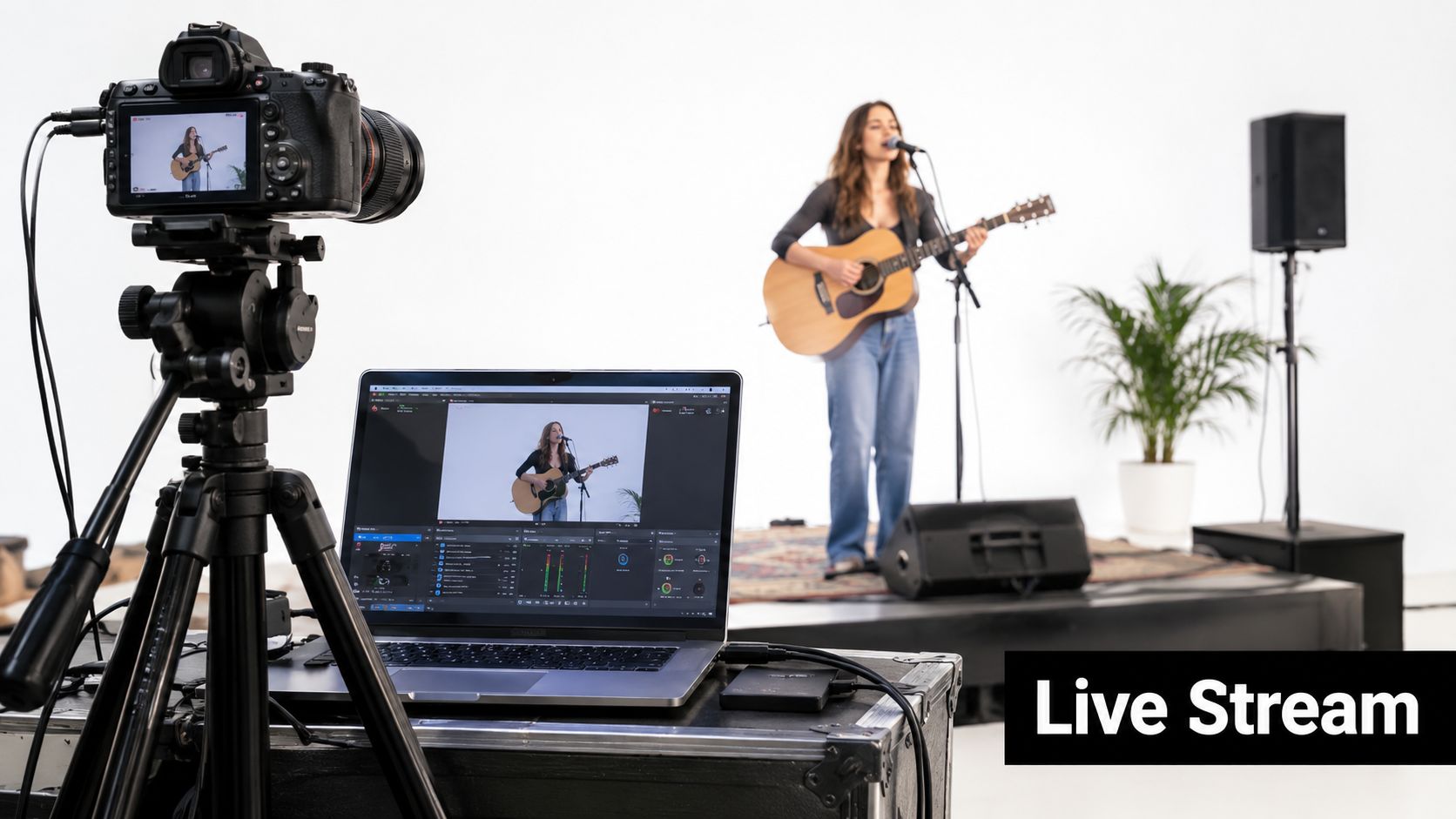
A livestream can widen access, but it shouldn't be treated as a camera pointed at a stage. Remote fans need a designed experience, with reliable sound, a clear viewing link, interaction, and a reason to watch live rather than wait for an unofficial clip.
Offer a distinct virtual package. It might include the main performance, a pre-show conversation, a soundcheck, a moderated Q&A, or later access to selected video. A premium option can add a multi-camera view or exclusive artist content. The right structure depends on the event, but every tier should be easy to understand.
Streaming also creates opportunities for merchandise and fan relationships. Show an event-specific product during the broadcast, place the purchase link where viewers can find it, and use an exclusive code or bundle when it adds value. OohYeah!'s artist profiles and commission-free marketplace can connect the performance to music, merchandise, and direct engagement without forcing remote attendees to search elsewhere.
Treat production as part of promotion
Announce the stream across the artist's owned channels and partner networks. Publish a short preview that demonstrates the sound and visual quality. Test the full setup before the event, including internet stability, microphones, camera angles, lighting, moderation, and the checkout journey.
Virtual attendance competes with other entertainment, so participation matters. Ask questions, respond to chat, invite remote fans to vote on a song, and give them moments they can't get from a static replay. A livestream can extend the event's life, but it requires real production work and should not be launched as an afterthought.
9. Public Relations and Media Outreach Strategy
Paid placements say the artist bought attention. Earned media can explain why the event deserves attention in the first place. A useful press strategy gives journalists a story, not just a date, venue, and ticket link.
Find a specific angle for each outlet. A local publication may care about the artist returning to the area, a music magazine may care about a new release or unusual collaboration, and a podcast may care about the creative process behind the performance. The same event can support different stories, but each pitch should feel written for its recipient.
Prepare a concise media kit with approved photographs, artist biography, event information, music links, contact details, and any relevant access terms. Offer journalists a practical next step, such as an interview, rehearsal access, an advance listen, or a conversation with the promoter. Make sure every factual detail matches the OohYeah! event page.
Build relationships before the announcement
A cold pitch sent on the day tickets go on sale gives the journalist little time and little reason to respond. Follow relevant writers, listen to their shows, share work that interests you, and contact them with a focused idea rather than a mass-distributed release.
Media coverage isn't guaranteed, and it shouldn't be the only conversion channel. A feature may create credibility without producing immediate ticket sales. Measure both direct traffic and assisted value, such as new followers, email sign-ups, interview opportunities, and partner interest. Give successful coverage a second life through OohYeah! community posts, artist profiles, email, and social content.
Don't claim that a platform has growth data or audience results you can't verify. Press materials should make the event interesting through real artist facts and a clear experience, not inflated platform language.
10. Referral and Incentive Programs
Referral programs work after fans have a reason to recommend the event. Asking people to share a generic poster rarely creates momentum. Give them a simple link, a clear reward, and a message that makes sharing feel like an invitation to friends rather than an advertisement.
A music event can offer early access, exclusive tracks, merchandise, a soundcheck experience, or recognition in the artist community. Rewards should protect the event's economics. A small digital bonus may be more sustainable than a deep ticket discount, especially when the artist also wants to preserve the perceived value of the live experience.
Make the loop visible and immediate
Create a unique referral link for each participant and show what happens after a friend registers. If the system indicates a fan has claimed a benefit, deliver it promptly. OohYeah! profiles and community posts can give supporters a place to find their link, see announcements, share the event, and receive the reward.
Use different prompts for different stages. Early in the campaign, invite fans to bring one friend who would appreciate the artist. Closer to the event, provide a shareable reminder with venue details and a direct purchase path. After the show, invite attendees to share photos or recommend the next event.
Public recognition can strengthen the loop. Feature helpful supporters in the artist community, thank local ambassadors, or offer a small VIP experience to people who consistently bring new fans. Be transparent about tracking and privacy. If the referral process feels confusing or the reward arrives late, the program creates frustration instead of advocacy.
A referral system compounds only when the event itself delivers. Fans won't repeatedly recommend shows that disappoint them, so treat post-event follow-up, gratitude, and future access as part of the promotion strategy.
Top 10 Event Promotion Strategies Comparison
| Strategy | 🔄 Implementation Complexity | 💡 Resource Requirements | ⭐ Expected Effectiveness | 📊 Ideal Use Cases | ⚡ Key Advantages |
|---|---|---|---|---|---|
| Social Media Campaign & Influencer Partnerships | Moderate→High, multi-platform coordination & ongoing content | Moderate budget + creator time; influencer fees vary | ⭐⭐⭐⭐, high engagement, ROI variable | Amplifying event reach, pre-sale buzz, viral promotion | Fast organic reach; authentic endorsements; UGC supply |
| Email Marketing & Newsletter Campaigns | Low→Moderate, segmentation, compliance, automation | Low–moderate cost for tools; requires quality lists & copy | ⭐⭐⭐⭐, strong conversion & measurable metrics | Direct ticket sales, early-bird offers, retention | High ROI; precise targeting; measurable performance |
| Community Building & Direct Artist Engagement | High, continuous moderation and artist time investment | High time commitment; community managers & platform features | ⭐⭐⭐⭐, strong long-term loyalty and advocacy | Superfan activation, VIP experiences, repeat attendance | Deep fan loyalty; word-of-mouth promotion; feedback loop |
| Content Marketing & Educational Storytelling | High, production planning and editorial consistency | High production resources, storytelling expertise | ⭐⭐⭐, builds credibility over time, slower conversions | Brand building, SEO, long-term discoverability | Evergreen assets; emotional connection; SEO benefits |
| Strategic Partnership & Cross-Promotion Networks | High, negotiation, alignment, and contract coordination | Moderate shared costs; legal/management overhead | ⭐⭐⭐⭐, exponential reach when partners align | Multi-artist shows, festivals, co-branded events | Shared audiences; cost-sharing; increased event prestige |
| Paid Advertising & Targeted Digital Campaigns | Moderate, ad ops and continuous optimization | Budget-heavy; analytics tools and creative production | ⭐⭐⭐⭐⭐, fast, measurable conversions when optimized | Time-sensitive ticket sales, geo-targeted promos | Scalable, fast results; precise targeting and attribution |
| Local Community Engagement & Street Team Activation | Moderate, on-the-ground coordination & logistics | Labor-intensive; local partnerships and materials | ⭐⭐⭐, high local conversion, limited scale | Local market launches, college towns, grassroots buzz | Authentic local reach; tangible experiences; reaches offline fans |
| Live Streaming & Virtual Event Experiences | High, technical setup, multi-platform delivery | High investment in equipment, crew, bandwidth | ⭐⭐⭐⭐, expands audience and creates new revenue | Hybrid events, international audiences, VOD monetization | Global reach; new revenue streams; content longevity |
| Public Relations & Media Outreach Strategy | High, relationship building and narrative crafting | PR expertise or agency; time for pitches & follow-up | ⭐⭐⭐, earned credibility; outcomes uncertain | High-profile events, artist narratives, earned coverage | Third-party credibility; organic exposure; SEO lift |
| Referral & Incentive Programs | Moderate, tracking systems and fraud mitigation | Platform development for tracking; cost of incentives | ⭐⭐⭐⭐, low CAC when incentives are attractive | Viral growth, friend-based ticketing, retention programs | Low acquisition cost; scalable referrals; social proof |
Build a Promotion System, Not a Single Post
The ten tactics work best as connected stages rather than isolated tasks. Start with the event story, then give that story enough distribution, enough direct communication, and enough local credibility to move a listener from passive awareness to a confident decision.
Use content and public relations to explain why the event matters. A rehearsal story, artist interview, local connection, or collaboration gives the campaign substance. Social media and partnerships then expand that story into related audiences. The goal isn't to repeat the same ticket message everywhere. It's to let each channel perform a different job while keeping the event promise consistent.
Email and community engagement should nurture intent. Email can deliver the announcement, practical details, and reminders to people who have opted in. Community posts and direct messages can make the event feel personal, especially when the artist shares context, answers questions, or offers supporters early access. Email's importance is reflected in the fact that 85% of event planners use it to promote events (Oniva's event marketing benchmarks). Use that channel carefully, with relevant segmentation and a direct path to action.
Paid campaigns should fill identifiable gaps, not replace planning. If local awareness is weak, promote performance-led creative to a defined geographic audience. If people visit the event page without purchasing, adjust the message, offer, or checkout experience before increasing spend. Local activation can reinforce paid reach with venue partnerships, radio, posters, pop-ups, and community ambassadors.
Livestreaming widens access when it has a designed experience, dependable production, and a clear offer. Referrals then give satisfied fans a way to extend the campaign. The strongest referral loop starts with a good event, continues with prompt recognition, and leads supporters toward the next artist interaction.
Choose one primary conversion path for each campaign. That might be a ticket purchase, a virtual registration, an email sign-up, or an OohYeah! event page visit that can lead to several actions. Every channel should have one measurable job, even if it also creates secondary benefits.
Use OohYeah! profiles, community posts, direct messaging, analytics, merchandise, and commission-free offerings where they reduce friction or strengthen the fan relationship. Keep the artist profile current, make event information easy to find, and connect promotional content to the action you want fans to take. For paid campaign planning, use a practical guide to offers and budgets to clarify the relationship between audience, message, spend, and conversion.
Review the campaign after the event. Which source brought qualified visitors? Which message produced conversation? Which partner followed through? Which content earned repeat attention? Record those answers while the details are fresh, then use them to improve the next event rather than starting from a blank page.
The broader direction is clear. Event promotion has moved from a small set of traditional channels toward coordinated distribution across email, paid social, search, outdoor media, and partners. Traditional advertising also accounted for 18.61% more spend than digital advertising channels during the period covered by the EventVesta summary (event promotion channel data). That doesn't make one channel universally better. It means artists should build a balanced system around audience behavior, local context, event economics, and the strength of their owned relationships.
OohYeah! gives artists a music-first place to promote events, build direct fan relationships, publish content, and sell tracks or merchandise through artist profiles and community tools. Visit OohYeah to connect your event promotion workflow with the audience and commerce features your next campaign needs.