Your Guide to Standout Disc Jockey Artwork
Transform your DJ brand with standout disc jockey artwork. This guide explores design, branding, and monetization strategies that get your music noticed.
April 1, 2026
Music Marketplace Advisor
Buying & SellingBefore a single beat drops, your artwork speaks. Think of your disc jockey artwork as the visual handshake—the silent ambassador that introduces your sound, your style, and your professional standard in one quick glance. It’s far more than just a thumbnail; it's the very first impression your brand makes on every platform.
Why Your Disc Jockey Artwork Is Your Brand's First Impression

In a sea of new music, your sound needs a visual anchor. Exceptional disc jockey artwork isn't just a nice-to-have; it's a critical piece of your marketing and identity. It becomes your visual signature across the sprawling digital and physical landscape of the music industry.
Think about a movie poster. Long before you watch a trailer, the poster's design—its colors, fonts, and imagery—tells you what to expect. A dark, shadowy poster screams thriller, while a vibrant, sun-soaked one promises comedy or romance. Your DJ artwork operates on the exact same principle, setting the stage for the audio journey to come.
Building Your Visual Signature
Cohesive and compelling artwork is the key to instant recognition. Imagine a fan scrolling through a crowded Spotify playlist or a fast-moving social feed. Your unique visual language is what will make you pop, cutting through the noise and stopping their thumb.
This visual identity isn't just about one release. It’s a unified system that includes:
- Profile Pictures: Your brand’s face in that tiny circle on Spotify or Instagram.
- Social Media Banners: The prime real estate on your SoundCloud, YouTube, and X profiles.
- Event Flyers: The promotional muscle for your gigs, whether live or virtual.
- Merchandise Designs: The graphics that empower your fans to become your biggest advocates.
A strong visual identity creates an immediate sense of professionalism and credibility. When your artwork is polished and cohesive, it tells bookers, collaborators, and fans that you take your craft seriously.
Disc jockey artwork serves multiple, crucial roles in shaping a career. The table below breaks down its core functions and why each one is so important for branding and commercial success.
The Core Functions of Disc Jockey Artwork
| Function | Description | Impact Area |
|---|---|---|
| Grab Attention | Acts as a visual hook in crowded digital spaces, prompting the first click or listen. | Discovery & Engagement |
| Set Expectations | Communicates genre, mood, and style before the music is even heard. | Branding & Marketing |
| Build Recognition | Creates a consistent visual language that makes your brand instantly identifiable. | Fan Loyalty & Recall |
| Signal Professionalism | High-quality, cohesive design conveys that you are a serious artist. | Industry Credibility |
| Tell a Story | Evokes emotion and creates a deeper narrative around your music. | Emotional Connection |
By mastering these functions, your artwork transitions from a simple graphic to a strategic business asset.
The Emotional Connection
At the end of the day, great artwork does more than just look sharp—it forges a genuine emotional link. It can tell a story, spark curiosity, and invite listeners into the world you've built around your music. A grainy, vintage photo might tap into a sense of nostalgia, while a sleek, futuristic design can signal a forward-thinking, innovative sound.
That connection is what turns a passive listener into a true fan.
This initial investment is one of the most powerful moves you can make. To dig deeper, we explore this very topic in our article on why artists should invest in quality cover art to truly stand out.
Once you understand its role as a brand-defining asset, you can start building a visual identity as unforgettable as your sound. It's not about decorating a release; it's about defining your career.
How DJ Identity Evolved From Voice to Visuals
It’s hard to imagine now, but the first disc jockeys were completely invisible. They were just voices on the radio, charismatic guides who introduced the world to new music, all from behind a studio microphone. Their power was purely auditory, built on the trust they earned with listeners who never once saw their face.
This was the golden age of radio, an era defined by pioneers who could make or break a record. The term 'disc jockey' itself was coined back in 1935 by commentator Walter Winchell to describe Martin Block's groundbreaking show. By the 1950s, the influence of DJs like Alan Freed was undeniable; their on-air endorsements were said to influence 70-80% of chart hits, effectively launching rock 'n' roll into the cultural stratosphere.
From Auditory Influence to Visible Performers
Everything changed when the party moved from the airwaves to the dance floor. With the explosion of discothèques and clubs, the DJ was suddenly thrust into the spotlight—no longer just a selector, but the focal point of the entire room.
This physical presence demanded a new kind of identity. It was no longer just about the records you spun or your on-air personality. Suddenly, DJs were performers who needed a visual brand to match their sonic signature.
This is where the very first seeds of disc jockey artwork were planted. We’re talking about the raw, energetic flyers and screen-printed posters that announced the next big night. These weren't just informational; they had to capture the entire vibe of the event—the music, the energy, the DJ's name—in one quick, memorable glance.
The move from the radio booth to the DJ booth marked the birth of visual branding in DJ culture. It was no longer enough to be heard; you now had to be seen and remembered.
The Modern Stage and the Visual Experience
Fast forward to today, and that evolution has reached a fever pitch. Modern DJs are the stars of massive productions, and their visual world is just as meticulously crafted as their sets. As the DJ identity evolved, visual elements like custom LED DJ booths became a core part of the performance and brand. These intricate setups are now integral to the artwork of the show itself.
This journey from an unseen voice to a visual icon tells us something important. A strong visual identity isn’t just a modern marketing gimmick; it's the natural conclusion of a story that has been unfolding for decades. For artists on platforms like OohYeah, this history provides a powerful lesson: you now have more control than ever to build a complete narrative, one where fans don't just hear your music—they see your world.
Crafting Artwork That Matches Your Sound
Think of your best track. Now, what does it look like? Great artwork for a DJ doesn't just put a name on a file; it gives your music a face. It’s the first thing a potential fan sees, a visual handshake that sets the stage for the sounds to come. Before anyone ever hits play, your artwork is already telling them a story.
Is your sound aggressive and industrial? Or is it more smooth and soulful? This is the core feeling you need to translate into a visual. A hardstyle producer will naturally lean into sharp lines, intense colors, and high-contrast chaos. Meanwhile, a DJ spinning deep, ambient grooves might find that soft textures, muted earth tones, and minimalist design better capture their vibe. Your artwork is your sonic DNA, made visible.
Choosing Your Visual Language
You don't need a degree in graphic design to steer the ship, but you do need to know your destination. Building a consistent visual identity comes down to a few key choices that work together to create a style that's unmistakably you.
- Color Palette: What’s the temperature of your music? Is it warm and inviting (reds, oranges, yellows) or cool and introspective (blues, greens, purples)? Bright, neon colors scream high-energy electronic music, while desaturated or black-and-white palettes can feel more underground, serious, or even nostalgic.
- Typography: The font you use is your brand’s voice. A bold, blocky, sans-serif font feels modern and powerful, a perfect match for techno or thumping bass music. On the other hand, a custom script or a more delicate serif font can evoke a personal, organic feel that works beautifully for soulful house or lo-fi beats.
- Imagery & Style: Are you a photography person, or do abstract graphics feel more authentic? A gritty, urban photograph communicates a completely different world than a clean, vector-based design. The key is finding a lane and sticking with it to build recognition.
Once you’ve locked in this visual story, you have a blueprint for all your creative assets. Knowing how to design prints for t-shirts and other merch, for example, becomes much easier when you've already defined the visual rules of your world.
Composition and Legibility
Having the right ingredients is one thing; how you put them together is another. Good composition is all about controlling where the viewer looks, ensuring they see the most important info—your name and the release title—right away.
I've seen it a thousand times: gorgeous artwork that's completely unreadable. Your name has to be crystal clear, even when it’s shrunk down to a tiny thumbnail on a phone screen.
Think about basic principles like the rule of thirds, negative space, and visual weight. Does your artwork feel cluttered and confusing, or is it clean and focused? A simple pro-tip is to place your logo or artist name in a consistent spot on every release. It becomes a powerful branding tool, helping fans spot your new track in a split second on a crowded playlist.
Ultimately, you’re creating a visual shortcut for your sound. By making intentional choices about color, type, and layout, you can craft artwork that's not just a placeholder, but an authentic extension of the music itself. It's the silent opening act for every track you drop.
Getting The Technical Details Right For Your Artwork
You've poured your soul into creating a killer track and a visual identity to match. But all that creative work can be completely undone by a few simple technical missteps. Getting your artwork ready for the digital world isn't just about the design itself; it's about making sure it looks sharp and professional everywhere it appears.
Think of it like mastering a track. You wouldn't send a muddy, low-res MP3 to a record label, right? The same principle applies to your visuals. Pixelated cover art, weirdly cropped promo images, or washed-out colors can instantly make your entire project feel amateurish. Let's walk through the essential specs you need to know to protect your brand's quality.
Don't Skimp on Resolution and Dimensions
The single most common mistake I see is artists using low-resolution images. It might look fine on your phone screen, but when it’s blown up on a high-definition monitor or printed on a flyer, it becomes a blurry mess.
Resolution determines the clarity of your image. For all digital releases, you need to think big. The industry standard for cover art is a square image, at least 3000 x 3000 pixels. This size ensures your artwork looks crisp whether it’s a tiny thumbnail on Spotify or a full-screen display on Apple Music.
When it comes to print, like posters or t-shirts, the game changes. You need a resolution of at least 300 DPI (Dots Per Inch). Anything less is a recipe for pixelation.
The Right File Formats and Color Modes
Beyond just the size, you have to save your files correctly. The format and color mode you choose will dictate how your artwork is rendered on screens and in print.
Color Mode (RGB vs. CMYK): This is a big one. RGB (Red, Green, Blue) is the color space for all digital screens—phones, laptops, TVs, you name it. Always save your files in RGB for online use. CMYK (Cyan, Magenta, Yellow, Black) is only for physical printing. Using the wrong one will make your colors look dull and inaccurate.
File Format (JPEG vs. PNG): For your final cover art, JPEG is your best friend. It offers a great combination of high quality and manageable file size, which is exactly what streaming platforms want. PNG files are your go-to when you need a transparent background, like for a logo you want to place over a video or a website banner.
This diagram is a great visual summary of how these core art principles—palette, font, and composition—all work together.

It’s all about creating a unified message where every visual element supports the others.
A Quick-Reference Cheat Sheet
Navigating the different requirements for each platform can feel like a chore. To make things easier, here’s a quick cheat sheet with the ideal specs for the most important platforms for DJs in 2026.
| Artwork Specification Cheat Sheet for DJs (2026) | |||
|---|---|---|---|
| Platform | Recommended Dimensions (pixels) | File Format | Color Mode |
| Spotify/Apple Music | 3000 x 3000 | JPEG, PNG | RGB |
| SoundCloud | 800 x 800 | JPEG, PNG | RGB |
| Bandcamp | 1400 x 1400 | JPEG, PNG, GIF | RGB |
| Instagram Post/Reel | 1080 x 1350 (Portrait) | JPEG, PNG | RGB |
| YouTube Thumbnail | 1280 x 720 | JPEG, PNG | RGB |
Bookmark this table! Keeping these specs handy will save you a ton of headaches down the road and ensure your brand looks consistently professional.
Getting these technical details right isn't just about following rules—it's about controlling how the world sees your art. A perfectly optimized image makes sure your first impression is always a powerful one.
Getting your files set up correctly from the very beginning makes the entire release process smoother. For those of you releasing music on OohYeah, nailing these specs is essential. For a step-by-step walkthrough, be sure to check out our guide on how to upload music and artwork correctly. Paying attention to these details is what separates the pros from the amateurs, ensuring your artwork always looks as good as your music sounds.
Turning Your Visuals Into a Revenue Stream

That incredible disc jockey artwork you commissioned? It’s not just a pretty picture for your release page. It’s a commercial asset, a money-making tool hiding in plain sight. When you stop thinking of your art as a cost and start seeing it as an investment, you open up a whole new world of income opportunities that can define your brand’s bottom line.
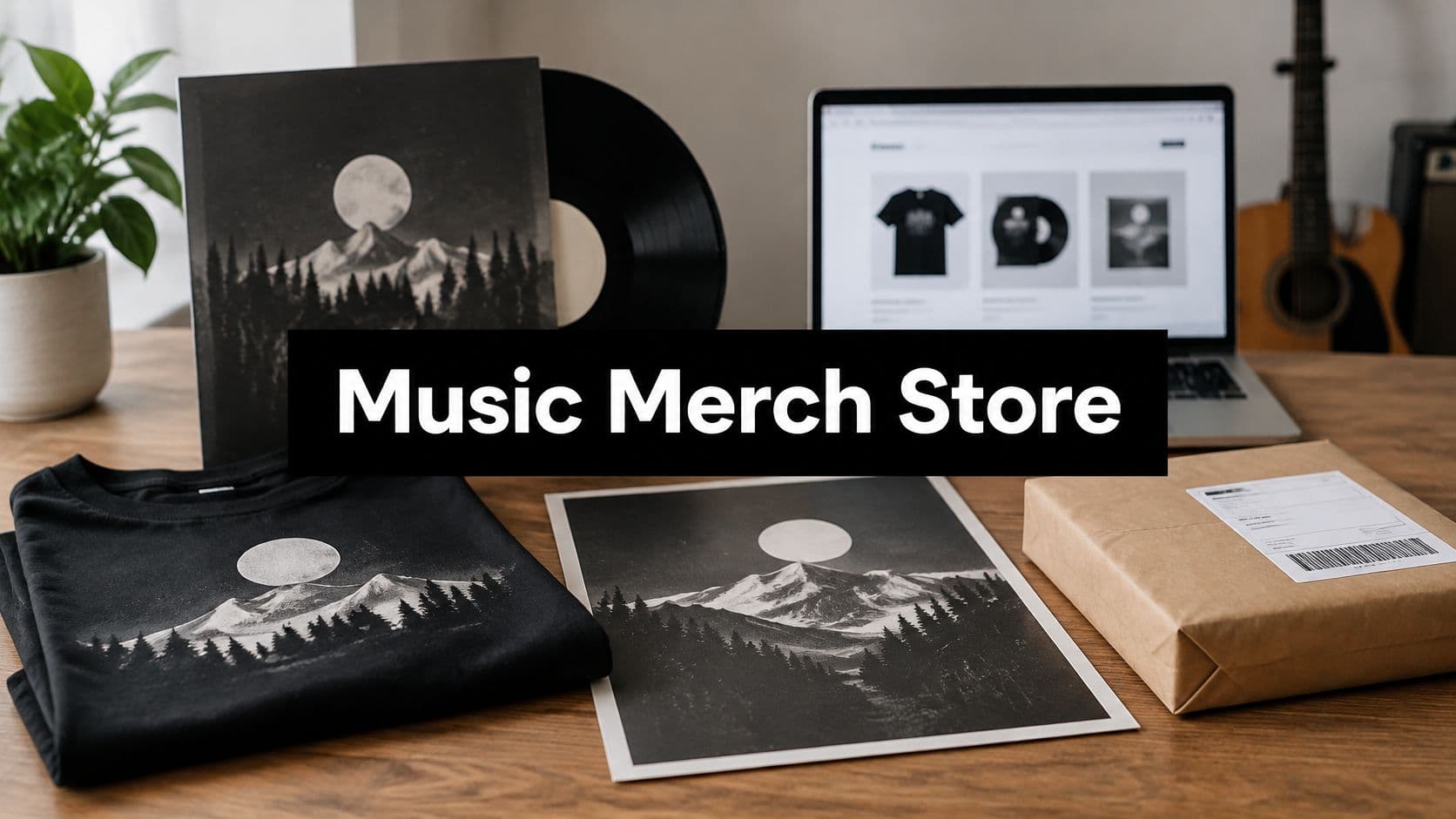
Consider your main artwork the 'master key.' Every piece of merchandise you spin off from it—a t-shirt, a poster, a custom slipmat—is a new door to revenue. This simple shift in thinking takes a one-off creative expense and turns it into an engine for recurring profit, giving you a real, tangible return on that initial design.
From Digital Art to Physical Products
The clearest path from art to income is merchandise. Let's be honest: fans who truly connect with your sound and your visual identity are looking for ways to show their support. They want a piece of your world. Giving them well-designed products turns them into walking billboards for your brand.
This is where a platform like OohYeah comes in, helping artists connect their art directly to their fans. By providing a marketplace where you keep 100% of the profits from every sale, it puts the power (and the money) right back where it belongs—with you.
Here are a few proven ways to get your artwork onto physical products:
- Apparel: The classics are classics for a reason. T-shirts, hoodies, and hats are the foundation of any solid merch lineup.
- Posters and Prints: Let fans bring your cover art into their own space with high-quality prints.
- Accessories: Stickers, enamel pins, and phone cases are great, lower-cost items that give everyone a chance to buy in.
- DJ-Specific Gear: Want to really connect with your core audience? Think branded slipmats or custom USBs loaded with an exclusive mix.
The Strategy Behind Limited-Edition Drops
If you really want to generate buzz and drive sales, master the art of the limited-edition drop. Tying exclusive merch to a new single or EP creates a powerful sense of urgency that your biggest fans can't resist. It elevates a new release from just something to hear into a full-on event.
A well-timed merch drop transforms a new release from just a listening event into a full-fledged commercial moment, driving both streams and sales simultaneously.
Imagine this: you're dropping a new track. Alongside it, you release a limited run of 100 t-shirts featuring the single's artwork, available for one week only. That scarcity makes owning the item feel like being part of an exclusive club. It rewards your most dedicated supporters and drives immediate revenue when you need it most—at launch.
This strategy of creating exclusive physical items has a digital counterpart, too. As you think about monetization, it's worth exploring the world of digital collectibles. You can get a sense of the possibilities by reading about how NFTs are changing the music industry and see if those principles can inspire your own sales tactics.
At the end of the day, fantastic disc jockey artwork does more than just catch the eye on Spotify. It's a foundational piece of your business that can fuel multiple income streams, build a die-hard community, and help turn your creative passion into a sustainable career. Your artwork isn't just decoration; it's currency.
Common Questions About Disc Jockey Artwork
Let's get straight to it. You have the tracks, but you're probably wondering about the visuals. Getting your disc jockey artwork right raises some practical questions, especially when you're trying to build a career. Here are some no-nonsense answers to the questions I hear most often.
How Much Should I Budget for Professional DJ Artwork?
Look, when you're starting out, every dollar counts. For custom artwork, you’ll see prices all over the map, but a realistic budget for an independent DJ is between $200 and $600.
In that range, you can expect to find a skilled freelance designer who can deliver a unique, high-quality piece. This should cover the initial design, a couple of revisions, and all the file formats you need for streaming, social media, and promo.
Think of it as an investment, not just an expense. You could go cheaper, sure, but a generic design often screams "amateur." A killer piece of custom art, on the other hand, elevates how people see you from the jump. Before you agree to anything, make sure you get the usage rights and the number of included revisions in writing.
Can I Use AI Art Generators for My DJ Brand?
This is the big question right now, isn't it? Yes, tools like Midjourney or DALL-E can be amazing for spitballing ideas, especially when you're on a shoestring budget. They let you see different concepts in minutes.
But you need to be careful. The legal side of AI-generated art is still a bit of a minefield. If you want to trademark your logo or brand down the road, using purely AI art could cause major headaches. More than that, AI images can feel a bit soulless—they often miss that personal touch a human designer provides, the thing that makes the art truly yours.
Here's a pro move: Use AI for your mood board. Generate a bunch of ideas to find a direction you love. Then, take those concepts to a real designer to refine, customize, and create something completely original and legally safe.
What Are the Biggest Mistakes To Avoid With DJ Artwork?
I see the same mistakes over and over, and they're all so easy to avoid. If you can sidestep these common blunders, you'll already look more polished and professional than most.
Here's what you absolutely need to get right:
- Using Low-Resolution Images: Nothing kills your credibility faster than a pixelated logo or blurry cover. Always work with high-resolution files from the very beginning.
- Choosing Illegible Fonts: Your name has to be readable, even on a tiny phone screen. Function over fashion here—if people can't read it, it doesn't matter how cool the font is.
- Brand Inconsistency: If your logo, colors, and vibe are different on every platform, you're just confusing people. A consistent brand is a memorable brand.
- Ignoring Copyright: This one's a deal-breaker. Using images or fonts you don't have the rights to can get you into serious legal and financial trouble. Stick to original work or use assets you have a clear license for.
Ready to turn your amazing artwork into real revenue? OohYeah provides the platform to sell merch, connect with fans, and grow your career, all while you keep 100% of the profits. Start building your empire at https://oohyeah.app.