
Diaphragm in Microphone: How It Shapes Your Sound
Learn how the diaphragm in microphone works, why size and material matter, and how to choose the right mic for vocals, instruments, and live recording.
July 28, 2026
Music Marketplace Advisor
Buying & SellingYou can spend an hour dialing in a vocal chain, move the mic a few inches, and still end up with a take that feels wrong. The room didn't change. Your preamp didn't change. The diaphragm in microphone did the heavy lifting, and that tiny moving surface decided whether the voice sounded intimate, brittle, roomy, or clear.
That's why mic shopping gets frustrating so fast. Model names blur together, marketing language gets louder than the audio, and the core reasons one mic works while another fights you stay hidden inside the capsule. The diaphragm is the part that turns air motion into signal, so once you understand it, you stop guessing and start choosing with intent. If you want the shortest path to better recordings, start here, because the diaphragm runs the show. For more creator-focused music resources, the OohYeah magazine sits in the same practical lane as this guide.

Why the Diaphragm in Your Microphone Quietly Runs the Show
A singer leans into the mic, the room is half treated, and the take sounds great in the first verse. Then the chorus hits, the mic starts exaggerating the room, and suddenly the vocal feels farther away than it did in the headphones. In moments like that, people blame the interface, the plugin, or the booth, but the true personality lives in the diaphragm.
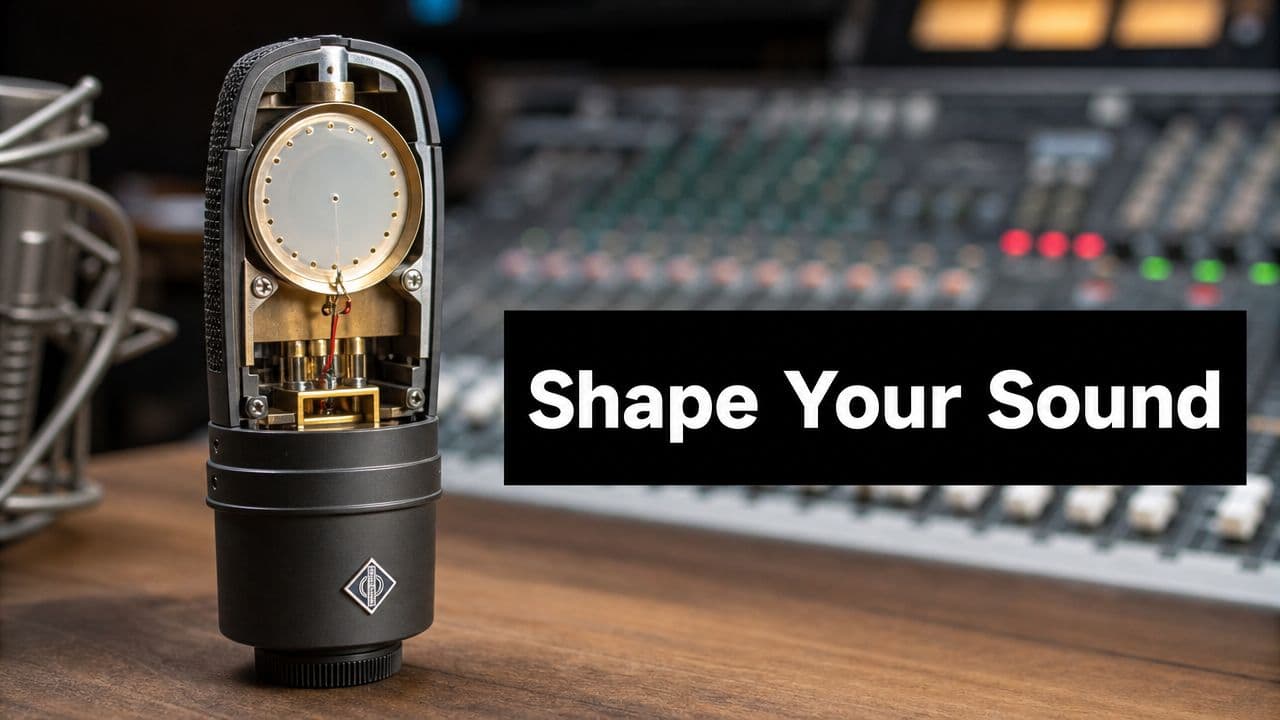
The diaphragm is the microphone's moving front end, the part that reacts first to sound pressure and starts the conversion into electrical energy. In a condenser mic, that little membrane is not just bouncing around for show. It is shaping the entire sonic result before the signal even reaches the circuit. That is why two microphones with similar features can feel completely different in a session.
Practical rule: if a mic sounds wrong before any EQ, compression, or reverb, the diaphragm's behavior is often where the problem starts.
The easiest way to think about it is like a drumhead that doubles as a measuring instrument. A stiffer head reacts differently than a loose one, and that difference changes the feel of the whole kit. In the microphone, diaphragm size, mass, and construction affect how quickly it responds, how much detail it catches, and how it behaves when sound comes in from the side.
That matters in real life, not just on a spec sheet. A vocal mic that flatters one singer can make another sound boxy, while a small-diaphragm mic that feels less “heroic” on paper may capture a piano, acoustic guitar, or cymbal with far more honesty. Once you see the diaphragm as the personality engine, the rest of the microphone starts making sense.
How a Microphone Diaphragm Turns Sound Into Electricity

The cleanest way to understand a condenser mic is to imagine two capacitor plates facing each other. One plate is the diaphragm, the other is the backplate, and the gap between them is only about 1/1,000 inch, or roughly 25 micrometers (Shure archive overview). Sound waves nudge the diaphragm, the spacing changes, capacitance changes, and that movement becomes the audio signal.
That tiny air gap is why condenser microphones feel so sensitive. The diaphragm does not merely wobble in the breeze. It directly modulates an electrical field, which is a much more precise job than just moving air around. Edward C. Wente's 1916 patent for a “Telephone Transmitter” is widely recognized as the origin point of the modern condenser microphone in that lineage (Shure archive overview).
Three diaphragm machines, three very different personalities
Dynamic microphones work differently. The diaphragm is attached to a coil suspended in a magnetic field, so when sound pushes the membrane, the coil moves and current is generated through electromagnetic induction (Diaphragm acoustics summary)). That's why dynamic mics tend to feel sturdier in rough live environments, even if they usually respond less delicately than condensers.
Ribbon microphones push the idea even further. In a ribbon mic, the diaphragm itself can be an extremely thin aluminum ribbon, and the format became a major milestone around 1920, when Walter H. Schottky and Erwin Gerlach developed the ribbon microphone (Diaphragm acoustics summary). Compared with early condenser designs, ribbon mics brought a different frequency character and a very distinct physical approach.
The historical thread matters because it shows the diaphragm has always been the transducer's core mechanical interface. From Emile Berliner's 1876 carbon button microphone to Edison's 1877 telephone diaphragm experiments, the same basic idea kept returning, sound pressure moving a membrane, the membrane driving a signal (Diaphragm acoustics summary). That makes the diaphragm one of the oldest and most important pieces of audio engineering still in daily use.
Large vs Small Diaphragm Mics and Why Size Changes the Sound
The size labels are more than marketing shorthand. In common industry use, a large-diaphragm mic has a capsule diaphragm of about 1 inch (25.4 mm) or more, while a small-diaphragm mic is about 1/2 inch (12.7 mm) or less (Broadcast Bridge diaphragm guide). Those numbers are not universal standards across every manufacturer, but they're close enough to help you read a spec sheet without getting lost.
A larger diaphragm usually gives you a stronger output feeling, a thicker vocal presentation, and a more obvious proximity effect when the singer leans in. A smaller diaphragm is often chosen when the goal is speed, accuracy, and a tighter sense of the source's real shape. That does not mean one is “better,” it means they make different tradeoffs before the signal ever hits your DAW.
What the ear notices first
Large diaphragms often sound flattering on spoken voice or lead vocals because they can lend weight and presence. Small diaphragms often feel more even across the stereo field and can preserve fast attacks on strummed strings or percussion more cleanly. In other words, one style tends to highlight size and body, while the other tends to highlight motion and detail.
| Large vs Small Diaphragm at a Glance | Large Diaphragm (≥1 in / 25.4 mm) | Small Diaphragm (≤1/2 in / 12.7 mm) |
|---|---|---|
| Typical feel | Fuller, more present | More neutral, more immediate |
| Transient handling | Can be smoother on attacks | Often tracks fast attacks more precisely |
| Proximity effect | Usually more noticeable | Usually less emphasized |
| Common use case | Vocals, broadcast speech | Acoustic guitar, overheads, stereo capture |
The practical takeaway is simple. If you want voice to feel bigger in the room, a large diaphragm often helps. If you want the shape of the instrument to stay honest, a smaller diaphragm usually gives you less drama and more accuracy.
Diaphragm Materials and Coatings That Shape Your Tone
The diaphragm is not only about size. It is also about what the membrane is made of, how it is coated, and how that surface behaves over time. A condenser capsule often uses a thin conductive film, while ribbon microphones rely on a lightweight metal strip. The construction changes mass, tension, and responsiveness, which changes what you hear.
Why material changes more than people expect
A lighter membrane tends to react faster to air movement. That usually helps transient response and can make fine details easier to hear. A heavier or stiffer moving system can feel more controlled on loud sources, but it may trade some speed for durability. That tradeoff is one reason two mics with the same size label can sound nothing alike.
In condenser designs, the thin conductive membrane and backplate work together as a capacitor, so surface consistency matters as much as thickness. In ribbon designs, the aluminum ribbon itself is the diaphragm, so the metal's physical behavior is part of the sound in a very direct way (Diaphragm acoustics summary). The material isn't just a shell, it's the moving audio sensor.
Studio reality: two microphones can share the same size category and still feel dramatically different because mass, tension, and coating shape the response before any electronics do.
Long-term behavior matters too. Capsule coatings and film tension can age, and humidity, dust, plosives, and repeated high SPL exposure all put stress on the membrane. A diaphragm that sounds crisp on day one may drift in feel over time if it is exposed to bad storage habits or rough handling. That is why build quality and environmental resilience matter just as much as the out-of-box tone.
If you've ever compared two “similar” mics and wondered why one feels more polished while the other feels a little smeared, the answer is often hiding in the diaphragm's materials. The capsule doesn't just capture sound, it sets the boundaries for what kind of detail survives the trip.
Matching Diaphragm Behavior to Vocals, Instruments, and Live Sound
A lead vocal usually asks for a diaphragm that flatters the voice without turning consonants into glare. That's why many engineers reach for a large-diaphragm condenser when they want presence and size, especially in controlled rooms. The mic adds a sense of intimacy that can make a dry vocal feel finished before processing.
Acoustic guitar often benefits from the opposite instinct. A small-diaphragm mic or matched pair can capture the string attack, body resonance, and stereo image with less haze. Drums and overheads lean the same way, because fast diaphragms tend to follow sharp transients better and keep cymbals from smearing into a wash. If you want a practical studio decision rule, the source's speed usually tells you more than its loudness.
Broadcast speech sits in the middle. Many hosts want a larger, closer tone that feels confident on air, while still keeping sibilance under control. Live touring rigs bring a different priority, durability, because a microphone that survives handling, plosives, and stage volume matters more than a capsule that sounds beautiful only in a quiet room.
For venue work, the listening environment matters just as much as the mic. A room with good isolation, clean stage sound, and sensible monitoring often gives the diaphragm a much easier job, which lines up with the attributes of a great venue that separate a workable performance space from a problematic one.
A simple way to choose
- Lead vocals: start with a large diaphragm if you want presence and a polished front edge.
- Acoustic guitar: start with a small diaphragm if you want attack, stereo detail, and a less colored room sound.
- Drum overheads: choose small diaphragms when transient precision matters more than extra thickness.
- Live speech and stage vocals: choose rugged dynamics when handling noise, feedback risk, and physical abuse matter most.
The best choice is usually the one that matches the source's movement, the room's behavior, and the amount of control you have in placement. A mic that flatters one singer in a treated booth may become the wrong tool the moment you move into a reflective rehearsal room.
Reading the Specs That Come From the Diaphragm
Microphone specs stop feeling random once you trace them back to diaphragm behavior. Sensitivity is measured as output voltage at 1 pascal, which equals 94 dB SPL in a free sound field (DPA specification guide). That number is basically a snapshot of how efficiently the diaphragm turns pressure into voltage.
A more responsive diaphragm generally helps with high-frequency detail and transient capture, because the membrane tracks the air movement more closely. A heavier moving system can be tougher and may tolerate abuse better, but it can also feel slower. That is why a low-output mic often needs more gain, while a more sensitive condenser may sound lively with less preamp push.
What the spec sheet is really telling you
| Diaphragm Characteristic | Effect on Spec | What It Means for the User |
|---|---|---|
| Lighter membrane | Higher responsiveness | Better transient detail on fingerpicking, percussion, and stereo imaging |
| Heavier moving system | Lower responsiveness, more robustness | Can handle rougher use and louder sources with a steadier tone |
| Greater sensitivity | Higher output at 94 dB SPL | Needs less gain from the preamp |
| Tighter tension and controlled suspension | Lower distortion risk | More stable response when the source gets loud |
Self-noise, max SPL, and transient response all connect back to the moving assembly, not just the badge on the grille. If you're recording quiet acoustic passages, a mic with a fast, sensitive diaphragm helps preserve nuance. If you're miking a cabinet or snare, the diaphragm's ability to stay composed under level becomes more important than sheer delicacy.
The trick is to read specs as behavior clues, not bragging rights. A number only matters when you know what part of the diaphragm design produced it. That's also why the same model type can still disappoint if the placement and source don't fit the capsule's personality, something that comes up often in the OohYeah FAQ when people ask how to match gear to real-world use.
The Case Against the Big Diaphragm Always Wins Myth
Big diaphragms get praised because they often sound flattering fast. They can add weight, make close vocals feel expensive, and give a source a polished center image without much effort. That convenience has turned into a rule of thumb, and the rule is too simple.
The missing piece is off-axis behavior. Neutral educational sources note that diaphragm and capsule design affect polar pattern and off-axis coloration, and that lighter diaphragms often improve sensitivity and transient response, while heavier moving systems can better tolerate loud sources and produce a more controlled tone (Past Paper Hero summary). In plain terms, a mic that sounds big on-axis can still smear the room differently when the sound arrives from the side.
Where small diaphragms win
Small diaphragms often keep their shape more consistently off-axis, which helps in real rooms where the source is never perfectly centered and the reflections are never perfectly kind. That makes them a strong choice for acoustic guitar, cymbals, overheads, and untreated spaces. They can also preserve stereo imaging more faithfully, because the left and right sides of the pair tend to respond with less tonal drift.
Large diaphragms still have a place. On vocals, they can create a smooth, forward tone that many singers prefer, especially when the room is controlled and the placement is careful. But if the room is ugly, or the source is fast and bright, the “big mic” advantage can turn into extra coloration you didn't ask for.

Bigger does not automatically mean better. It means different, and in a lot of rooms, different is the whole problem.
The upgrade is choosing the diaphragm that fits the source and the room, not the one with the biggest marketing halo. Once you start listening for off-axis tone and transient shape, the old large-vs-small debate turns into a much smarter question, which is how do you want the microphone to behave when the room gets involved.
Choosing, Protecting, and Maintaining a Microphone Diaphragm
Choosing a diaphragm starts with the source, but it should also account for the room and the job. A studio that stays dry and clean lets a delicate condenser live a much easier life than a humid venue, a mobile rig, or a rehearsal space full of dust. If you tour, record outdoors, or move gear between climates, long-term stability matters just as much as the tone on day one.
Treat the capsule like a precision surface, because that is what it is. Use a pop filter on vocals, keep the mic in a case or sealed bag when it's not in use, and avoid blowing directly into the grille. Sudden temperature swings can be rough on condensers, and repeated abuse from plosives or careless handling can slowly change how the diaphragm responds.
Habits that protect the capsule
- Use a pop filter: it reduces direct air blasts, which protects the membrane from plosives.
- Store it dry and covered: humidity and dust are two of the most common long-term threats.
- Handle the stand, not the body: shock and rough mounting transfer stress to the capsule.
- Watch for drift: if a mic gradually sounds duller, harsher, or less consistent, don't ignore it.
The biggest mistake is assuming a diaphragm either works or fails. In practice, it can age gradually. A capsule may still pass signal while its response slowly changes, especially if it has lived in bad humidity or been exposed to hard use over time. If you care about consistency, buy for the room you work in, then protect the mic like it has to earn its keep every week.
A diaphragm is small, but it's not disposable. Pick it for the source, guard it from the environment, and you'll hear the difference every time you press record.
If you're building a smarter mic locker or just trying to stop wasting takes on the wrong capsule, visit OohYeah for creator tools, music resources, and practical support that fits the way modern artists work. It's a useful place to keep your recording choices, your releases, and your audience strategy moving in the same direction.