Guide to Clear Lake Recording Studios & 6 Top Peers
Find your sound at the best Clear Lake recording studios and top LA alternatives. Our 2026 guide covers 7 iconic studios, rates, gear, and booking tips.
June 1, 2026
Music Marketplace Advisor
Buying & SellingFinding the right room in Los Angeles usually starts with a messy search. You type Clear Lake into Google, get a mix of results, and then realize you're not just choosing a studio. You're choosing a workflow, a neighborhood, a staff culture, and a room sound that will either help your record move fast or slow the whole project down.
That's why artists get this decision wrong. They compare studio names like they're interchangeable rental spaces, when the essential question is simpler. Do you need the big rock drum sound, the polished pop vocal chain, the orchestral room, or the client-facing facility that can handle content capture and label expectations without drama?
Clear Lake Recording Studios deserves to be first in that conversation because it's one of the clearest examples of a Los Angeles room that sits between heritage and practicality. It has history, recognizable gear, and modern services, but it also raises the booking questions that matter in real life: who can book, what kind of session the room is best for, and whether the studio operates like a classic commercial facility or a more curated service environment.
Below is the shortlist I'd give an artist, manager, or producer trying to book smart in LA. It starts with Clear Lake Recording Studios, then moves through six peers that make sense depending on genre, budget pressure, and what you need the room to do on camera as well as on record.
1. Clear Lake Recording Studios

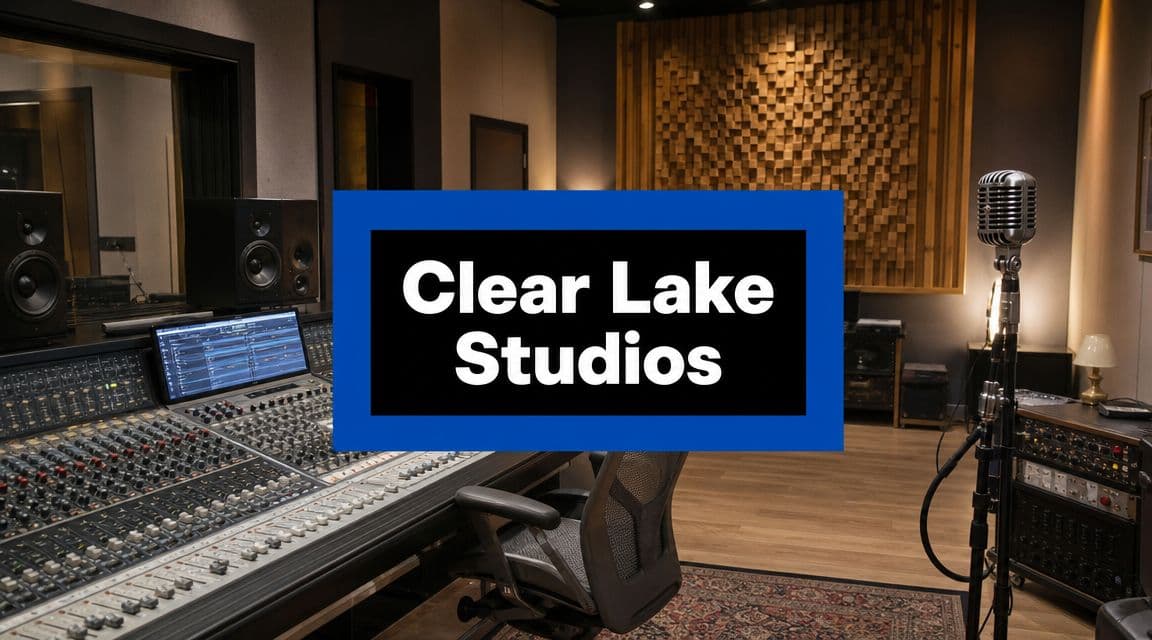
An artist usually lands on this name before they know whether they need a heritage room, a pop vocal room, or a full-service production base. If your search started with "Clear Lake," this is the actual Los Angeles studio commonly referred to. Clear Lake Recording Studios earns the top spot here because it sits in a useful middle ground. You get a real commercial facility with history and recognizable gear, but without automatically paying for the biggest legacy brand on the block.
That middle ground matters in practice. Some projects need the prestige and acoustics of a famous Hollywood room. Others need a studio that can track a band, turn overdubs quickly, handle mix work, and keep the session moving without forcing a move across town. Clear Lake is strongest in that second category.
What stands out in practice
The room identity is part of the appeal. Clear Lake has kept a long-running presence in North Hollywood, and that kind of continuity usually signals more than nostalgia. It points to repeat clients, stable operations, and staff who know how to keep sessions efficient under budget pressure.
The gear profile supports that read. ADAM Audio's feature on Clear Lake highlights the studio's monitoring setup, which is the sort of detail I pay attention to before recommending a room for serious decision-making. Good monitoring does not make a record for you, but it cuts down second-guessing. Visiting producers settle in faster, mix revisions tend to tighten up, and artists hear a more honest picture of what is being captured.
Practical rule: Book Clear Lake when you need one facility that can cover tracking, overdubs, editing, and mix-stage work without rebuilding the workflow every day.
There is a trade-off. Public information around booking is less transparent than at some competitor rooms. Third-party listings suggest outside clients can access the studio, and Clutch's Clear Lake Recording Studios profile references a SoundBetter day rate around $700 through Clutch's profile, but that still leaves the usual commercial-studio questions. Which room is included, what engineering support comes with it, and how often the best spaces are available are details you should confirm before locking dates.
Best fit and real trade-offs
Clear Lake makes the most sense for rock bands, singer-songwriters cutting with live players, and producers who want in-house support instead of a bare room rental. It is also a credible option for projects that may spill into adjacent services, since the studio presents itself as more than a tracking room and includes mixing, mastering, Atmos-related work, voice work, and other production services in its offering.
The upside is flexibility with infrastructure already in place. The downside is that artists who want instant online pricing and a simple self-serve booking path may find the process less direct than newer boutique rooms. If your priority is a managed session in a proven North Hollywood facility with a real commercial workflow, Clear Lake stays near the top of the LA shortlist.
2. Fever Recording

Fever Recording is the move when the room itself needs to sell confidence. Some sessions are about sound only. Others are part audio session, part label presentation, part content day. Fever sits in that second lane.
What makes it useful next to Clear Lake is ecosystem continuity. You're not starting from zero with a completely unrelated facility model. You're staying close to a team and ownership context associated with polished client service, but stepping into a more visibly premium environment.
When Fever is the better call
I would recommend this studio for a pop artist, writer camp, executive-facing vocal date, or any project where on-camera presentation matters almost as much as the chain. A lot of artists underestimate that factor until management, sponsors, or a content team shows up. Then the room's appearance suddenly matters.
Fever also works well when you need hospitality to feel turnkey. That doesn't make better records by itself, but it keeps sessions from losing momentum. In client-facing situations, friction shows up in small ways. Waiting on setup, awkward common spaces, and rooms that feel technically fine but visually flat all affect the day.
- Best for vocal-driven projects: Strong option for toplines, overdubs, production sessions, and social capture happening in the same booking.
- Best for managed sessions: Better fit than a stripped-down rental room when artists need support staff, polished presentation, and a tighter guest experience.
- Less ideal for budget-sensitive band dates: If your goal is to cut a lot of live instruments for the least possible spend, Fever may be more facility than you need.
Some rooms are chosen for sound. Others are chosen because the artist, manager, and label all walk in and immediately relax. Fever belongs in that second category.
The downside is predictable. Premium rooms usually come with premium inquiry conversations, and prime dates can take more planning. That's not a flaw. It just means you should book Fever because the session warrants that level of environment, not because the website looked good.
3. NRG Recording Studios

NRG Recording Studios is what I recommend when the project needs scale. Not perceived scale. Actual acoustic scale. If the brief is “we need drums to sound finished before the mix starts,” NRG goes straight to the top tier.
This is the classic major-room answer for bands and producers who don't want to piece together backline, microphones, and room strategy from three vendors. The appeal isn't only prestige. It's efficiency under pressure.
Why producers still book rooms like this
A big room changes musician behavior. Drummers play differently. Guitar players hear the amp differently. Engineers can use distance and depth instead of faking everything later with samples and ambience plugins. If you've got a record that lives or dies on live tracking, a room like NRG can save you from spending the next month trying to simulate size.
Its multi-room setup also helps when the project is moving in phases. You can track in a larger room, then shift to a smaller environment for overdubs or editing without completely changing facilities. That matters more than many first-time clients realize.
Trade-offs that matter before you book
NRG is not the place to show up half-prepared.
- Great for full-band sessions: Best when arrangements are finished, tempos are locked, and the producer can move quickly.
- Less efficient for short tasks: A quick vocal fix or two-hour overdub doesn't always justify a major-studio lockout.
- Good for consolidated logistics: Fewer moving parts can mean fewer day-of surprises for bigger productions.
What doesn't work is treating NRG like a casual creative clubhouse. Rooms at this level reward discipline. The better your pre-production, the more value you get. If the songs are still changing in the room, you're paying for square footage and infrastructure you aren't fully using.
4. EastWest Studios

EastWest Studios occupies a different lane from most project-focused LA rooms because it can legitimately support scale across records, voice work, and scoring-adjacent sessions. If your production needs to move between pop tracking and larger ensemble work, EastWest becomes very hard to ignore.
The key advantage is range. Some famous studios are amazing at one thing and awkward at everything else. EastWest tends to stay in the conversation because it can support several kinds of high-end sessions without feeling like a compromise.
The strategic value of a room like EastWest
For an artist team, EastWest is often less about gear talk and more about operational flexibility. If the record might expand into strings, choir, ADR, or higher-profile live capture, choosing a studio that can absorb those changes matters. You don't have to redesign the project every time the creative ambition gets bigger.
That also makes EastWest attractive to managers and label teams. A facility with a strong professional reputation can reduce the risk of scrambling later when a project's needs grow beyond a simple tracking date.
Booking lens: Choose EastWest when you need headroom. Not just sonic headroom, but production headroom for a project that may expand after the first session.
Where it can be too much
If your project is intimate, laptop-centered, and mostly about vocal production over programmed tracks, EastWest may be more room than record. You can still make that work, but the fit is strongest when the music benefits from larger acoustics or the campaign benefits from working in a studio with real heritage value.
The other trade-off is planning. Facilities that handle multiple professional session types often have schedules shaped by more than artist bookings alone. If your release plan is date-sensitive, get on the calendar early and confirm every technical need in advance.
5. Sunset Sound

Sunset Sound is for artists who want room character to be part of the record, not just the backdrop. Some studios are neutral containers. Sunset Sound is not one of them.
That's the appeal and the caution. Historic rooms and echo chambers don't just give you options. They push you toward making actual room decisions. For the right producer, that's the whole point.
What works best here
Sunset Sound is especially strong when you want personality on the front end. Drums, guitar amps, vocals, and ambient decisions all benefit when the room contributes something identifiable. A good staff knows how to lean into that character without turning every session into a museum exercise.
It also has serious visual value. If your team is capturing behind-the-scenes footage, interviews, or documentary-style assets, a room with instant visual identity helps. That's not superficial. In a release cycle, the room can become part of the story fans and press associate with the project.
- Strong fit for band records: Especially when arrangements leave space for room tone and performance dynamics.
- Strong fit for heritage-minded artists: Useful when sonic identity and studio narrative are part of the branding.
- Weaker fit for purely clinical production: If you want a highly controlled, modern-neutral environment, other rooms may suit you better.
Great heritage rooms speed up decisions when the team trusts the room. They slow everything down when nobody knows how to use the space.
That's the main trade-off. Sunset Sound rewards producers who can commit. If your process depends on endless option paralysis, you won't get the best from it.
6. Westlake Recording Studios

Westlake Recording Studios is the recommendation I give when the conversation turns from “where should we track?” to “where can the vocalist finish the record?” Those are not always the same studio.
Westlake has long been tied to polished pop and R&B workflows, and that identity still matters because those sessions are less about romantic room myths and more about repeatable execution. Signal chain, comfort, speed, tuning of the room, and engineer familiarity all count.
Why vocal records live or die on workflow
A lot of artists think they need the most famous room in town. Usually they need the room where the singer feels comfortable, headphone mixes come fast, and the engineer can move through comping, punch-ins, and chain adjustments without breaking the mood.
That's where a studio like Westlake earns its reputation. Controlled rooms and established vocal-production routines make a difference on long vocal days. If the artist is cutting stacked harmonies, doubles, ad-libs, and revisions, the room has to disappear and let performance take over.
Best use case
Westlake is especially strong for artists deep in release prep, where sessions need to be efficient and polished. Managers also like facilities in this lane because they're often easier to integrate into a broader team workflow that includes producers, songwriters, A&R, and vocal coaches moving in and out.
The trade-off is that this isn't necessarily the first call for a raw live-band record built around a big drum room. You book Westlake for precision, consistency, and vocal-forward execution. If that's your priority, it makes a lot of sense.
7. Paramount Recording Studios

Paramount Recording Studios is often the practical answer for teams that want a recognizable Hollywood facility without locking themselves into one narrow session type. It's flexible, centrally located, and usually easier to justify when the project includes a mix of artist work, label visits, and media-adjacent needs.
That flexibility is Paramount's biggest strength. Some projects don't need a mythic room identity. They need a studio that can host different kinds of professional work cleanly and without friction.
Why Paramount stays useful
For managers and producers, a multi-configuration facility is valuable because real projects change. The artist may need one room for overdubs, another for mixing, and another setup entirely for voice or content-related work. A studio that can support those shifts without forcing a move to another property keeps the schedule tighter.
Hollywood location also matters in a very unglamorous way. People can get there. Talent, crew, photographers, and outside collaborators already work nearby. That logistical convenience isn't sexy, but it protects the session.
When to choose it over a more specialized room
Choose Paramount when the project needs flexibility more than a single iconic sonic identity. It's a strong fit for mixed-format production calendars where the team wants credible infrastructure, familiar booking patterns, and room options across different scales.
The trade-off is that convenience can come with the usual Hollywood realities. Scheduling takes attention. Parking takes attention. Day-of movement takes attention. If your team plans for that, Paramount can be one of the more adaptable choices on this list.
Top 7 Recording Studios Comparison
| Studio | Implementation complexity 🔄 | Resource requirements ⚡ | Expected outcomes ⭐ / 📊 | Ideal use cases 💡 | Key advantages 📊 |
|---|---|---|---|---|---|
| Clear Lake Recording Studios | Low–Moderate, easy booking with veteran engineers | Mid-budget; vintage desk/outboard available | Reliable, vintage-modern hybrid sound, ⭐⭐⭐⭐ | Band tracking, full production, Atmos mixes | Consistent commercial rooms; veteran staff and classic Trident signal path |
| Fever Recording | Low (turnkey) but higher lead times for prime rooms | High, premium rooms and hospitality | Polished, high-end deliverables, ⭐⭐⭐⭐⭐ | A‑list sessions, on-camera content, vocal production | Upscale rooms; seamless Clear Lake engineering integration |
| NRG Recording Studios | High, large-room logistics and standard full-day lockouts | Premium; day rates include backline, extensive gear | Big-room drum/rock sound and major-studio results, ⭐⭐⭐⭐⭐ | Large bands, full backline sessions, big-tracking days | Massive tracking rooms, Neve 8068, consolidated gear package |
| EastWest Studios | High, scheduling complexity due to film/TV bookings | Premium bespoke pricing; orchestra-capable rentals | World-class orchestral and scoring quality, ⭐⭐⭐⭐⭐ | Orchestral scoring, strings/choirs, large-scale tracking | Historic pedigree; Studio 1 orchestra capability and pro session roster |
| Sunset Sound | Moderate–High, high demand and limited availability | Premium; unique rooms and echo chambers | Distinctive vintage character and strong press appeal, ⭐⭐⭐⭐ | Classic rock/pop records, documentary/visual content | Iconic rooms and echo chambers; heritage-driven sonic identity |
| Westlake Recording Studios | Moderate, streamlined pop/R&B workflows | Premium; tuned rooms for vocals and mixing | Polished vocal/pop productions, ⭐⭐⭐⭐ | Vocal production, pop/R&B, mixing and record cycles | Efficient vocal chains, central West Hollywood location |
| Paramount Recording Studios | Low–Moderate, flexible booking across rooms | Variable budgets; multiple room sizes to match projects | Versatile, dependable outcomes across genres, ⭐⭐⭐ | Indie-to-major sessions, VO/ADR, label lockouts | Flexible room configurations and convenient Hollywood location |
From Studio to Streaming: What's Next?
Picking the right studio in Los Angeles is one of the few creative decisions that affects everything after it. The room influences performances, session efficiency, mix decisions, visual content, and how confidently your team moves through the project. A bad fit doesn't just waste money. It creates revision cycles, scheduling problems, and avoidable stress when the release clock is already ticking.
Clear Lake Recording Studios stands out because it sits in a very useful middle ground. It has history, a recognizable analog identity, and a modern service posture. That makes it a strong option for artists who want a serious studio experience without automatically reaching for the most expensive legacy room in town. At the same time, the best choice isn't always Clear Lake. If you need a luxury client-facing environment, Fever may fit better. If you need giant live-room energy, NRG makes more sense. If you need orchestral capability, EastWest is the conversation. If the room character itself is part of the sound, Sunset Sound belongs on the shortlist. If vocals drive the project, Westlake is hard to beat. If you need broad operational flexibility in Hollywood, Paramount remains a reliable call.
For teams comparing these facilities, I'd also recommend plotting them on a map before booking. In Los Angeles, neighborhood friction is real. Commute time changes call times, load-ins, guest flow, and how long an artist can stay fresh in the room. Studio quality matters, but geography affects morale more than people admit.
Once the masters are done, the next decision is just as important. Don't hand off all that work and all that margin to a platform that treats artists like traffic. Put the finished release somewhere that supports direct monetization, fan relationships, and real control over how the music reaches people.
If you've done the hard part and made a great record, the smartest next move is building a release path that keeps more of the upside with you.
After your final bounce, put the release where it can earn. OohYeah gives artists a music-first platform to sell downloads, merch, and subscriptions directly to fans, commission-free, while keeping control over pricing, audience access, and promotion.