
A Guide to CD Disc Replication for Independent Artists
Discover the professional CD disc replication process. Learn how manufacturing high-quality physical media can elevate your music and merch strategy.
February 10, 2026
Music Marketplace Advisor
Buying & SellingWhen you're ready to produce a serious run of your album, you’ll hear the term CD replication. This is the official, industry-standard process for manufacturing professional, retail-ready CDs. Forget burning discs one-by-one; replication involves creating a "glass master" of your audio and then using a high-tech injection molding process to press thousands of perfect, durable copies.
This is the exact method used for major label releases and is the only real option for any artist planning to press 500 or more units.
Understanding the Power of Physical Media

In a world obsessed with streaming, pressing a physical CD might feel a bit old-school. But for any working musician, it's one of the smartest business moves you can make. This isn't about nostalgia; it's about creating a premium piece of merchandise for your most dedicated supporters.
Think of it like this: CD duplication (burning) is your trusty home office printer—great for a few quick copies. CD replication is the industrial printing press, built to mass-produce a flawless, high-quality product that lasts.
Physical media is a direct-to-fan revenue stream that completely eclipses digital. While streaming services pay out fractions of a penny for each listen, selling a single CD at a show can bring in the equivalent of thousands of streams. It puts money directly into your pocket.
A Tangible Connection in a Digital World
A replicated CD offers something a digital file never can: a genuine connection. It's an artifact your fans can hold, unwrap, and own, transforming them from a casual listener into someone who is truly invested in your music and career.
This is a critical move to make once you’ve figured out how to upload music to streaming platforms and are ready to cultivate a real, paying fanbase. That physical connection translates directly to your bottom line. CDs are a cornerstone of a solid merch strategy and can be bundled with t-shirts or posters to create high-value packages that fans love.
By investing in professionally manufactured CDs, artists create a premium product that reflects the quality of their music. It signals to fans, venues, and industry professionals that you are serious about your craft and your career.
Why Replication Is a Smart Investment
Choosing CD replication is an investment in your brand and your financial stability. It gives you a physical asset to sell at live shows, on your website, and through your email list, opening up multiple streams of income.
While there's a higher upfront cost compared to burning a few discs, the per-unit price plummets on larger orders. This makes it, by far, the most cost-effective option for any legitimate album release.
This guide will walk you through the entire process. We’ll break down how replication actually works, when it's the right choice, and how you can fit these high-quality discs into a modern distribution plan that helps you build a sustainable career in music.
Replication Versus Duplication: Choosing the Right Path for Your Music
Sooner or later, every musician with a physical release runs into a crucial question: should I replicate or duplicate my CDs? They might sound like the same thing, but they're worlds apart. Making the right call here will have a big impact on your budget, your timeline, and the final quality of your album.
Let's break it down with an analogy. Think of duplication as burning a mix CD for a friend. You take a blank, recordable disc (a CD-R) and use a laser to "burn" your music onto its dye layer. It's fast, straightforward, and perfect for small batches—anything under 500 units, really.
Replication, on the other hand, is the full-blown factory process. It’s how major label albums are made. Instead of burning data onto a premade disc, replication starts from scratch. It involves creating a glass master of your album and then physically stamping out every single CD, pressing your music directly into the disc's polycarbonate foundation. This is the method for serious, large-scale production.
Understanding the Core Differences
The real distinction is in how the disc is made. Duplication writes your music onto a blank disc that already exists. Replication creates a brand-new disc with your music physically embedded in it from the very start. This one difference creates a ripple effect, influencing cost, quality, and how quickly you get your hands on the final product.
If you’re a new artist needing 50 demos for a local showcase tomorrow night, duplication is a lifesaver. It’s flexible, and you don’t have to sink a ton of cash into a massive order.
But for an official album launch—where you're planning a tour, selling online, and stocking a merch table—replication is the only way to go. It’s the professional standard and becomes much more affordable per disc when you scale up. The entire US recordable media manufacturing industry, valued at around $1.5 billion, is built around serving these two distinct needs.
CD Replication vs Duplication At a Glance
To really see the difference, it helps to put the two methods side-by-side. The table below lays out the key trade-offs to help you decide which process fits your current project.
| Feature | CD Replication | CD Duplication |
|---|---|---|
| Best For | Official album releases, retail sales, large quantities (500+). | Demos, tour-only EPs, promotional copies, small runs (<500). |
| Process | Injection molding from a glass master; data is physically pressed. | Data is burned onto a blank CD-R using a laser. |
| Per-Unit Cost | Lower on large orders, but higher initial setup fee. | Higher on a per-disc basis, but no large setup cost. |
| Turnaround | Slower (typically 10-15 business days) due to the mastering process. | Faster (often just 1-3 business days) for quick needs. |
| Quality | Highest professional standard; more durable and universally compatible. | Good quality, but CD-Rs can degrade faster and may have issues with older players. |
| Printing | Professional silkscreen or offset printing directly on the disc. | Typically inkjet printing on the disc surface. |
Ultimately, this isn't about one being "better" than the other. They're just different tools for different jobs.
The Bottom Line: Go with duplication for speed and small quantities. Choose replication for professional quality, long-term durability, and major cost savings on larger orders.
Matching the Method to Your Release Goals
Your final choice should always circle back to your goals. Are you just testing the waters with a new EP and need 100 copies for your next gig? Duplication is your best friend.
But if you're planning a full album launch with a pre-order campaign and need 1,000 discs for your merch table and online store, CD replication is the industry standard. It's the only way to get that truly professional feel and lock in the lowest possible price per unit. Knowing when to use each method is a vital part of your business plan and directly impacts the success of your release. To learn how this decision fits into the bigger picture, check out these best strategies for independent music distribution.
From Your Files to a Finished CD: The Replication Process
So, how do your digital audio files become a stack of shiny, professional-grade CDs? It's a fascinating manufacturing process, far more involved than simply burning a disc at home. CD replication isn't about copying; it's about creating a perfect, durable clone of your original master, thousands of times over.
This industrial method is what gives replicated CDs their retail-ready quality and incredible longevity. Think of it less like burning a playlist and more like minting a coin—each one is a permanent, physical artifact of your music. Let's walk through exactly how it’s done.
Stage 1: Glass Mastering
Everything starts with a pristine, perfectly polished circle of glass. This isn't your windowpane; it's an optically pure disc that serves as the foundation for your entire project. Inside a super-clean, dust-free room, this glass disc gets coated with a light-sensitive chemical called a photoresist.
Next, we take your audio master (usually a DDP file) and use it to guide a high-powered laser. This laser meticulously etches the ones and zeros of your music into that photoresist layer, creating a spiral of billions of microscopic pits. This one "glass master" is the blueprint for every single CD you order, so this step has to be absolutely flawless.
Think of the glass master as the original film negative for a movie. It's the one perfect source from which every single copy is made. Its quality determines the quality of everything that follows.
This stage is the most critical and time-consuming part of the whole operation, which is why replication orders always have an initial setup fee. You're paying for the creation of this one-of-a-kind master.
Stage 2: Creating the Stamper
Once the glass master is created and passes a rigorous quality check, it's time to make the tool that will actually press your discs. The glass master is sprayed with a thin layer of nickel, which forms a perfect metal negative of your etched data. This first metal part is called the "father."
From that "father," a series of inverse copies ("mothers") are made to produce the final production tools: the stampers. These are tough, nickel-plated discs that are the exact inverse of your audio data—where the master had pits, the stamper has bumps.
These stampers are the real workhorses of the production line. They get mounted into massive injection molding machines and will physically press your music into every single disc.
Stage 3: Injection Molding and Metallization
This is where the magic of mass production really kicks in. The stamper is locked inside an injection molding machine that heats up raw polycarbonate plastic until it's molten. Then, under immense pressure, this liquid plastic is shot into a mold containing your stamper.
In a split second, the polycarbonate cools and solidifies into a clear plastic disc, with your music's data permanently embossed onto its surface. This cycle repeats with incredible speed and precision, churning out the raw bodies of your CDs.
But a clear disc is unreadable. So, the discs immediately move on to metallization. A micro-thin, reflective layer of aluminum is applied to each one. This is the shiny layer that allows a CD player's laser to bounce back and read the pits and lands that were just pressed into the plastic.
Stage 4: Finishing Touches and Printing
We're almost there. That delicate aluminum layer is fragile, so it needs protection. A tough, clear lacquer is spin-coated over the metal and instantly cured with UV light. This hard coat is what shields your music from scratches, oxygen, and general wear and tear, ensuring it can be played for decades to come.
Finally, your album art is printed directly onto that lacquered surface. Using either professional silkscreen or offset printing, the image becomes part of the disc itself. This process delivers a sharp, durable finish that looks and feels professional—a world away from the sticky paper labels or smudgy inkjet printing you see on home-burned CD-Rs.
After printing and a final quality check, your discs are ready for packaging and shipping, completing the journey from a digital file to a physical product ready for your merch table.
Getting Your Project Ready for Flawless Replication
Once you’ve put the final touches on your music, the last creative step is handing everything over for manufacturing. Getting your audio and artwork files right the first time is absolutely essential. It’s the difference between a smooth, exciting process and one filled with frustrating, costly delays.
Think of it this way: you wouldn't give a master chef a grocery list with vague ingredients and expect a Michelin-star meal. You'd give them a precise, tested recipe. The same goes for your CD manufacturer—they need a perfect, ready-to-go "recipe" to bring your vision to life without any guesswork.
This comes down to preparing two critical components: the audio master and the print-ready artwork. Each has its own set of non-negotiable technical specs.
Nailing the Audio Master
When it comes to submitting your audio for professional CD replication, there's one industry standard that stands above all others: the DDP (Disc Description Protocol) file set. This isn't just a folder of WAV files; it's a complete, self-contained, and error-checked package that tells the pressing plant exactly how to manufacture your CD.
A properly made DDP master locks in every detail, leaving nothing to chance.
- Track Order: The exact sequence of songs is set in stone.
- Gaps & Pacing: The precise timing and silence between tracks are embedded.
- Metadata: All your CD-Text (artist name, album title, track names) is included.
- Data Integrity: The DDP includes built-in checksums to ensure the data is 100% intact.
Delivering a DDP essentially eliminates the possibility of human error during setup. It is, without a doubt, the single best way to ensure that the thousandth disc off the line is an identical clone of the master you approved in the studio.
This flowchart shows the journey your master file takes from digital submission to physical product.
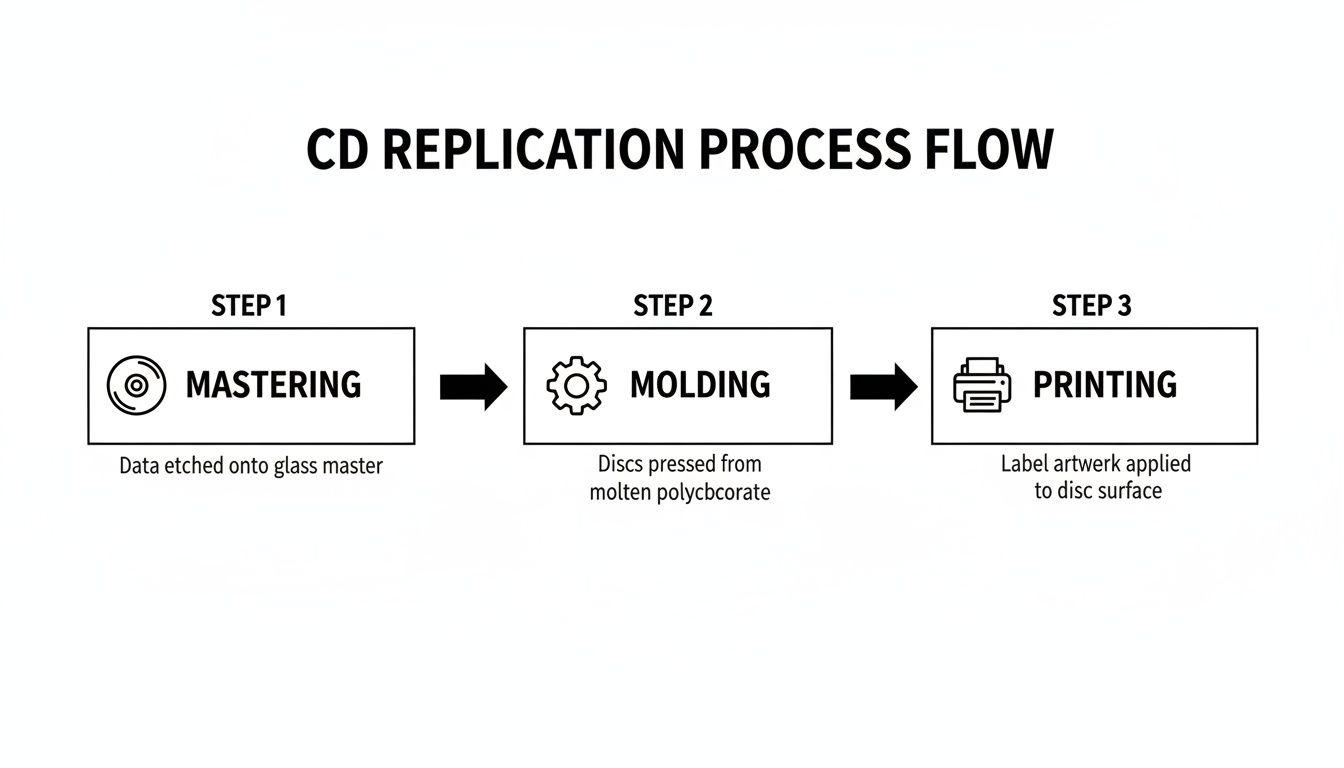
As you can see, the process moves from the highly precise mastering stage to industrial-scale molding and printing. This is why getting your initial files perfect is so critical—there’s no "fixing it" later.
Preparing Print-Ready Artwork
The look of your album is just as important as the sound. To get professional results, you must design your artwork using the specific templates provided by your manufacturer. While the dimensions will change depending on whether you choose a jewel case, a digipak, or a sleeve, the core technical rules are always the same.
The Artwork Specification Checklist:
- Color Mode: All artwork files must be in CMYK (Cyan, Magenta, Yellow, Black). RGB is for screens; CMYK is for ink. Submitting RGB files will lead to disappointing and inaccurate colors on the final product.
- Resolution: Every file needs to be at a minimum of 300 DPI (dots per inch). Anything less will result in blurry, pixelated images and text. High resolution is key to a sharp, professional look.
- Bleed Margins: Always extend your background colors and images beyond the final cut line, usually by 1/8th of an inch (or 3mm). This "bleed" area ensures that you won't see any ugly white slivers on the edge if the cutting machine shifts ever so slightly.
These specs aren't just suggestions—they are fundamental requirements for professional printing. Following them prevents the most common problems like muddy colors, fuzzy text, and sloppy-looking white borders, making sure your physical release looks as polished as it sounds.
Despite the digital age, the market for physical media is strong and growing. Projections show the global duplication disc market is set to expand to $3.055 billion by 2035. This growth is fueled by manufacturing innovations that improve quality and reduce waste, making professional products more attainable for independent artists. You can discover more insights about the duplication disc market and see how key players are shaping the industry.
Budgeting for Your CD Run: Costs and Timelines
Alright, let's talk money and time. This is where your creative project starts to feel like a real business, and getting these two things right is crucial for a successful release. CD replication isn't like burning a few discs at home; it's a manufacturing process with its own cost structure and schedule.
The first thing you’ll see on any quote is the glass master fee. This is a one-time, non-negotiable cost to create the master stamper—the mold for all your CDs. Think of it as the setup charge for the whole operation. Once you've covered that, the price for each individual CD drops significantly, especially as you order more.
That's the real magic of replication. Ordering 1,000 CDs can get your per-unit cost down to a little over a dollar. This incredible economy of scale is precisely why replication is the only sensible choice for anyone pressing 500 units or more.
Breaking Down Your Project Costs
Your total budget is more than just the price per disc. The packaging you choose plays a huge role in the final bill, so you'll need to find the sweet spot between what looks amazing, what protects the disc, and what you can actually afford.
Here are the main things that will determine your final cost:
- Quantity: This is the biggest factor. More discs mean a lower price for each one. Simple as that.
- Packaging: A basic cardboard sleeve will be your cheapest option. A multi-panel digipak with a custom booklet? That’s a premium choice with a premium price tag.
- Disc Printing: You can go with simple black text, but full-color offset or silkscreen printing gives your CD that polished, professional look for a bit more.
- Inserts and Booklets: Adding a booklet with lyrics, photos, and liner notes costs more, but it also makes the whole package feel more valuable to a fan.
- Shipping: Don't forget this! The cost to get pallets of finished CDs from the plant to your door needs to be in your budget from day one.
As you plan your budget, you need to know what you'll make back. A great way to figure out your profit margins and set a smart retail price is to build an ecommerce profit calculator and get a real handle on the numbers.
Setting a Realistic Timeline
If there's one mistake I see artists make over and over, it's not leaving enough time for production. CD replication is an industrial process—you can't just hit "print" and have them the next day. Rushing is simply not an option.
A realistic timeline for a standard replication project is 10 to 15 business days, and that clock only starts after you’ve approved the final proofs. This doesn't include shipping.
This window allows the plant to properly create the glass master, press the discs, print all your artwork, and assemble everything without cutting corners on quality. This process is why smart artists choose replication for runs over 500 units; you get a durable, universally compatible product for about $1-2 per disc.
My best advice? Build a buffer into your release schedule. If you have a tour kicking off or an album release show on the calendar, place your CD order at least a month ahead of time. It will save you from a world of stress and ensure you have merch in hand, ready to sell when it matters most. A little planning goes a long way.
Integrating CDs Into Your Modern Merch Strategy
Once you’ve got the technical side of CD replication sorted, it's time to think about the bigger picture: how this all fits into building a real, sustainable career in music. A professionally replicated CD isn't just a format. It’s a powerful, profitable centerpiece for your entire merch strategy, turning your music from a file into a tangible artifact.
Selling a physical album directly to a fan is one of the single best ways to generate meaningful income. Think about it: while streaming pays out fractions of a cent, a single CD sold for $15 at a gig can bring in the same revenue as over 3,700 streams. That direct-to-fan transaction puts actual money in your pocket, helping to fund your next recording or get the van back on the road.
Beyond the Disc: Creative Bundling
The real magic happens when you start bundling. Don't just sell a CD—sell an experience. This approach dramatically increases the perceived value of your merch and encourages fans to spend a little more, especially when they know it's supporting you directly.
- The Starter Bundle: Pair the CD with a digital download code and a sticker. This is a simple, high-margin way to give fans both the physical item and the digital convenience they expect.
- The Superfan Package: Combine the CD with an exclusive t-shirt design. This classic combo is a merch table staple for a reason—it just works.
- The Deluxe Edition: Create a limited run of signed CDs bundled with a poster, and maybe even a few handwritten lyric sheets. Scarcity and that personal touch make these irresistible to your most dedicated supporters.
CDs are a fantastic anchor for your physical releases, but a well-rounded merch strategy often includes more. To get ideas for other products you can offer, it's worth exploring broader band merchandise options that can sit alongside your music.
A well-planned merch table is more than just a point of sale; it’s an interactive hub for your community. Every transaction is an opportunity to strengthen the artist-fan relationship, turning a listener into a long-term supporter of your career.
Fostering a Lasting Connection
Here’s something a stream can never do: create a lasting physical memory. When a fan buys your CD, they’re taking home a piece of your artistic journey. It sits on their shelf, gets played in their car, and serves as a constant, physical reminder of your music and the moment they connected with it.
That tangible connection is invaluable. It builds a sense of loyalty and community that a playlist simply can't replicate. By investing in CD disc replication, you aren't just manufacturing a product; you're building a physical foundation for your fanbase and creating an asset that generates income long after the release show is over.
If you need help figuring out where to sell your music and merch online, our guide on how to choose the right platform to sell your music can point you in the right direction. Ultimately, offering CDs changes the conversation from passive listening to active support, empowering you to build a career on your own terms.
A Few More Questions About CD Replication
Even after laying out all the details, you probably have a few practical questions kicking around. Let's tackle some of the most common ones we get from artists who are getting ready to press their first big run of CDs.
What's the Smallest Order I Can Place?
For CD replication, the starting line is almost always 500 copies. This number isn't arbitrary—it’s the point where the intensive setup process, especially creating that initial glass master, becomes economically viable.
If you need fewer than 500 discs, you'll want to look at CD duplication instead. That process is much better suited for smaller, more immediate needs.
Can I Get a Sample Disc Before You Make All 500?
Unfortunately, the answer is no. The replication process is an all-or-nothing affair. The expensive glass master and metal stampers have to be created before the first disc can be pressed, making a single "proof" copy impossible.
What you will get are digital proofs. You’ll receive final versions of your artwork and a digital audio master (often a DDP file) for your final sign-off.
Pay close attention here: Scrutinize every single detail on those digital proofs. Once you give the green light, the presses start rolling. Any changes after that point are costly and will throw your timeline off schedule.
How Long Will This Actually Take?
Plan on about 10 to 15 business days for a standard replication job. That timeline officially kicks off the moment you approve your final artwork and audio proofs, not when you submit them.
Remember, this doesn't include shipping time. Always build in a buffer for transit when you're planning around a release date or tour.
Will These CDs Play in My Grandpa's Old Stereo?
Yes, absolutely. This is one of the biggest selling points of replication. Every disc is manufactured to the official Red Book audio CD standard, which guarantees they'll play in just about any device designed to play CDs.
From brand-new car stereos to ancient boomboxes, you can be confident your music will play back flawlessly. This universal compatibility gives replicated discs a major edge over burned CD-Rs, which can be notoriously finicky in older or more sensitive players.
Ready to create a professional, retail-quality CD for your next release? At OohYeah, we empower artists to take control of their music and merchandise. Start building your artist-first business today on oohyeah.app.