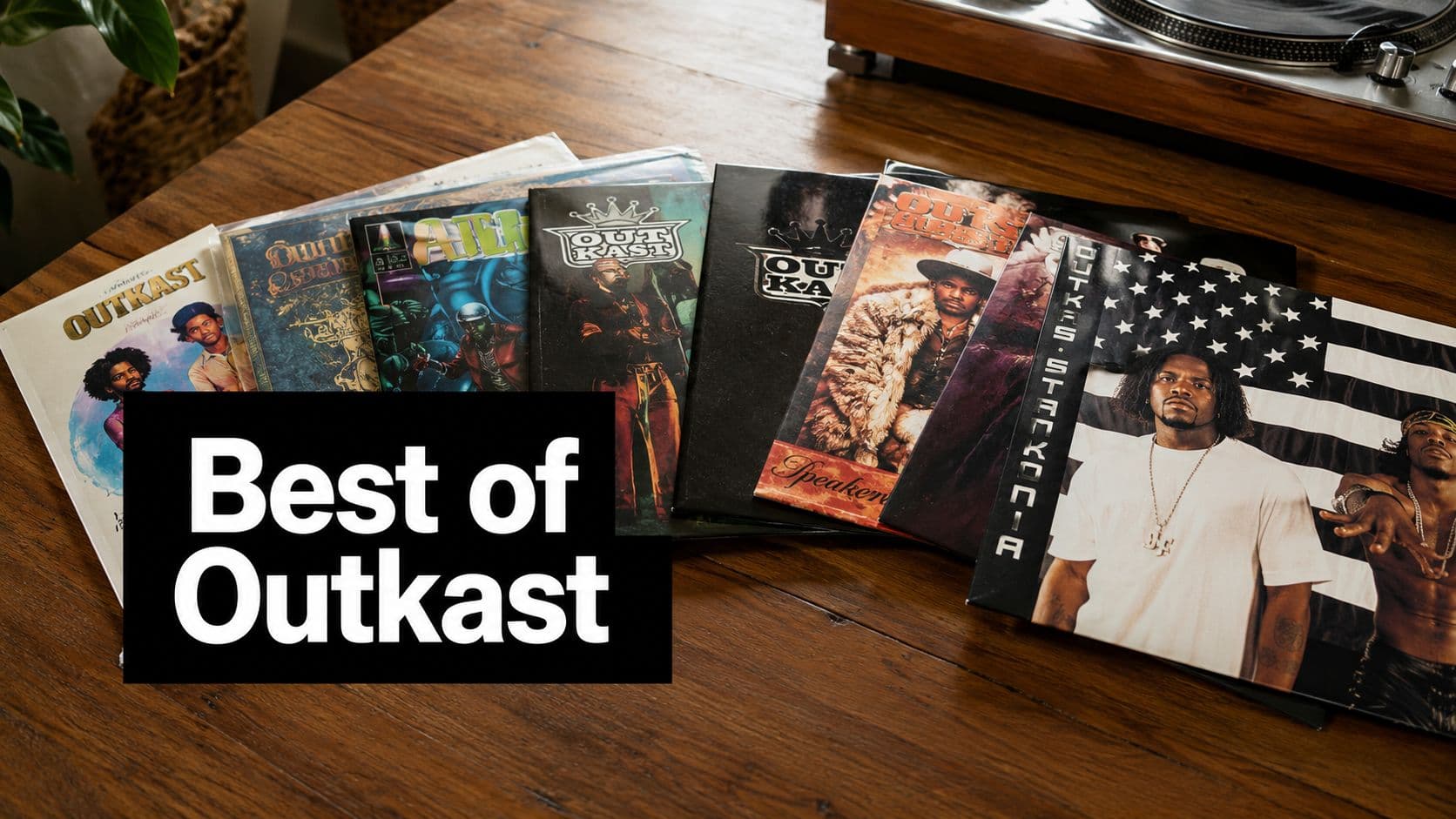
Best of Outkast Album: The Definitive 7-Album Ranking
Explore our ranking of the best of Outkast album releases, from 'Aquemini' to 'Stankonia.' Discover each album's legacy and find your next favorite.
June 18, 2026
Music Marketplace Advisor
Buying & SellingOutKast made the commercial case for artistic risk before streaming platforms turned genre-blending into a growth strategy. Speakerboxxx/The Love Below spent 3 consecutive weeks at No. 1 on the Billboard 200, won the 2004 Grammy Award for Album of the Year, and is certified 5× Platinum by the RIAA. Few rap releases matched that level of market reach while presenting two sharply different creative identities on the same project.
That result matters because OutKast's catalog works as a sequence of strategic decisions, not just a list of great albums. Across six studio releases, the duo kept changing the problem they were solving. Early records built credibility in the South. Middle-period albums expanded the sonic frame without losing regional character. Later releases showed that wide audience growth did not require a safer sound. It required clearer artistic positioning.
For independent artists on platforms like OohYeah, that is the useful lens for a best of OutKast album debate.
The question is not only which album sounds best. The better question is which release offers the strongest lesson for your stage of career. One album shows how to define a market before chasing national attention. Another shows how distinct creative voices can coexist inside one brand. Another demonstrates that experimentation works commercially when the identity underneath it stays legible to listeners.
Viewed that way, OutKast's discography is less a ranking exercise and more a playbook for cohesion, expansion, reinvention, and staying power.
1. Aquemini (1998)
If you want the purest answer to best of OutKast album, Aquemini is the critic's pick because it sounds like two artists pushing in separate directions without breaking the group at the center. That tension is the album's advantage. André 3000 leans inward, Big Boi stays grounded in Southern detail, and the record turns that contrast into identity instead of compromise.
For an independent act, that's the first real lesson. Don't smooth out the differences that make collaborators valuable. Build around them. The duo format works here because each voice is distinct enough to attract different listeners, yet disciplined enough to serve the same world.

What indie artists should copy
An artist on OohYeah can use Aquemini as a model for audience segmentation without brand dilution. If one member writes reflective material and another delivers more kinetic records, present both lanes clearly instead of forcing a false middle. Fans often respond more strongly when they can identify who does what.
A smart release plan looks like this:
- Track the split appeal: Use platform analytics to see whether lyrical cuts, tracks with live sound elements, or harder records hold listeners longer.
- Sell process, not just product: Post studio-session clips, beat breakdowns, and writing notes to make the craft part of the offer.
- Package depth for superfans: Music-only versions, alternate versions, and session commentary work well as premium content because they extend the album's world.
Practical rule: Cohesion doesn't mean uniformity. It means every creative choice points back to the same identity.
Aquemini also shows why some albums age better than bigger hits. It doesn't depend on one obvious crossover move. It wins through total design. Independent artists should pay attention to that. A catalog album with high replay value can outlast a short spike, especially when you own the fan relationship directly.
2. Speakerboxxx/The Love Below (2003)
No OutKast release makes the business case for artistic risk better than Speakerboxxx/The Love Below. On the supply side, it's identified in the provided results as the highest-certified rap album in RIAA history at 13× Platinum. That matters because it turns a common industry myth on its head. Going broader didn't require sanding off the weird parts. The weird parts became the event.
This album worked because it treated divergence as a product feature. Big Boi and André 3000 didn't hide their differences. They sold them together.
The bundle strategy that still works
Independent artists can borrow this structure in a modern form. If you're in a duo, collective, or producer-rapper partnership, you don't have to choose between solo identity and shared brand. You can create a bundled release with separate visual systems, separate song pages, and a unified storefront.
That approach is especially useful on OohYeah, where creators can sell music, merch, and subscriptions inside one ecosystem. One side of the project can serve the fan who wants pure rap. The other can serve the fan who wants pop, funk, or experimentation.
- Build distinct lanes: Give each collaborator separate branding, cover language, and release notes.
- Offer the bundle and the parts: Let fans buy one side or support the complete vision.
- Cross-sell intelligently: A listener who discovers one member's style is already one click away from the other.
The commercial lesson is simple. Difference can increase value when the audience understands the frame.
This is also the safest answer if someone wants a commercially validated pick for the best of OutKast album. Not because sales alone decide greatness, but because this record proved that bold structure, not safer structure, can create the broadest market.
3. ATLiens (1996)
ATLiens is where OutKast stopped sounding like a promising regional act and started sounding like a self-contained universe. The futuristic tone mattered, but the more durable move was geographic specificity. They didn't chase a neutral rap identity. They made Atlanta feel central.
That's still one of the strongest plays an independent artist can make. Local detail isn't a limitation. It's a moat. Scenes form around artists who document a place with enough confidence that outsiders want in.

Turn place into positioning
For artists using OohYeah, ATLiens suggests a practical rollout strategy. Start by owning your immediate community. That can mean city-specific merch, neighborhood references in visual content, fan meetups, or direct messages to early supporters in your strongest market.
A rapper from Birmingham, a punk band from Leeds, or a dance producer from Lagos can all use the same framework. Make your location visible enough that it becomes part of the brand language.
- Name the place: Put city identity into cover art, captions, and merch drops.
- Reward local fans first: Early-access songs or event offers give your base a reason to champion you.
- Document the scene: Behind-the-scenes footage from local venues and collaborators adds social proof without fake hype.
OutKast also benefited from timing. Southern rap was still fighting for national respect, so sounding unmistakably Southern was a strategic stand. Independent artists face similar choices now when platforms reward sameness. The answer isn't to sound generic enough for everybody. It's to be specific enough that the right audience claims you.
4. Stankonia (2000)
Stankonia is OutKast's best case study in scale. It proved the duo could reach far beyond their core rap audience without sanding down the qualities that made them distinctive in the first place. That balance is why it still belongs near the top of any best of OutKast album discussion.
What changed here was execution. The album packaged disruptive ideas inside songs that could travel on radio, in clubs, and across MTV rotation. Tracks such as "Ms. Jackson" and "B.O.B." widened the entry point, but the album around them stayed restless, strange, and unmistakably theirs. For independent artists, that is the lesson. Reach works better when the broadest song still points back to a larger artistic system.

Use your most accessible songs as gateways
Independent artists often misread what crossover means. Some release only the safest material and train the audience to expect less. Others hide the clearest song because they equate accessibility with compromise. Stankonia offers a better model. Put the strongest entry point in front, then give new listeners a richer world to explore once they arrive.
That approach fits platforms like OohYeah especially well because discovery and direct monetization do not have to happen in separate places.
- Lead with one high-clarity single: Choose the track with the fastest emotional read, not the one that best summarizes every part of your identity.
- Build paid depth behind the single: Offer demos, alternate versions, annotated lyrics, or live takes for listeners who want more than the algorithm serves them.
- Package the creative process: If production is part of your appeal, sell stems, versions without vocals, or breakdown videos to fans and fellow musicians.
- Keep the world coherent: Artwork, captions, performance clips, and merch should connect the accessible song to the deeper catalog.
Artist takeaway: Accessibility works when it functions as an invitation, not a replacement for your point of view.
That is what Stankonia handled so well. It did not simplify OutKast for the market. It translated their identity into a format large enough to compete, then turned attention into long-term catalog value. For artists building independently, that is smarter than chasing a one-off hit. It creates a funnel, not just a spike.
5. Southernplayalisticadillacmuzik (1994)
Debuts rarely win a best of OutKast album argument, but Southernplayalisticadillacmuzik might be the most useful OutKast record for artists at the beginning of a career. It introduced the duo before the broader market had fully accepted Southern rap as a center of gravity. That context matters because the album's biggest achievement wasn't polish. It was proof of concept.
A lot of independent artists want their first release to do everything at once. It usually can't. A debut's job is to establish a point of view strong enough that future growth feels like expansion, not reinvention.
Build the base before the peak
This album offers a grounded lesson in patience. OutKast didn't begin with the crossover scale of their later work. They began with a regional voice, a clear chemistry, and a world listeners could recognize. That's the right sequence for most self-directed artists now.
If you're releasing on OohYeah, treat your first project like a foundation asset:
- Reward the earliest supporters: Offer exclusive downloads, handwritten notes, or early merch access to the first wave of paying fans.
- Reinvest direct revenue: Commission-free sales create room to fund the next single, better visuals, or stronger mastering.
- Tell the development story: Fans who discover you early often care as much about the arc as the song.
A useful real-world scenario is the local artist who sells a small run of shirts, posts rehearsal clips, and answers fan messages personally. That won't look glamorous beside a viral spike, but it builds the kind of durable support that can carry a second and third release. Southernplayalisticadillacmuzik reminds artists that beginnings don't need to look complete. They need to look believable.
6. Idlewild (2006)
Idlewild usually sits lower in album rankings, but that underrates its value as a career case study. By tying music to a film concept, OutKast expanded the album from an audio product into a broader narrative property. Even if listeners don't rank it at the top of the discography, artists should study the move carefully because it points toward multi-format monetization.
That idea is even more relevant now than it was then. Independent musicians no longer need a major studio ecosystem to think cinematically. A project can include short films, visual interludes, archival footage, scripted skits, or episodic behind-the-scenes content.
When an album becomes a world
On OohYeah, Idlewild maps neatly onto a multimedia release strategy. You can host music, pair it with premium video, and sell merchandise that belongs to the same storyline. That makes the release feel larger than a tracklist.
A useful approach looks like this:
- Create companion video: Mini-documentaries, narrative clips, or visual essays can deepen fan investment.
- Bundle formats together: Pair digital music with posters, apparel, or collectible add-ons tied to the project's aesthetic.
- Use community features for lore: Let fans discuss characters, references, and recurring themes inside one platform.
Here's a relevant visual reference from the project's era and presentation:
Some albums are best judged less as playlists and more as intellectual property.
That's the practical defense of Idlewild. It shows artists how to keep a catalog alive by extending it across formats instead of asking songs alone to do all the work.
7. Big Boi's solo path through the OutKast lens
This final spot isn't an OutKast album in the strict catalog sense, but it belongs in the ranking logic because any best of OutKast album conversation eventually runs into a deeper question. What happens when a group's internal differences become too large for one format to contain? OutKast answered that by letting each member's identity sharpen rather than collapse.
Big Boi's path matters because it offers a practical model for artists in duos and collectives. You don't have to abandon the shared brand to build an individual one. You need clear differentiation, honest messaging, and release architecture that helps fans follow both stories.
The dual-brand lesson
For independent artists on OohYeah, this is one of the most actionable parts of OutKast's legacy. A producer can keep releasing under a collective while launching beat tapes under a personal profile. A singer in a band can issue acoustic songs without framing them as a breakup. The point is clarity.
The guidance here is operational, not abstract:
- Keep separate artist pages: Distinct profiles make discovery cleaner and reduce fan confusion.
- Explain the relationship clearly: Tell supporters how the solo work connects to the group identity.
- Use bundles to reduce friction: Fans who love the main act are the warmest audience for side projects.
Public discussion around OutKast's top tier still clusters around ATLiens, Aquemini, Stankonia, and sometimes Southernplayalisticadillacmuzik, especially in fan spaces that ask which album suits which listening job, as reflected in fan discussion cited in the provided material. Big Boi's lane helps explain why. OutKast was never only one thing. The catalog's durability comes from giving each side room to breathe.
Best of Outkast: 7-Album Comparison
The strongest OutKast album depends on the career problem an artist is trying to solve. The catalog works less like a simple ranking and more like a playbook. Each release answers a different question about brand building, creative range, audience growth, and long-term ownership.
For independent artists on platforms like OohYeah, that is the useful frame. The point is not only which album sounds best. The point is which album model fits your current stage, budget, and audience strategy.
| Title | 🔄 Implementation complexity | ⚡ Resource requirements | 📊 Expected outcomes | 💡 Ideal use cases | ⭐ Key advantages |
|---|---|---|---|---|---|
| Aquemini (1998) | High, layered arrangements and strong artistic coordination | High, extended studio time, live instrumentation, experienced producers | Lasting acclaim, strong catalog value, deep fan retention | Artists focused on a signature body of work rather than quick singles | Distinct identity, musical range, durable replay value |
| Speakerboxxx / The Love Below (2003) | Very high, two separate creative directions under one package | High, split production paths, distinct branding, coordinated rollout | Audience expansion across segments and stronger commercial reach | Collaborators testing individual identities without dissolving the shared brand | Clear market segmentation, broader appeal, higher content volume |
| ATLiens (1996) | Moderate, concept-first execution with cohesive world-building | Moderate, focused production and clear thematic control | Strong identity formation and lasting influence on artist positioning | Artists turning local culture into a recognizable artistic point of view | Strong mood, consistent vision, memorable sonic identity |
| Stankonia (2000) | Moderate to high, balancing radio-ready songs with left-field choices | Moderate to high, strong production, visual rollout, promotion | Breakout visibility with enough credibility to support future risks | Artists aiming for reach without flattening their sound | Accessible entry points, high energy, crossover potential |
| Southernplayalisticadillacmuzik (1994) | Low to moderate, focused debut with a clear regional voice | Low to moderate, lean production and grassroots campaign work | Steady audience growth and durable hometown support | New artists building proof of concept before scaling | Immediate identity, local trust, efficient foundation-building |
| Idlewild (2006) | Very high, album tied to a broader narrative product | Very high, film coordination, release planning, merchandising, live support | More revenue paths, but with higher execution risk | Artists with the team and budget to connect music with visual storytelling | Multi-format storytelling, event potential, premium fan experiences |
| The Way It Is (Big Boi solo lens) | Moderate, solo positioning while preserving group context | Moderate, separate release planning and targeted messaging | Personal brand growth and added income without erasing the core association | Artists managing solo work alongside a duo or collective | Career flexibility, clearer audience mapping, brand extension |
A pattern stands out. The highest-ranked records are not merely the most ambitious. They are the projects where ambition matched format discipline. Aquemini turns contrast into cohesion. Speakerboxxx/The Love Below packages divergence in a way the market could understand. ATLiens narrows the palette and gains identity strength. That is a useful lesson for independent artists who often mistake bigger concepts for better releases.
The sharper takeaway is strategic fit. If your priority is trust and local traction, Southernplayalisticadillacmuzik is the better model than a sprawling concept album. If you already have an audience and need a wider funnel, Stankonia offers a better template because it pairs adventurous ideas with obvious entry points. If a duo or collective is starting to branch creatively, Speakerboxxx/The Love Below shows that separation can work if the packaging explains the relationship clearly.
OutKast's catalog holds up because each album solved a specific business and artistic challenge at the right moment. That is why the best of Outkast album debate stays active. Different records win under different criteria, and that makes the discography more useful than a one-size-fits-all classic.
The OutKast Legacy Your Blueprint for Artistic Growth
OutKast's catalog doesn't offer one formula for success. It offers several. Southernplayalisticadillacmuzik teaches artists to build from local credibility. ATLiens shows how place can become positioning. Aquemini proves that contrast inside a partnership can create depth instead of confusion. Stankonia demonstrates how to use accessible songs as entry points into a richer body of work.
Then the strategy expands. Speakerboxxx/The Love Below is the clearest evidence that creative divergence can become a commercial advantage when the packaging is smart and the brand is coherent. Idlewild points toward multimedia thinking. Big Boi's solo path shows that side identities don't have to weaken the main act if the audience understands the structure.
There's also a useful modern angle that most nostalgia-driven rankings miss. Current conversation still frames Aquemini and Stankonia as frequent top choices, while OutKast's official catalog continues to surface through greatest-hits and best-of style listening on major platforms, a sign of enduring relevance noted in the provided material's discussion of streaming-era demand signals and ranking content through this referenced video source. That means the best of OutKast album question isn't settled by legacy alone. It's kept alive by continued listening behavior and by the fact that different records perform different jobs for different audiences.
That's the primary takeaway for independent artists. Stop chasing a single ideal album career. Build a sequence. One project should establish your scene. Another should widen your reach. Another should deepen the bond with your paying supporters. Another might open a separate lane entirely.
OutKast's legacy isn't that they made one undeniable classic. It's that they turned each phase of growth into a distinct strategic move. If you're building on OohYeah, that's the model worth copying. Own your voice, package it clearly, and give fans more than songs to invest in.
If you're building your own version of that path, OohYeah gives you the infrastructure to do it directly. You can stream and sell music, offer subscriptions, move merchandise, message fans, and keep control of pricing and distribution in one place. For artists who want more than passive platform exposure, OohYeah is built for the harder goal: turning a creative identity into a sustainable business.